
The Affective Domain The Elephant in the Classroom
- Slides: 18
The Affective Domain: The Elephant in the Classroom Zachary Goodell Associate Director Center for Teaching Excellence
Emotion and Cognition are inextricably linked and perhaps never entirely separate, distinctive nor pure. ~William James The separation of the head from the heart has contributed to a fractured education system that produces minds that do not know how to feel and hearts that do not know how to think. ~Parker Palmer
Activity • Develop a classroom assessment technique around a particular learning objective from one of your courses – Course goal – Learning objective – Authentic activity – feedback
The Reflexive Mind • • Symbols Language Beliefs / values Schemas Emotions Social objects (the “Self”) Associations / Appropriations / Attributions
The Reflexive Mind • Locus of our central nervous system – Thoughts – Feelings – Behavior • Thomas Theorem = Mind over matter – Placebo effect – Self-fulfilling prophesies • Communication / Interaction
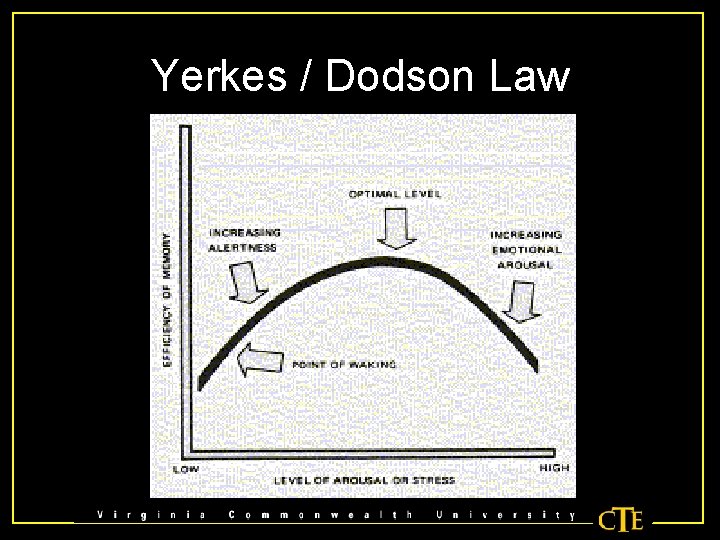
Significance of the Affective Domain • It colors every thought and every behavior • Closely tied to the “Self” = self esteem ØSelf = values & beliefs/cognition/behavior • A strong relationship between affect and memory • A strong relationship between affect and student engagement • A strong relationship between affect high impact activities
What is the Affective Domain? • • • Motivations Moods Feelings Emotions Attitudes Beliefs / Values
What is the Affective Domain? • Motivations • Moods • Feelings Ø Choice / Power Ø Relevance Ø Need Ø Enthusiasm Ø Priming Ø Humor Ø Community Ø Competition Ø Engagement
Yerkes / Dodson Law
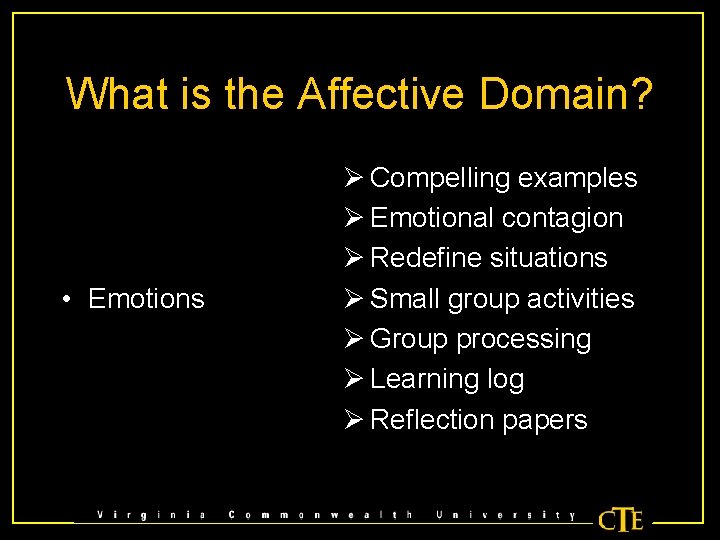
What is the Affective Domain? • Emotions Ø Compelling examples Ø Emotional contagion Ø Redefine situations Ø Small group activities Ø Group processing Ø Learning log Ø Reflection papers
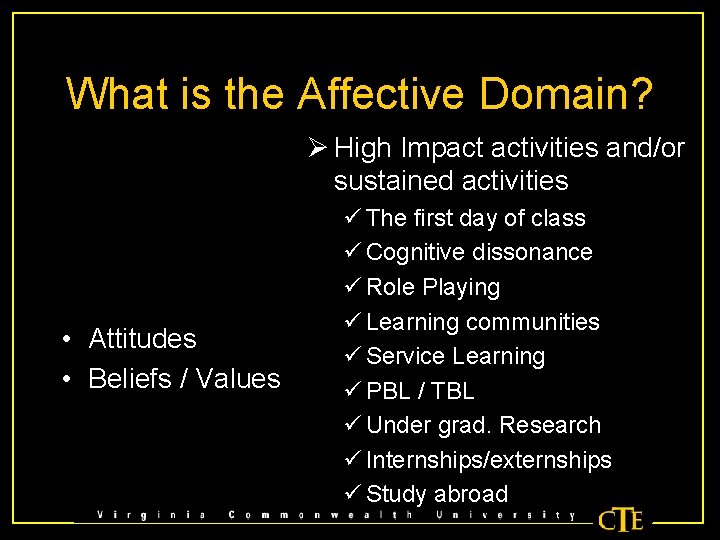
What is the Affective Domain? Ø High Impact activities and/or sustained activities • Attitudes • Beliefs / Values ü The first day of class ü Cognitive dissonance ü Role Playing ü Learning communities ü Service Learning ü PBL / TBL ü Under grad. Research ü Internships/externships ü Study abroad
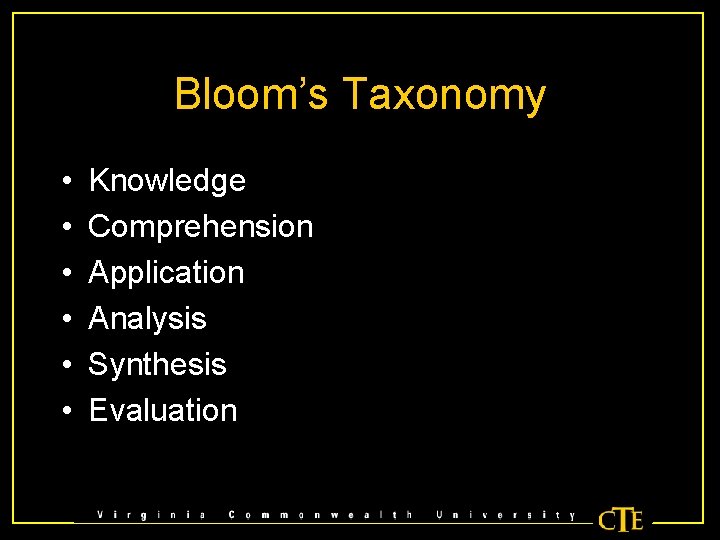
Bloom’s Taxonomy • • • Knowledge Comprehension Application Analysis Synthesis Evaluation
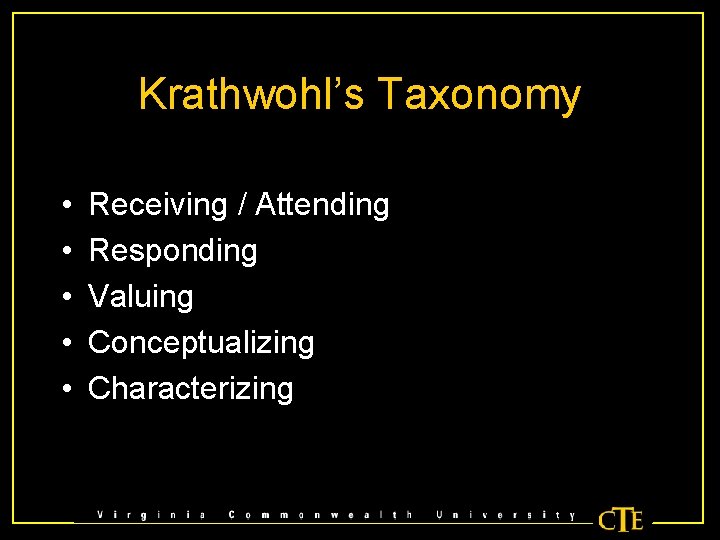
Krathwohl’s Taxonomy • • • Receiving / Attending Responding Valuing Conceptualizing Characterizing
What is the Affective Field? • The space around people and their environment. – Lighting – Color – Architecture – Climate – Configuration – Sound
What is the Affective Field? • The space between the people engaged in an interaction – Safety – Trust – Respect – Power – Communication
Implications for course / curricular design • • • Communication -verbal, written and body High impact activities (PBL / TBL) Small group work / learning communities Service learning Self – assessment Ø(reflection papers, learning logs, etc. ) • Group processing • Capstone courses / learning portfolios
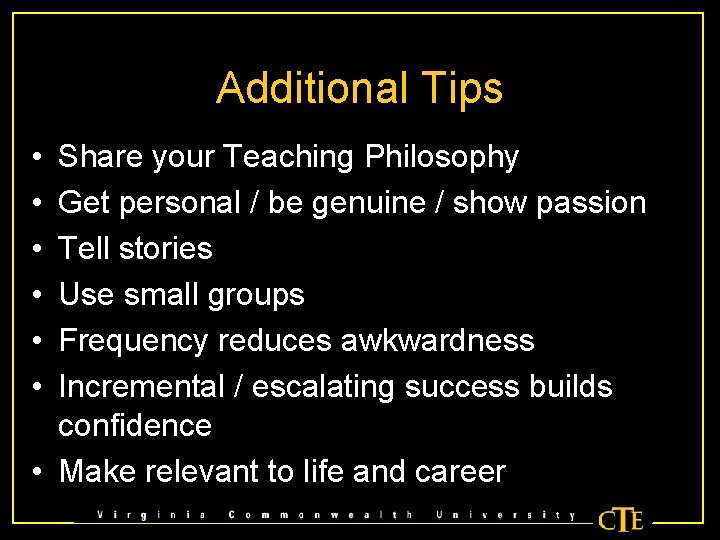
Additional Tips • • • Share your Teaching Philosophy Get personal / be genuine / show passion Tell stories Use small groups Frequency reduces awkwardness Incremental / escalating success builds confidence • Make relevant to life and career
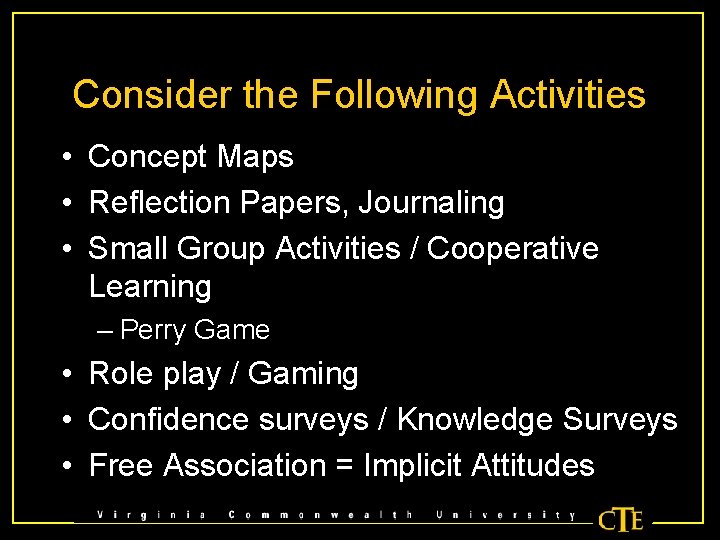
Consider the Following Activities • Concept Maps • Reflection Papers, Journaling • Small Group Activities / Cooperative Learning – Perry Game • Role play / Gaming • Confidence surveys / Knowledge Surveys • Free Association = Implicit Attitudes