
THE AFFECTIVE DOMAIN Fraulein Dynette Lacy Fresno Pacific


![References Ø [Committee for Children]. (2016, Aug 1). Social-Emotional Learning: What It Is and](https://slidetodoc.com/presentation_image_h2/6b365af37bdeafa07bb7cc414d304739/image-22.jpg "References Ø [Committee for Children]. (2016, Aug 1). Social-Emotional Learning: What It Is and")
- Slides: 22
THE AFFECTIVE DOMAIN Fraulein Dynette Lacy Fresno Pacific University
"Learning about one's emotions, understanding another person's feelings, acquiring a concept of self, and developing self-efficacy are hallmarks of the affective domain (Kostelnik, Spderman & Whiren, 2011). "
EMERGING AFFECTIVE DEVELOPMENT ü It takes growth, maturity and time coupled with intentional effort for a child to learn how to appropriately and effectively to express themselves and reveal their true characteristics. ü Children are constantly working on their social skills, exploring and understanding both their emotions/feelings and their relationships with others.
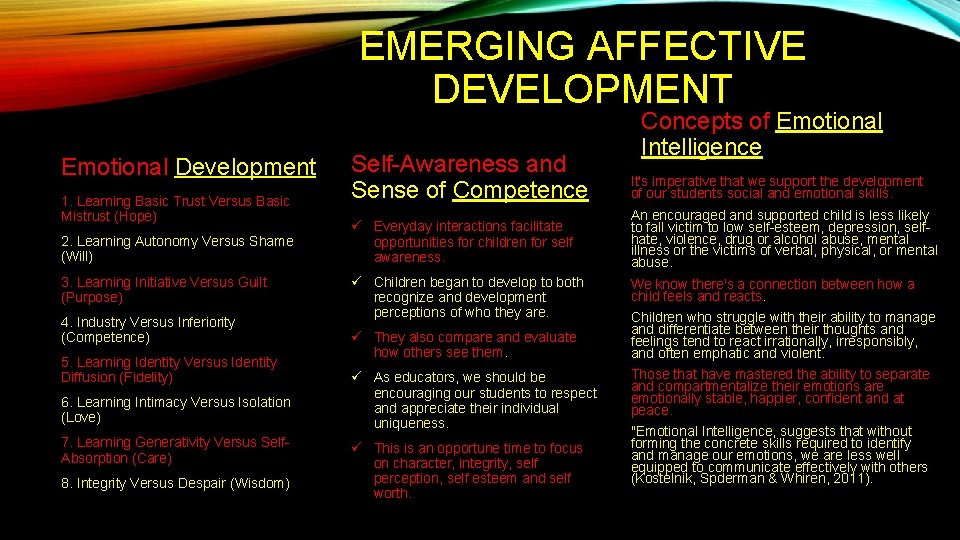
EMERGING AFFECTIVE DEVELOPMENT Emotional Development 1. Learning Basic Trust Versus Basic Mistrust (Hope) 2. Learning Autonomy Versus Shame (Will) 3. Learning Initiative Versus Guilt (Purpose) 4. Industry Versus Inferiority (Competence) 5. Learning Identity Versus Identity Diffusion (Fidelity) 6. Learning Intimacy Versus Isolation (Love) 7. Learning Generativity Versus Self. Absorption (Care) 8. Integrity Versus Despair (Wisdom) Concepts of Emotional Intelligence Self-Awareness and Sense of Competence It's imperative that we support the development of our students social and emotional skills. ü Everyday interactions facilitate opportunities for children for self awareness. An encouraged and supported child is less likely to fall victim to low self-esteem, depression, selfhate, violence, drug or alcohol abuse, mental illness or the victims of verbal, physical, or mental abuse. ü Children began to develop to both recognize and development perceptions of who they are. ü They also compare and evaluate how others see them. ü As educators, we should be encouraging our students to respect and appreciate their individual uniqueness. ü This is an opportune time to focus on character, integrity, self perception, self esteem and self worth. We know there's a connection between how a child feels and reacts. Children who struggle with their ability to manage and differentiate between their thoughts and feelings tend to react irrationally, irresponsibly, and often emphatic and violent. Those that have mastered the ability to separate and compartmentalize their emotions are emotionally stable, happier, confident and at peace. "Emotional Intelligence, suggests that without forming the concrete skills required to identify and manage our emotions, we are less well equipped to communicate effectively with others (Kostelnik, Spderman & Whiren, 2011).
k ink l lick k c se wor a t Ple esn’ do if h yp in erl Disney Pixar and Erikson's Eight Stages of Development https: //www. youtube. com/watch? v=Iz-Ae. GMhz. V 0&feature=youtu. be&t=4 S 8 s
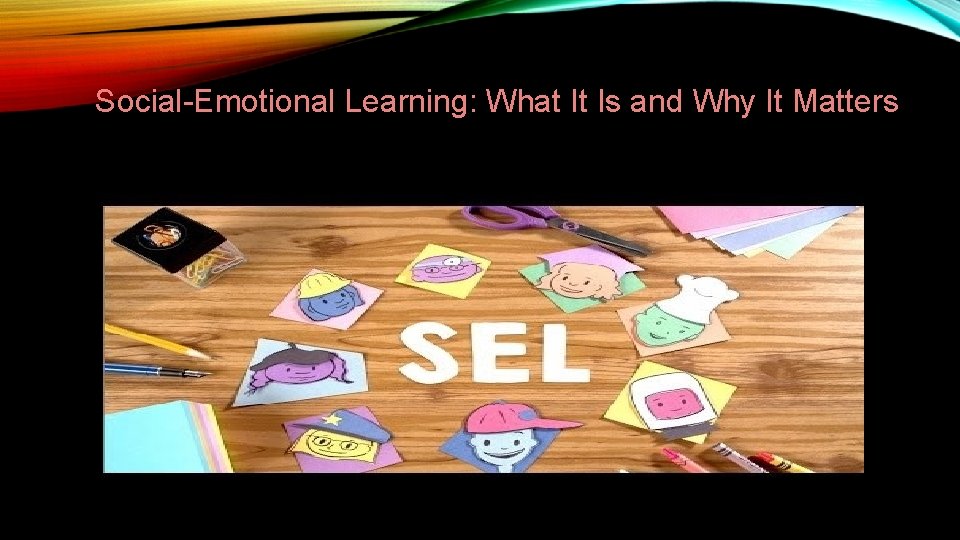
Social-Emotional Learning: What It Is and Why It Matters
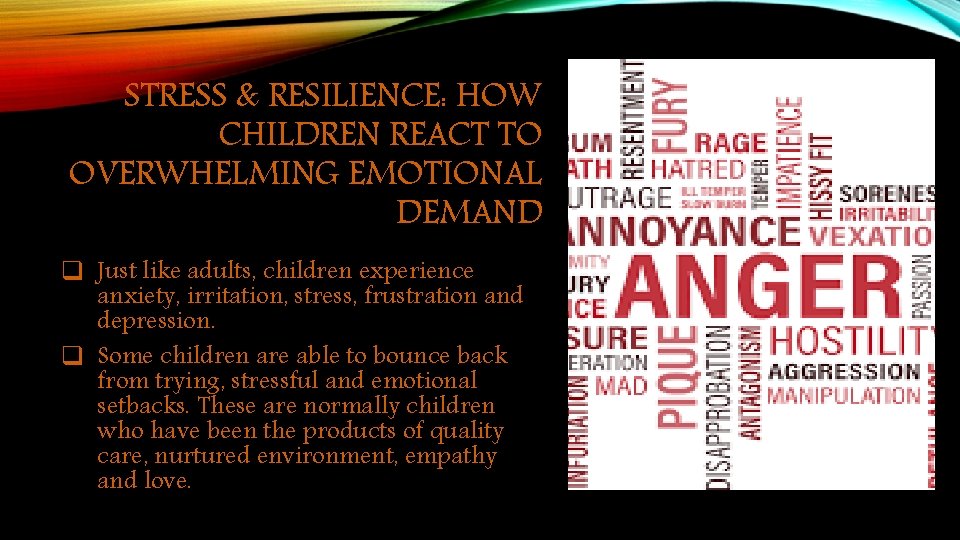
STRESS & RESILIENCE: HOW CHILDREN REACT TO OVERWHELMING EMOTIONAL DEMAND q Just like adults, children experience anxiety, irritation, stress, frustration and depression. q Some children are able to bounce back from trying, stressful and emotional setbacks. These are normally children who have been the products of quality care, nurtured environment, empathy and love.
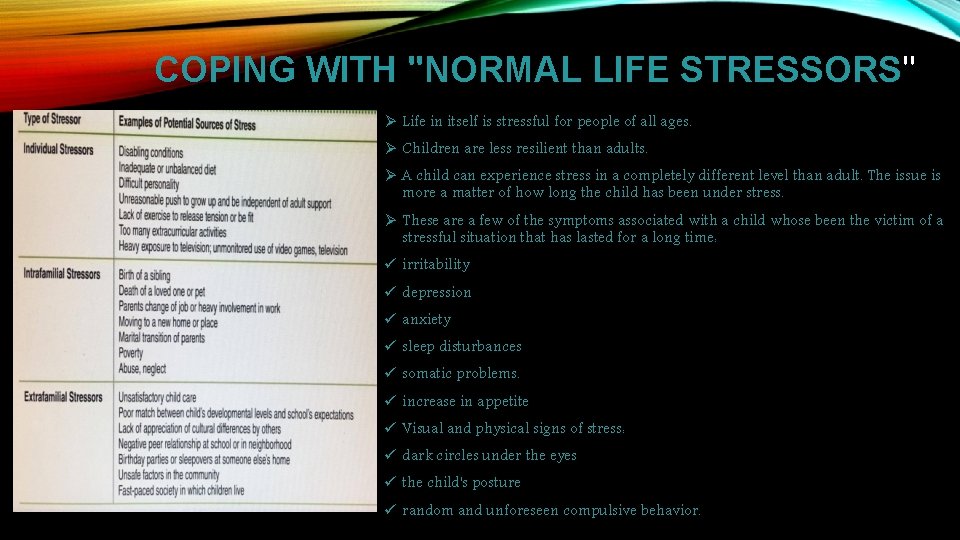
COPING WITH "NORMAL LIFE STRESSORS" Ø Life in itself is stressful for people of all ages. Ø Children are less resilient than adults. Ø A child can experience stress in a completely different level than adult. The issue is more a matter of how long the child has been under stress. Ø These are a few of the symptoms associated with a child whose been the victim of a stressful situation that has lasted for a long time: ü irritability ü depression ü anxiety ü sleep disturbances ü somatic problems. ü increase in appetite ü Visual and physical signs of stress: ü dark circles under the eyes ü the child's posture ü random and unforeseen compulsive behavior.
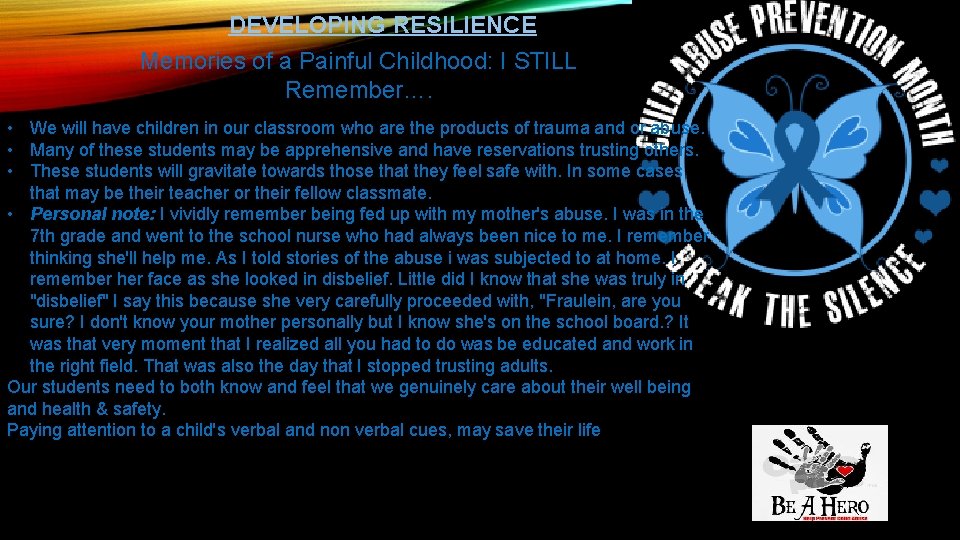
Children in Toxic and Violent Environments: ü CHILDREN IN TOXIC AND VIOLENT ENVIRONMENTS: > EDUCATORS NEED TO UNDERSTAND THAT FOR MANY OF OUR STUDENTS ARE SAFER IN OR CLASSROOM THAN THEY ARE AT HOME. > WHILE THE AVERAGE CHILD MAY HAVE A WARM AND LOVING HOME. THERE ARE JUST AS MANY IF NOT MORE WHO DO NOT. > ABUSE & NEGLECT: SOME OF OUR STUDENTS MAY BE SUBJECTED TO A HOSTILE ENVIRONMENT, ABUSE WITHIN THE HOME, NEGLECT AND ABANDONMENT. > FOR THOSE WHO CHOOSE NOT TO DIVULGE WHAT LIFE IS LIKE FOR THEM AT HOME. WE SHOULD BE TOTALLY PREPARED FOR POSSIBLE CHANGES IN THEIR ATTITUDE, BEHAVIOR AD TEMPERAMENT.
DEVELOPING RESILIENCE Memories of a Painful Childhood: I STILL Remember…. • We will have children in our classroom who are the products of trauma and or abuse. • Many of these students may be apprehensive and have reservations trusting others. • These students will gravitate towards those that they feel safe with. In some cases that may be their teacher or their fellow classmate. • Personal note: I vividly remember being fed up with my mother's abuse. I was in the 7 th grade and went to the school nurse who had always been nice to me. I remember thinking she'll help me. As I told stories of the abuse i was subjected to at home. I remember her face as she looked in disbelief. Little did I know that she was truly in "disbelief" I say this because she very carefully proceeded with, "Fraulein, are you sure? I don't know your mother personally but I know she's on the school board. ? It was that very moment that I realized all you had to do was be educated and work in the right field. That was also the day that I stopped trusting adults. Our students need to both know and feel that we genuinely care about their well being and health & safety. Paying attention to a child's verbal and non verbal cues, may save their life
A spe SEN IT R M r S E g S S I C y e D O I n r R T F R d Y E r O o U P S D m I R D A N e O D I S C O Y O I E R T S T I D S N I E V N E I R G T T S T C A RA E P Y H DUAL LANGUAGE LEA AFFECTIVE DEVELOPMENT IN CHILDREN WITH SPECIAL NEEDS
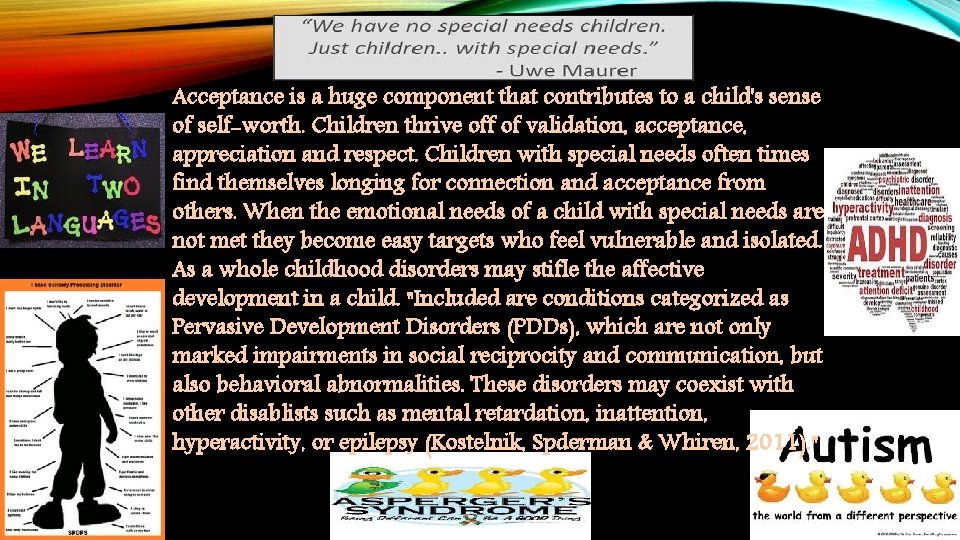
Acceptance is a huge component that contributes to a child's sense of self-worth. Children thrive off of validation, acceptance, appreciation and respect. Children with special needs often times find themselves longing for connection and acceptance from others. When the emotional needs of a child with special needs are not met they become easy targets who feel vulnerable and isolated. As a whole childhood disorders may stifle the affective development in a child. "Included are conditions categorized as Pervasive Development Disorders (PDDs), which are not only marked impairments in social reciprocity and communication, but also behavioral abnormalities. These disorders may coexist with other disablists such as mental retardation, inattention, hyperactivity, or epilepsy (Kostelnik, Spderman & Whiren, 2011). "
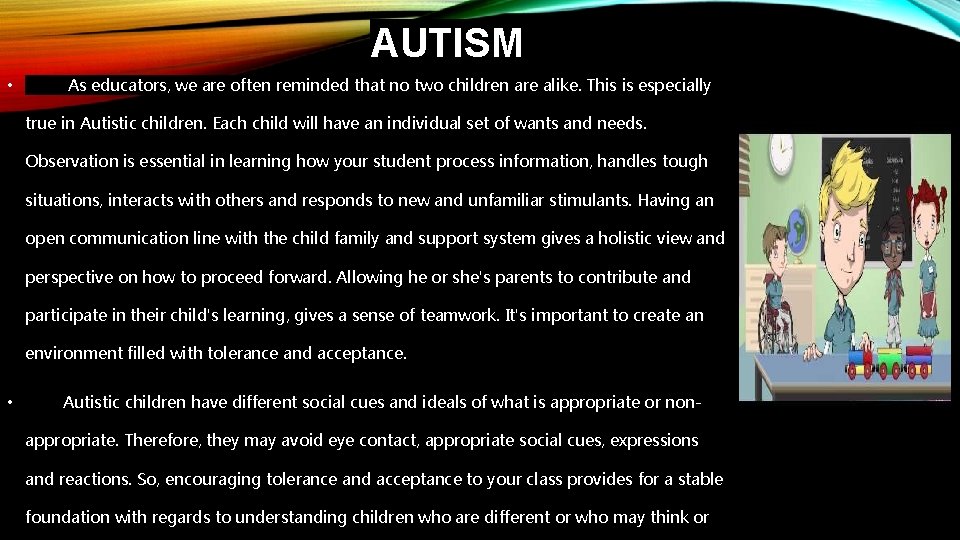
AUTISM • As educators, we are often reminded that no two children are alike. This is especially true in Autistic children. Each child will have an individual set of wants and needs. Observation is essential in learning how your student process information, handles tough situations, interacts with others and responds to new and unfamiliar stimulants. Having an open communication line with the child family and support system gives a holistic view and perspective on how to proceed forward. Allowing he or she's parents to contribute and participate in their child's learning, gives a sense of teamwork. It's important to create an environment filled with tolerance and acceptance. • Autistic children have different social cues and ideals of what is appropriate or nonappropriate. Therefore, they may avoid eye contact, appropriate social cues, expressions and reactions. So, encouraging tolerance and acceptance to your class provides for a stable foundation with regards to understanding children who are different or who may think or
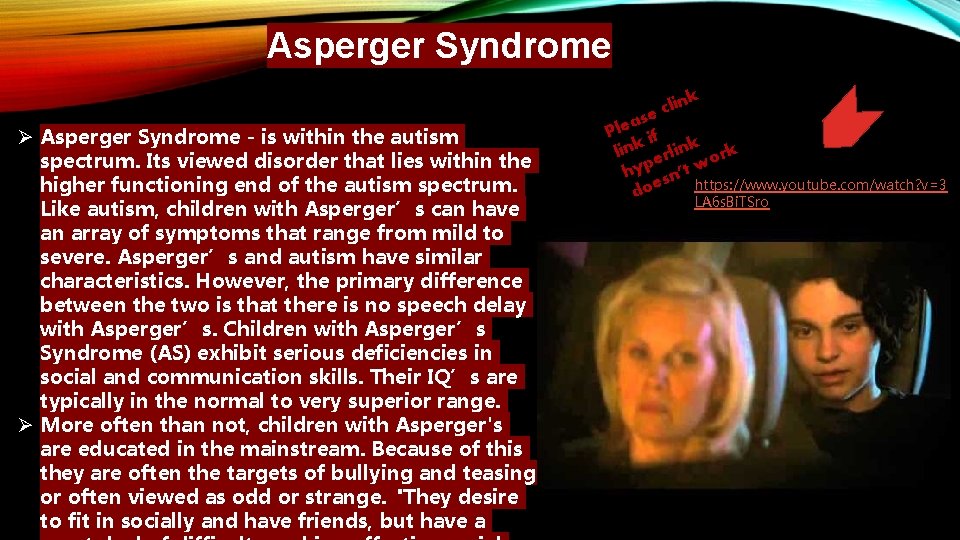
Asperger Syndrome k Ø Asperger Syndrome - is within the autism spectrum. Its viewed disorder that lies within the higher functioning end of the autism spectrum. Like autism, children with Asperger’s can have an array of symptoms that range from mild to severe. Asperger’s and autism have similar characteristics. However, the primary difference between the two is that there is no speech delay with Asperger’s. Children with Asperger’s Syndrome (AS) exhibit serious deficiencies in social and communication skills. Their IQ’s are typically in the normal to very superior range. Ø More often than not, children with Asperger's are educated in the mainstream. Because of this they are often the targets of bullying and teasing or often viewed as odd or strange. "They desire to fit in socially and have friends, but have a lin c e as e l P if k nk rk n i l li r o e hyp sn’t w https: //www. youtube. com/watch? v=3 doe LA 6 s. Bi. TSro
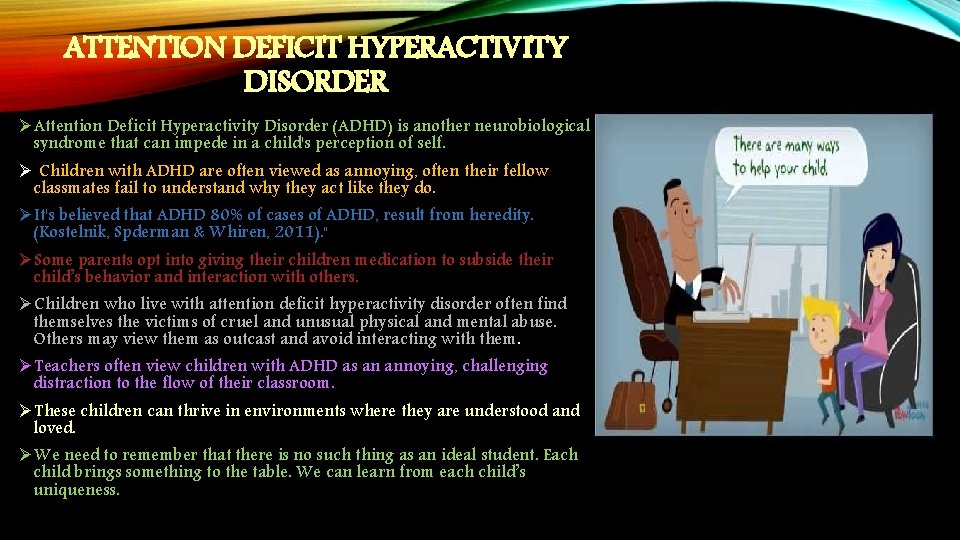
ATTENTION DEFICIT HYPERACTIVITY DISORDER ØAttention Deficit Hyperactivity Disorder (ADHD) is another neurobiological syndrome that can impede in a child's perception of self. Ø Children with ADHD are often viewed as annoying, often their fellow classmates fail to understand why they act like they do. ØIt's believed that ADHD 80% of cases of ADHD, result from heredity. (Kostelnik, Spderman & Whiren, 2011). " ØSome parents opt into giving their children medication to subside their child’s behavior and interaction with others. ØChildren who live with attention deficit hyperactivity disorder often find themselves the victims of cruel and unusual physical and mental abuse. Others may view them as outcast and avoid interacting with them. ØTeachers often view children with ADHD as an annoying, challenging distraction to the flow of their classroom. ØThese children can thrive in environments where they are understood and loved. ØWe need to remember that there is no such thing as an ideal student. Each child brings something to the table. We can learn from each child’s uniqueness.
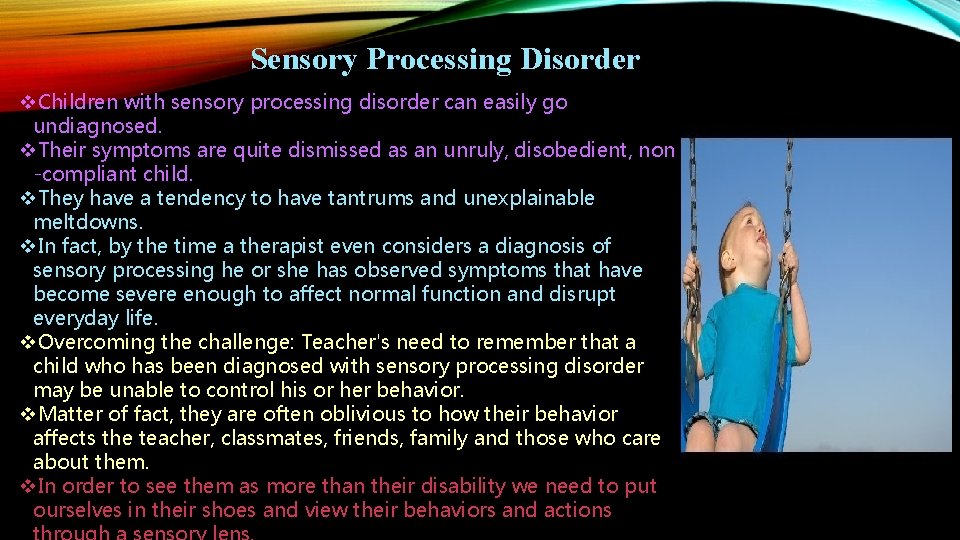
Sensory Processing Disorder v. Children with sensory processing disorder can easily go undiagnosed. v. Their symptoms are quite dismissed as an unruly, disobedient, non -compliant child. v. They have a tendency to have tantrums and unexplainable meltdowns. v. In fact, by the time a therapist even considers a diagnosis of sensory processing he or she has observed symptoms that have become severe enough to affect normal function and disrupt everyday life. v. Overcoming the challenge: Teacher's need to remember that a child who has been diagnosed with sensory processing disorder may be unable to control his or her behavior. v. Matter of fact, they are often oblivious to how their behavior affects the teacher, classmates, friends, family and those who care about them. v. In order to see them as more than their disability we need to put ourselves in their shoes and view their behaviors and actions
GE LEARNE RS while others may have been here all their life. It's not uncommon to have a 5 -year-old who has been in this country their whole life yet they don't speak English. This is a very common site at the beginning of the year in any given Kindergarten class. Parents who speak little or no English find themselves enrolling their child for school. These children are often raised speaking their native language. • School can be challenging to them. It's an adjustment for the student, their family and a challenge to their teacher. Their parents may struggle with the emphasis on their child learning English. While many parents welcome the opportunity for their child to learn English, there are those who would prefer it if their child wasn’t forced to take on a new language. We tend to see this in families who fear their child becoming to Americanized. • The teachers focus should rely on bridging the gap and making a connection with he or she's student. Remember that forward progress with a dual language learner relies on community and inclusion.
Implementing Developmentally Appropriate Curriculum and Instruction in the Affective Domain
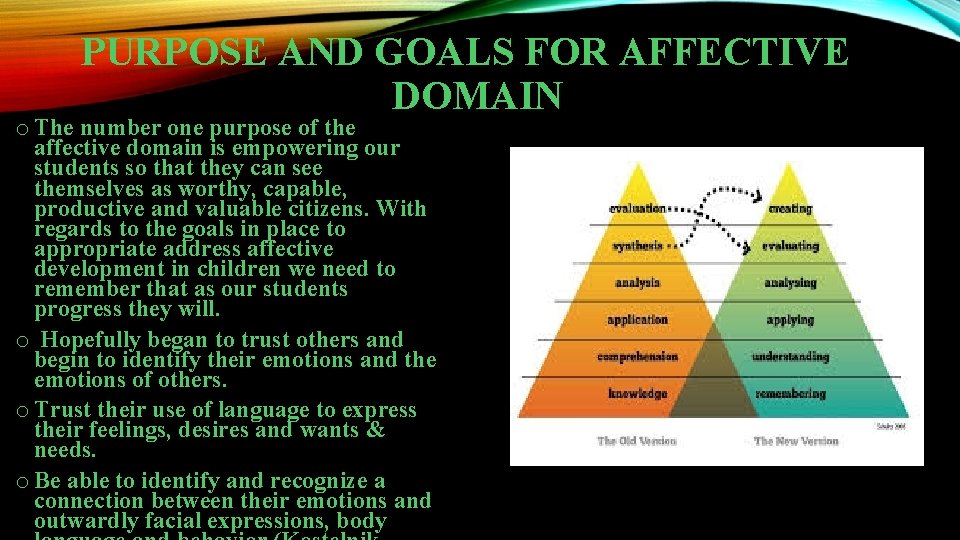
PURPOSE AND GOALS FOR AFFECTIVE DOMAIN o The number one purpose of the affective domain is empowering our students so that they can see themselves as worthy, capable, productive and valuable citizens. With regards to the goals in place to appropriate address affective development in children we need to remember that as our students progress they will. o Hopefully began to trust others and begin to identify their emotions and the emotions of others. o Trust their use of language to express their feelings, desires and wants & needs. o Be able to identify and recognize a connection between their emotions and outwardly facial expressions, body
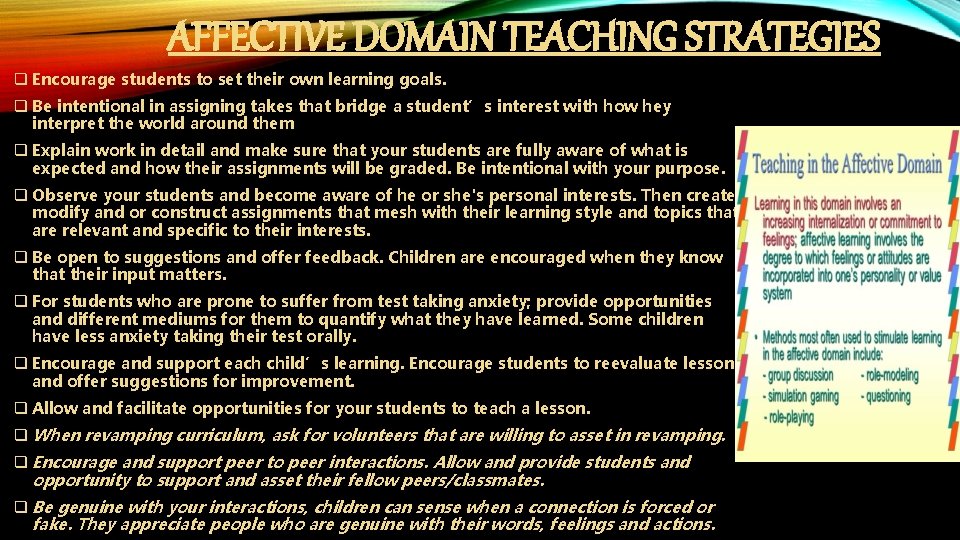
AFFECTIVE DOMAIN TEACHING STRATEGIES q Encourage students to set their own learning goals. q Be intentional in assigning takes that bridge a student’s interest with how hey interpret the world around them q Explain work in detail and make sure that your students are fully aware of what is expected and how their assignments will be graded. Be intentional with your purpose. q Observe your students and become aware of he or she's personal interests. Then create, modify and or construct assignments that mesh with their learning style and topics that are relevant and specific to their interests. q Be open to suggestions and offer feedback. Children are encouraged when they know that their input matters. q For students who are prone to suffer from test taking anxiety; provide opportunities and different mediums for them to quantify what they have learned. Some children have less anxiety taking their test orally. q Encourage and support each child’s learning. Encourage students to reevaluate lessons and offer suggestions for improvement. q Allow and facilitate opportunities for your students to teach a lesson. q When revamping curriculum, ask for volunteers that are willing to asset in revamping. q Encourage and support peer to peer interactions. Allow and provide students and opportunity to support and asset their fellow peers/classmates. q Be genuine with your interactions, children can sense when a connection is forced or fake. They appreciate people who are genuine with their words, feelings and actions.
IN CLASS ACTIVITY: THERE WERE TWO SPECIFIC IN CLASS ACTIVITIES THAT I WAS GOING TO DO • For the first one I was going to give each of my fellow classmates two sets of index cards. The first set would have key words from my presentation, the second set would have there corresponding definitions. Each of my classmates would be given a chance to see who could correctly match each word with its counterpart. • The second activity involved asking who could verbally define and or explain the difference between Autism and Asperger's?
References Ø [Committee for Children]. (2016, Aug 1). Social-Emotional Learning: What It Is and Why It Matters [Video File]. Retrieved from https: //www. youtube. com/watch? v=ikeh. X 9 o 1 Jb. I Ø [Howcast]. (2013, Oct 13). What Is Sensory Processing Disorder? | Child Development [Video File]. Retrieved from https: //www. youtube. com/watch? v=-um_sk. YQ 43 w Ø [Marvelous Max]. (2015, July 7). Marvelous Max - Autism Awareness for Kids [Video File]. Retrieved from https: //www. youtube. com/watch? v=wc 77 Mks. M_2 c Ø [Myer Center for Developmental Pediatrics]. (2014, OCT 14). What is ADHD? [Video File]. Retrieved from https: //www. youtube. com/watch? v=btyg. Zh. XPGwc Ø [Ryanne Ehrman]. (2016, Feb 5). Disney Pixar and Erikson's Eight Stages of Development [Video File]. Retrieved from https: //www. youtube. com/watch? v=Iz-Ae. GMhz. V 0&feature=youtu. be&t=4 S 8 s Ø Sensory Processing Disorder. (2005 -2017). Web. MD, LLC. Retrieved from http: //www. webmd. com/children/sensory-processing-disorder#1 -2