
The Adversary System Role of the Adversary System

- Slides: 30
The Adversary System
Role of the Adversary System To provide a procedure for disputing parties to present and resolve their cases in as fair a manner as possible Controlled by strict rules of evidence and procedure
Features of the Adversary System Major features of the adversary system Role of the parties Role of the judge Standard and burden of proof Need for legal representation Need for rules of evidence and procedure
Role of the parties Party Control - Each party controls their own case (within the rules of evidence and procedure) Parties are responsible for: Instigating the proceedings – the person who believes they have been wronged (plaintiff is civil, prosecution in criminal) brings the case to court Investigating the facts
Role of the parties Parties are also responsible for: Deciding which facts to bring to court – each side decides which evidence they wish to present to court (although prosecution must disclose all evidence even if it is not beneficial) Investigating the law that is relevant to the case
Role of the parties Parties are also responsible for: Deciding whether to have a jury in a civil case Choosing whether to have legal representation
Role of the parties Party control allows the parties to feel that they are in control of the situation and are responsible for the outcome Satisfies the competitive spirit Gives people the opportunity to fight to win their case – leads to a sense of satisfaction
The elements In civil cases – it means that cases can be resolved But it makes the process expensive – which means that not everyone has effective access to mechanisms to resolve disputes
Role of the Judge Impartial umpire - Ensures the court processes and procedures are carried out according to the rules of evidence and procedure May only ask questions to clarify matters Minimises unfairness to either party
Role of the judge Decides: Admissibility of evidence Questions of law Directs the jury whethere is one Decides the outcome of a case where there is no jury
Role of the Judge For the adversary system to work effectively the judge must be impartial Essential that the decision maker (judge or jury) is independent from the case Judge has no prior knowledge of the case before hearing the evidence presented
The elements The impartial, independent judge ensures a fair and unbiased hearing
Burden and Standard of Proof Burden of proof lies with the party bringing the case to court Criminal – prosecution Civil – plaintiff Person who brings the case must prove the other party was in the wrong
Burden and Standard of Proof Standard of proof – the strength of evidence needed to prove the case Criminal – beyond reasonable doubt Civil – on the balance of probabilities
Burden and Standard of Proof Essential elements of the adversary system Burden of proof indicates who must begin the battle Standard of proof indicates the strength of proof required to decide the winner
The elements Burden and standard of proof ensure a fair and unbiased hearing
Need for legal representation Legal representatives – prepare the case on behalf of the parties Legal representatives are experts – are familiar with rules of evidence and procedure Help to ensure that the parties are able to present their best possible case Assists in achieving a just outcome
Need for legal representation Bringing out the truth and showing your case in the best light depends on being legally represented – with the best possible lawyer Presenting a case without legal representation is very difficult and can result in an unjust outcome
Need for legal representation For the adversary system to work effectively there needs to be equal representation Parties should have an equal opportunity to present their cases Truth should be brought out through both sides bringing their evidence and cross examination by the other side
The elements If one party is better represented than the other, this could lead to an unfair advantage and possibly an incorrect result – so it will not be a fair and unbiased hearing
The elements A person who can afford a more competent barrister is more likely to win than a person represented by a less experienced barrister this means that there is not effective access for everyone
Need for rules of evidence and procedure Evidence is concerned with proof of facts Rules of evidence aim to ensure fair and equal treatment
Need for rules of evidence and procedure Evidence can be Oral – given by witnesses Sworn statements (called an affidavit) Objects – murder weapons, photos diagrams, tape-recording Circumstances and facts (called circumstantial evidence)
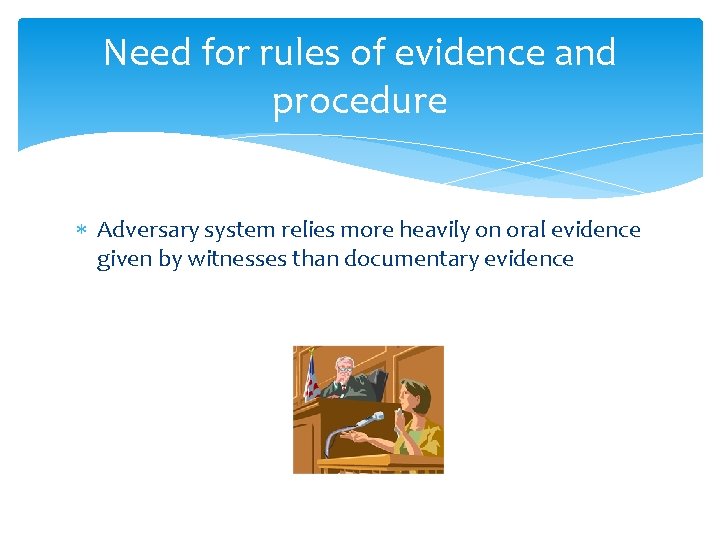
Need for rules of evidence and procedure Adversary system relies more heavily on oral evidence given by witnesses than documentary evidence
Need for rules of evidence and procedure Rules of evidence are primarily for the protection of the parties Ensure that Parties are treated fairly Jury is not distracted by irrelevant material Unreliable or illegally obtained evidence is not heard by the court Evidence is not unduly prejudicial to the defence Prior convictions are not admissible
Need for rules of evidence and procedure Rules of procedure provide a framework in which court cases take place Provide the way in which the court will try to bring about a resolution Procedures are aimed at treating both sides fairly Create at atmosphere of formality so that the decision is followed
Need for rules of evidence and procedure Assist the parties in achieving a just outcome Rule of evidence keep the contest fair Rules of procedure should assist the truth to emerge
Evidence not admissible Hearsay evidence Prior convictions (unless used as propensity evidence) Irrelevant evidence Opinion Evidence obtained illegally Privileged information
The elements Only allow certain types of evidence to ensure a fair and unbiased hearing Rules of procedure help assist timely resolution of disputes
Juries NOT The jury system is a feature of the adversary system – it is an entirely different system!