
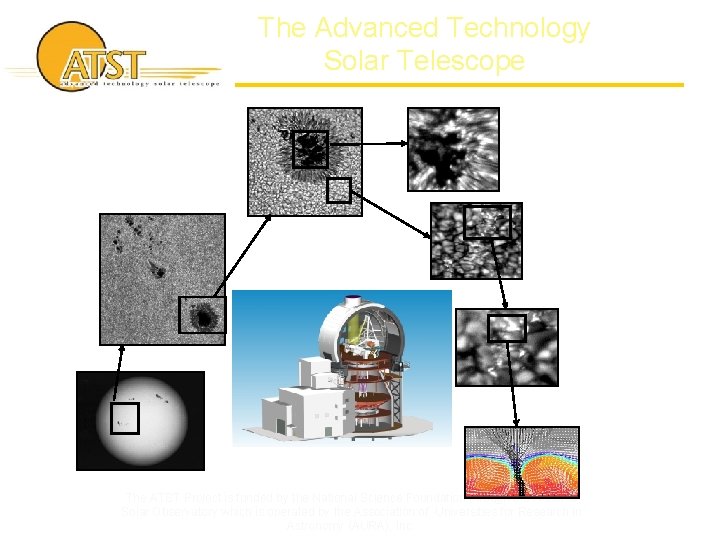
The Advanced Technology Solar Telescope The ATST Project
- Slides: 22
The Advanced Technology Solar Telescope The ATST Project is funded by the National Science Foundation through the National Solar Observatory which is operated by the Association of Universities for Research in Astronomy (AURA), Inc.
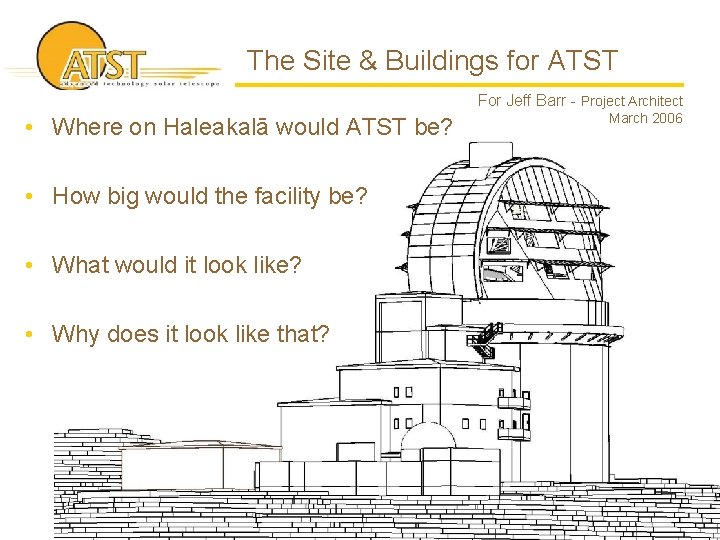
The Site & Buildings for ATST For Jeff Barr - Project Architect • Where on Haleakalā would ATST be? • How big would the facility be? • What would it look like? • Why does it look like that? March 2006
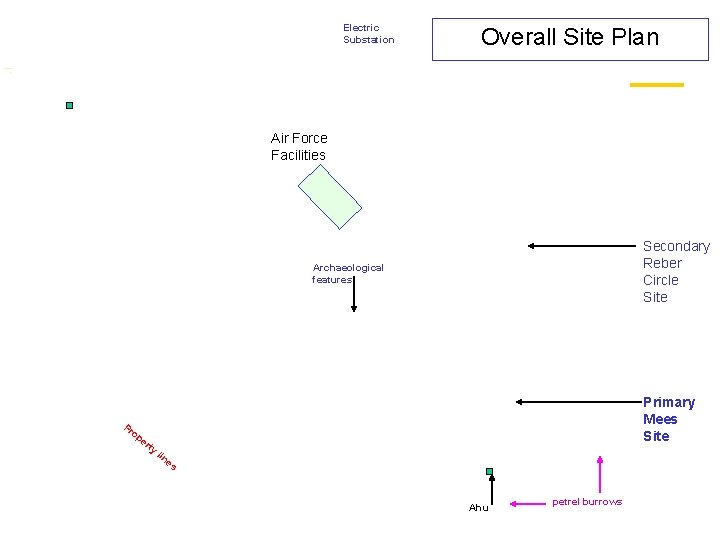
Electric Substation Overall Site Plan Air Force Facilities Secondary Reber Circle Site Archaeological features Pr Primary Mees Site op er ty lin es Ahu petrel burrows
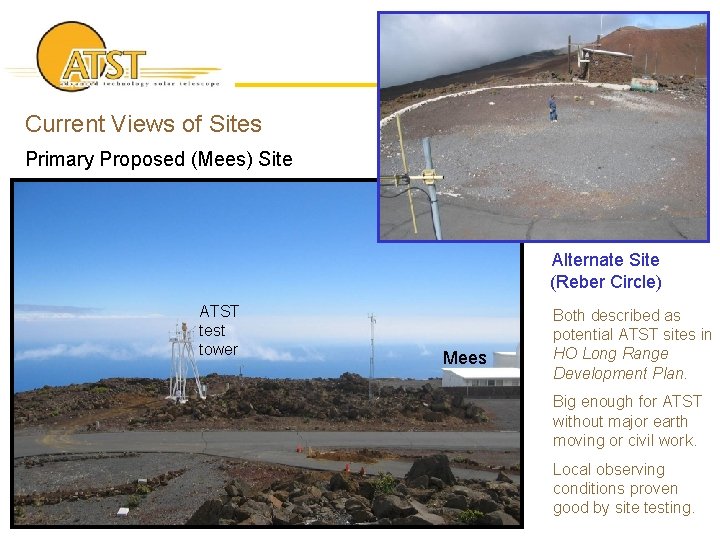
Current Views of Sites Primary Proposed (Mees) Site Alternate Site (Reber Circle) ATST test tower Mees Both described as potential ATST sites in HO Long Range Development Plan. Big enough for ATST without major earth moving or civil work. Local observing conditions proven good by site testing.
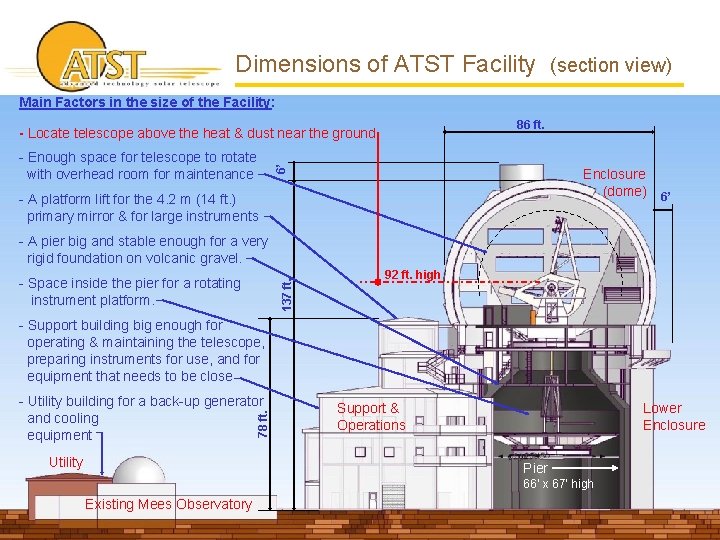
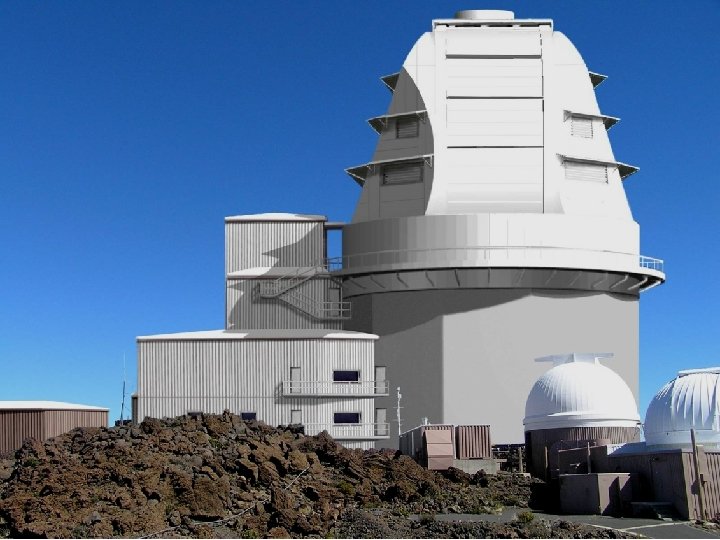
Dimensions of ATST Facility (section view) Main Factors in the size of the Facility: 86 ft. - Locate telescope above the heat & dust near the ground 6’ - Enough space for telescope to rotate with overhead room for maintenance Enclosure (dome) - A platform lift for the 4. 2 m (14 ft. ) primary mirror & for large instruments 6’ - A pier big and stable enough for a very rigid foundation on volcanic gravel. 137 ft. - Space inside the pier for a rotating instrument platform. 92 ft. high - Support building big enough for operating & maintaining the telescope, preparing instruments for use, and for equipment that needs to be close 78 ft. - Utility building for a back-up generator and cooling equipment Utility Support & Operations Lower Enclosure Pier 66’ x 67’ high Existing Mees Observatory
Building Layout Plan ~78 ft.
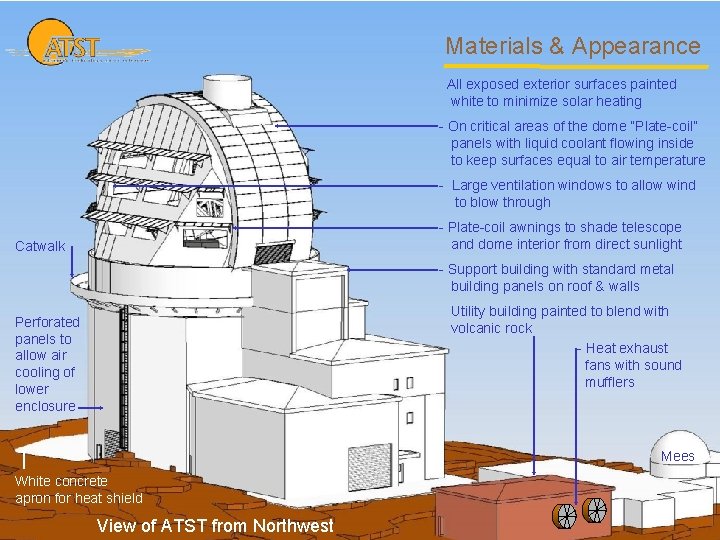
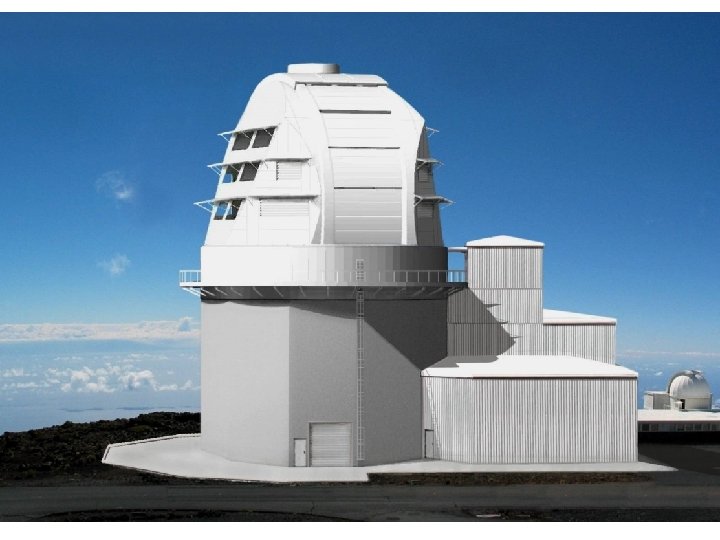
Materials & Appearance All exposed exterior surfaces painted white to minimize solar heating - On critical areas of the dome “Plate-coil” panels with liquid coolant flowing inside to keep surfaces equal to air temperature - Large ventilation windows to allow wind to blow through - Plate-coil awnings to shade telescope and dome interior from direct sunlight Catwalk - Support building with standard metal building panels on roof & walls Utility building painted to blend with volcanic rock - Heat exhaust fans with sound mufflers Perforated panels to allow air cooling of lower enclosure Mees White concrete apron for heat shield View of ATST from Northwest
Summary of Site & Building Characteristics • The two potential sites – At good seeing locations on the existing compound – Enough available area for the proposed ATST facility • Enclosure would be the most dominant visual element – High enough to allow good seeing conditions for the telescope – Large enough to allow telescope to rotate inside – White to minimize solar heating of surface • Support & Operations Building – Near the telescope, so also white – Just large enough for telescope-related activities – Existing Mees structure re-utilized for some ATST functions • Utility Building – Allows remote location and exhaust of heat from surfaces & equipment – Sound insulated and painted brown
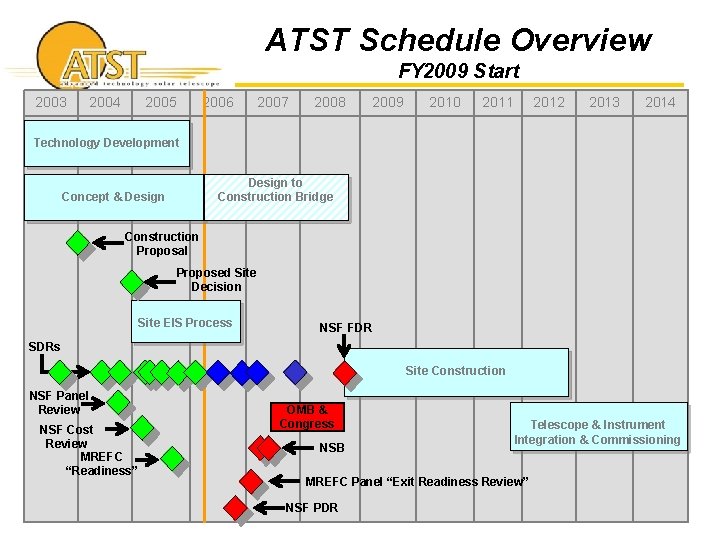
ATST Schedule Overview FY 2009 Start 2003 2004 2005 2006 2007 2008 2009 2010 2011 2012 2013 2014 Technology Development Design to Construction Bridge Concept & Design Construction Proposal Proposed Site Decision Site EIS Process NSF FDR SDRs Site Construction NSF Panel Review NSF Cost Review MREFC “Readiness” OMB & Congress NSB Telescope & Instrument Integration & Commissioning MREFC Panel “Exit Readiness Review” NSF PDR
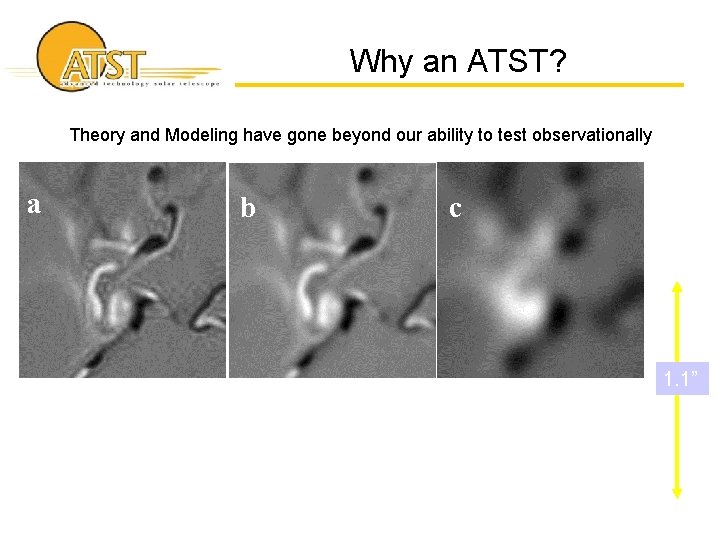
Why an ATST? Theory and Modeling have gone beyond our ability to test observationally a b c 1. 1” a. Numerical simulation of magneto-convection (courtesy of Fausto Cattaneo b. As viewed with a diffraction limited 4 m telescope c. As viewed with a diffraction limited 1 m telescope
Major Questions ATST will Address • How are the highly intermittent magnetic fields observed at the solar surface generated by dynamo processes and how are they dissipated? • What magnetic configurations and evolutionary paths lead to flares and coronal mass ejections? • What mechanisms are responsible for variations in the spectral and total irradiance of the Sun?
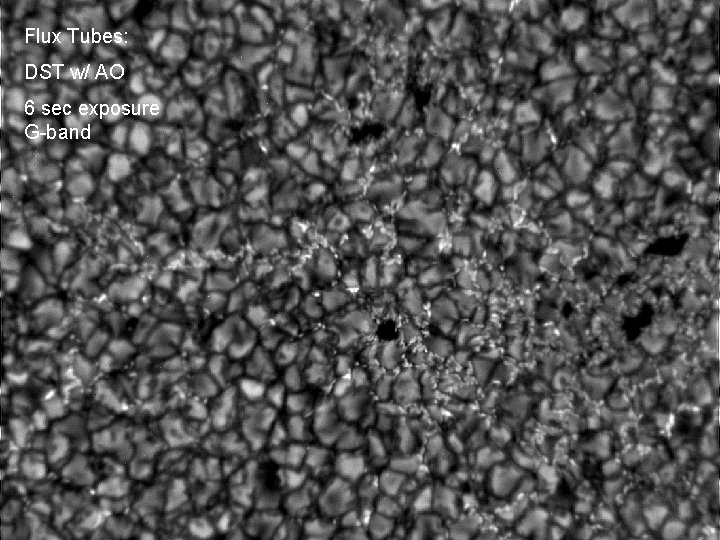
Flux Tubes: DST w/ AO 6 sec exposure G-band
: The ATST Will: • • Clearly resolve fundamental astrophysical processes at the spatial scale needed to test models Provide a high photon flux for accurate and precise measurements of physical parameters throughout the solar atmosphere – High signal to noise spectro-polarimetry of magnetic field on its elemental scale – Measure magnetic strength and direction, temperature and velocity, on the short time scales of the dynamic solar atmosphere • • Directly measure coronal and chromospheric magnetic fields Observationally test models of: – – – – • Magneto-convection Flux emergence and annihilation Flux transport Flux tube formation and evolution Sunspot magnetic fields and flows Atmospheric heating Solar Activity Enable, complement and enhance planned space missions
Progress in Solar Physics Needs: • More Quantitative Data: – Full Stokes Vector Polarimetry – Full line spectroscopy with good spectral resolution • A “Systems Approach” to get a (more) complete picture – Multi-line, multi-wavelength observations – NIR, Thermal IR • Better Spatial Resolution! Larger Aperture • Higher Temporal Resolution! • Photons, Photons !!! Ø We need the ATST
4 m Aperture Solar Telescope with Adaptive Optics • Unique tool to study the Sun • Will replace major existing Solar Facilities • Expected lifetime 30 -40 years • Addresses scientific challenges of today • Look ahead when defining requirements (e. g. Multi Conjugate Adaptive Optics) • Able to adapt to new scientific challenges • Flexibility/Adaptability
Building Layout Plan ~78 ft.
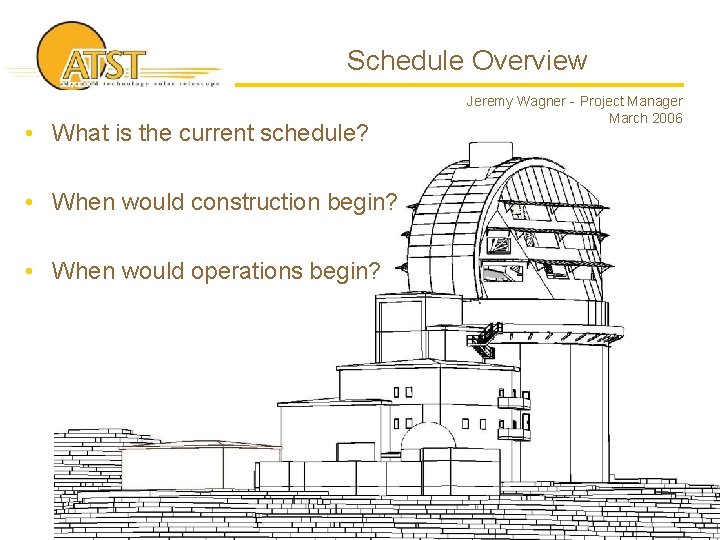
Schedule Overview • What is the current schedule? • When would construction begin? • When would operations begin? Jeremy Wagner - Project Manager March 2006
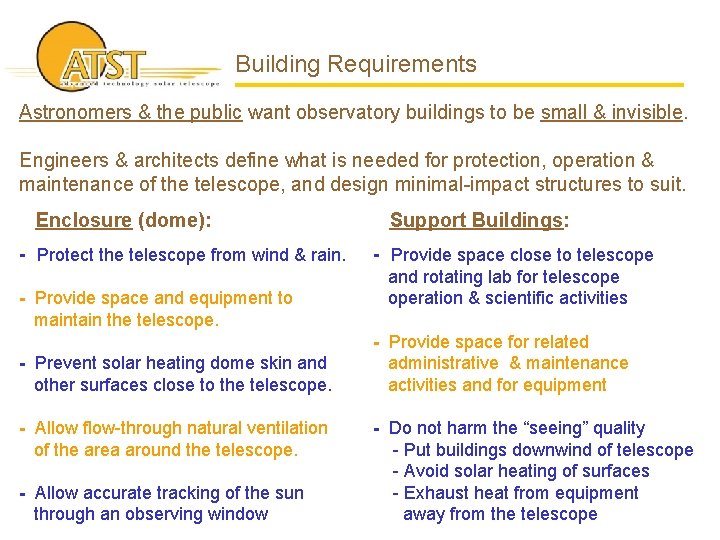
Building Requirements Astronomers & the public want observatory buildings to be small & invisible. Engineers & architects define what is needed for protection, operation & maintenance of the telescope, and design minimal-impact structures to suit. Enclosure (dome): - Protect the telescope from wind & rain. - Provide space and equipment to maintain the telescope. - Prevent solar heating dome skin and other surfaces close to the telescope. - Allow flow-through natural ventilation of the area around the telescope. - Allow accurate tracking of the sun through an observing window Support Buildings: - Provide space close to telescope and rotating lab for telescope operation & scientific activities - Provide space for related administrative & maintenance activities and for equipment - Do not harm the “seeing” quality - Put buildings downwind of telescope - Avoid solar heating of surfaces - Exhaust heat from equipment away from the telescope
ATST Collaboration • • PI – National Solar Observatory Co-PIs – High Altitude Observatory – University of Hawaii – University of Chicago – New Jersey Institute of Technology Collaborators – 22+ Universities and Institutions International Partnerships