
The Advanced Technology Solar Telescope ATST Project Highlights
- Slides: 20
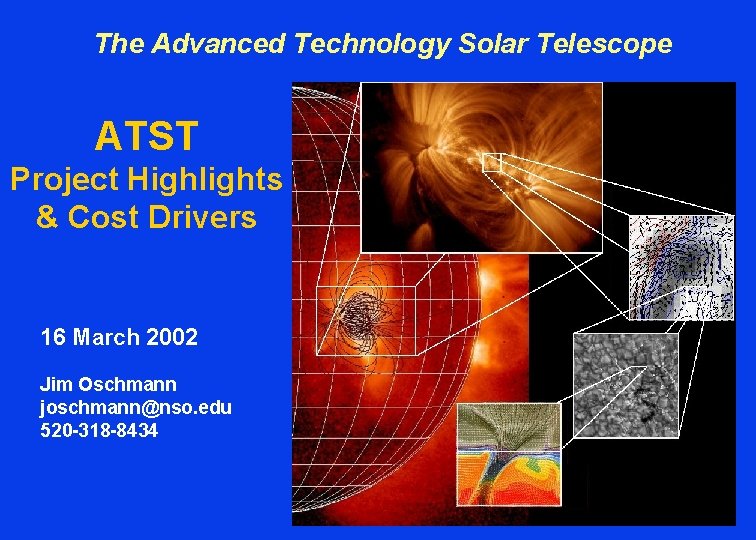
The Advanced Technology Solar Telescope ATST Project Highlights & Cost Drivers 16 March 2002 Jim Oschmann joschmann@nso. edu 520 -318 -8434
ATST Status D&D Phase Goals • Develop Partnerships • Refine Science Objectives and Telescope Requirements (Science Requirements Document) • Develop Design Concepts • Investigate the Cost and Feasibility of Design Concepts • Test and Select a Site for the Facility • Complete the Detailed Design and Costing for the Telescope, Instrumentation and Facility Infrastructure • Develop the Construction Phase Proposal • Develop Partnerships for Construction Funding
ATST Status Project Team Formation • Project Management – Jim Oschmann & Jeremy Wagner(Deputy) • Mechanical Engineer – Mark Warner • Mechanical Designer – Jerry Duffek • Thermal Engineer • • • – Nathan Dalyrimple (USAF/AFRL) – Myung Cho Software Engineer – Bret Goodrich Site Survey Project Engineer – John Briggs (U. Chicago) Adaptive Optics Engineer – Kitt Richards Librarian/Web/Documentation – Ruth Kneale Admin – Jennifer Purcell • Currently looking for Systems and Optics personnel Project Scientist – Thomas Rimmele • Optics, Adaptive Optics – Thomas Rimmele • ATST Polarimetry, Telescope Mount and Structure, Telescope in Instrument Control, Visible Polarimeter – Christoph Keller • Infrared Filter System – Matt Penn • Visible Filter System – Balasubramaniam • Site Survey Scientist– Frank Hill
ATST Status Project Team Formation • Co-PIs and associates – HAO • Michael Knoelker, Steve Tomczyk, Dave Elmore, Phil Judge, Tim Brown – University of Hawaii • Jeff Kuhn; Haosheng Lin, Roy Coulter – University of Chicago • Bob Rosner, Fausto Cattaneo, Jacques Beckers – New Jersey Institute of Technology • Phil Goode; Carsten Denker, Haiman Wang
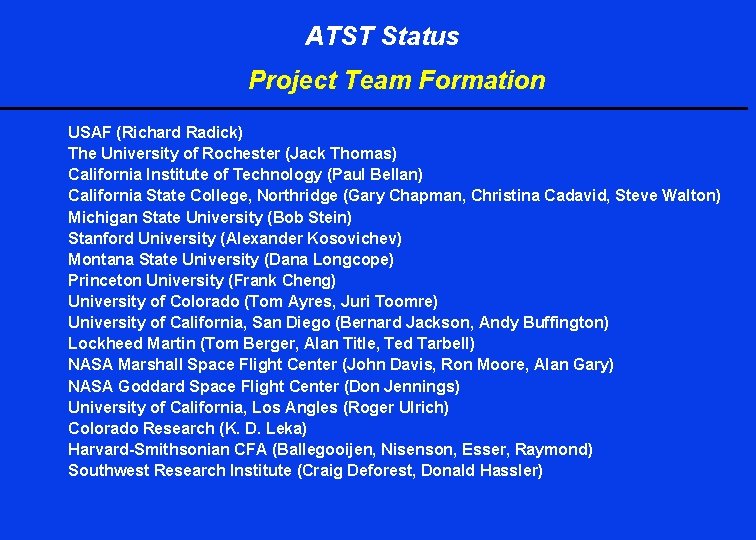
ATST Status Project Team Formation USAF (Richard Radick) The University of Rochester (Jack Thomas) California Institute of Technology (Paul Bellan) California State College, Northridge (Gary Chapman, Christina Cadavid, Steve Walton) Michigan State University (Bob Stein) Stanford University (Alexander Kosovichev) Montana State University (Dana Longcope) Princeton University (Frank Cheng) University of Colorado (Tom Ayres, Juri Toomre) University of California, San Diego (Bernard Jackson, Andy Buffington) Lockheed Martin (Tom Berger, Alan Title, Ted Tarbell) NASA Marshall Space Flight Center (John Davis, Ron Moore, Alan Gary) NASA Goddard Space Flight Center (Don Jennings) University of California, Los Angles (Roger Ulrich) Colorado Research (K. D. Leka) Harvard-Smithsonian CFA (Ballegooijen, Nisenson, Esser, Raymond) Southwest Research Institute (Craig Deforest, Donald Hassler)
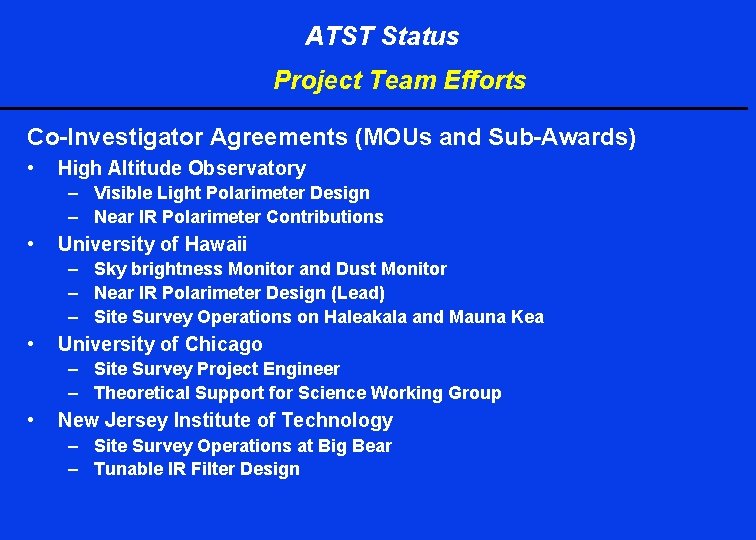
ATST Status Project Team Efforts Co-Investigator Agreements (MOUs and Sub-Awards) • High Altitude Observatory – Visible Light Polarimeter Design – Near IR Polarimeter Contributions • University of Hawaii – Sky brightness Monitor and Dust Monitor – Near IR Polarimeter Design (Lead) – Site Survey Operations on Haleakala and Mauna Kea • University of Chicago – Site Survey Project Engineer – Theoretical Support for Science Working Group • New Jersey Institute of Technology – Site Survey Operations at Big Bear – Tunable IR Filter Design
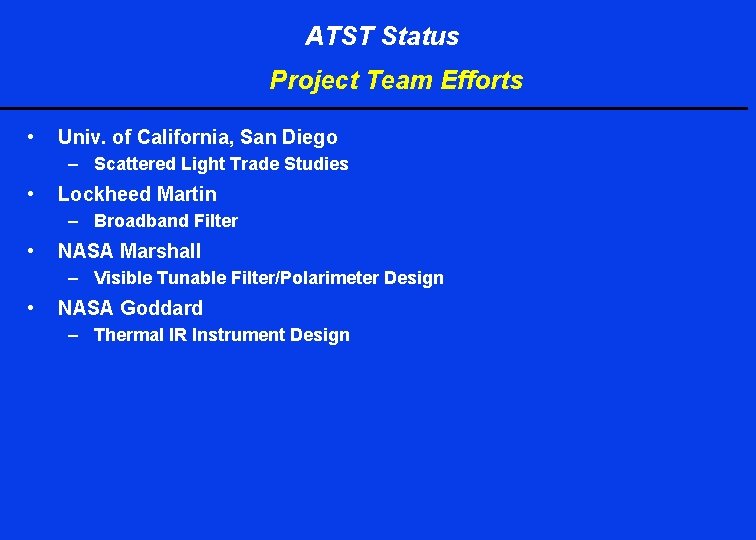
ATST Status Project Team Efforts • Univ. of California, San Diego – Scattered Light Trade Studies • Lockheed Martin – Broadband Filter • NASA Marshall – Visible Tunable Filter/Polarimeter Design • NASA Goddard – Thermal IR Instrument Design
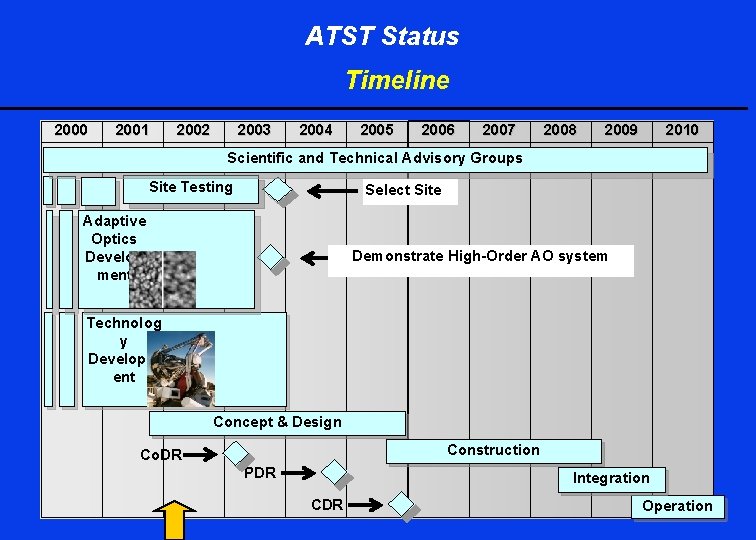
ATST Status Timeline 2000 2001 2002 2003 2004 2005 2006 2007 2008 2009 2010 Scientific and Technical Advisory Groups Site Testing Select Site Adaptive Optics Develop ment Demonstrate High-Order AO system Technolog y Developm ent Concept & Design Construction Co. DR PDR Integration CDR Operation
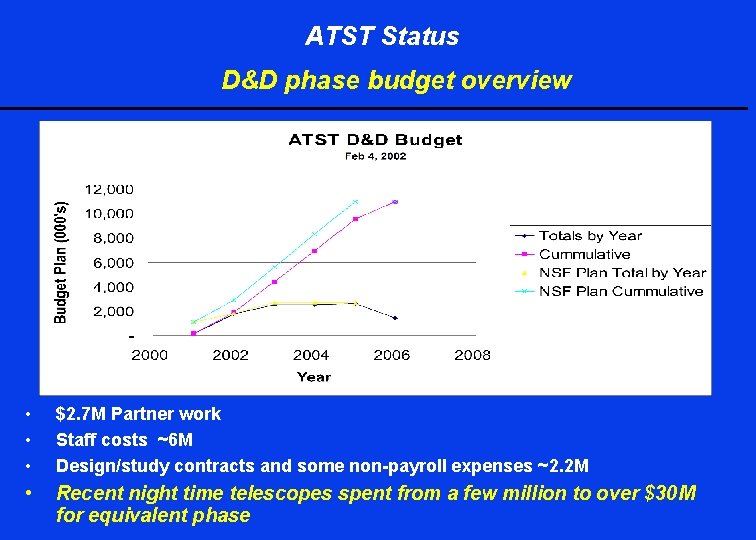
ATST Status D&D phase budget overview • • • $2. 7 M Partner work Staff costs ~6 M Design/study contracts and some non-payroll expenses ~2. 2 M • Recent night time telescopes spent from a few million to over $30 M for equivalent phase
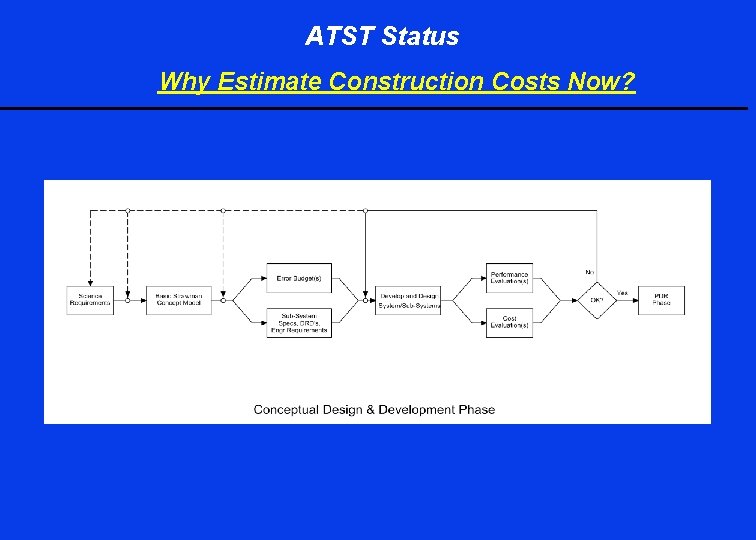
ATST Status Why Estimate Construction Costs Now?
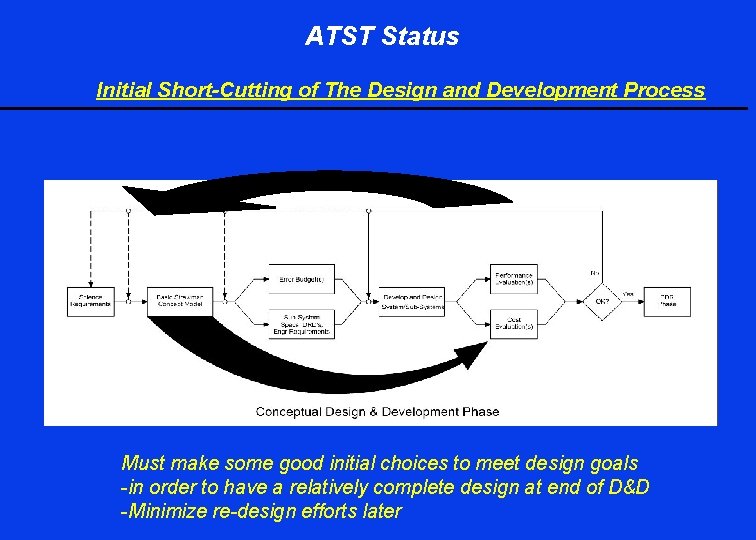
ATST Status Initial Short-Cutting of The Design and Development Process Must make some good initial choices to meet design goals -in order to have a relatively complete design at end of D&D -Minimize re-design efforts later
ATST Status Design Phase Cost drivers How to break down system design • Think of construction phase to optimize • Search for fit for capability at reasonable system level – Trade minimal level of subsystem breakdown with maintaining a competitive process What can we copy from other projects? • Minimize risk and development effort Modular approaches to allow upgrades where possible Unique for this telescope: • • • Optics Manufacturing Scattered light control Heat stop Thermal control Desired wide level of flexibility Technology assumptions, science requirements drive design costs
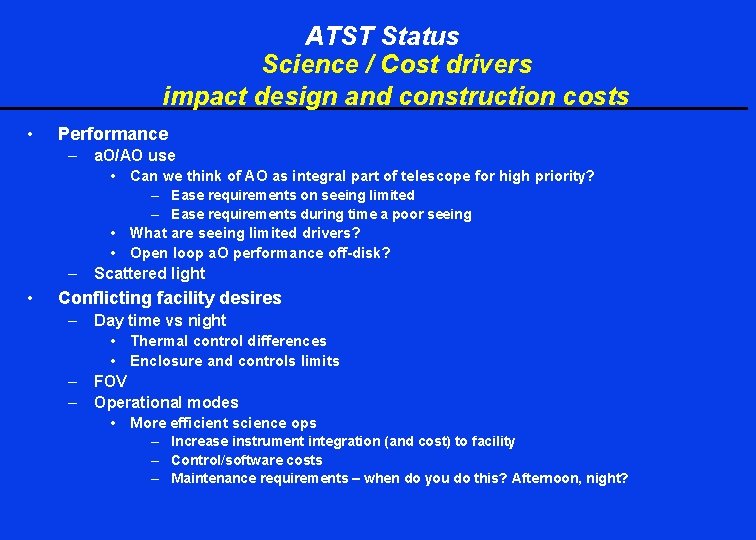
ATST Status Science / Cost drivers impact design and construction costs • Performance – a. O/AO use • Can we think of AO as integral part of telescope for high priority? – Ease requirements on seeing limited – Ease requirements during time a poor seeing What are seeing limited drivers? Open loop a. O performance off-disk? – • • • Scattered light Conflicting facility desires – – – Day time vs night • Thermal control differences • Enclosure and controls limits FOV Operational modes • More efficient science ops – Increase instrument integration (and cost) to facility – Control/software costs – Maintenance requirements – when do you do this? Afternoon, night?
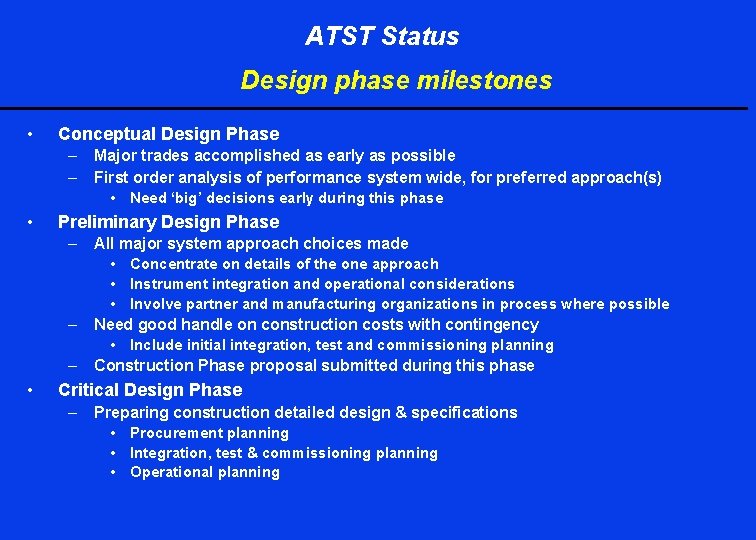
ATST Status Design phase milestones • Conceptual Design Phase – – • Preliminary Design Phase – – – • Major trades accomplished as early as possible First order analysis of performance system wide, for preferred approach(s) • Need ‘big’ decisions early during this phase All major system approach choices made • Concentrate on details of the one approach • Instrument integration and operational considerations • Involve partner and manufacturing organizations in process where possible Need good handle on construction costs with contingency • Include initial integration, test and commissioning planning Construction Phase proposal submitted during this phase Critical Design Phase – Preparing construction detailed design & specifications • Procurement planning • Integration, test & commissioning planning • Operational planning
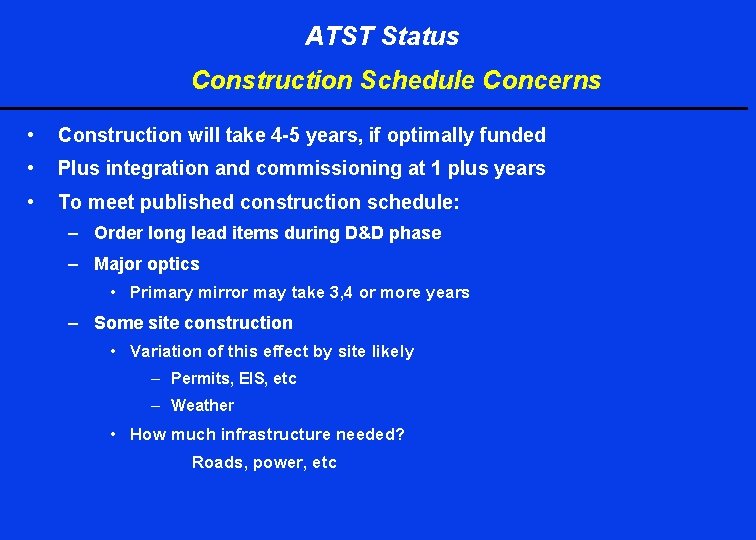
ATST Status Construction Schedule Concerns • Construction will take 4 -5 years, if optimally funded • Plus integration and commissioning at 1 plus years • To meet published construction schedule: – Order long lead items during D&D phase – Major optics • Primary mirror may take 3, 4 or more years – Some site construction • Variation of this effect by site likely – Permits, EIS, etc – Weather • How much infrastructure needed? Roads, power, etc
ATST Status Size of facility • Size/Cost comparisons – Rough comparisons to SOAR, Gemini to ‘bound’ ranges – Two design examples of initial costing presented next by Mark Warner
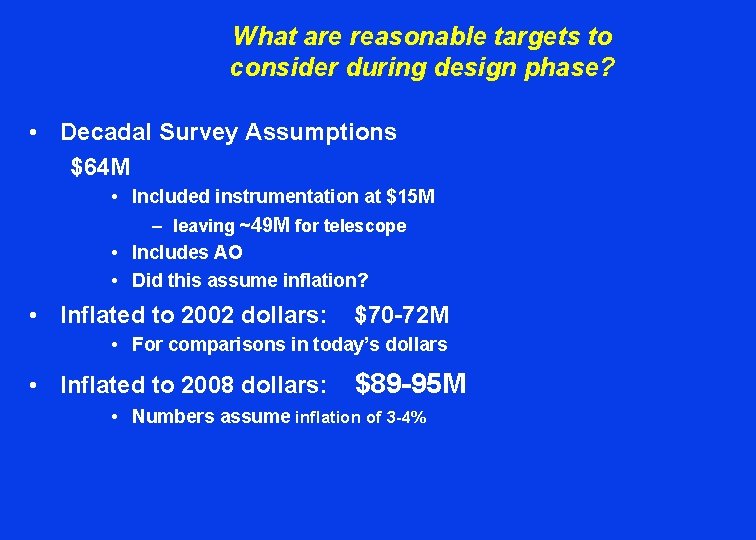
What are reasonable targets to consider during design phase? • Decadal Survey Assumptions $64 M • Included instrumentation at $15 M – leaving ~49 M for telescope • Includes AO • Did this assume inflation? • Inflated to 2002 dollars: $70 -72 M • For comparisons in today’s dollars • Inflated to 2008 dollars: $89 -95 M • Numbers assume inflation of 3 -4%
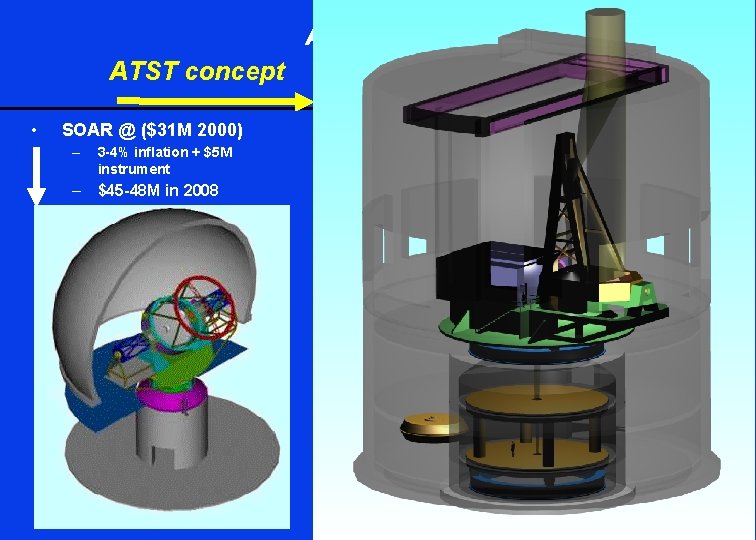
ATST Status ATST concept • SOAR @ ($31 M 2000) – 3 -4% inflation + $5 M instrument – $45 -48 M in 2008
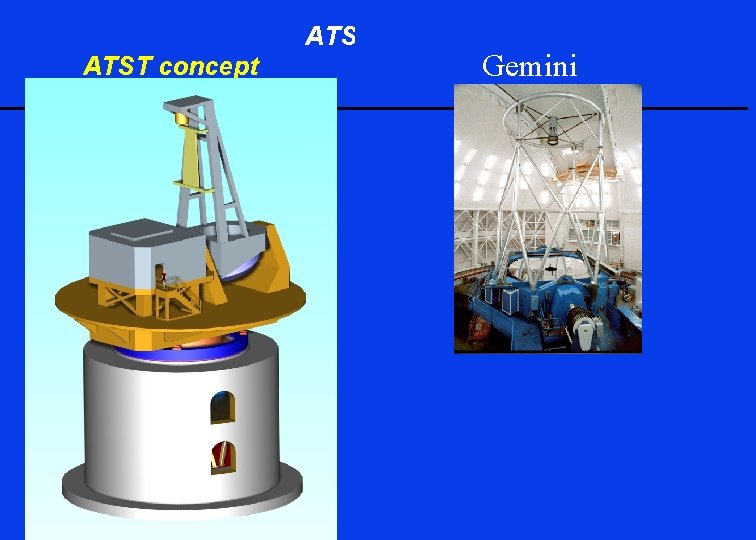
ATST Status ATST concept Gemini
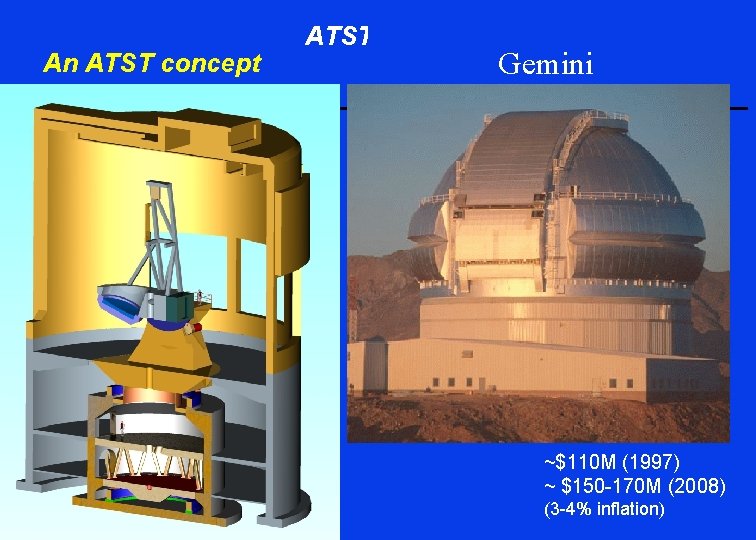
An ATST concept ATST Status Gemini ~$110 M (1997) ~ $150 -170 M (2008) (3 -4% inflation)