
The Adult Learner and Addressing Learning Styles North
- Slides: 35
The Adult Learner and Addressing Learning Styles North Carolina Network for Excellence in Teaching www. nc-net. info
Topics v Characteristics of the Adult Learner v Implications for Teaching v Learning Styles Defined v Factors Affecting Learning Styles v Different Learning Styles Models v Teaching to Styles v Developing MY Plan North Carolina Network for Excellence in Teaching www. nc-net. info
Outcomes 1. 2. 3. 4. 5. 6. 7. Identify characteristics of the adult learner and design activities with adult learning characteristics in mind. Define learning style. Identify different learning style models. Assess his/her own learning style. Discuss benefits of addressing different learning styles. Experience various learning style models, inventories and instruments. Select appropriate learning style teaching strategies. North Carolina Network for Excellence in Teaching www. nc-net. info
What I Want to Know is… On the index card at your seat, put your response to one statement on one side and the other statement on the reverse side. • My challenge in teaching adults is … • One thing I really want to know about addressing learning styles is… North Carolina Network for Excellence in Teaching www. nc-net. info
Traits of Adult Learners v Adult learners have a practical reason for being in school. They are goal-oriented. v Adult learners approach learning from a practical point of view. They want to know how the material learned is related to their work or to their planned careers. v Adult learners bring experience to the classroom. v Adult learners are independent. v Adult learners are self-directed. v Adult learners are motivated to do well and to complete their course of study as soon as practically possible. Source: Dr. Leora Baron, 2007 North Carolina Network for Excellence in Teaching www. nc-net. info
Traits of Adult Learners v Adult learners have experience in training modes of learning rather than academic modes of learning. v Adult learners may be apprehensive about schoolwork because they have been away from it for a while. v Adult learners may be unsure of their basic skills, especially the ones acquired a long time ago. v Adult learners are not used to working in isolation; they are much more used to working in groups. v Adult learners are used to being evaluated on their performance, not on memorization or rote learning. Source: Dr. Leora Baron, 2007 North Carolina Network for Excellence in Teaching www. nc-net. info
Creating a Positive Learning Environment for Adults 3 R’s of Adult Learning • Respect: respect the life experiences of learners, and connect them to learning. • Relevance: help learners to understand why they are learning, and why it’s relevant. • Responsibility: provide opportunities for learners to take increasing responsibility for their own learning. Source: Diana K. Kelly, Ph. D Director of Time 2 LRN http: //www. time 2 lrn. com North Carolina Network for Excellence in Teaching www. nc-net. info
Adults prefer instructors who 1. 2. 3. 4. 5. Are content experts Provide relevance Are well organized Don’t waste time Provide clearning goals 6. 7. 8. 9. Consider learner interests Individualize instruction Use active learning Encourage self-directed learning 10. Are supportive and nonthreatening Source: Diana K. Kelly, Ph. D Director of Time 2 LRN http: //www. time 2 lrn. com North Carolina Network for Excellence in Teaching www. nc-net. info
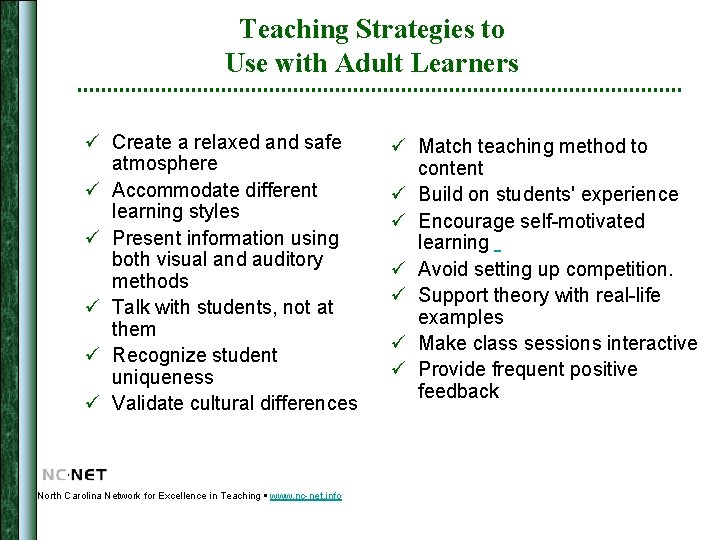
Teaching Strategies to Use with Adult Learners ü Create a relaxed and safe atmosphere ü Accommodate different learning styles ü Present information using both visual and auditory methods ü Talk with students, not at them ü Recognize student uniqueness ü Validate cultural differences North Carolina Network for Excellence in Teaching www. nc-net. info ü Match teaching method to content ü Build on students' experience ü Encourage self-motivated learning ü Avoid setting up competition. ü Support theory with real-life examples ü Make class sessions interactive ü Provide frequent positive feedback
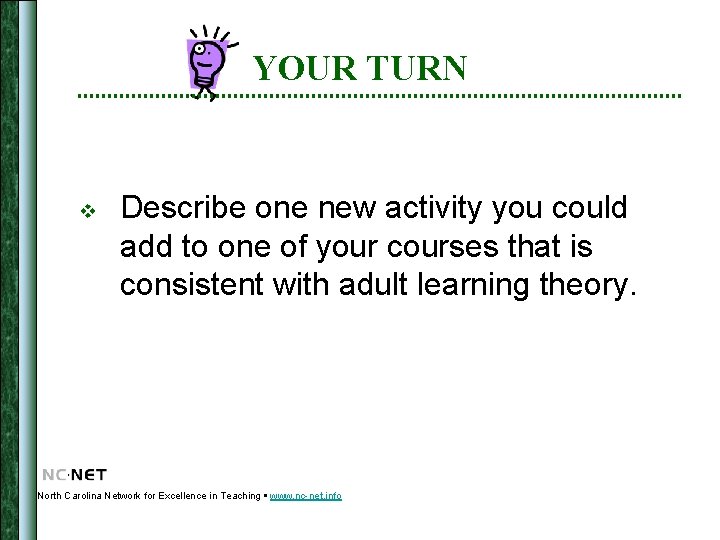
YOUR TURN v Describe one new activity you could add to one of your courses that is consistent with adult learning theory. North Carolina Network for Excellence in Teaching www. nc-net. info
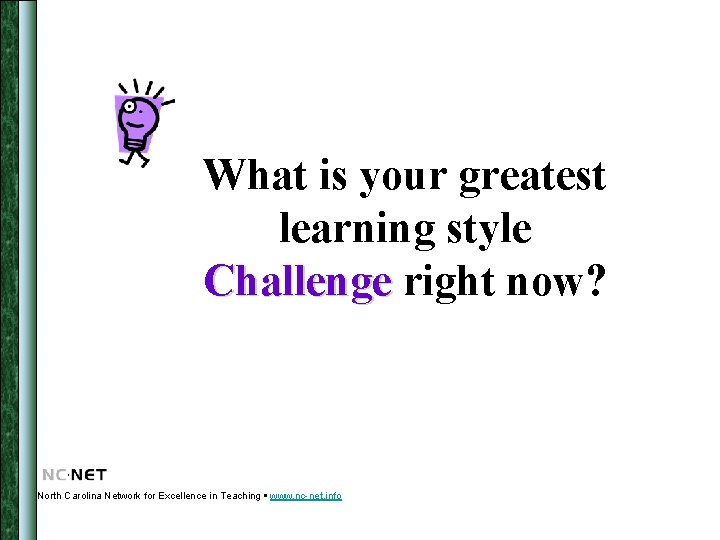
What is your greatest learning style Challenge right now? North Carolina Network for Excellence in Teaching www. nc-net. info
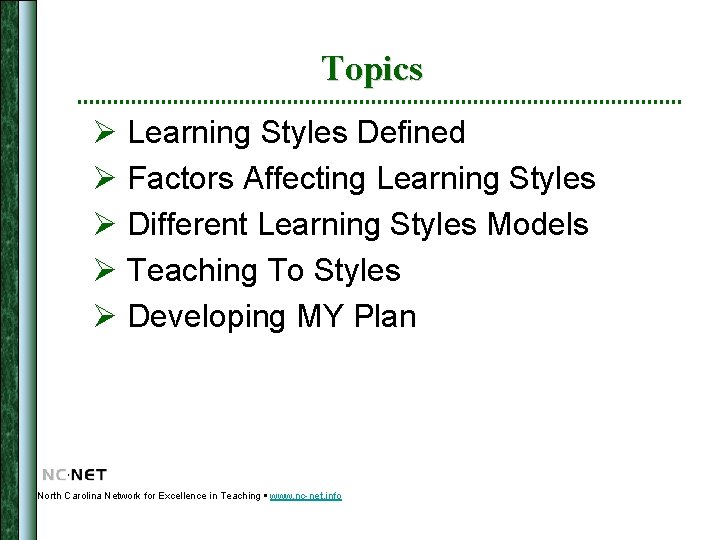
Topics Ø Learning Styles Defined Ø Factors Affecting Learning Styles Ø Different Learning Styles Models Ø Teaching To Styles Ø Developing MY Plan North Carolina Network for Excellence in Teaching www. nc-net. info
Objectives 1. Determine your preferred learning style. 2. Define learning styles. 3. Discuss benefits of attending to different learning styles. 4. Identify different learning style models. 5. Select learning style activities appropriate for your style of teaching and your students’ needs. 6. Design learning strategies to create a learning environment in which all can possibly succeed. North Carolina Network for Excellence in Teaching www. nc-net. info
Learning Styles are… Ways in which a person approaches, processes and retains new and difficult information. North Carolina Network for Excellence in Teaching www. nc-net. info
Learning styles are influenced by many factors. Can you name three? North Carolina Network for Excellence in Teaching www. nc-net. info
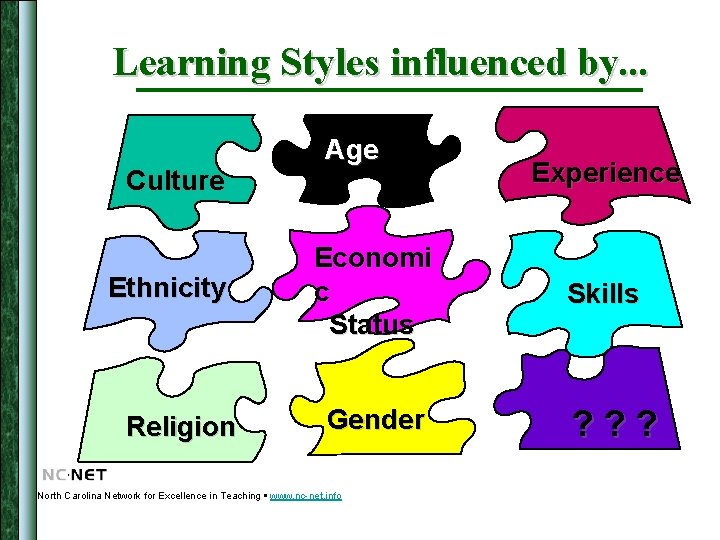
Learning Styles influenced by. . . Culture Ethnicity Religion Age Economi c Status Gender North Carolina Network for Excellence in Teaching www. nc-net. info Experience Skills ? ? ?
Learning Styles Models Ø VARK : Perceptual Modality Preferences Ø Hemispheric Models ( e. g. Left Brain / Right Brain) Ø Howard Gardner’s Multiple Intelligences North Carolina Network for Excellence in Teaching www. nc-net. info
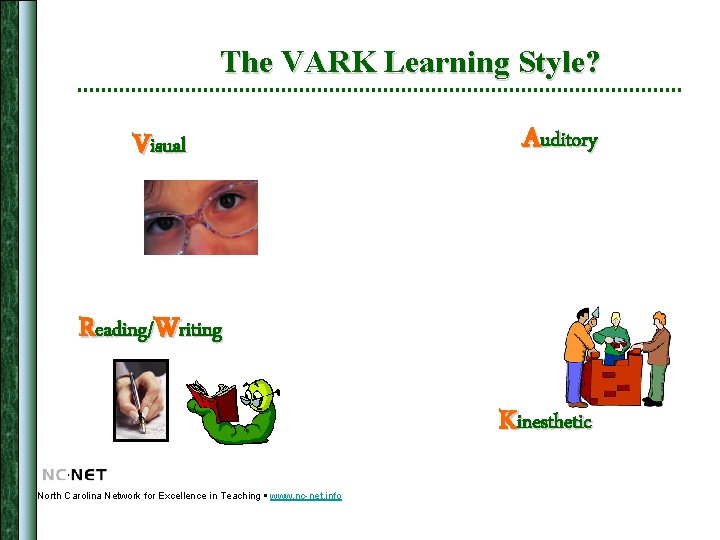
The VARK Learning Style? Visual Auditory Reading/Writing Kinesthetic North Carolina Network for Excellence in Teaching www. nc-net. info
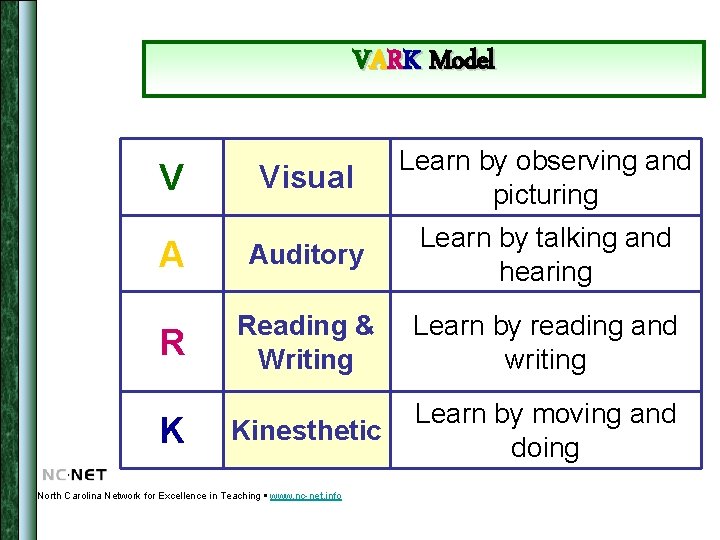
VARK Model Visual Learn by observing and picturing A Auditory Learn by talking and hearing R Reading & Writing Learn by reading and writing Kinesthetic Learn by moving and doing V K North Carolina Network for Excellence in Teaching www. nc-net. info
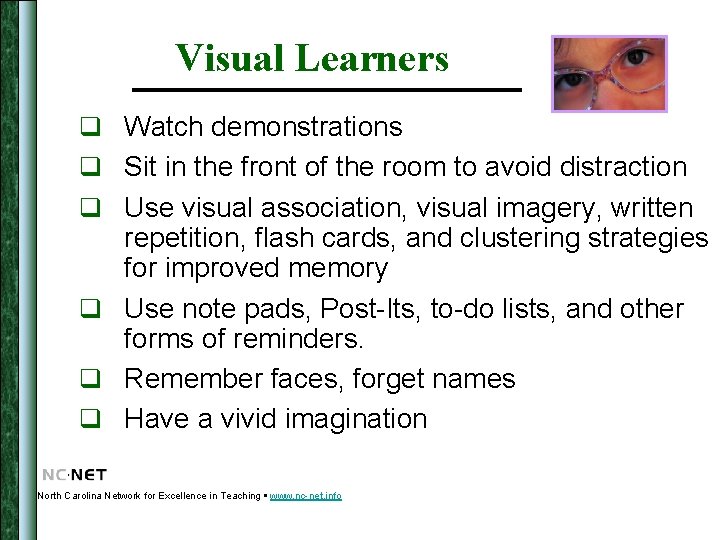
Visual Learners q Watch demonstrations q Sit in the front of the room to avoid distraction q Use visual association, visual imagery, written repetition, flash cards, and clustering strategies for improved memory q Use note pads, Post-Its, to-do lists, and other forms of reminders. q Remember faces, forget names q Have a vivid imagination North Carolina Network for Excellence in Teaching www. nc-net. info
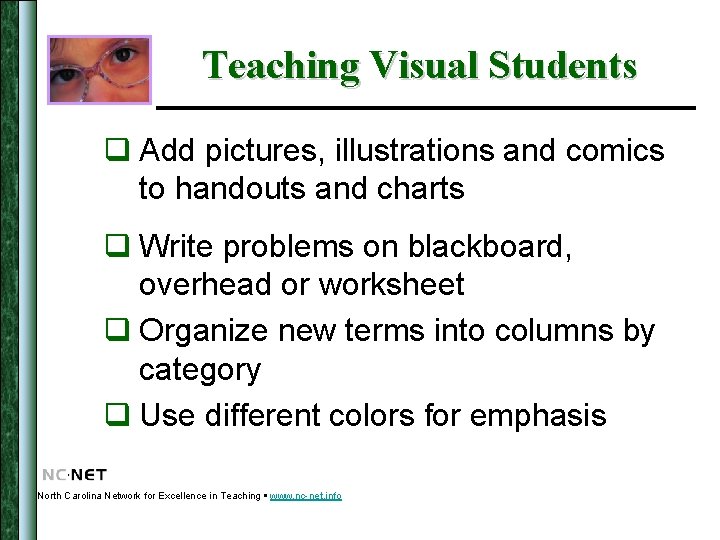
Teaching Visual Students q Add pictures, illustrations and comics to handouts and charts q Write problems on blackboard, overhead or worksheet q Organize new terms into columns by category q Use different colors for emphasis North Carolina Network for Excellence in Teaching www. nc-net. info
Auditory Learners v Like verbal instructions v Enjoy dialogue, plays v Remember names, forget faces v Rehearse information orally and read notes. v Use mnemonics, rhymes, jingles v Use tape recorders to document lectures and for reading materials v Are easily distracted by noise North Carolina Network for Excellence in Teaching www. nc-net. info
Teaching Auditory Learners v Provide tapes of previous lectures v Utilize group discussion v Ask students to verbally state the main ideas v Give oral instructions v Allow soft music in classroom North Carolina Network for Excellence in Teaching www. nc-net. info
Reading & Writing Learners q Write many drafts q Take notes and outline their reading assignments q Turn charts and diagrams into words q Make lists and organize them into categories. q Make use of extra information such as manuals, dictionaries, and glossaries. North Carolina Network for Excellence in Teaching www. nc-net. info
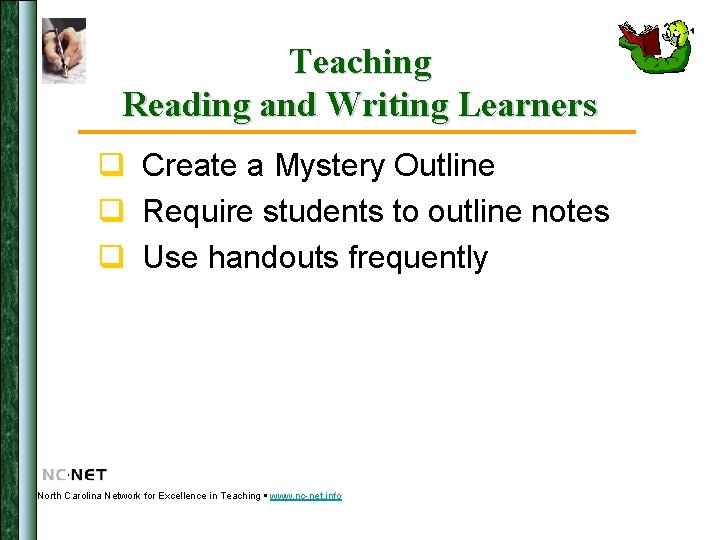
Teaching Reading and Writing Learners q Create a Mystery Outline q Require students to outline notes q Use handouts frequently North Carolina Network for Excellence in Teaching www. nc-net. info
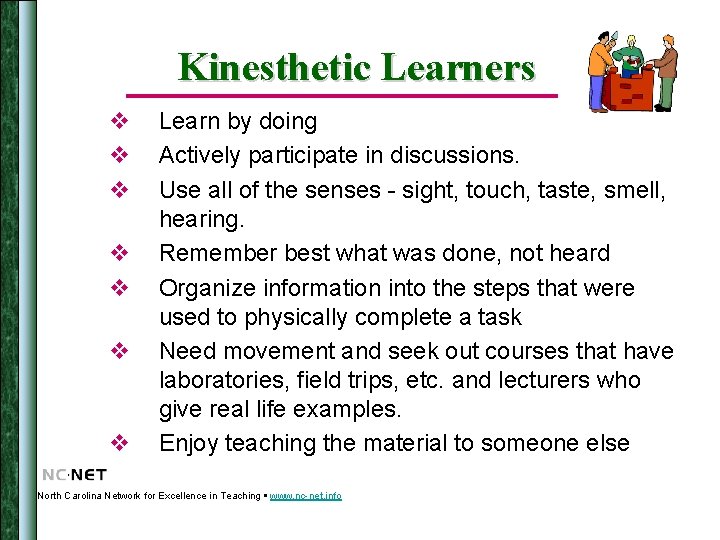
Kinesthetic Learners v v v v Learn by doing Actively participate in discussions. Use all of the senses - sight, touch, taste, smell, hearing. Remember best what was done, not heard Organize information into the steps that were used to physically complete a task Need movement and seek out courses that have laboratories, field trips, etc. and lecturers who give real life examples. Enjoy teaching the material to someone else North Carolina Network for Excellence in Teaching www. nc-net. info
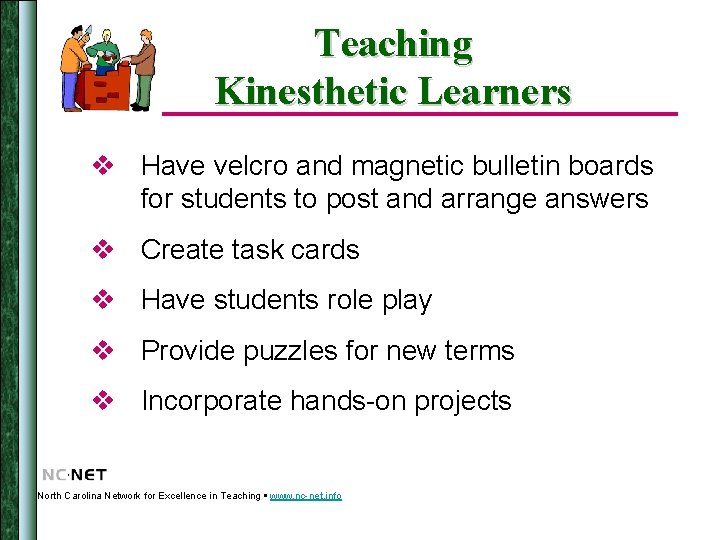
Teaching Kinesthetic Learners v Have velcro and magnetic bulletin boards for students to post and arrange answers v Create task cards v Have students role play v Provide puzzles for new terms v Incorporate hands-on projects North Carolina Network for Excellence in Teaching www. nc-net. info
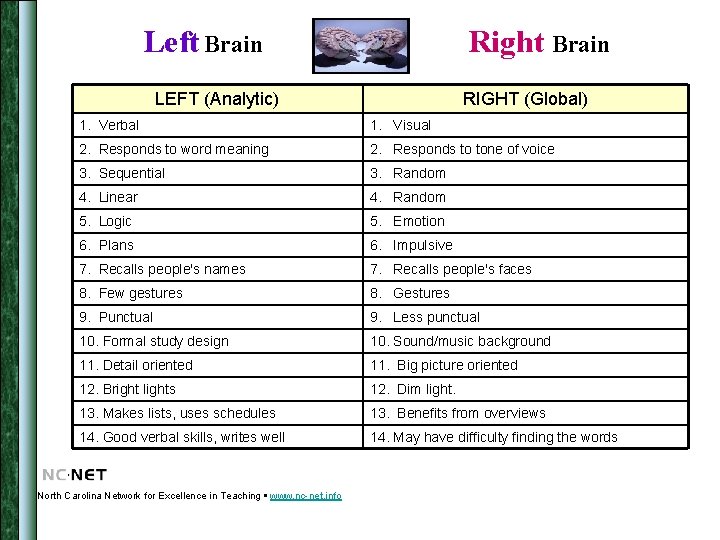
Left Brain Right Brain LEFT (Analytic) RIGHT (Global) 1. Verbal 1. Visual 2. Responds to word meaning 2. Responds to tone of voice 3. Sequential 3. Random 4. Linear 4. Random 5. Logic 5. Emotion 6. Plans 6. Impulsive 7. Recalls people's names 7. Recalls people's faces 8. Few gestures 8. Gestures 9. Punctual 9. Less punctual 10. Formal study design 10. Sound/music background 11. Detail oriented 11. Big picture oriented 12. Bright lights 12. Dim light. 13. Makes lists, uses schedules 13. Benefits from overviews 14. Good verbal skills, writes well 14. May have difficulty finding the words North Carolina Network for Excellence in Teaching www. nc-net. info
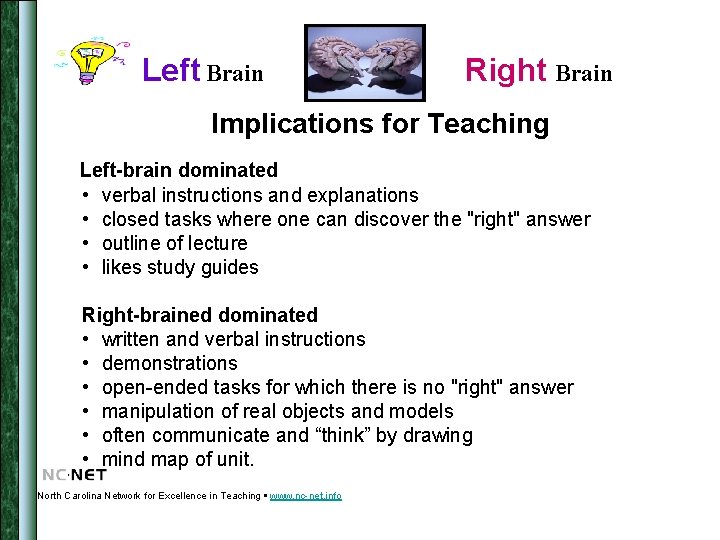
Left Brain Right Brain Implications for Teaching Left-brain dominated • verbal instructions and explanations • closed tasks where one can discover the "right" answer • outline of lecture • likes study guides Right-brained dominated • written and verbal instructions • demonstrations • open-ended tasks for which there is no "right" answer • manipulation of real objects and models • often communicate and “think” by drawing • mind map of unit. North Carolina Network for Excellence in Teaching www. nc-net. info
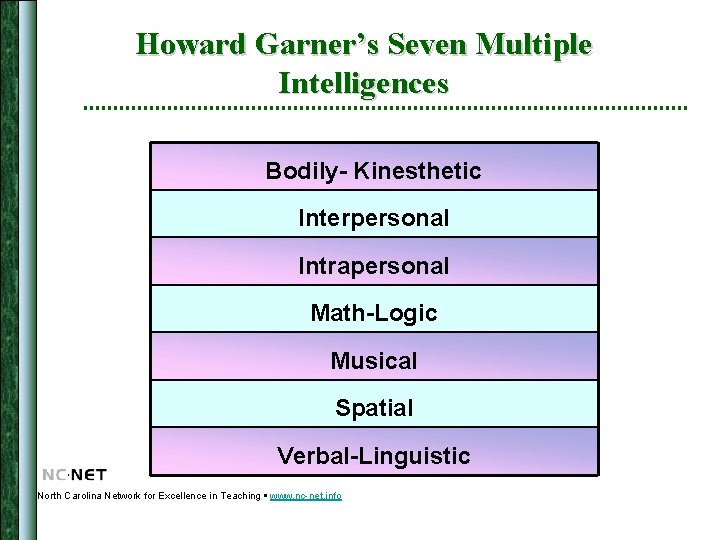
Howard Garner’s Seven Multiple Intelligences Bodily- Kinesthetic Interpersonal Intrapersonal Math-Logic Musical Spatial Verbal-Linguistic North Carolina Network for Excellence in Teaching www. nc-net. info
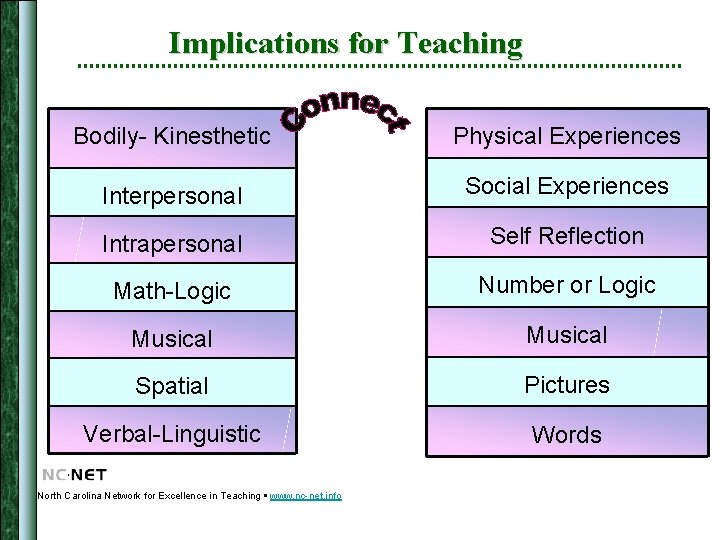
Implications for Teaching Bodily- Kinesthetic Physical Experiences Interpersonal Social Experiences Intrapersonal Self Reflection Math-Logic Number or Logic Musical Spatial Pictures Verbal-Linguistic Words North Carolina Network for Excellence in Teaching www. nc-net. info
Name the 7 Multiple Intelligences? North Carolina Network for Excellence in Teaching www. nc-net. info
• What are some ideas you can already apply for the model assigned to your group? North Carolina Network for Excellence in Teaching www. nc-net. info
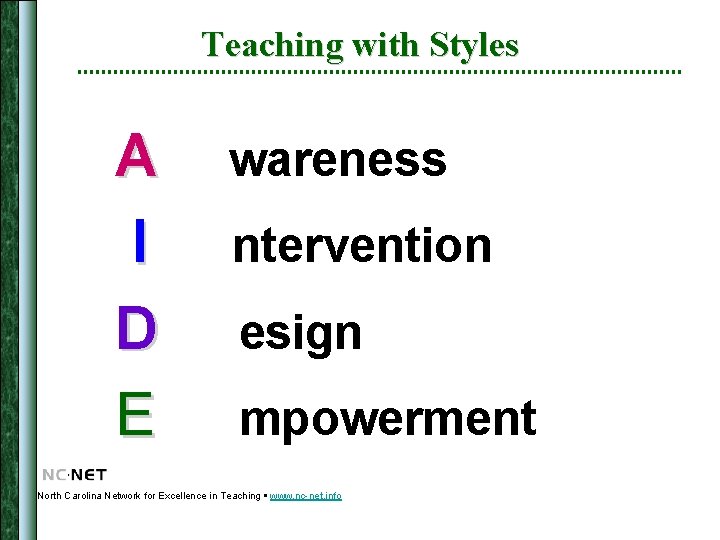
Teaching with Styles A I D E wareness ntervention esign mpowerment North Carolina Network for Excellence in Teaching www. nc-net. info
Consider the Brain and How Students Learn North Carolina Network for Excellence in Teaching www. nc-net. info