
The AdolescentAdult Sensory Profile Tana Brown Ph D
The Adolescent/Adult Sensory Profile Tana Brown Ph. D, OTR FAOTA University of Kansas Medical Center Occupational Therapy Education
Presentation topics o History of the A/ASP o Overview of the sensory processing model o Taking and scoring the profile o Interpreting the profile o Intervention guidelines o Practice designing environments to support sensory processing preferences o Considerations for specific diagnostic groups
General information before we get started o Not a “sensory integration” presentation o The model applies to all people – not an impairment model o Will provide a framework for assessment and intervention that is applicable regardless of the population
History of the A/ASP o Statistical analysis of the children’s version of the Sensory Profile o Development of the model of Sensory Processing o Relationship to adult issues o Development of the Adult version o Revisions to make applicable to adolescents
Overview of Dunn’s Model of Sensory Processing Theoretical framework for interpreting the measure and designing intervention
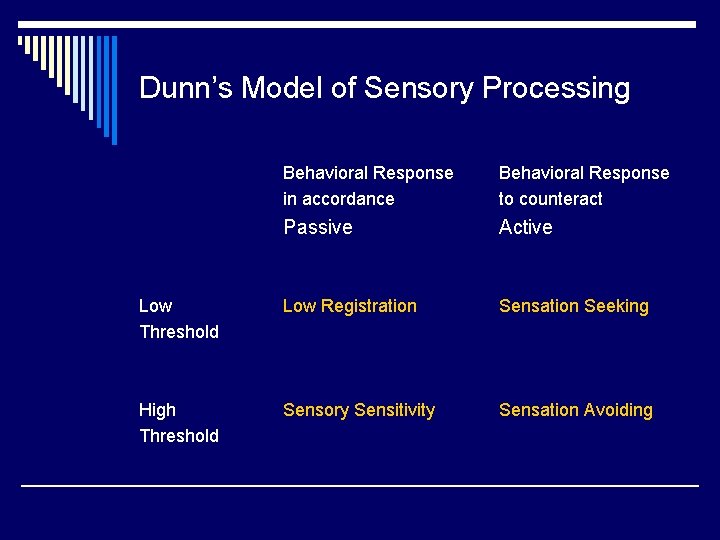
Dunn’s Model of Sensory Processing Behavioral Response in accordance Behavioral Response to counteract Passive Active Low Threshold Low Registration Sensation Seeking High Threshold Sensory Sensitivity Sensation Avoiding
Sensory Sensitivity o passive response to a low threshold o easily respond to sensory stimuli o notice things other people don’t notice o highly aware of their surroundings o distractible
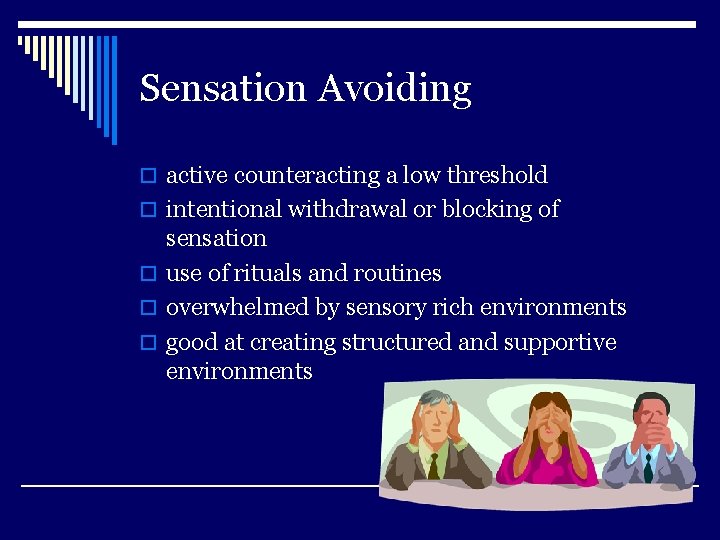
Sensation Avoiding o active counteracting a low threshold o intentional withdrawal or blocking of sensation o use of rituals and routines o overwhelmed by sensory rich environments o good at creating structured and supportive environments
Low Registration o Passive response with a high threshold o miss available sensory input o spacey, clumsy o under-responsive or slow to respond o can focus in distracting environments o flexible, comfortable in wide range of environments
Sensation Seeking o behavioral response to counteract a high threshold o enjoys sensory rich environments o creates sensation o easily bored o trouble tolerating low stimulus environments
Adolescent/Adult Sensory Profile o measure of sensory processing preferences o Self questionnaire o 60 items – 15/quadrant o Taste/smell, movement, visual, tough, auditory, activity level o Ages 11 and up
If/when the A/ASP is revised… o Change the double negative items o Better distinguish sensory sensitivity and sensation avoiding by making sensitivity items focus on detection and not annoyance of sensation
Who should fill out the A/ASP? o It is designed to be a self-report o Informant reporting should be done cautiously and avoid interpretations based on scores o Best informants would be those that have caretaking responsibilities
Fill out and score the A/ASP
Classification System o Based on standardization sample n 193 adolescents, 496 adults, 261 older adults o Cut scores for each quadrant o Classifications n Much less than most people n Less than most people n Similar to most people n More than most people n Much more than most people
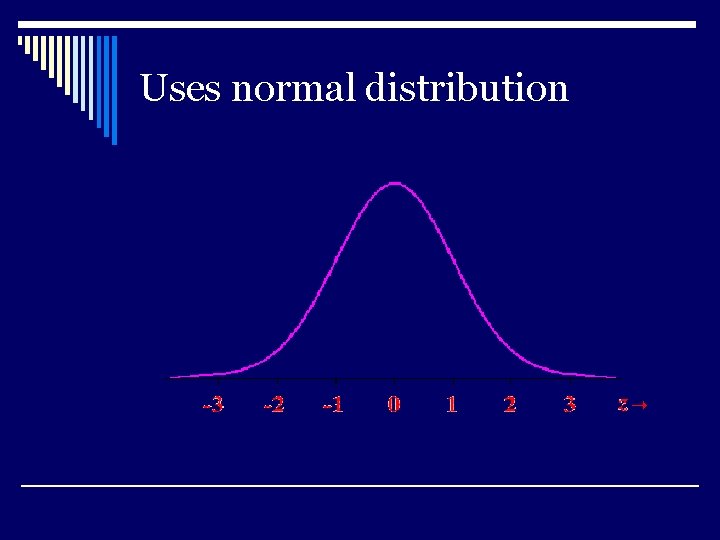
Uses normal distribution
Support for Reliability o Internal consistency for quadrants range from . 65 -. 78 o Each item on a subscale correlates best with its intended subscale o Standard error of measurement ranges from 3. 58 – 4. 51
Validity Evidence o Discriminant Validity with Adult Temperament Questionnaire (Chess & Thomas, 1998) o Sensation seeking scores negatively correlated withdrawal and dysphoric mood subscales o Sensitivity subscales positively correlated with dysphoric mood and sensory threshold subscales o Sensation avoiding positively correlated with low adaptability, withdrawal and dysphoric mood
Further support for validity o Physiological data consistent with four quadrants n n Sensory sensitivity respond intensely and habituate slowly Sensation avoiding respond intensely but habituate quickly Low registration respond weakly and habituate quickly Sensation seeking respond weakly but habituate slowly
More support for validity o Distinguished people with and without mental illness o Distinguished younger and older adults o Child version distinguished children with autism and ADHD
Considerations o Scoring different than child, infant/toddler o o versions All preferences have advantages and disadvantages Consider all quadrants together Consider meaning of low scores (particularly for seeking and avoiding behaviors) Consider patterns within sensory categories
Intervention Strategies o. Create a supportive environment o Increase tolerance, rather than change the person’s preference
Increase tolerance o Graded exposures o Personal commitment, rewards or other external motivators
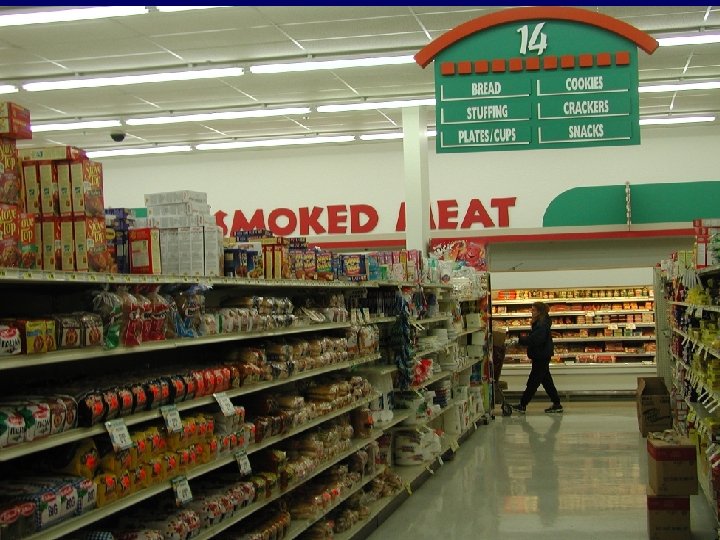
Analyzing the environment o Intensity o Amount o Repetition o Competing stimuli o Predictability o Familiarity o Speed
The Auditory Environment o Intensity – soft/loud o Amount – intermittent, constant o Repetition – rhythmic o Competing stimuli – background noise, multiple conversations o Predictability - startle o Familiarity – accents or garbled speech o Speed – rate of speech

The Visual Environment o Intensity – brightness, colors o Amount – number of objects to process o Repetition – clean lines, patterns o Competing stimuli - clutter o Predictability – organized, movement o Familiarity – visual input is recognizable, known vs. unknown setting o Speed – how much time to process information (static environment versus moving {driving})
The Tactile Environment o Intensity – light versus deep pressure, degree of o o o irritability Amount – body surface Repetition – constant or intermittent Competing stimuli – consider ambient environment – temperature, wind, fans Predictability – handshake versus being touched from behind Familiarity – recognize what you are touching (stepping on something unfamiliar) Speed – fast/slow

The Gustatory Environment o Intensity – spices, temperature o Amount – how much is taste a part of the o o o experience Repetition – different tastes or lots of the same Competing stimuli – eat everything separately, mix foods together Predictability – taste surprises (e. g. plantains not bananas) Familiarity – eaten before Speed – how quickly you eat and therefore taste
The Olfactory Environment o Intensity – strength of the smell o Amount – e. g. bath stores, restaurants o Repetition – less relevant o Competing stimuli – unpleasant smells can be especially distracting o Predictability – can detect when and where o Familiarity – can detect what o Speed – tends to be more constant, smells generally do not come and go quickly
The Vestibular/Proprioceptive Environment o Intensity – large, pounding movements o Amount – activity level o Repetition – rhythmic, cadenced o Competing stimuli – mostly when not executing movements on own, - car, rides, elevator o Predictability – can anticipate movement and body in space o Familiarity – established motor patterns o Speed – slow versus quick movements
Let’s analyze an environment
Low Registration o ↑ Intensity o ↑ Amount o ≈ Consistency o ≈ Competing (↑ intensity of salient stimuli) o ↓ Predictability o ↓ Familiarity o ↓ Speed
Other Low Registration Considerations o There could be safety issues related to noticing o Will probably have a high level of tolerance for different types of environments so capitalize on flexibility o Cues are an essential strategy because it increases accessibility of salient/important information
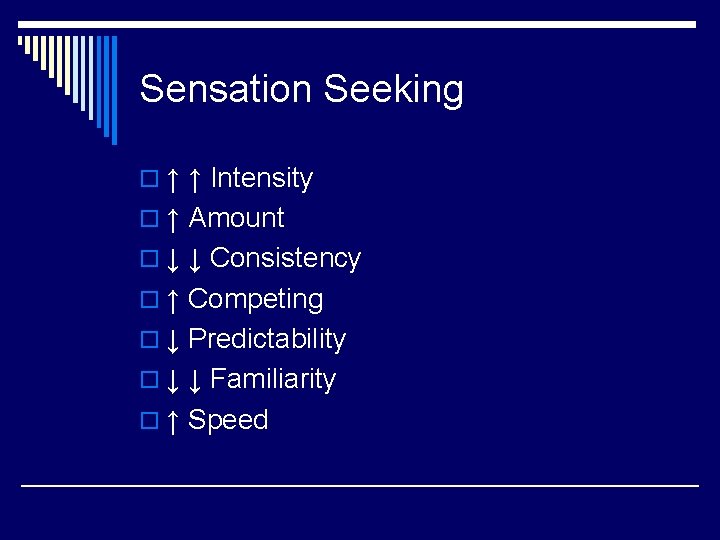
Sensation Seeking o ↑ ↑ Intensity o ↑ Amount o ↓ ↓ Consistency o ↑ Competing o ↓ Predictability o ↓ ↓ Familiarity o ↑ Speed
Other sensation seeking considerations o Incorporate additional sensations into daily routines o What may be distracting for others, may help increase arousal/promote attention for sensation seekers

Sensory Sensitivity o ↓ Intensity o ↓ Amount o ↑ Consistency o ↓ ↓ Competing o ↑ Predictability o ↑ Familiarity o ↓ Speed
Other sensory sensitivity considerations o How capable is person of assimilating multiple stimuli (may be sensitive but able to handle/process information effectively) o Otherwise remove distractors and create organizational systems
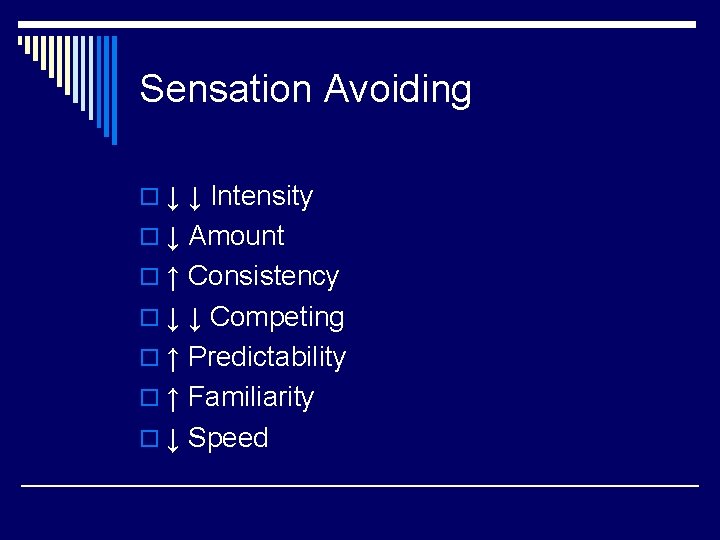
Sensation Avoiding o ↓ ↓ Intensity o ↓ Amount o ↑ Consistency o ↓ ↓ Competing o ↑ Predictability o ↑ Familiarity o ↓ Speed
Other sensation avoiding considerations o Be sure to distinguish low registration and avoiding because approaches are often contradictory o When possible give the individual control over the environment when introducing sensory input
Other strategies……
Distress tolerance o Idea comes from dialectical behavior therapy o There are times when will have to tolerate an uncomfortable situation o Develop coping mechanisms for managing those times
Information is part of the intervention o Awareness of personal preferences increases self-awareness and is reassuring o Provide information to relevant others – spouses, employers, parents, teachers, so that they can understand
Incorporate breaks o Avoider may need to leave the party and retreat to the kitchen o Seeker may need to leave a long lecture and go outside for a run
Meet needs internally/selfsoothing o Self talk o Meditation o Chew gum o Rock
Use others as intervention o To help focus attention o To provide feedback about behavior o To reassure o To distract
Design an environment for each quadrant around a specific occupation
Findings related to specific populations
Individuals with schizophrenia o Low scores on sensation seeking o High scores on sensation avoiding and low registration
People with bipolar disorder o Average scores on low registration o High scores on sensation avoiding and low scores on sensation seeking
Older adults o Low scores on sensation seeking o High scores on low registration with cumulatively higher scores as age from 60 – 70 - 80
Autism/Asperger o More likely to exhibit behaviors in n Sensation seeking, low registration and sensory sensitivity o Especially sensitive to auditory and oral motor input
Attention Deficit Hyperactivity Disorder o Differences across all quadrants – may be more reflective of a modulation problem
Adults with brain injury o High scores on sensory sensitivity o Low scores on sensation avoiding
- Slides: 54