
THE ADJUSTMENT PROCESS 8 1 In this unit


- Slides: 59
THE ADJUSTMENT PROCESS 8. 1
In this unit we will focus on financial statements prepared at the end of a fiscal period or year. When preparing these financial statements, the accountants must ensure that all: accounts are brought up to date late transactions are taken into account calculations have been made correctly accounting principles and standards have been met.
Accounting Principles & Standards The International Financial Reporting Standards identifies quality characteristics that all financial statements should have. They should: Be relevant - readers of financial statements want a current picture of a business’ important features. Be reliable - The financial figures should be based on solid evidence. Be comparable - be able to make meaningful comparisons of dollar amounts - from one year to the next, from business to business, etc.
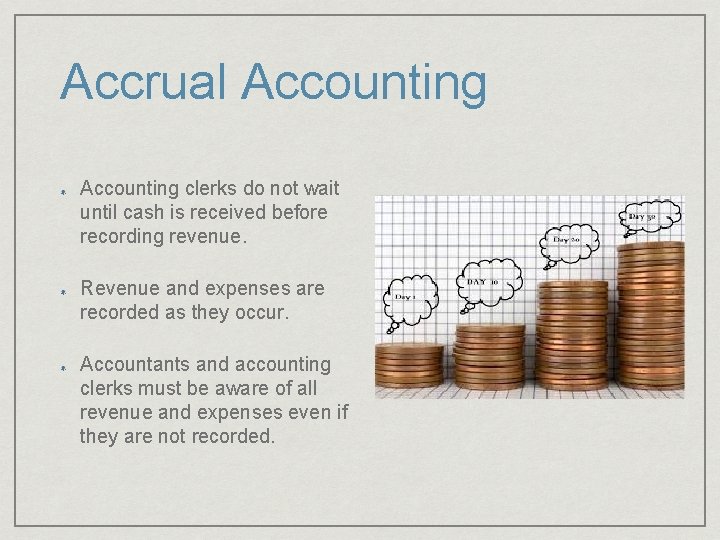
Accrual Accounting clerks do not wait until cash is received before recording revenue. Revenue and expenses are recorded as they occur. Accountants and accounting clerks must be aware of all revenue and expenses even if they are not recorded.
Adjusting the Accounts Senior accountants take action at the end of the fiscal period to adjust the accounts. This happens by making journal entries. An adjusting entry is a journal entry that assigns an amount of revenue or expense to the appropriate accounting period. It also brings the balance sheet account to its true value.
Income Statement Perspective VS. Balance Sheet Perspective
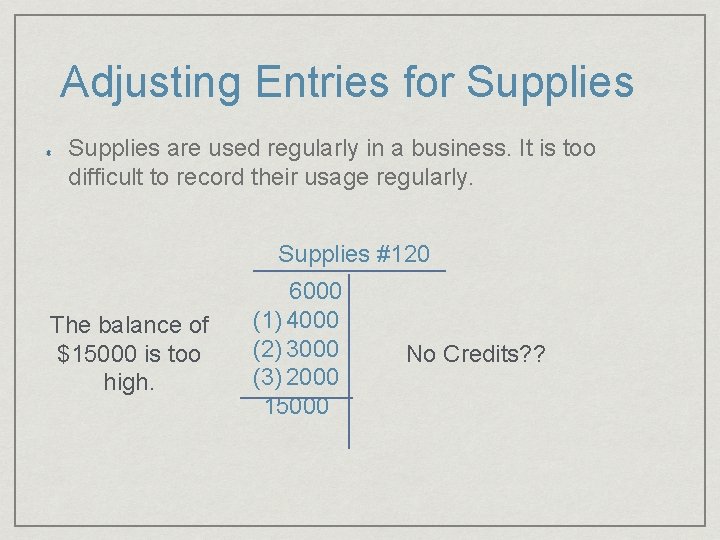
Adjusting Entries for Supplies are used regularly in a business. It is too difficult to record their usage regularly. Supplies #120 The balance of $15000 is too high. 6000 (1) 4000 (2) 3000 (3) 2000 15000 No Credits? ?
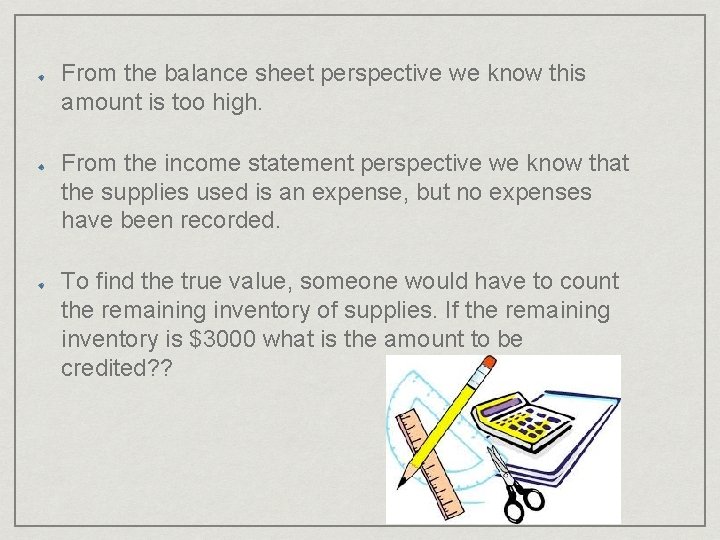
From the balance sheet perspective we know this amount is too high. From the income statement perspective we know that the supplies used is an expense, but no expenses have been recorded. To find the true value, someone would have to count the remaining inventory of supplies. If the remaining inventory is $3000 what is the amount to be credited? ?
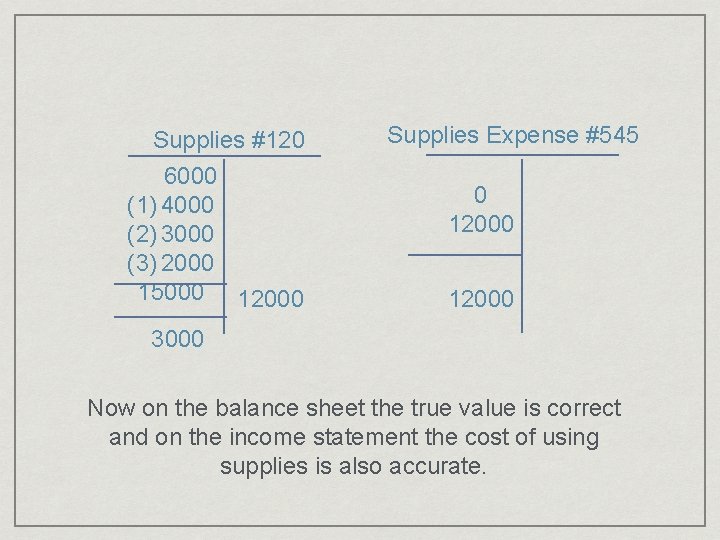
Supplies #120 6000 (1) 4000 (2) 3000 (3) 2000 15000 12000 Supplies Expense #545 0 12000 3000 Now on the balance sheet the true value is correct and on the income statement the cost of using supplies is also accurate.
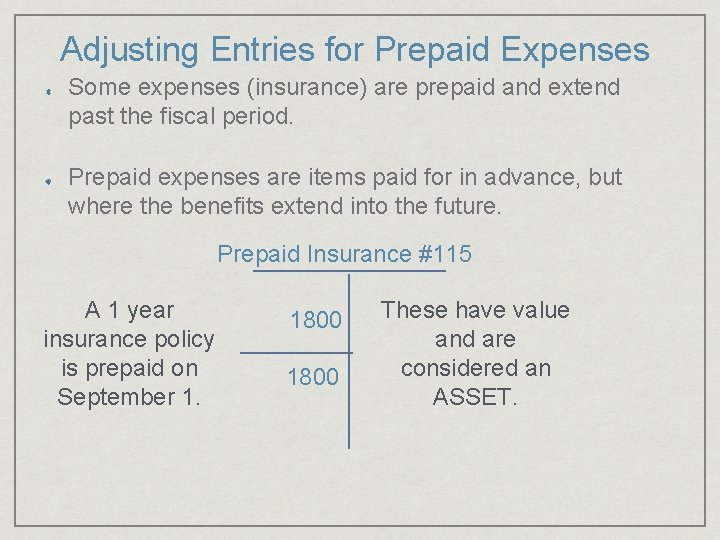
Adjusting Entries for Prepaid Expenses Some expenses (insurance) are prepaid and extend past the fiscal period. Prepaid expenses are items paid for in advance, but where the benefits extend into the future. Prepaid Insurance #115 A 1 year insurance policy is prepaid on September 1. 1800 These have value and are considered an ASSET.
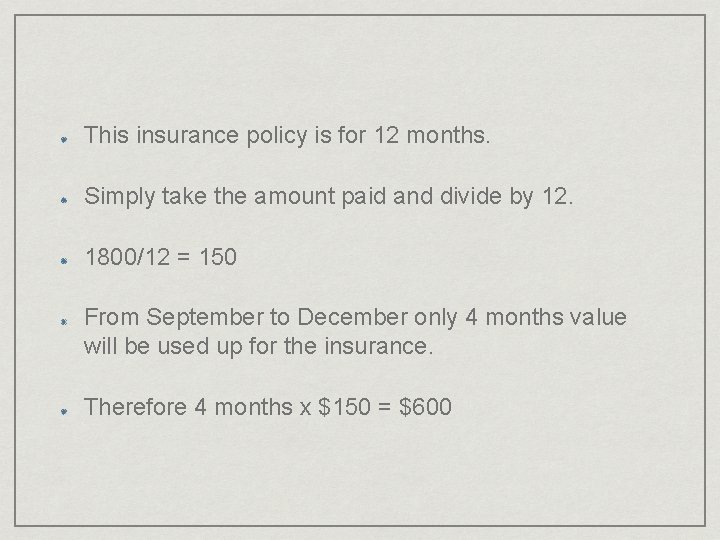
This insurance policy is for 12 months. Simply take the amount paid and divide by 12. 1800/12 = 150 From September to December only 4 months value will be used up for the insurance. Therefore 4 months x $150 = $600
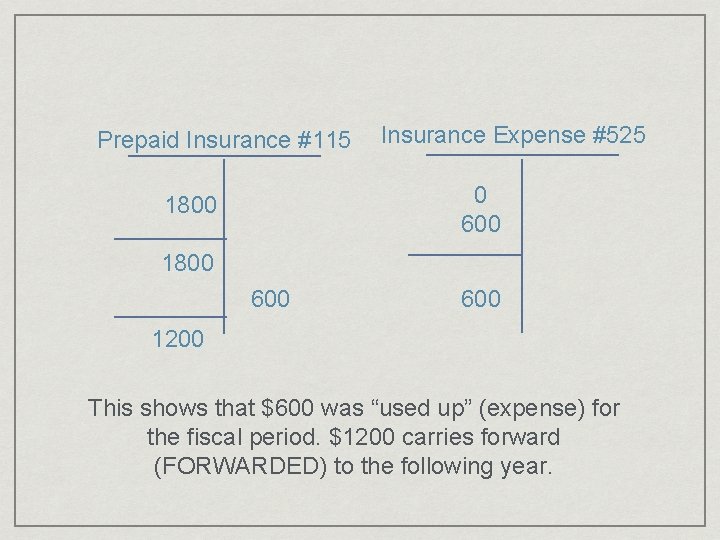
Prepaid Insurance #115 Insurance Expense #525 0 600 1800 600 1200 This shows that $600 was “used up” (expense) for the fiscal period. $1200 carries forward (FORWARDED) to the following year.
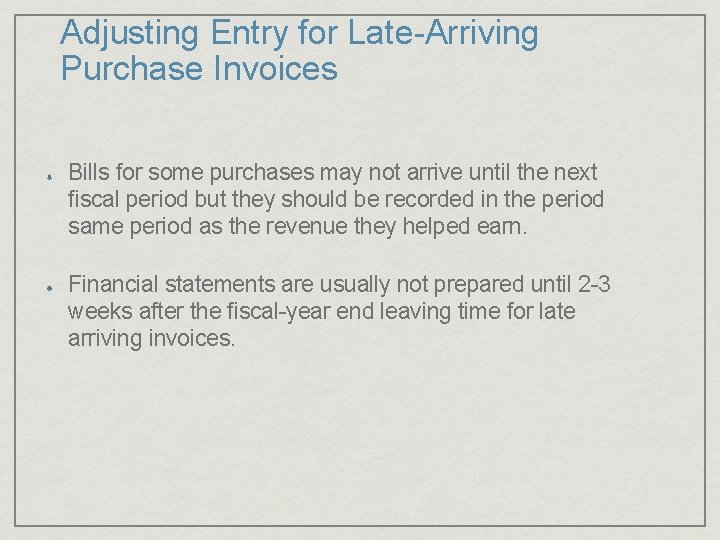
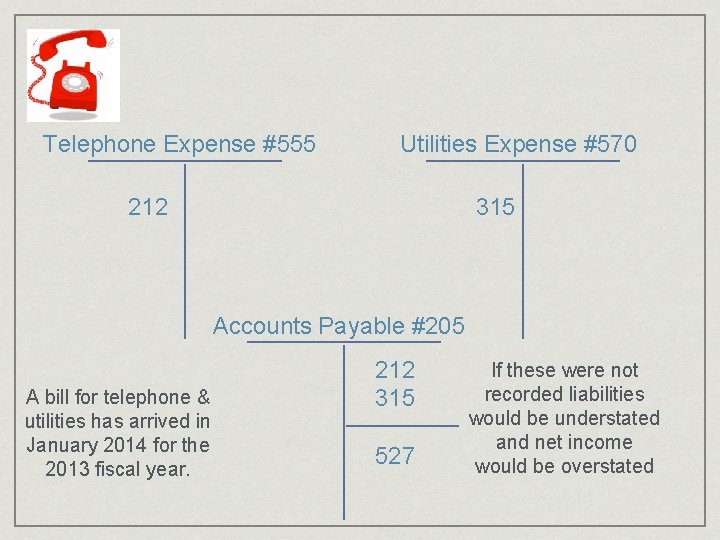
Adjusting Entry for Late-Arriving Purchase Invoices Bills for some purchases may not arrive until the next fiscal period but they should be recorded in the period same period as the revenue they helped earn. Financial statements are usually not prepared until 2 -3 weeks after the fiscal-year end leaving time for late arriving invoices.
Telephone Expense #555 Utilities Expense #570 212 315 Accounts Payable #205 A bill for telephone & utilities has arrived in January 2014 for the 2013 fiscal year. 212 315 527 If these were not recorded liabilities would be understated and net income would be overstated
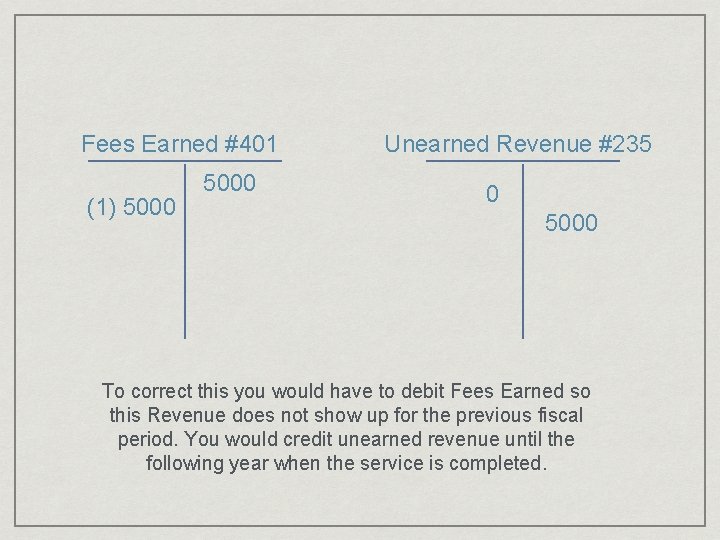
Adjusting Entry for Unearned Revenue Sometimes you may be paid in advance for a service you will be completing later. If you are paid $5000 for work to be completed in January you would debit Bank and credit Fees Earned. However, this violates the revenue recognition principle.
Fees Earned #401 (1) 5000 Unearned Revenue #235 0 5000 To correct this you would have to debit Fees Earned so this Revenue does not show up for the previous fiscal period. You would credit unearned revenue until the following year when the service is completed.
Adjusting Entries in the Journal All the entries that were adjusted are recorded as journal entries on page 275 of your textbook.
Adjusting Entries and the Work Sheet 8. 2
Adjusting Entries and the Sheet Work ➢ The first place that adjusting entries are recorded is on the work sheet. ➢ As the work sheet is prepared, adjusting entries are calculated and recorded in a section headed Adjustments. 20
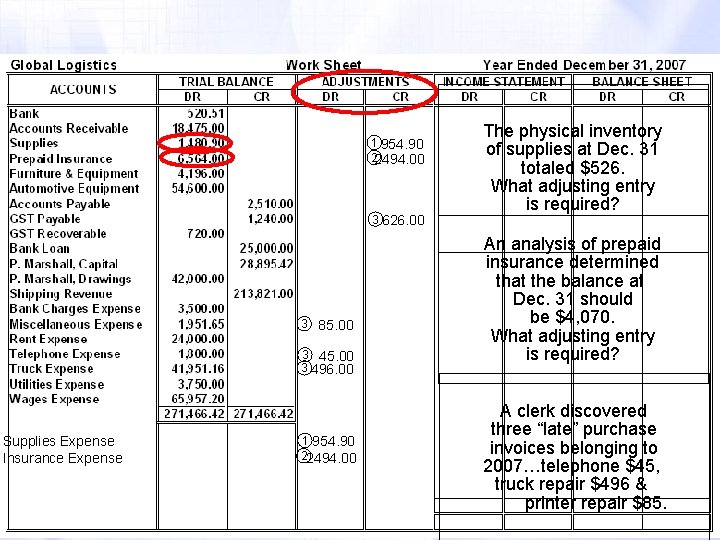
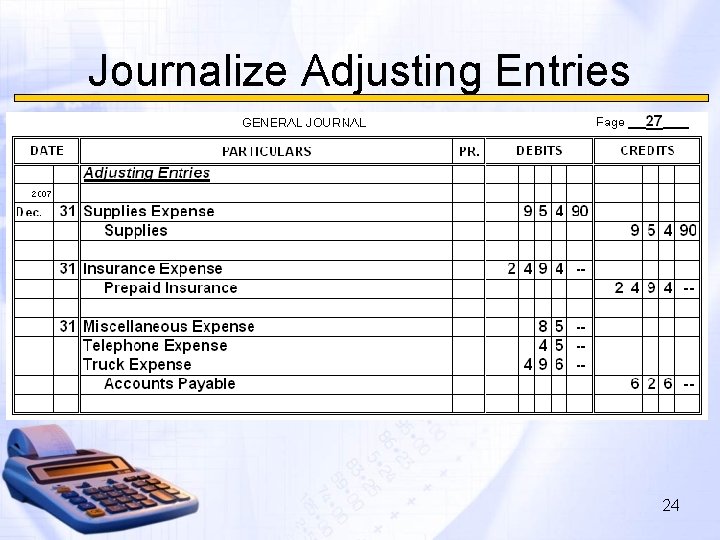
1 954. 90 22494. 00 3 626. 00 3 85. 00 3 496. 00 Supplies Expense Insurance Expense 1 954. 90 22494. 00 The physical inventory of supplies at Dec. 31 totaled $526. What adjusting entry is required? An analysis of prepaid insurance determined that the balance at Dec. 31 should be $4, 070. What adjusting entry is required? A clerk discovered three “late” purchase invoices belonging to 2007…telephone $45, truck repair $496 & printer repair $85.
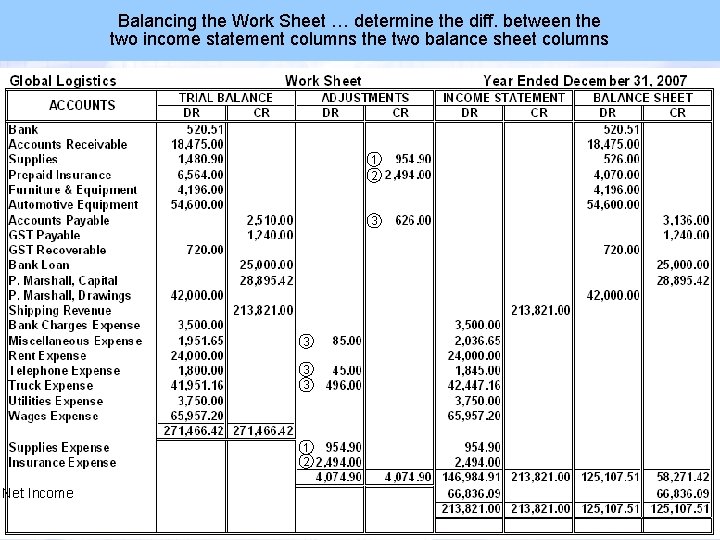
Extending Balancingthe the. Work Balancing Sheetthe … … determine add Workor. Sheet subtract the …diff. thebetween adjustments the Balance the Adjustments Columns. twofrom income the trial statement total balance each columns and of the record last the four two in the balance columns last four sheet columns 1 2 3 3 1 2 Net Income 526. 00 4, 070. 00 3, 136. 00
Journalize Adjusting Entries ➢ So far, the adjusting entries have been recorded only on the work sheet ➢ Once the work sheet is complete / balanced, the adjusting entries must be recorded in the books of accounts. ➢ Journalize and post all entries that appear in the adjustments section of the work sheet. 23
Journalize Adjusting Entries 24
Closing Entries 8. 3
Closing Entries Concepts ➢ The Time Period Concept states that financial reporting, or net income in particular, is done in equal period of time. ➢ After you do your adjusting entries and prepare your formal income statements, the accounts must be made ready for the next accounting cycle. 27
Closing Entries Concepts ➢ Determine which accounts have balances that continue from one period to the next and which do not. ➢ There are two types of accounts … real accounts and nominal accounts ➢ All asset and liability accounts, as well as the owner’s capital account, are considered to be real accounts 28
Closing Entries Concepts ➢ Real accounts have balances that continue into the next fiscal period. ➢ Nominal accounts (revenue, expense and drawings accounts) have balances that do not continue into the next fiscal period. ➢ Nominal accounts, accounts with the exception of drawings, are related to the income statement. 29
Closing Entries Concepts ➢ A special nominal account, called the Income Summary account, account is used only during the closing entry process. ➢ Once the income statement for a period has been completed, the balances in the nominal accounts are no longer useful … their balance must be taken to zero in preparation for the next accounting cycle. 30
Closing Entries Concepts ➢ Closing an account means to cause it to have no balance. ➢ Any changes in equity during the period are contained in the Revenue, Expense, and Drawings accounts. ➢ Closing these nominal accounts moves the values collected in these accounts into the one real equity account, the Capital account. 31
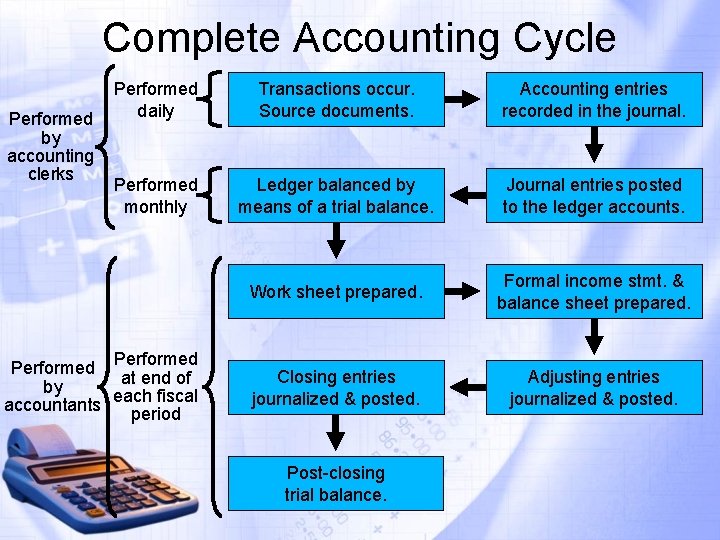
Complete Accounting Cycle Performed by accounting clerks Performed daily Transactions occur. Source documents. Accounting entries recorded in the journal. Performed monthly Ledger balanced by means of a trial balance. Journal entries posted to the ledger accounts. Work sheet prepared. Formal income stmt. & balance sheet prepared. Closing entries journalized & posted. Adjusting entries journalized & posted. Performed at end of by each fiscal accountants period Post-closing trial balance.
Journalizing and Posting the Closing Entries
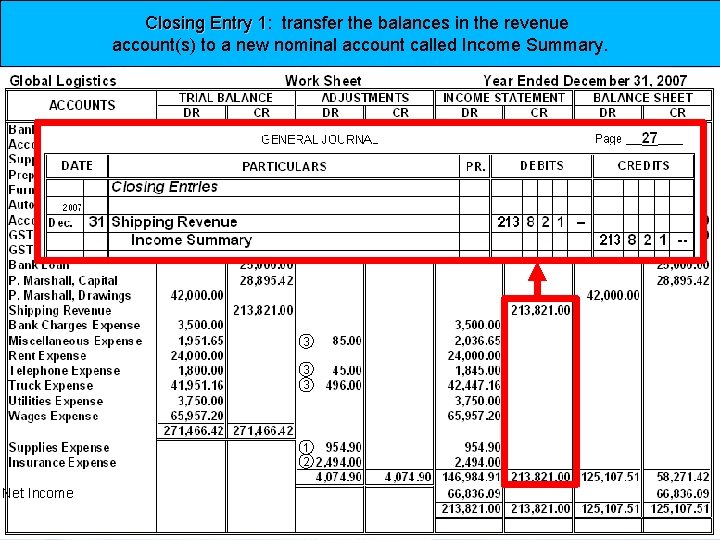
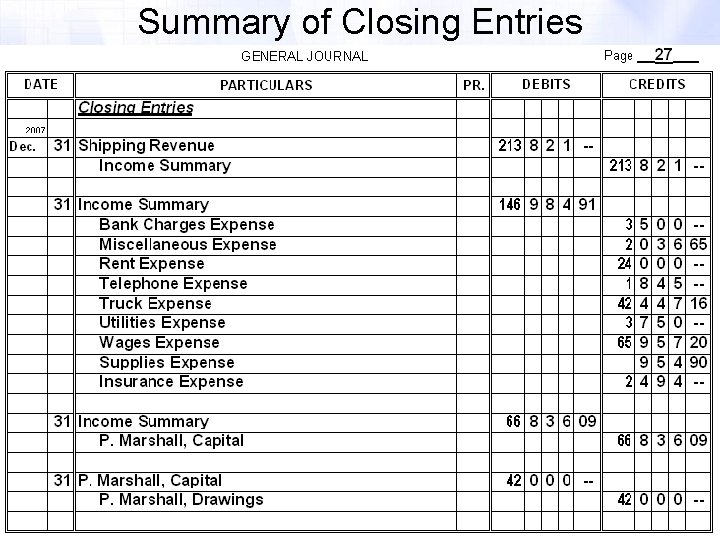
Closing Entry 1: 1 transfer the balances in the revenue account(s) to a new nominal account called Income Summary. 1 2 3 3 1 2 Net Income
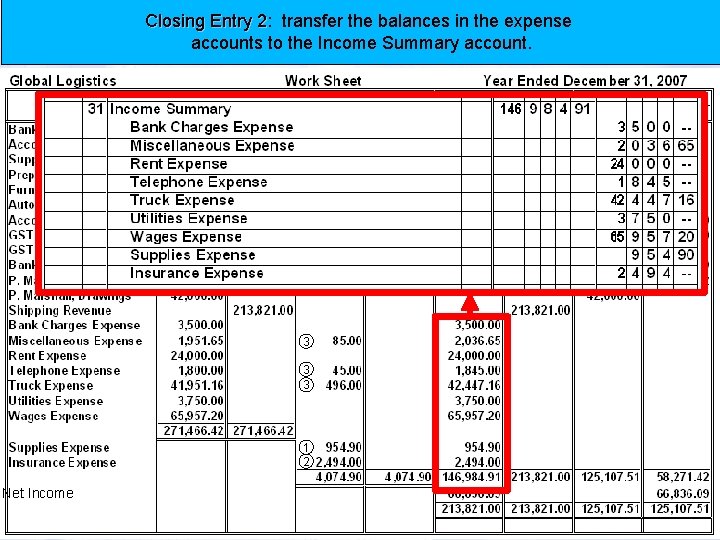
Closing Entry 2: 2 transfer the balances in the expense accounts to the Income Summary account. 1 2 3 3 1 2 Net Income
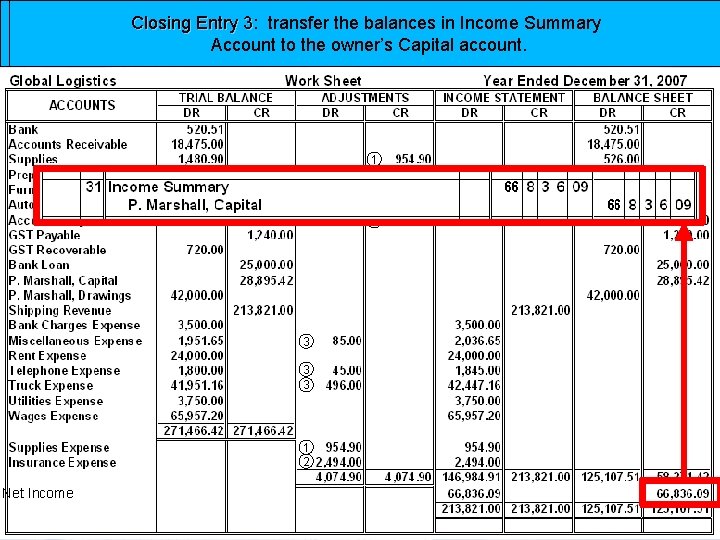
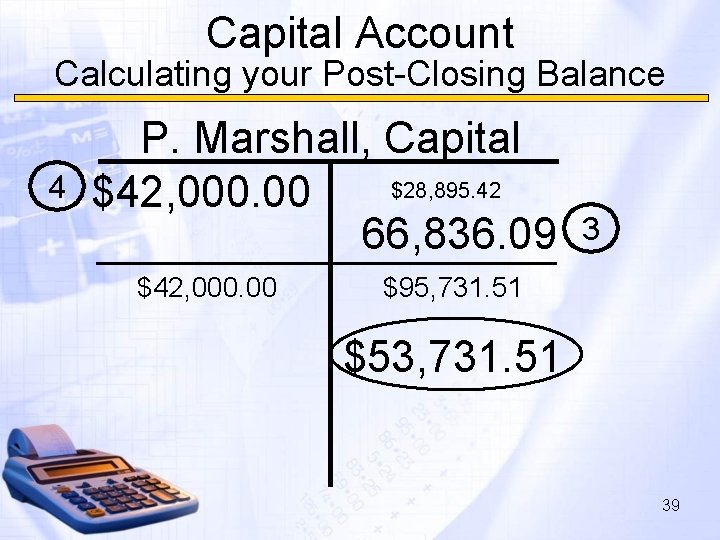
Closing Entry 3: 3 transfer the balances in Income Summary Account to the owner’s Capital account. 1 2 3 3 1 2 Net Income
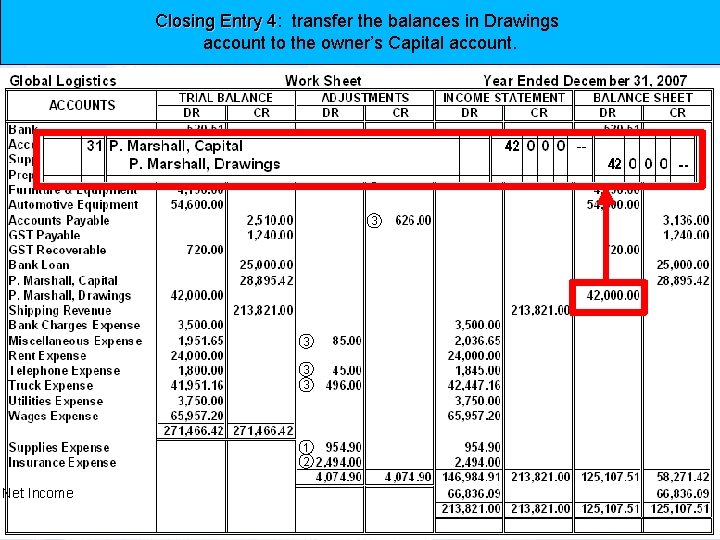
Closing Entry 4: 4 transfer the balances in Drawings account to the owner’s Capital account. 1 2 3 3 1 2 Net Income
Summary of Closing Entries
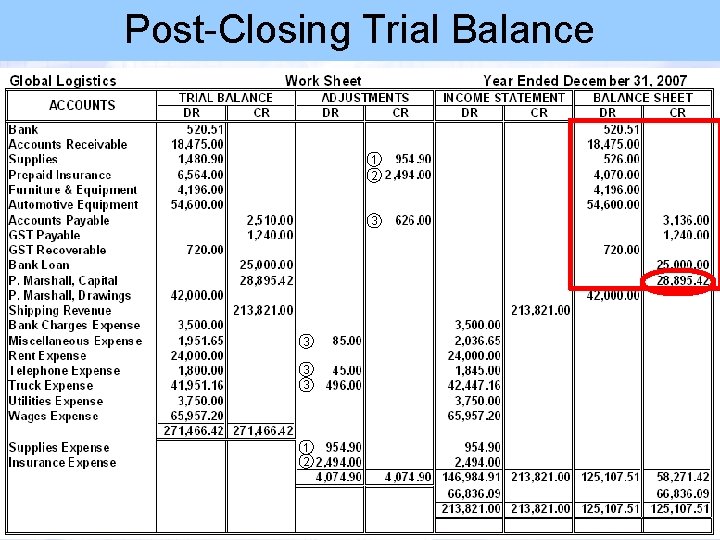
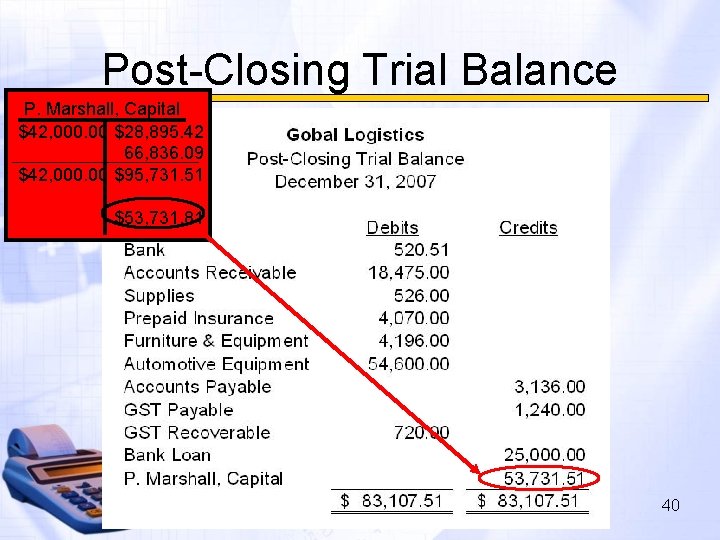
Post-Closing Trial Balance - Lastly, a post-closing trial balance is completed to check the accuracy of the ledger. - On page 290 of your textbook you will see that the nominal accounts have zero balances after taking off the post-closing trial balance.
Post-Closing Trial Balance Extending the Work Balancing Sheet the … add Workor. Sheet subtract … the adjustments Balance the Columns. from the trialtotal balance each. Adjustments and of the record last four in the columns last four columns. 1 2 3 3 1 2 526. 00 4, 070. 00 3, 136. 00
Capital Account Calculating your Post-Closing Balance 4 P. Marshall, Capital $28, 895. 42 $42, 000. 00 66, 836. 09 $42, 000. 00 3 $95, 731. 51 $53, 731. 51 39
Post-Closing Trial Balance P. Marshall, Capital $42, 000. 00 $28, 895. 42 66, 836. 09 $42, 000. 00 $95, 731. 51 $53, 731. 81 40
Adjusting for Depreciation 8. 4
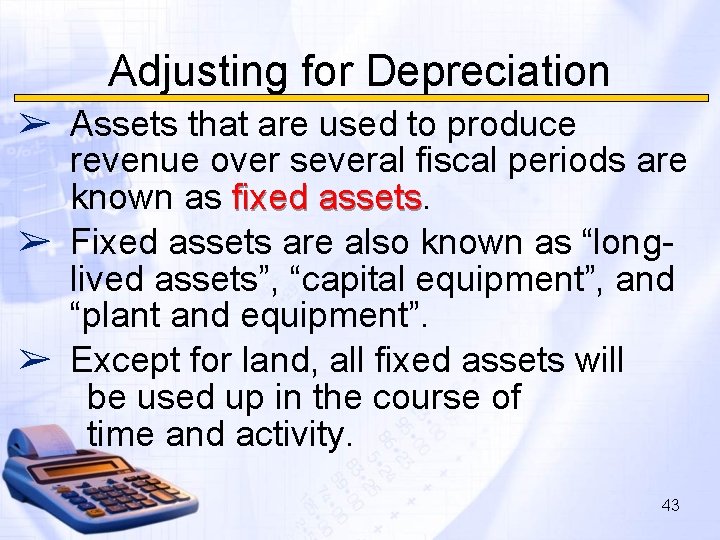
Adjusting for Depreciation ➢ Assets that are used to produce revenue over several fiscal periods are known as fixed assets ➢ Fixed assets are also known as “longlived assets”, “capital equipment”, and “plant and equipment”. ➢ Except for land, all fixed assets will be used up in the course of time and activity. 43
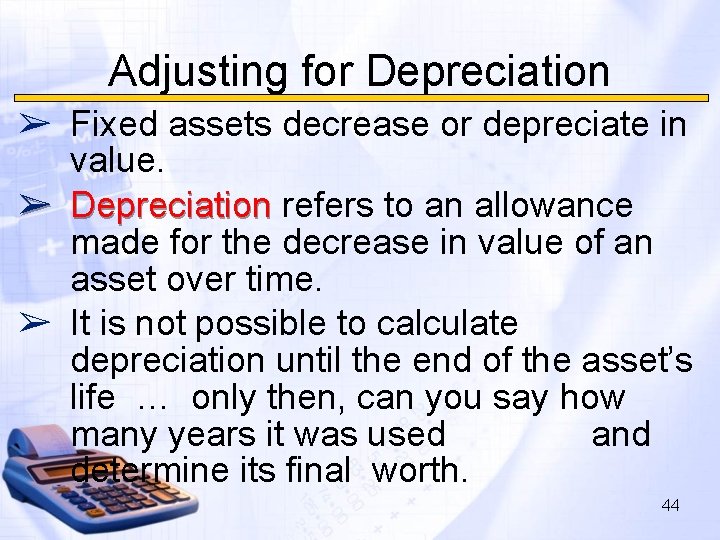
Adjusting for Depreciation ➢ Fixed assets decrease or depreciate in value. ➢ Depreciation refers to an allowance made for the decrease in value of an asset over time. ➢ It is not possible to calculate depreciation until the end of the asset’s life … only then, can you say how many years it was used and determine its final worth. 44
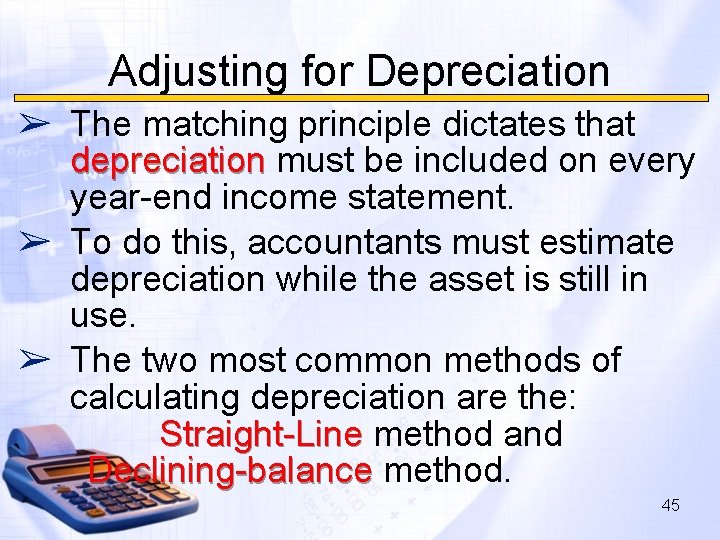
Adjusting for Depreciation ➢ The matching principle dictates that depreciation must be included on every year-end income statement. ➢ To do this, accountants must estimate depreciation while the asset is still in use. ➢ The two most common methods of calculating depreciation are the: Straight-Line method and Declining-balance method. 45
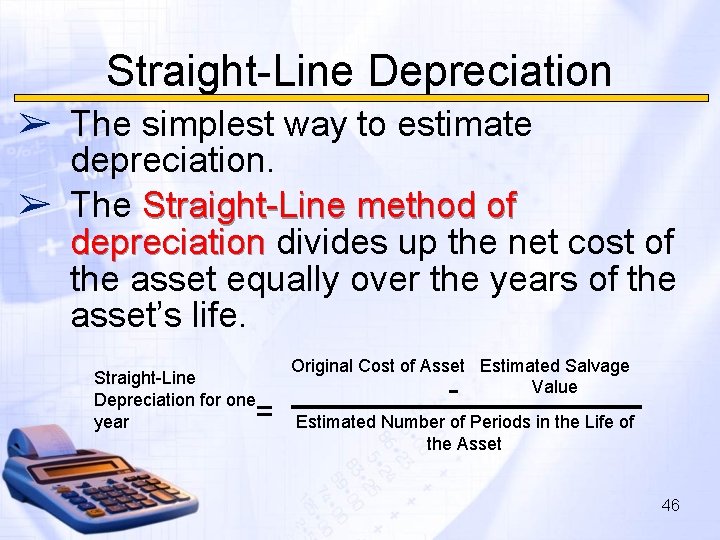
Straight-Line Depreciation ➢ The simplest way to estimate depreciation. ➢ The Straight-Line method of depreciation divides up the net cost of the asset equally over the years of the asset’s life. Straight-Line Depreciation for one year = Original Cost of Asset Estimated Salvage Value - Estimated Number of Periods in the Life of the Asset 46
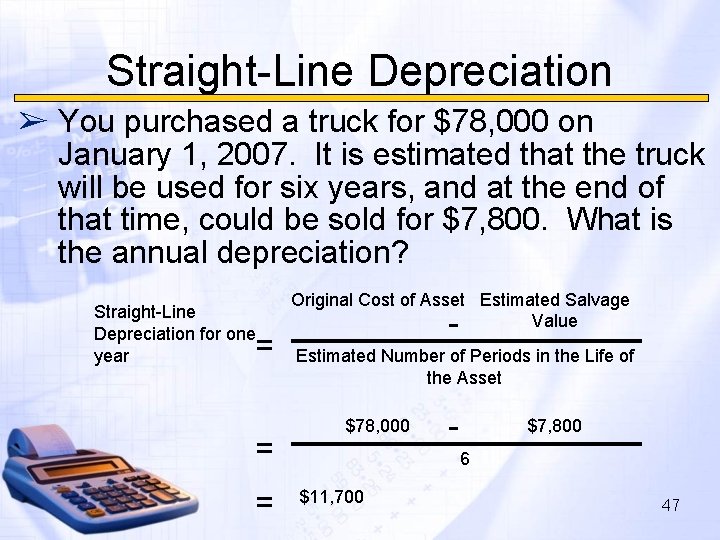
Straight-Line Depreciation ➢ You purchased a truck for $78, 000 on January 1, 2007. It is estimated that the truck will be used for six years, and at the end of that time, could be sold for $7, 800. What is the annual depreciation? Straight-Line Depreciation for one year = = = Original Cost of Asset Estimated Salvage Value - Estimated Number of Periods in the Life of the Asset $78, 000 - $7, 800 6 $11, 700 47
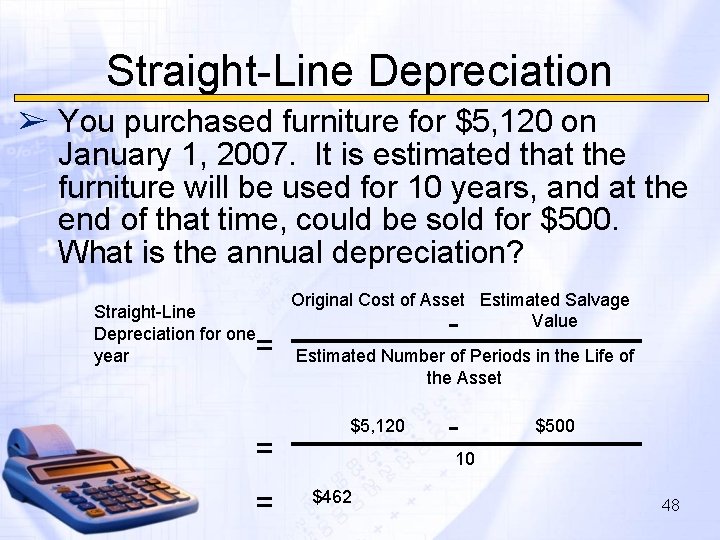
Straight-Line Depreciation ➢ You purchased furniture for $5, 120 on January 1, 2007. It is estimated that the furniture will be used for 10 years, and at the end of that time, could be sold for $500. What is the annual depreciation? Straight-Line Depreciation for one year = = = Original Cost of Asset Estimated Salvage Value - Estimated Number of Periods in the Life of the Asset $5, 120 - $500 10 $462 48
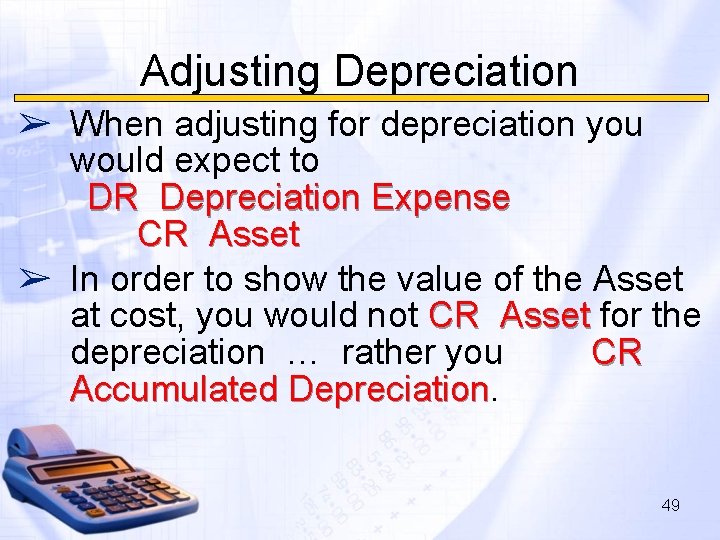
Adjusting Depreciation ➢ When adjusting for depreciation you would expect to DR Depreciation Expense CR Asset ➢ In order to show the value of the Asset at cost, you would not CR Asset for the depreciation … rather you CR Accumulated Depreciation 49
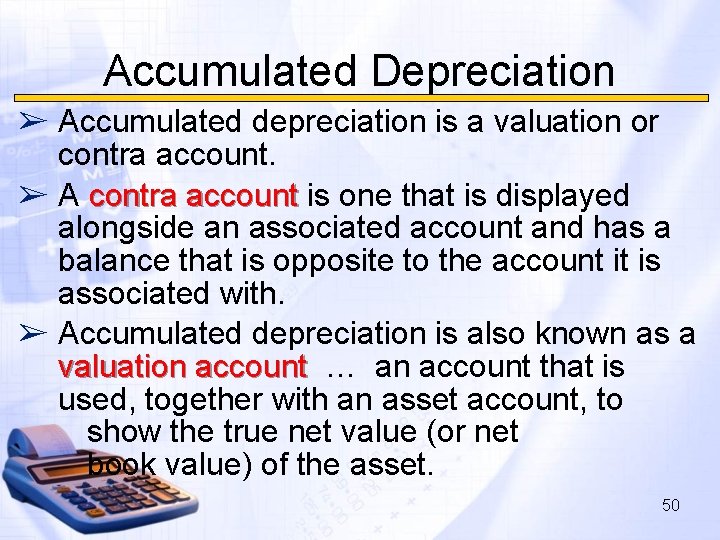
Accumulated Depreciation ➢ Accumulated depreciation is a valuation or contra account. ➢ A contra account is one that is displayed alongside an associated account and has a balance that is opposite to the account it is associated with. ➢ Accumulated depreciation is also known as a valuation account … an account that is used, together with an asset account, to show the true net value (or net book value) of the asset. 50
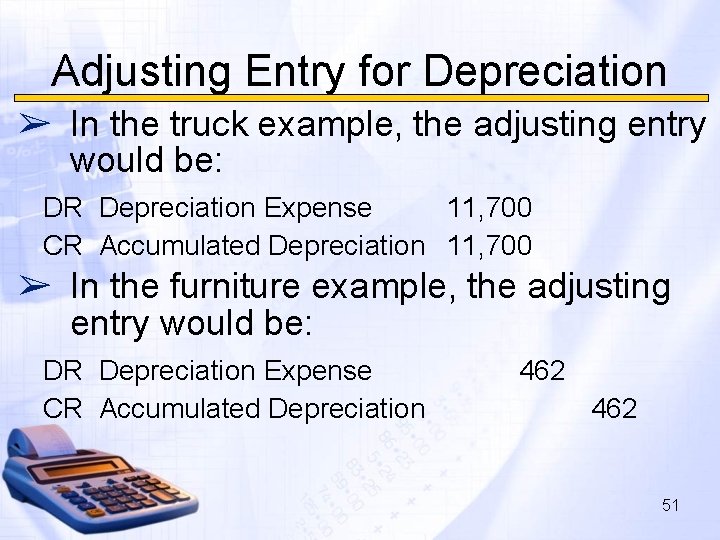
Adjusting Entry for Depreciation ➢ In the truck example, the adjusting entry would be: DR Depreciation Expense 11, 700 CR Accumulated Depreciation 11, 700 ➢ In the furniture example, the adjusting entry would be: DR Depreciation Expense CR Accumulated Depreciation 462 51
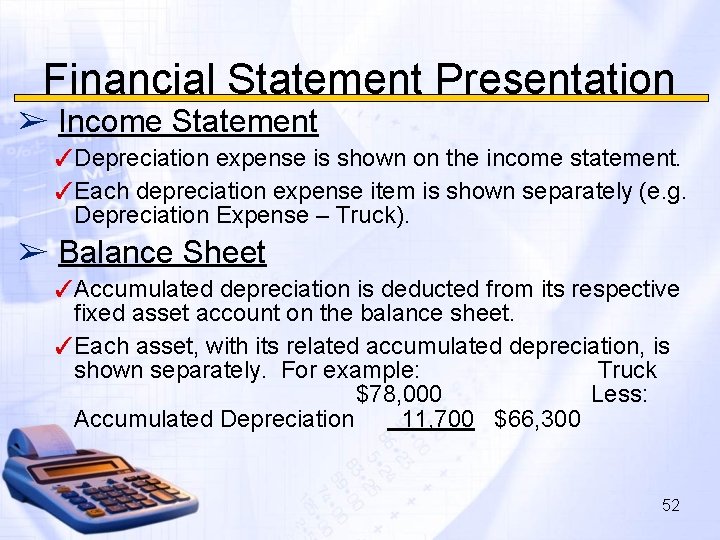
Financial Statement Presentation ➢ Income Statement ✓Depreciation expense is shown on the income statement. ✓Each depreciation expense item is shown separately (e. g. Depreciation Expense – Truck). ➢ Balance Sheet ✓Accumulated depreciation is deducted from its respective fixed asset account on the balance sheet. ✓Each asset, with its related accumulated depreciation, is shown separately. For example: Truck $78, 000 Less: Accumulated Depreciation 11, 700 $66, 300 52
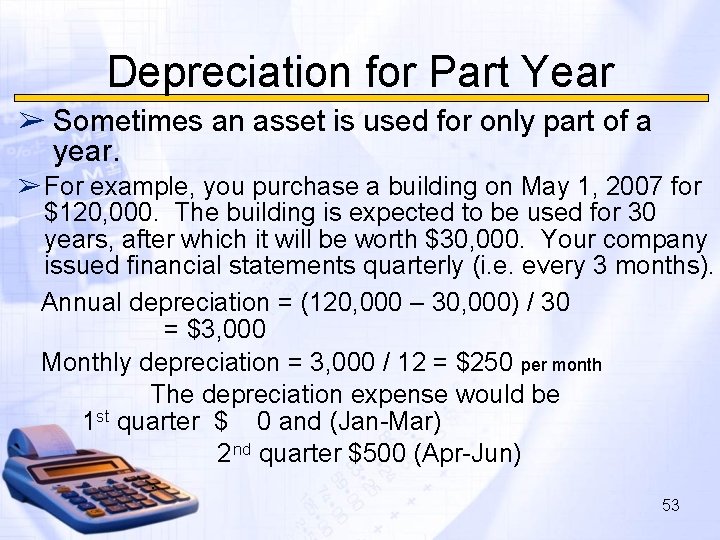
Depreciation for Part Year ➢ Sometimes an asset is used for only part of a year. ➢ For example, you purchase a building on May 1, 2007 for $120, 000. The building is expected to be used for 30 years, after which it will be worth $30, 000. Your company issued financial statements quarterly (i. e. every 3 months). Annual depreciation = (120, 000 – 30, 000) / 30 = $3, 000 Monthly depreciation = 3, 000 / 12 = $250 per month The depreciation expense would be 1 st quarter $ 0 and (Jan-Mar) 2 nd quarter $500 (Apr-Jun). 53
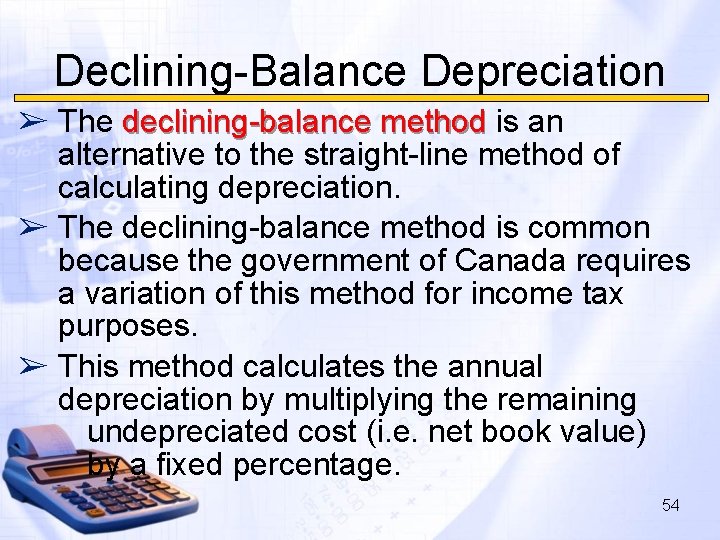
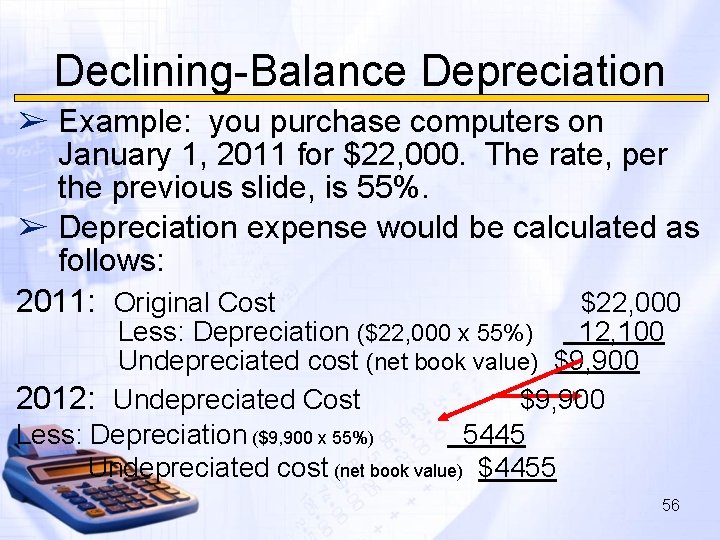
Declining-Balance Depreciation ➢ The declining-balance method is an alternative to the straight-line method of calculating depreciation. ➢ The declining-balance method is common because the government of Canada requires a variation of this method for income tax purposes. ➢ This method calculates the annual depreciation by multiplying the remaining undepreciated cost (i. e. net book value) by a fixed percentage. 54
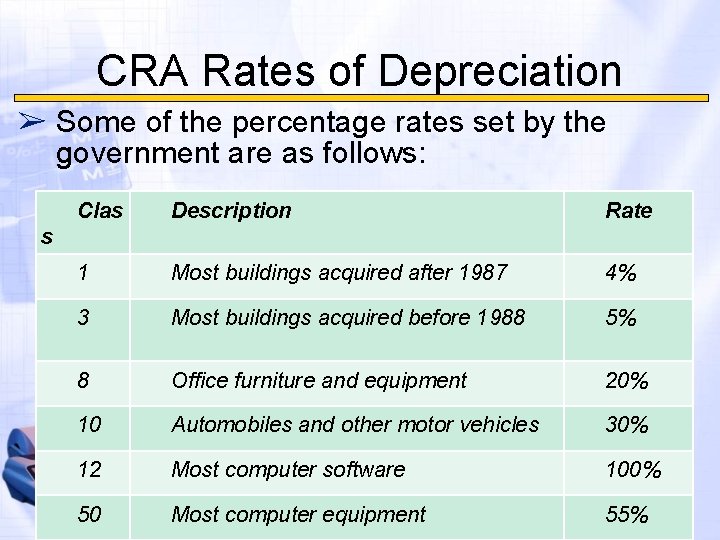
CRA Rates of Depreciation ➢ Some of the percentage rates set by the government are as follows: Clas Description Rate 1 Most buildings acquired after 1987 4% 3 Most buildings acquired before 1988 5% 8 Office furniture and equipment 20% 10 Automobiles and other motor vehicles 30% 12 Most computer software 100% 50 Most computer equipment 55% s 55
Declining-Balance Depreciation ➢ Example: you purchase computers on January 1, 2011 for $22, 000. The rate, per the previous slide, is 55%. ➢ Depreciation expense would be calculated as follows: 2011: Original Cost $22, 000 Less: Depreciation ($22, 000 x 55%) 12, 100 Undepreciated cost (net book value) $9, 900 2012: Undepreciated Cost $9, 900 Less: Depreciation ($9, 900 x 55%) 5445 Undepreciated cost (net book value) $4455 56
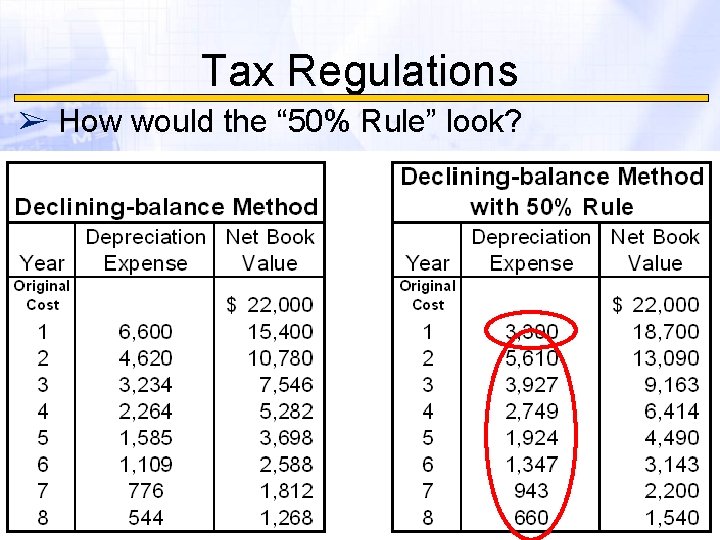
Tax Regulations ➢ Canada Customs and Revenue Agency (CCRA) requires businesses to use the declining-balance method when calculating depreciation for tax purposes. ➢ In addition, the CCRA generally allows 50% of the asset’s cost to be eligible for depreciation in its first year of use … regardless of the month it was purchased. ➢ The CCRA refers to this as the “ 50% Rule” 59
Tax Regulations ➢ How would the “ 50% Rule” look? 60
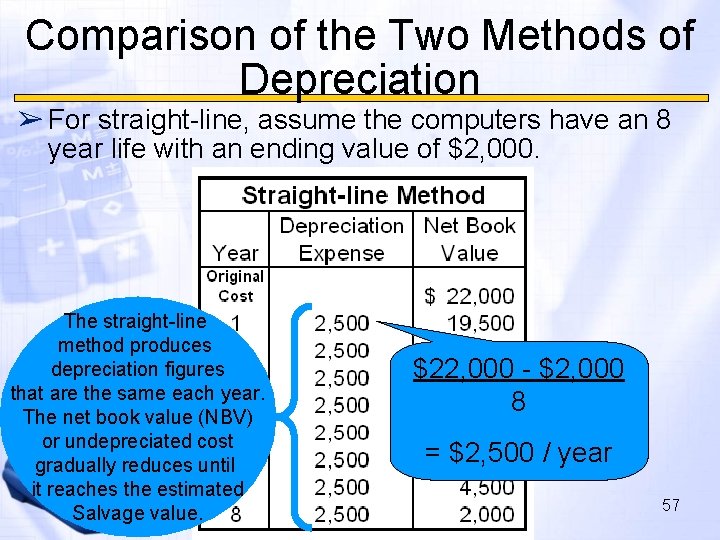
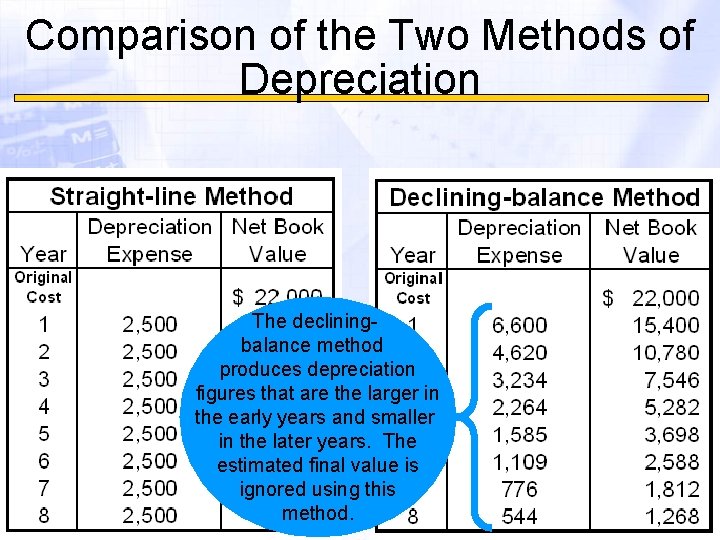
Comparison of the Two Methods of Depreciation ➢ For straight-line, assume the computers have an 8 year life with an ending value of $2, 000. The straight-line method produces depreciation figures that are the same each year. The net book value (NBV) or undepreciated cost gradually reduces until it reaches the estimated Salvage value. $22, 000 - $2, 000 8 = $2, 500 / year 57
Comparison of the Two Methods of Depreciation The decliningbalance method produces depreciation figures that are the larger in the early years and smaller in the later years. The estimated final value is ignored using this method. 58