
The Ad Hoc Committee on Budgeting Process Informational
The Ad Hoc Committee on Budgeting Process Informational Session – Responsibility Center Management March 18, 2015
Dr. Larry Calhoun, Dean, College of Pharmacy, Chair Dr. Gordon Anderson, Dean, College of Arts and Sciences Mr. James Batchelder, Assistant Dean (Fiscal Affairs), College of Clinical and Rehabilitative Health Sciences Dr. Randy Byington, Associate Professor, Allied Health Sciences Dr. Wallace Dixon, Jr, Chair and Professor, Psychology Dr. William Duncan, Vice Provost for Research, Office of Sponsored Programs Dr. Amal Khoury, Associate Dean, Quality and Planning, College of Public Health Dr. B. J. King, Senior Associate Vice-President for Finance and Administration, Office of Financial Services Dr. David Linville, Associate Dean, Graduate Medical Education, Quillen College of Medicine Ms. Raven Moody, Associate Director, Budget and Financial Planning Dr. Wendy Nehring, Dean, College of Nursing Dr. Michael Smith, Professor & Chair, Department of Social Work Dr. Randy Wykoff, Dean, College of Public Health
Agenda • Introduction – Dr. Larry Calhoun • Why RCM – How the Landscape is Changing – Dr. Randy Wykoff • Process of the Committee – Dr. David Linville • Elements of RCM – Mr. James Batchelder • Guiding Principles to this Point – Dr. Michael Smith • Open Discussion
Key Issues • Strategic Planning Budgeting • What We Didn’t Do • Importance of Site Visits to Implementation
Why Are We Considering any Changes in the Budget Model at ETSU?

Challenges we Face in 2015 and Beyond. . . • Changes in State Funding Amounts
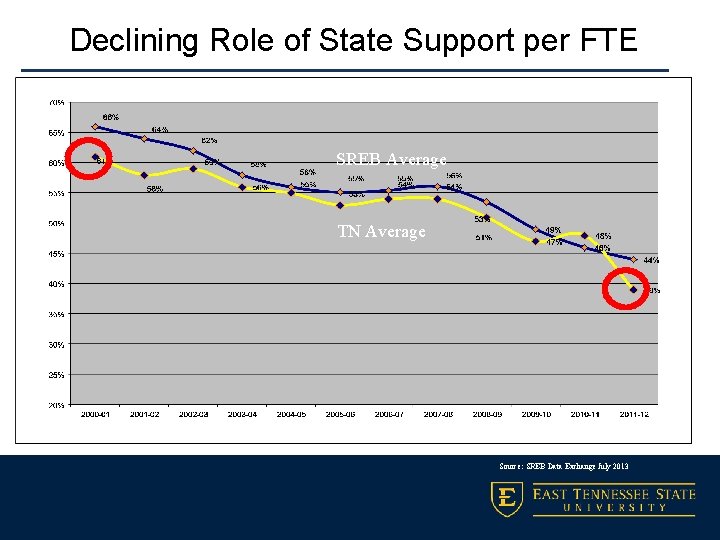
Declining Role of State Support per FTE SREB Average TN Average Source: SREB Data Exchange July 2013
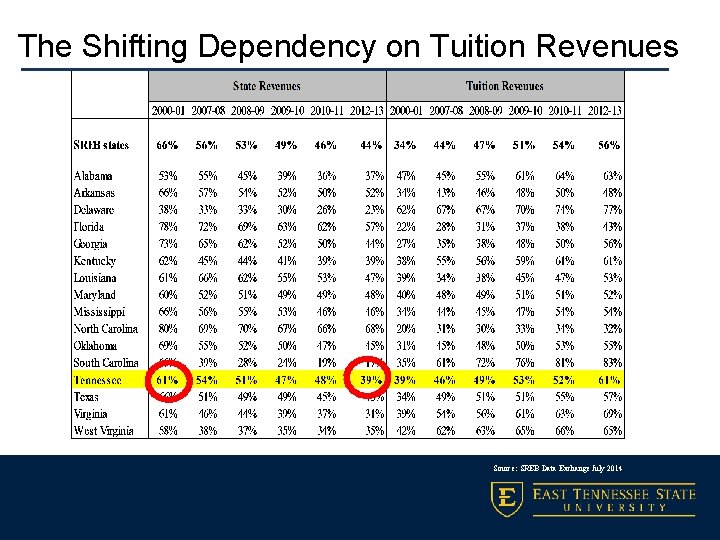
The Shifting Dependency on Tuition Revenues Source: SREB Data Exchange July 2014
Challenges we Face in 2015 and Beyond. . . • Changes in State Funding Amounts
Challenges we Face in 2015 and Beyond. . . • Changes in State Funding Amounts • Changes in State Funding Formula
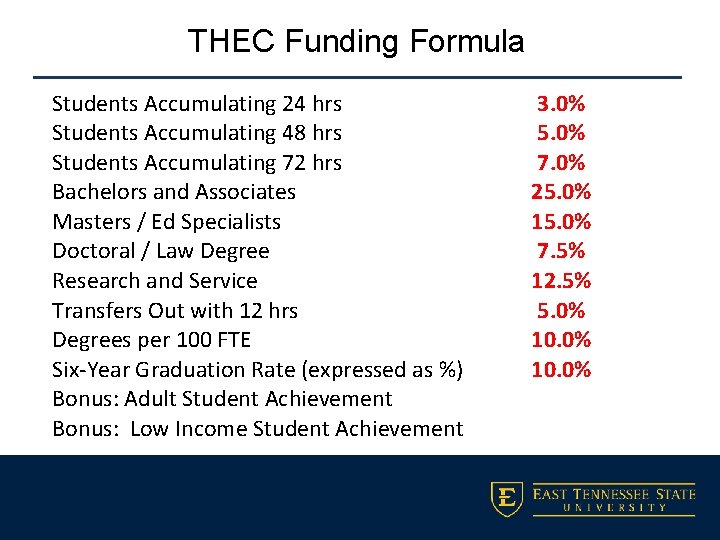
THEC Funding Formula Students Accumulating 24 hrs Students Accumulating 48 hrs Students Accumulating 72 hrs Bachelors and Associates Masters / Ed Specialists Doctoral / Law Degree Research and Service Transfers Out with 12 hrs Degrees per 100 FTE Six-Year Graduation Rate (expressed as %) Bonus: Adult Student Achievement Bonus: Low Income Student Achievement 3. 0% 5. 0% 7. 0% 25. 0% 15. 0% 7. 5% 12. 5% 5. 0% 10. 0%
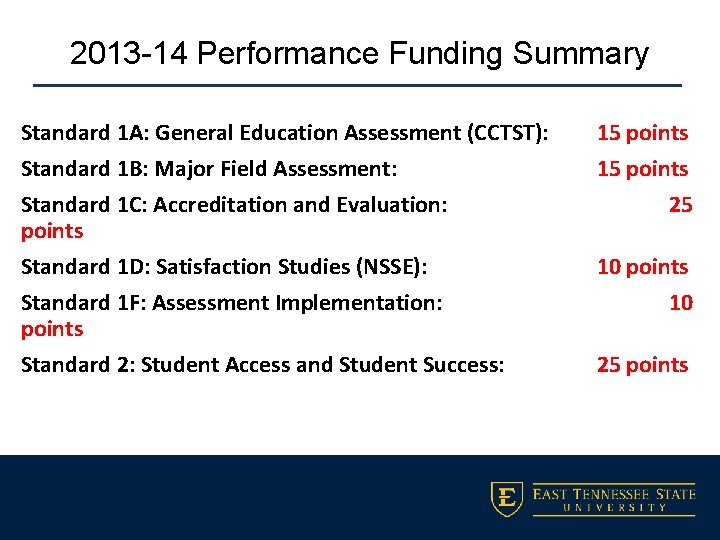
2013 -14 Performance Funding Summary Standard 1 A: General Education Assessment (CCTST): Standard 1 B: Major Field Assessment: Standard 1 C: Accreditation and Evaluation: points Standard 1 D: Satisfaction Studies (NSSE): Standard 1 F: Assessment Implementation: points Standard 2: Student Access and Student Success: 15 points 25 10 points 10 25 points
Challenges we Face in 2015 and Beyond. . . • Changes in State Funding Amounts • Changes in State Funding Formula
Challenges we Face in 2015 and Beyond. . . • Changes in State Funding Amounts • Changes in State Funding Formula • Changes in Student Numbers
Challenges we Face in 2015 and Beyond. . . • Changes in State Funding Amounts • Changes in State Funding Formula • Changes in Student Numbers • Number of High School Graduates
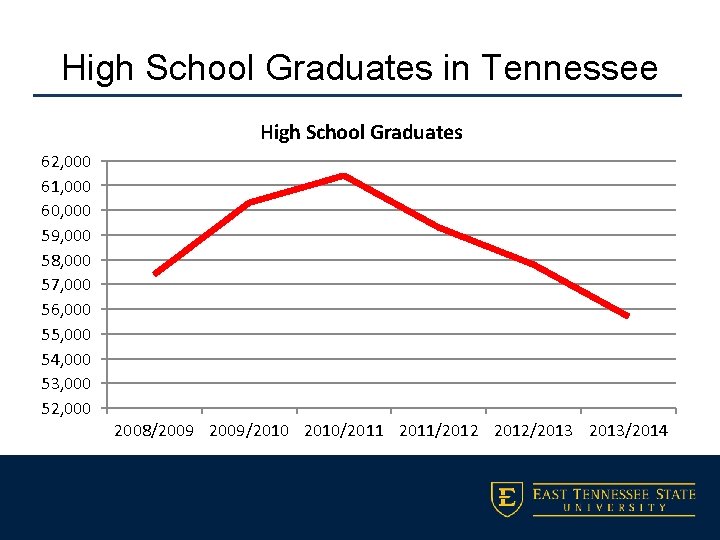
High School Graduates in Tennessee High School Graduates 62, 000 61, 000 60, 000 59, 000 58, 000 57, 000 56, 000 55, 000 54, 000 53, 000 52, 000 2008/2009/2010/2011/2012/2013/2014
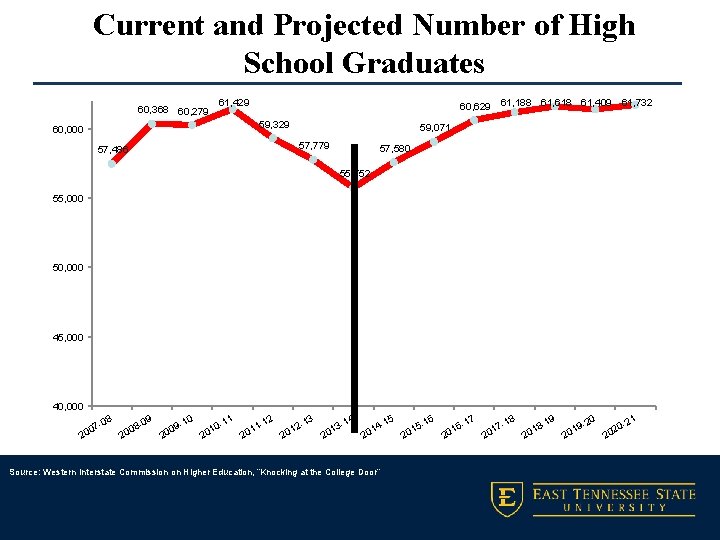
Current and Projected Number of High School Graduates 60, 368 60, 279 61, 429 60, 629 61, 188 61, 618 61, 409 61, 732 59, 329 60, 000 59, 071 57, 779 57, 486 57, 580 55, 752 55, 000 50, 000 45, 000 40, 000 -08 07 20 9 8 -0 0 20 9 -1 0 1 20 0 -1 1 2 1 -1 1 20 -13 -14 -15 -16 -17 -19 -20 -21 -18 12 13 14 15 16 18 19 20 17 0 0 0 0 0 2 2 2 2 2 Source: Western Interstate Commission on Higher Education, “Knocking at the College Door”
Challenges we Face in 2015 and Beyond. . . • Changes in State Funding Amounts • Changes in State Funding Formula • Changes in Student Numbers • Number of High School Graduates
Challenges we Face in 2015 and Beyond. . . • Changes in State Funding Amounts • Changes in State Funding Formula • Changes in Student Numbers • • Number of High School Graduates Actual enrollment
Challenges we Face in 2015 and Beyond. . . • Changes in State Funding Amounts • Changes in State Funding Formula • Changes in Student Numbers
Challenges we Face in 2015 and Beyond. . . • • Changes in State Funding Amounts Changes in State Funding Formula Changes in Student Numbers Changes in the Competitive Background
Challenges we Face in 2015 and Beyond. . . • • Changes in State Funding Amounts Changes in State Funding Formula Changes in Student Numbers Changes in the Competitive Background • Program Specific
Challenges we Face in 2015 and Beyond. . . • • Changes in State Funding Amounts Changes in State Funding Formula Changes in Student Numbers Changes in the Competitive Background • Program Specific
Challenges we Face in 2015 and Beyond. . . • • Changes in State Funding Amounts Changes in State Funding Formula Changes in Student Numbers Changes in the Competitive Background • Program Specific • Not Program Specific

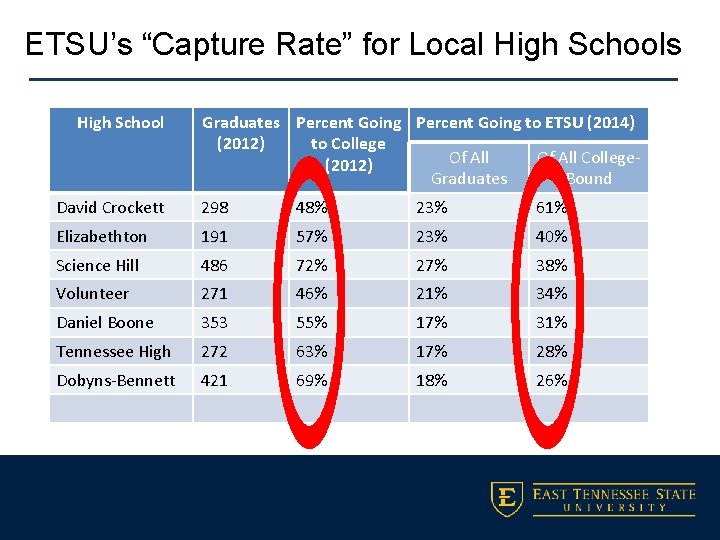
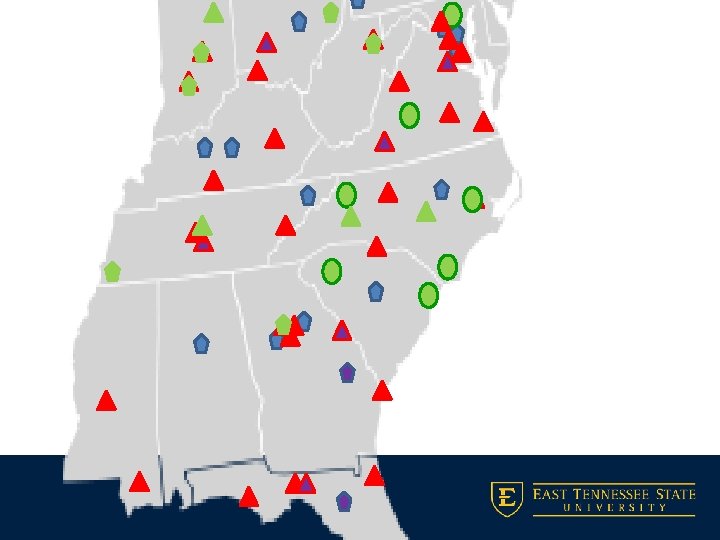
ETSU’s “Capture Rate” for Local High Schools High School Graduates Percent Going to ETSU (2014) (2012) to College Of All College(2012) Graduates Bound David Crockett 298 48% 23% 61% Elizabethton 191 57% 23% 40% Science Hill 486 72% 27% 38% Volunteer 271 46% 21% 34% Daniel Boone 353 55% 17% 31% Tennessee High 272 63% 17% 28% Dobyns-Bennett 421 69% 18% 26%

Challenges we Face in 2015 and Beyond. . . • • Changes in State Funding Amounts Changes in State Funding Formula Changes in Student Numbers Changes in the Competitive Background
Challenges we Face in 2015 and Beyond. . . • • • Changes in State Funding Amounts Changes in State Funding Formula Changes in Student Numbers Changes in the Competitive Background Limitations in the Current Budget Process
So What Do We Do About these Challenges. . . Challenges we Face in 2015 and Beyond. . . • Focus on Student Retention • Focus on Student Recruitment • Empower Colleges and Departments to be Entrepreneurial
Timeline • Ad-hoc committee convened, November 2013 • Received charge from Dr. Noland as a result of the work from the 125 Committee • Our committee has met 19 times from then until now
Committee Process • Information from consultant, rpk. GROUP • Review of ETSU’s current budget process • Review of relevant publications and examples • National webinar series on RCM • Telephone/video conferences – Indiana University – Miami University • Extensive committee discussions
Moving Forward • Committee progress reports presented at President’s leadership retreats • Today’s session • Final report to Dr. Noland
The RCM Model • RCM Model divides campus units into Revenue Centers and Cost Centers. • Revenue Centers = Colleges, Auxiliaries, or other revenue producing units. • Cost Centers = Administrative or support units which don’t produce revenue. • RCM aligns budget authority and responsibility with accountability.
The RCM Model – Revenue Centers • RCM provides incentives to Revenue Centers for increasing revenue and supports entrepreneurial efforts. • Revenue Centers own the unrestricted revenue generated from tuition, fees, charges, unrestricted grants or gifts, research dollars, etc. • Revenue Centers cover all their own direct expenses. • Revenue Centers pay a “tax” or overhead rate to support Cost Centers, mission critical high-cost or low-revenue academic programs (subvention), and institutional strategic priorities and initiatives.
The RCM Model – Cost Centers • Cost Centers are necessary to carry out the institutional mission. • Cost Centers are dependent on the Revenue Center “tax”. • RCM supports efficient, competitive administration of Cost Centers. • RCM encourages customer focused Cost Centers.

Recommendations • The implementation and on-going operation of the RCM model should be intimately tied to the comprehensive strategic planning process of the University. • Careful analysis of the experience of other institutions in the implementation of RCM should inform the process at ETSU.
Recommendations • Technical, personnel, and financial resources--especially in the service of empowering colleges and non-academic equivalents--should be developed as part of RCM implementation. This includes identifying a senior leader to be the champion for RCM at the university level.
Recommendations • There should be a variable assessment (e. g. "tax") among colleges and other revenue centers based on their unique missions. • Cost-center/centralized functions should be focused on providing those services essential to the operation of the University, and on supporting the revenue centers in their activities.
Recommendations • Responsibility Centers (e. g. , colleges and major service and administrative units) should have the flexibility to roll over unspent, net revenue. • The RCM process should be carefully and regularly evaluated, particularly in the first year, to account for unintended consequences and errors in assumptions.
Recommendations • Throughout the implementation of RCM there should be a careful communication/ education/buy-in program to ensure clarity and transparency.
Challenges • Models don’t create new $’s – only facilitate the process • Still have to build in opportunities for special situations • Education – Organization (specifically leadership at all levels) • “The Transition”
The Ad Hoc Committee on Budgeting Process Informational Session – Responsibility Center Management March 18, 2015
- Slides: 43