
The Acutely Agitated Patient Project BETA and how
The Acutely Agitated Patient (Project BETA and how it might just help you deal with patients better) Michael Wilson, MD Ph. D FAAEM University of California San Diego
A personal note… 54. 5% There are no financial relationships with any drug mentioned in this talk.

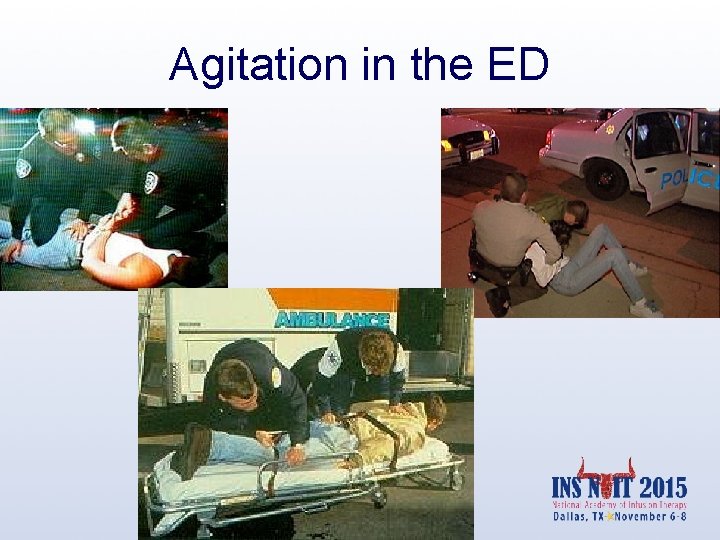
Agitation in the ED

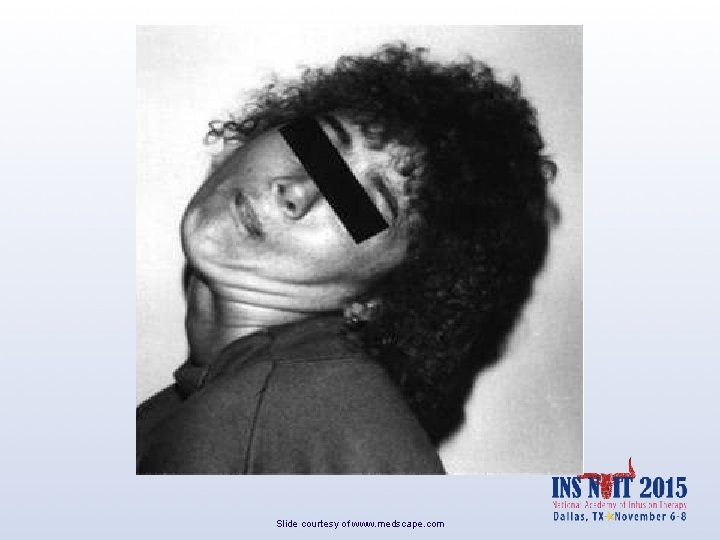
The agitation you might see…
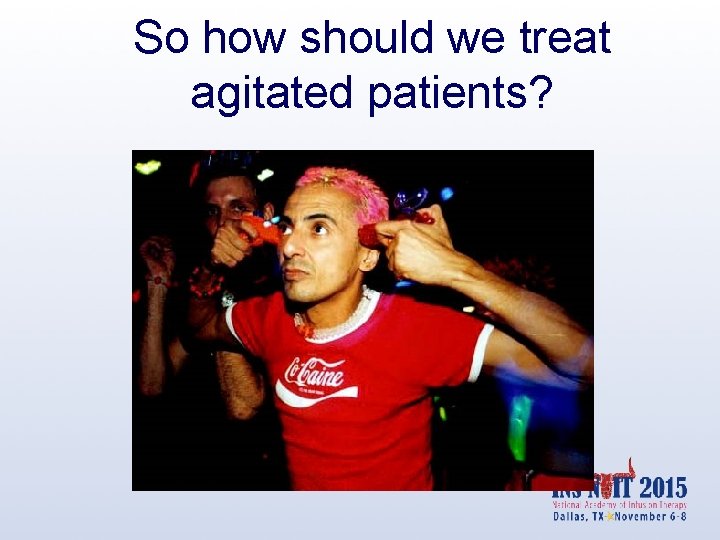
So how should we treat agitated patients?
Project BETA • In October 2010, AAEP embarked on Project BETA. – Challenge: to develop new guidelines that were effective, safety-minded, and in best interests of the patient. – Over 35 emergency psychiatrists, emergency medicine physicians, mental health clinicians, nurses, and patient advocates participated. – Mission was to develop and disseminate guidelines that represent Best practices for the Evaluation and Treatment of Agitation.

Project BETA Available for free reading/download: Through Pub. Med. Central or Bing “Agitation BETA”
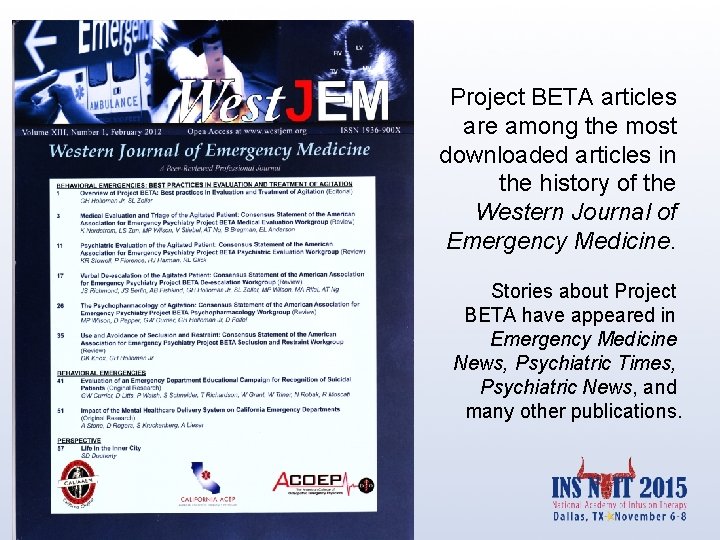
Project BETA articles are among the most downloaded articles in the history of the Western Journal of Emergency Medicine. Stories about Project BETA have appeared in Emergency Medicine News, Psychiatric Times, Psychiatric News, and many other publications.
Selected Guidelines • Use verbal de-escalation • Staff should be appropriate for the job • Oral medications instead of IM • Reduce seclusion & restraint
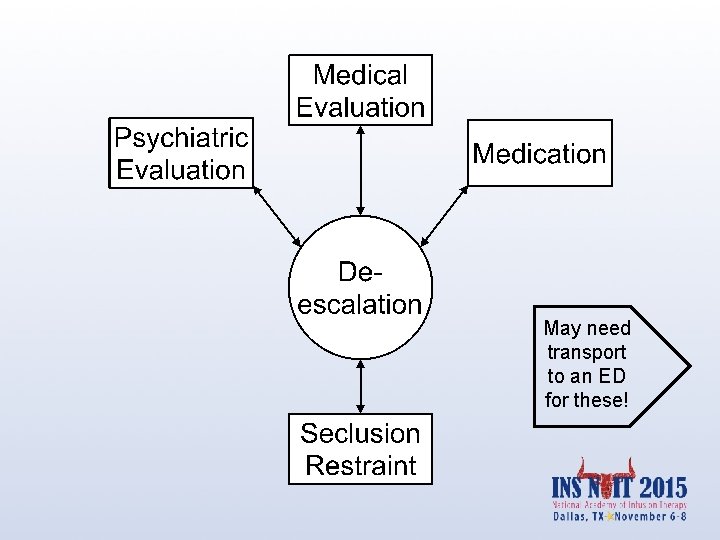
May need transport to an ED for these!
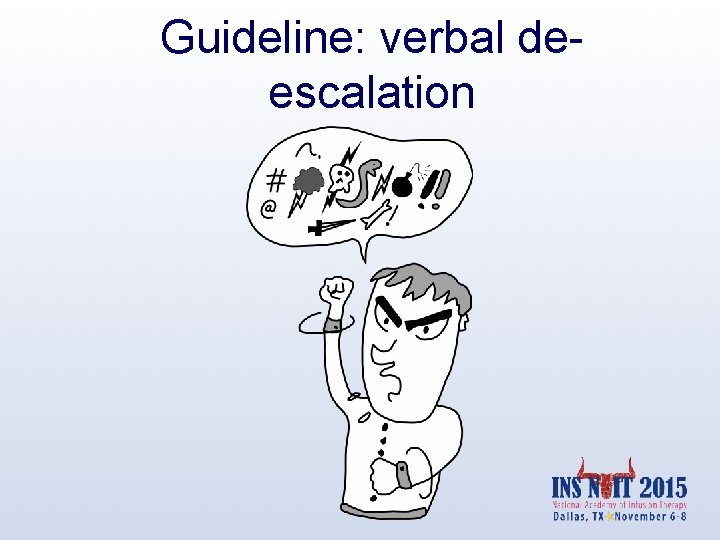
Guideline: verbal deescalation

Verbal De-escalation • Goal is to help the patient regain control – While engaging in verbal de-escalation, clinician observations & medical judgment must drive management – Successful de-escalation is the key to avoiding seclusion/restraint – Most injuries to staff occur during restraint

BETA recommendations: verbal deescalation I You shall be non-provocative: • calm demeanor, facial expression • soft-spoken with no angry tone, • empathic - genuine concern • relaxed stance- arms uncrossed. . …hands open. . knees bent II You shall respect personal space • 2 x arms length • Normal eye contact • Offer a line of egress • expand space if paranoid • Move if told to do so III You shall establish verbal contact: • tell them who you are, • establish you are keeping them safe, • you will allow them no harm • you will help them regain control • ONE COMMUNICATOR Richmond JS, et al. Verbal de-escalation of the agitated patient: Statement of the American Association for Emergency Psychiatry Project BETA de-escalation workgroup. West J Emerg Med. 2012; 13(1): 17 -25.
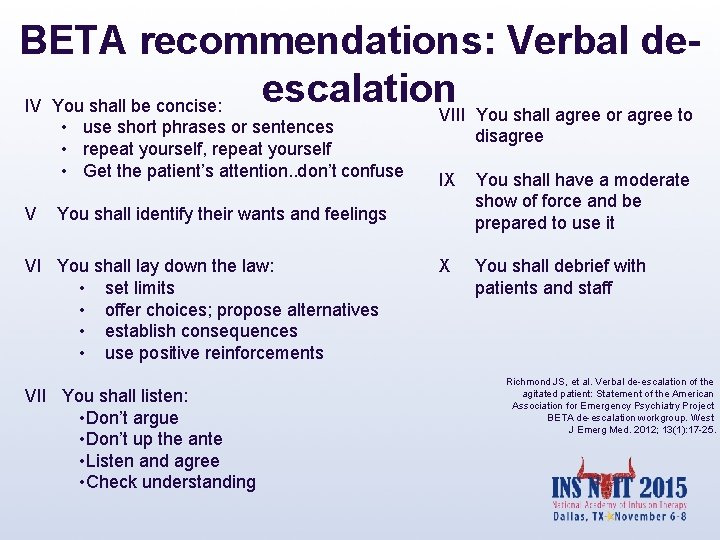
BETA recommendations: Verbal deescalation. VIII You shall agree or agree to IV You shall be concise: • use short phrases or sentences • repeat yourself, repeat yourself • Get the patient’s attention. . don’t confuse V You shall identify their wants and feelings VI You shall lay down the law: • set limits • offer choices; propose alternatives • establish consequences • use positive reinforcements VII You shall listen: • Don’t argue • Don’t up the ante • Listen and agree • Check understanding disagree IX You shall have a moderate show of force and be prepared to use it X You shall debrief with patients and staff Richmond JS, et al. Verbal de-escalation of the agitated patient: Statement of the American Association for Emergency Psychiatry Project BETA de-escalation workgroup. West J Emerg Med. 2012; 13(1): 17 -25.
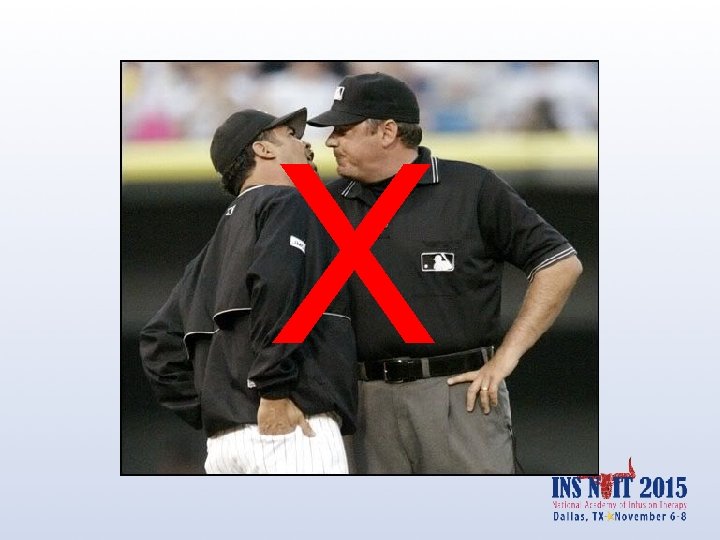
X
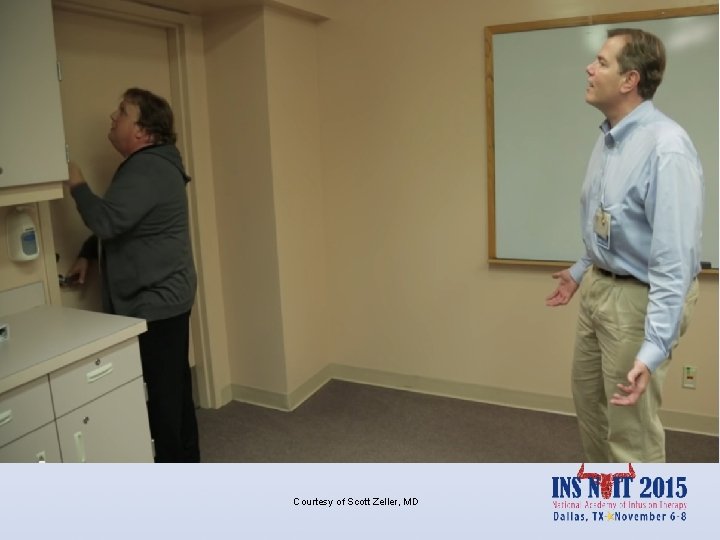
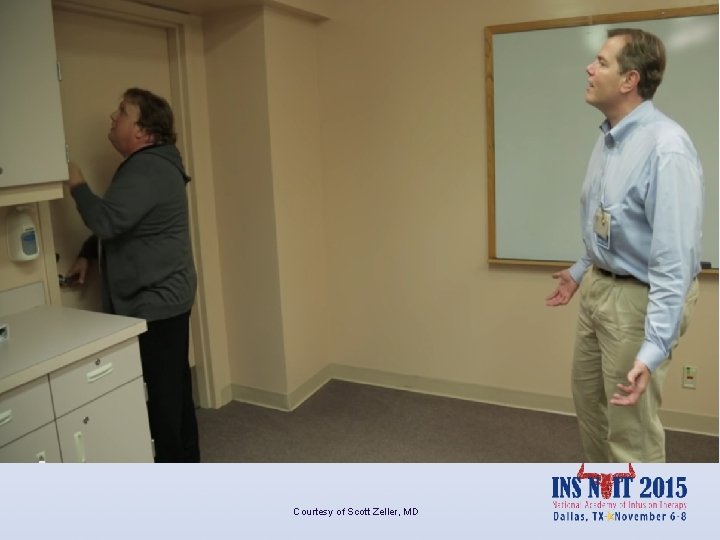
Courtesy of Scott Zeller, MD
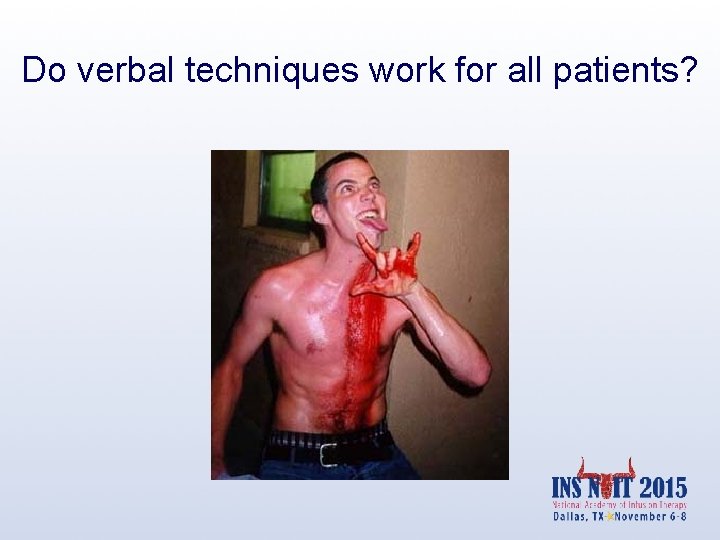
Do verbal techniques work for all patients?
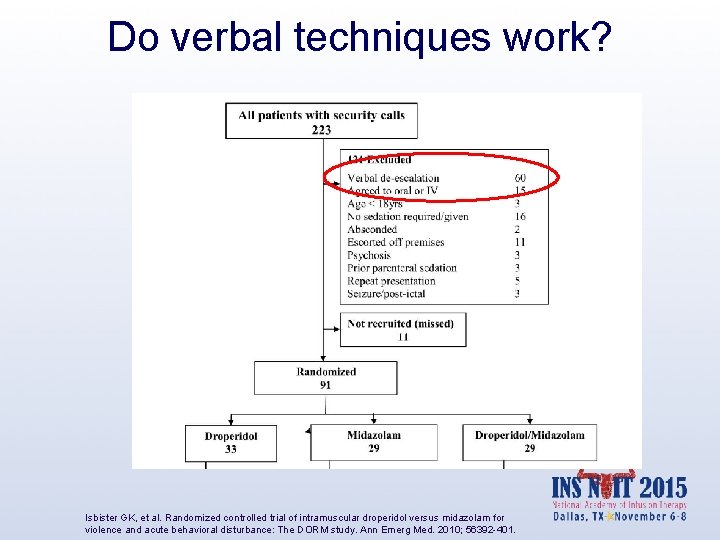
Do verbal techniques work? Isbister GK, et al. Randomized controlled trial of intramuscular droperidol versus midazolam for violence and acute behavioral disturbance: The DORM study. Ann Emerg Med. 2010; 56392 -401.
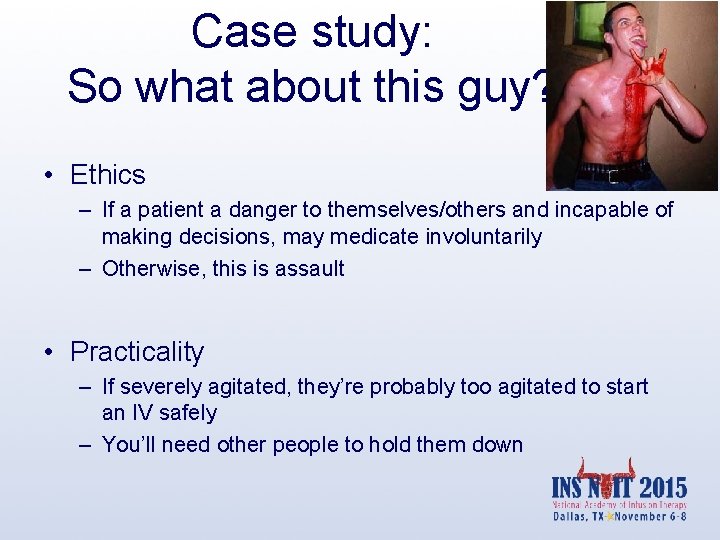
Case study: So what about this guy? • Ethics – If a patient a danger to themselves/others and incapable of making decisions, may medicate involuntarily – Otherwise, this is assault • Practicality – If severely agitated, they’re probably too agitated to start an IV safely – You’ll need other people to hold them down
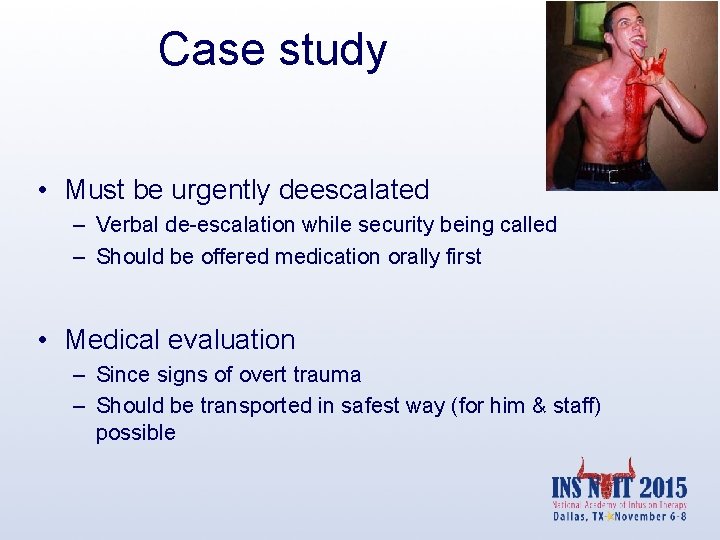
Case study • Must be urgently deescalated – Verbal de-escalation while security being called – Should be offered medication orally first • Medical evaluation – Since signs of overt trauma – Should be transported in safest way (for him & staff) possible
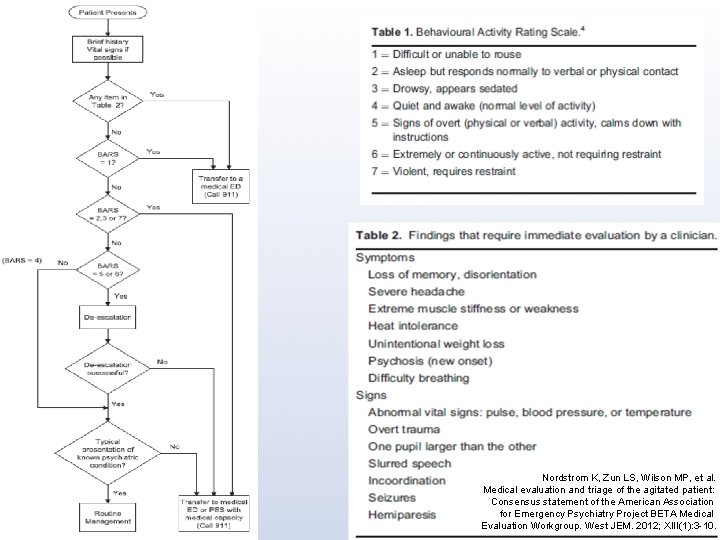
Nordstrom K, Zun LS, Wilson MP, et al. Medical evaluation and triage of the agitated patient: Consensus statement of the American Association for Emergency Psychiatry Project BETA Medical Evaluation Workgroup. West JEM. 2012; XIII(1): 3 -10.
Guideline: Staff should be appropriate for the job: Attitudes • • • Inadequate education/preparation Societal attitudes/personal biases Organizational climate Safety concerns Crowding Caregiver lack of confidence in skills & experience • Lack of guidelines ENA: Care of psychiatric patient in the emergency department. https: //www. ena. org/practice-research/Aresearch/Documents/White. Paper. Careof. Psych. pdf. Accessed July 5, 2015.
Staff Attitudes about Suicide • “ Suicidal behavior appears to elicit mostly negative feelings among staff members…” – If not acknowledged and properly handled…may lead to premature discharge…justified by statements ‘he is not really suicidal’” – “It is important task for staff members is to contain and work through negative feelings towards patients. ” Rossberg, JI, Frills, S: Staff members emotional reactions to aggressive and suicidal behavior of inpatients. Psychiatr Serv. 2003; 54(10): 1388 -1394.
Guideline: Oral over IM when possible
BETA recommendation: oral medications over IM when possible • Control agitation as rapidly as IM – despite slower time to peak plasma concentrations • No risk of needlestick • Less risk of oversedation • (probably) fewer side effects
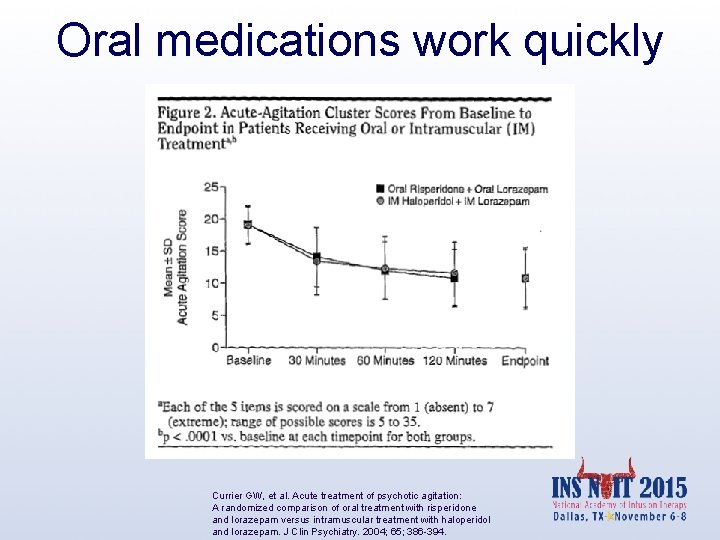
Oral medications work quickly Currier GW, et al. Acute treatment of psychotic agitation: A randomized comparison of oral treatment with risperidone and lorazepam versus intramuscular treatment with haloperidol and lorazepam. J Clin Psychiatry. 2004; 65; 386 -394.
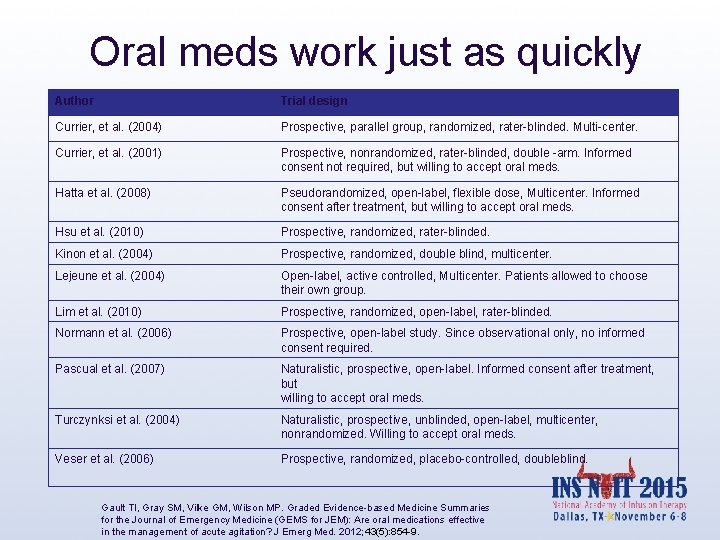
Oral meds work just as quickly Author Trial design Currier, et al. (2004) Prospective, parallel group, randomized, rater-blinded. Multi-center. Currier, et al. (2001) Prospective, nonrandomized, rater-blinded, double -arm. Informed consent not required, but willing to accept oral meds. Hatta et al. (2008) Pseudorandomized, open-label, flexible dose, Multicenter. Informed consent after treatment, but willing to accept oral meds. Hsu et al. (2010) Prospective, randomized, rater-blinded. Kinon et al. (2004) Prospective, randomized, double blind, multicenter. Lejeune et al. (2004) Open-label, active controlled, Multicenter. Patients allowed to choose their own group. Lim et al. (2010) Prospective, randomized, open-label, rater-blinded. Normann et al. (2006) Prospective, open-label study. Since observational only, no informed consent required. Pascual et al. (2007) Naturalistic, prospective, open-label. Informed consent after treatment, but willing to accept oral meds. Turczynksi et al. (2004) Naturalistic, prospective, unblinded, open-label, multicenter, nonrandomized. Willing to accept oral meds. Veser et al. (2006) Prospective, randomized, placebo-controlled, doubleblind. Gault TI, Gray SM, Vilke GM, Wilson MP. Graded Evidence-based Medicine Summaries for the Journal of Emergency Medicine (GEMS for JEM): Are oral medications effective in the management of acute agitation? J Emerg Med. 2012; 43(5): 854 -9.
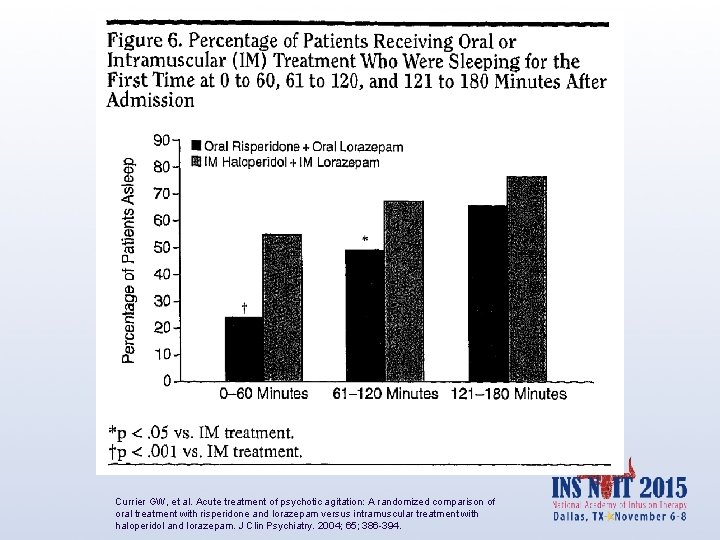
Currier GW, et al. Acute treatment of psychotic agitation: A randomized comparison of oral treatment with risperidone and lorazepam versus intramuscular treatment with haloperidol and lorazepam. J Clin Psychiatry. 2004; 65; 386 -394.
Slide courtesy of www. medscape. com
BETA recommendation: IM SGA over FGA • Similar efficacy – Haloperidol can cause dysphoria; patients often complain of the way it makes them feel later – Fewer side effects (unless Et. OH) – Probably less sedating than haloperidol/lorazepam Lambert M, et al. Subjective well-being and initial dysphoric reaction under antipsychotic drugs—concepts, measurement and clinical relevance. Pharmacopsychiatry. 2003; 36(suppl 3): S 181–S 190. Karow A et al. What would the patient choose: subjective comparison of atypical and typical neuroleptics. Pharmacopsychiatry. 2006; 39: 47– 51.
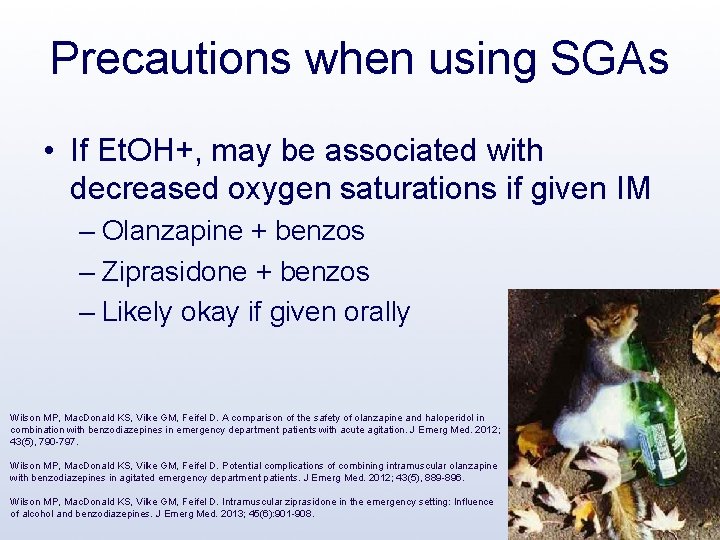
Precautions when using SGAs • If Et. OH+, may be associated with decreased oxygen saturations if given IM – Olanzapine + benzos – Ziprasidone + benzos – Likely okay if given orally Wilson MP, Mac. Donald KS, Vilke GM, Feifel D. A comparison of the safety of olanzapine and haloperidol in combination with benzodiazepines in emergency department patients with acute agitation. J Emerg Med. 2012; 43(5), 790 -797. Wilson MP, Mac. Donald KS, Vilke GM, Feifel D. Potential complications of combining intramuscular olanzapine with benzodiazepines in agitated emergency department patients. J Emerg Med. 2012; 43(5), 889 -896. Wilson MP, Mac. Donald KS, Vilke GM, Feifel D. Intramuscular ziprasidone in the emergency setting: Influence of alcohol and benzodiazepines. J Emerg Med. 2013; 45(6): 901 -908.
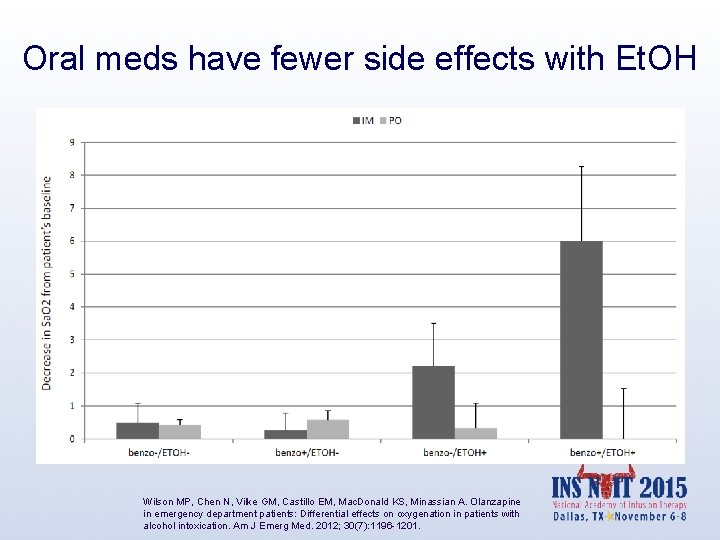
Oral meds have fewer side effects with Et. OH Wilson MP, Chen N, Vilke GM, Castillo EM, Mac. Donald KS, Minassian A. Olanzapine in emergency department patients: Differential effects on oxygenation in patients with alcohol intoxication. Am J Emerg Med. 2012; 30(7): 1196 -1201.
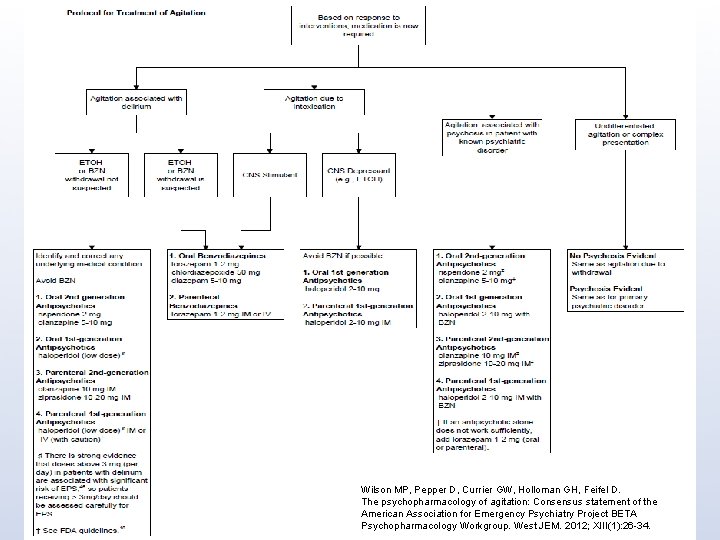
Wilson MP, Pepper D, Currier GW, Holloman GH, Feifel D. The psychopharmacology of agitation: Consensus statement of the American Association for Emergency Psychiatry Project BETA Psychopharmacology Workgroup. West JEM. 2012; XIII(1): 26 -34.
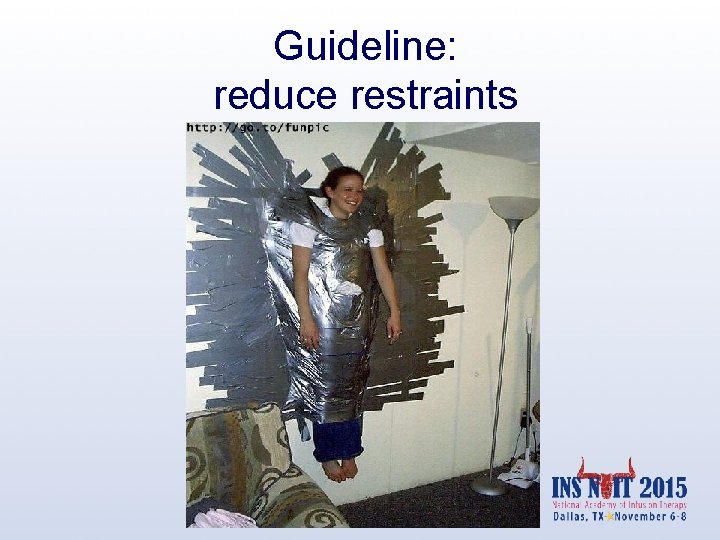
Guideline: reduce restraints
So why are we talking about restraints? (Isn’t a restrained patient a safe patient? ) • Most mental health advocacy groups have called for less coercion in treating mental health patients – In particular, calls for little or no restraint use by: • • • American Psychiatric Association American Psychiatric Nurses Association American Academy of National Alliance for the Mentally Ill Mental Health America the American Association of Community Psychiatrists the National Association of State Mental Health Program Directors
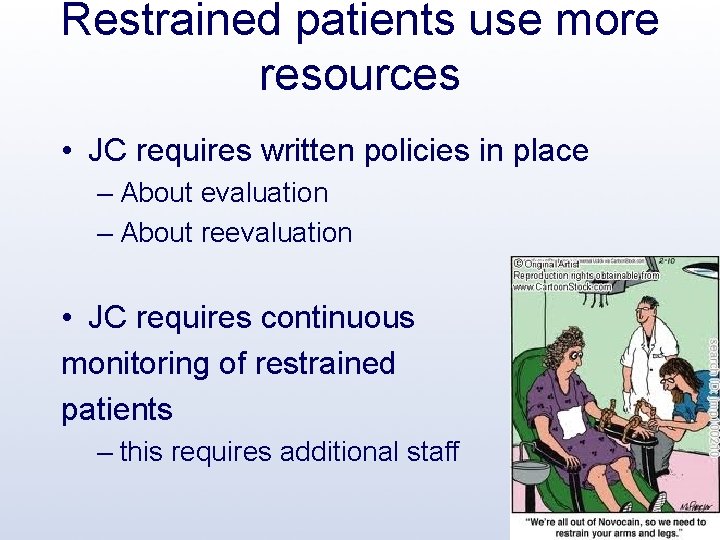
Restrained patients use more resources • JC requires written policies in place – About evaluation – About reevaluation • JC requires continuous monitoring of restrained patients – this requires additional staff
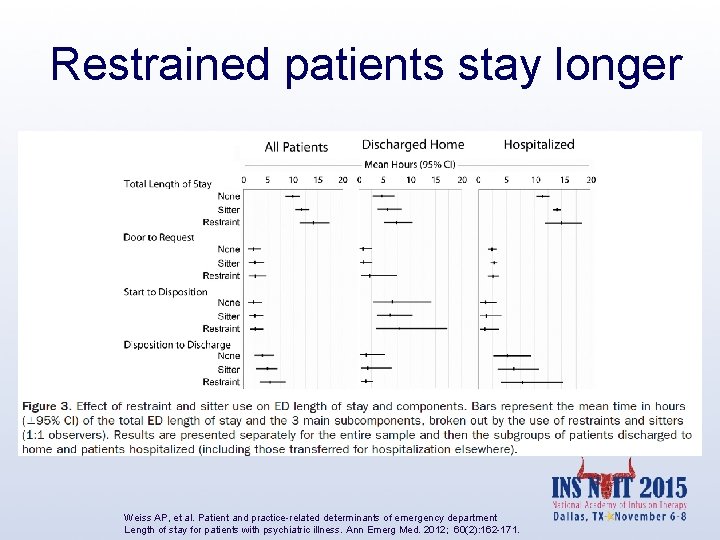
Restrained patients stay longer Weiss AP, et al. Patient and practice-related determinants of emergency department Length of stay for patients with psychiatric illness. Ann Emerg Med. 2012; 60(2): 162 -171.
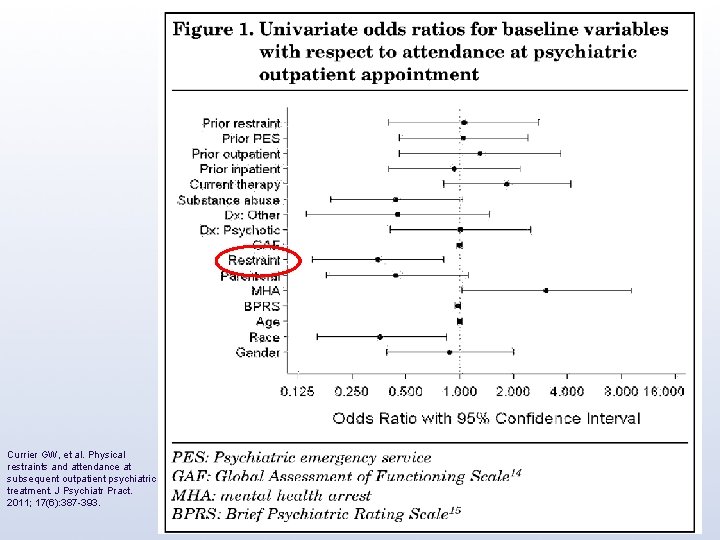
Currier GW, et al. Physical restraints and attendance at subsequent outpatient psychiatric treatment. J Psychiatr Pract. 2011; 17(6): 387 -393.
Selected Guidelines • Use verbal de-escalation • Staff should be appropriate for the job • Oral medications instead of IM • Reduce seclusion & restraint

Does BETA work? A California psychiatric ER using BETA recommendations: 6 months 1/2010 to 6/2010 compared to 6 months 7/2011 to 12/2011 Seclusion/Restraint Assaults 43% 58%

Decrease in assaults, injuries, insurance costs; Increase in patient/staff satisfaction at John George Psychiatric Hospital • 35% further reduction in assaults, with or without injury, over this continued time period • Workman’s Compensation Insurance Costs by 90% • Patient Satisfaction Scores >90 th • Employee Satisfaction and Retention percentile for the USA, 99 th percentile two of the past three months
Similar Improvements in Hospitals Worldwide • BETA guidelines in use in multiple locations around the world with good results • Honolulu, HI Queen’s Medical Center Trauma Center/ED – after implementing BETA recommendations, decreased from 20 restraints/month to ZERO restraints/month Cole R. Reducing restraint use in a trauma center emergency room. Nurs Clin N Am. 2014; 49: 371 -381.
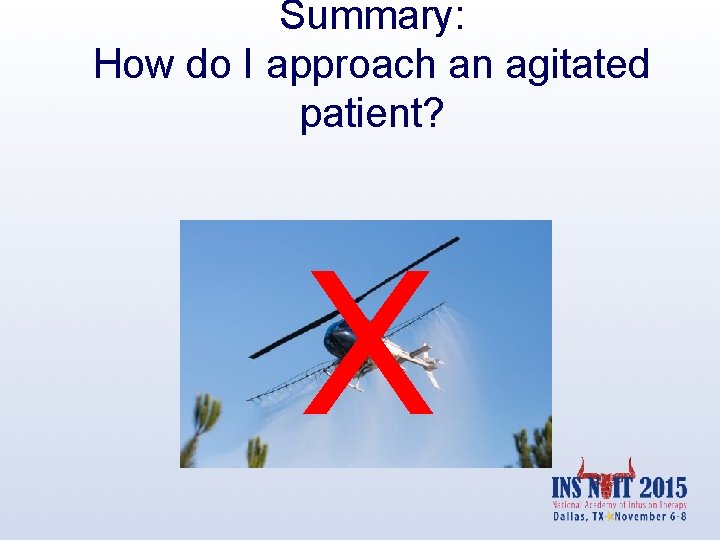
Summary: How do I approach an agitated patient? X
Courtesy of Scott Zeller, MD
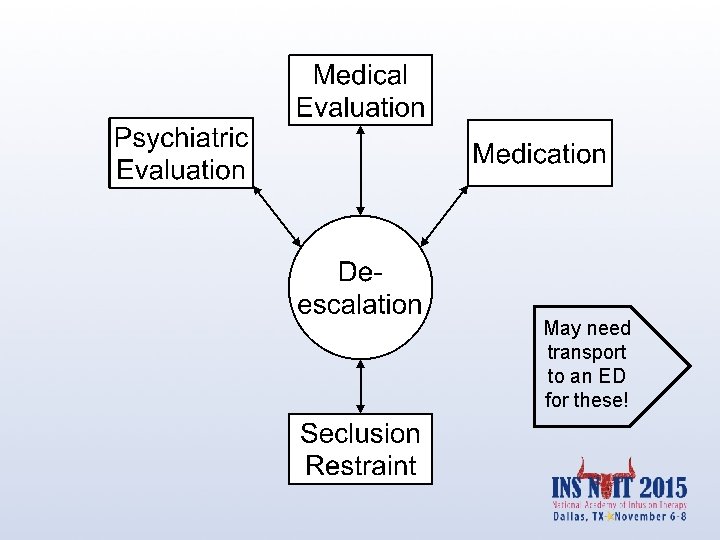
May need transport to an ED for these!
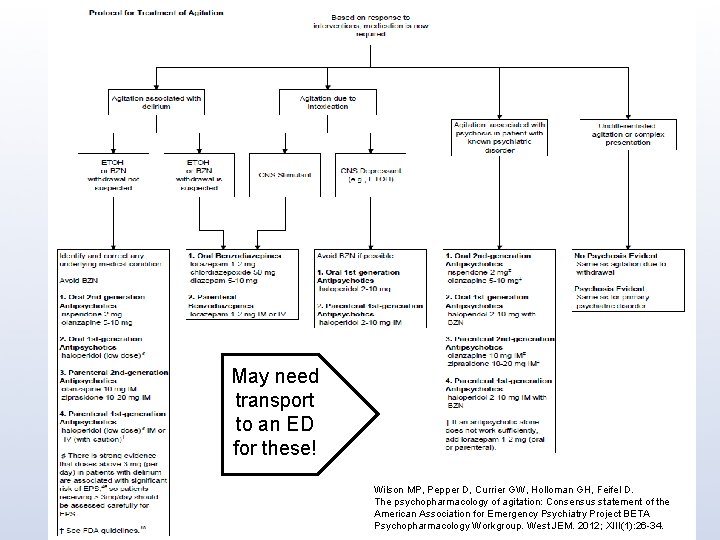
May need transport to an ED for these! Wilson MP, Pepper D, Currier GW, Holloman GH, Feifel D. The psychopharmacology of agitation: Consensus statement of the American Association for Emergency Psychiatry Project BETA Psychopharmacology Workgroup. West JEM. 2012; XIII(1): 26 -34.
Project BETA Available for free reading or download at the Western Journal of Emergency Medicine website Or through Bing/Google

Educational resources

Questions? mpwilso 1@outlook. com
- Slides: 51