
The Activities of Tokyo Climate Center Fumio WATANABE
The Activities of Tokyo Climate Center Fumio WATANABE Tokyo Climate Center Climate Prediction Division, JMA
Tokyo Climate Center (TCC) Establishment : April 2002 Mission : To assist Climate Services of NMHSs in the Asia-Pacific region with the aim of Mitigating climate-related disasters and Contributing to the sustainable development in the region
The Activities of TCC 1. Significance of Climate Information and Necessity of effective Application 2. Backgrounds of TCC’s Establishment Framework proposed by WMO for Advanced Climate Service Long-range Forecasting Service in JMA 3. 4. 5. 6. Tasks of TCC Data and Products available from TCC About this Workshop Concluding Remarks
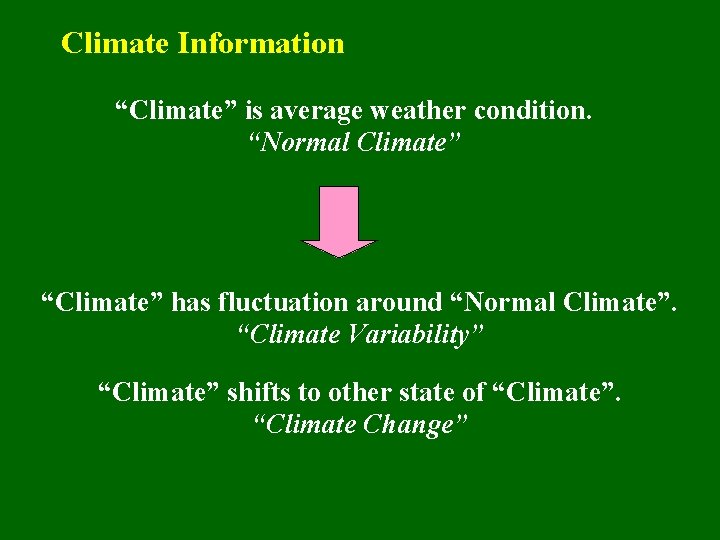
Climate Information “Climate” is average weather condition. “Normal Climate” “Climate” has fluctuation around “Normal Climate”. “Climate Variability” “Climate” shifts to other state of “Climate”. “Climate Change”
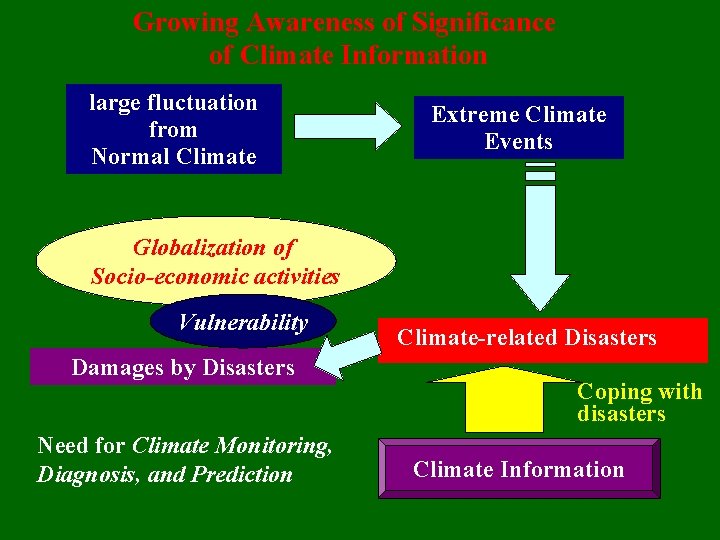
Growing Awareness of Significance of Climate Information large fluctuation from Normal Climate Extreme Climate Events Globalization of Socio-economic activities Vulnerability Damages by Disasters Need for Climate Monitoring, Diagnosis, and Prediction Climate-related Disasters Coping with disasters Climate Information
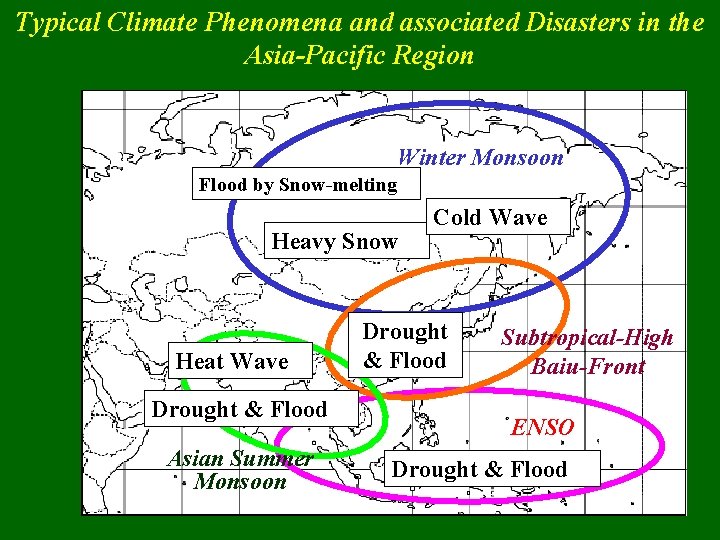
Typical Climate Phenomena and associated Disasters in the Asia-Pacific Region Winter Monsoon Flood by Snow-melting Heavy Snow Heat Wave Drought & Flood Asian Summer Monsoon Cold Wave Drought & Flood Subtropical-High Baiu-Front ENSO Drought & Flood
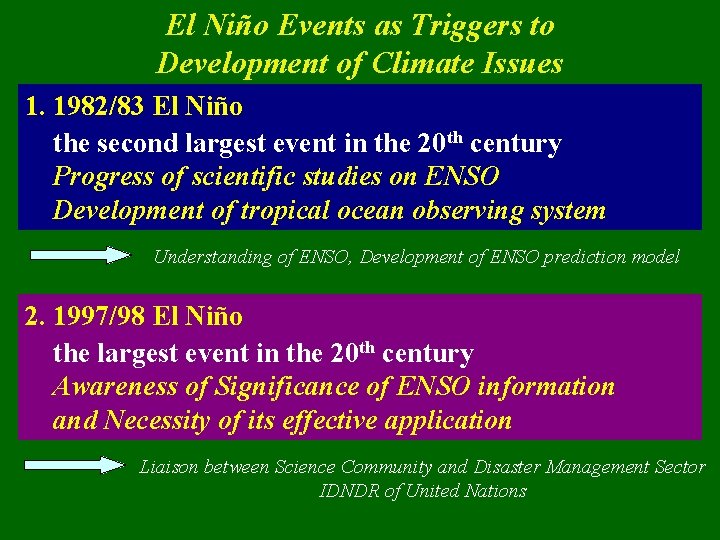
El Niño Events as Triggers to Development of Climate Issues 1. 1982/83 El Niño the second largest event in the 20 th century Progress of scientific studies on ENSO Development of tropical ocean observing system Understanding of ENSO, Development of ENSO prediction model 2. 1997/98 El Niño the largest event in the 20 th century Awareness of Significance of ENSO information and Necessity of its effective application Liaison between Science Community and Disaster Management Sector IDNDR of United Nations
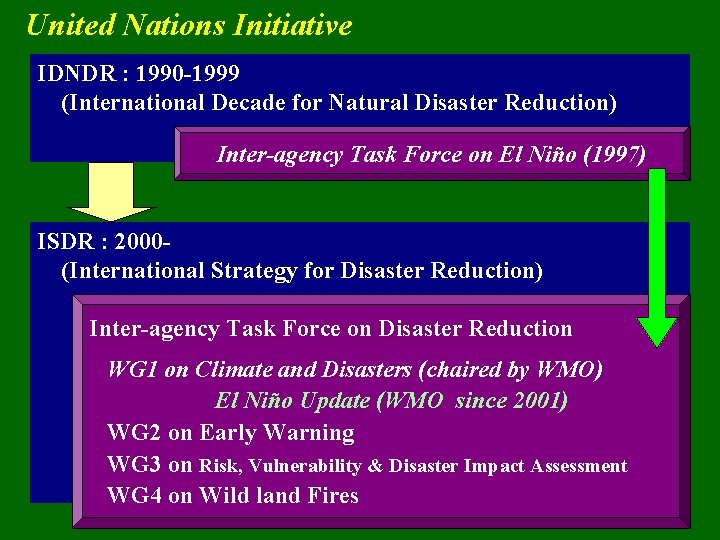
United Nations Initiative IDNDR : 1990 -1999 (International Decade for Natural Disaster Reduction) Inter-agency Task Force on El Niño (1997) ISDR : 2000(International Strategy for Disaster Reduction) Inter-agency Task Force on Disaster Reduction WG 1 on Climate and Disasters (chaired by WMO) El Niño Update (WMO since 2001) WG 2 on Early Warning WG 3 on Risk, Vulnerability & Disaster Impact Assessment WG 4 on Wild land Fires
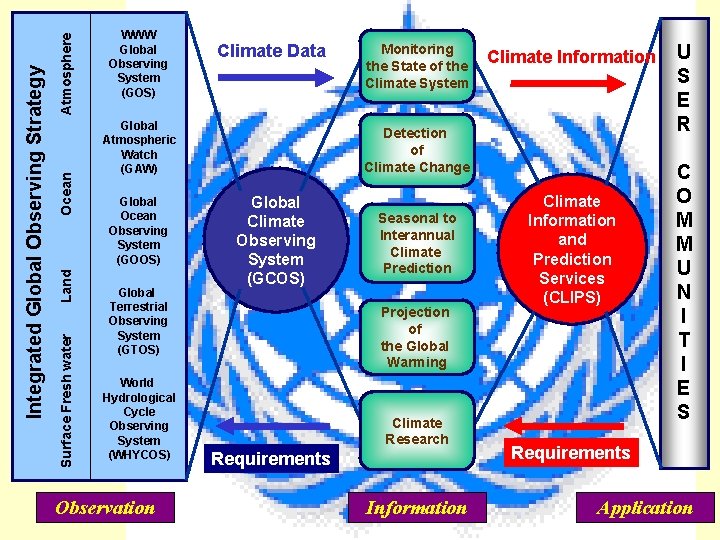
Atmosphere Ocean Land Surface Fresh water Integrated Global Observing Strategy WWW Global Observing System (GOS) Climate Data Global Atmospheric Watch (GAW) Global Ocean Observing System (GOOS) Global Terrestrial Observing System (GTOS) World Hydrological Cycle Observing System (WHYCOS) Observation Monitoring the State of the Climate System Climate Information Detection of Climate Change Global Climate Observing System (GCOS) Seasonal to Interannual Climate Prediction Projection of the Global Warming Climate Research Requirements Information Climate Information and Prediction Services (CLIPS) U S E R C O M M U N I T I E S Requirements Application
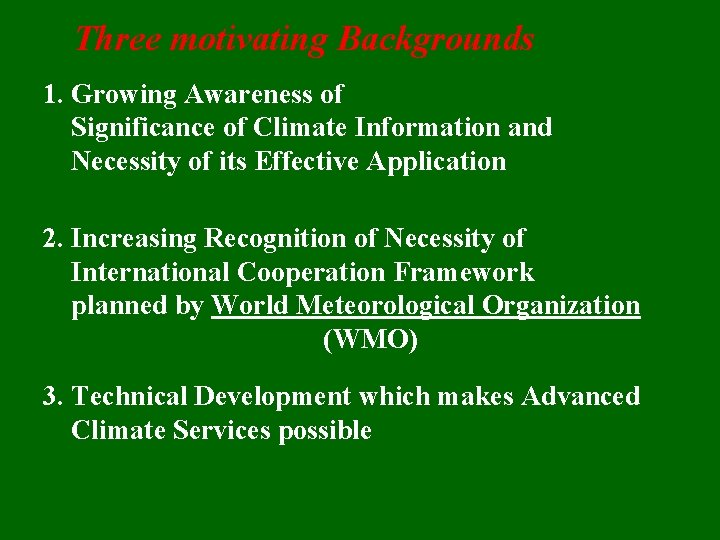
Three motivating Backgrounds 1. Growing Awareness of Significance of Climate Information and Necessity of its Effective Application 2. Increasing Recognition of Necessity of International Cooperation Framework planned by World Meteorological Organization (WMO) 3. Technical Development which makes Advanced Climate Services possible
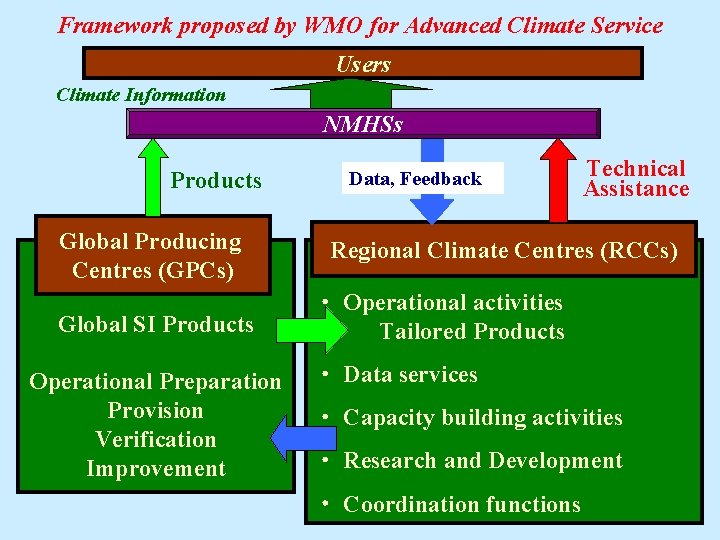
Framework proposed by WMO for Advanced Climate Service Users Climate Information NMHSs Products Global Producing Centres (GPCs) Global SI Products Operational Preparation Provision Verification Improvement Data, Feedback Technical Assistance Regional Climate Centres (RCCs) ・ Operational activities Tailored Products ・ Data services ・ Capacity building activities ・ Research and Development ・ Coordination functions
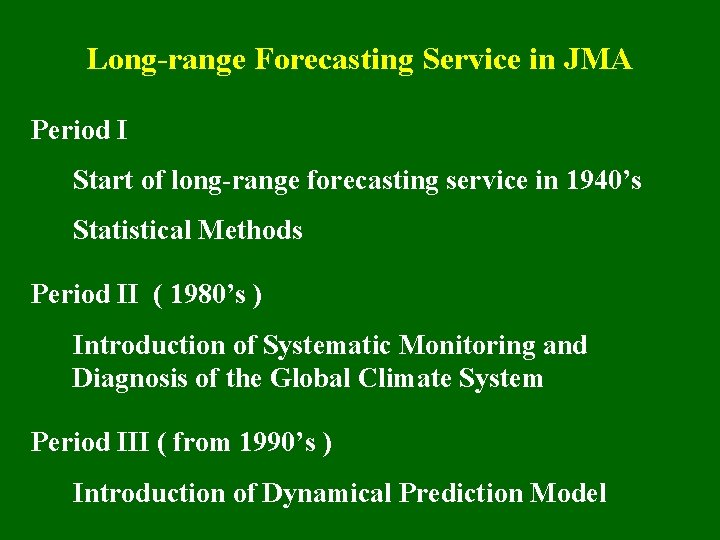
Long-range Forecasting Service in JMA Period I Start of long-range forecasting service in 1940’s Statistical Methods Period II ( 1980’s ) Introduction of Systematic Monitoring and Diagnosis of the Global Climate System Period III ( from 1990’s ) Introduction of Dynamical Prediction Model
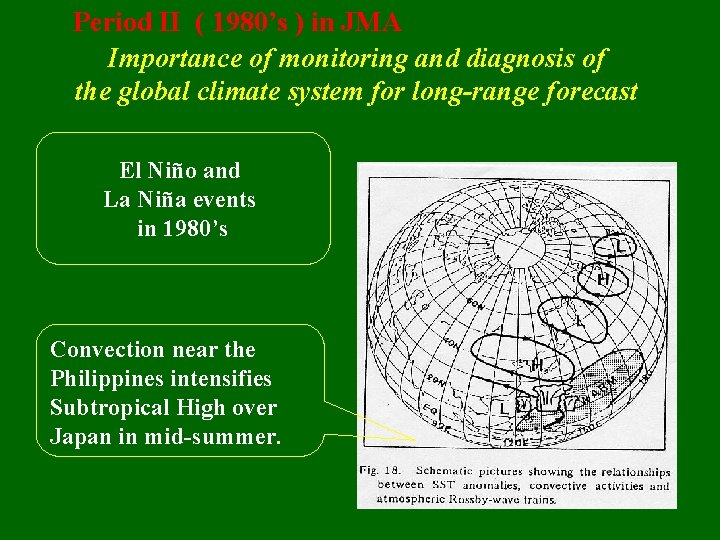
Period II ( 1980’s ) in JMA Importance of monitoring and diagnosis of the global climate system for long-range forecast El Niño and La Niña events in 1980’s Convection near the Philippines intensifies Subtropical High over Japan in mid-summer.
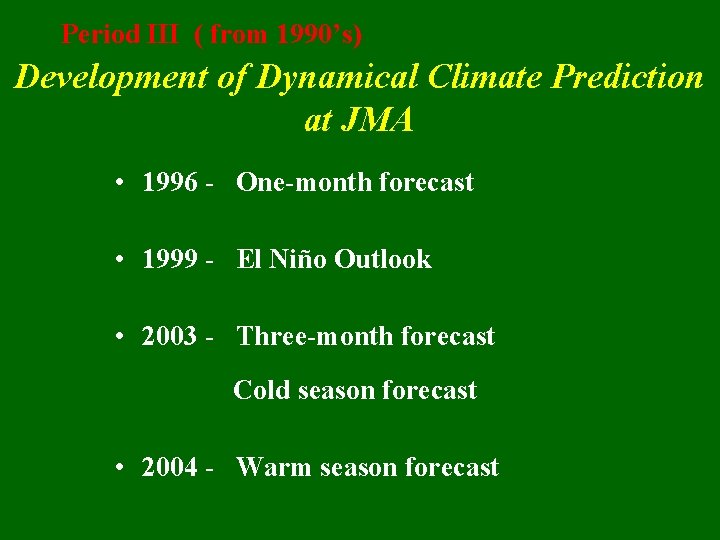
Period III ( from 1990’s) Development of Dynamical Climate Prediction at JMA • 1996 - One-month forecast • 1999 - El Niño Outlook • 2003 - Three-month forecast Cold season forecast • 2004 - Warm season forecast
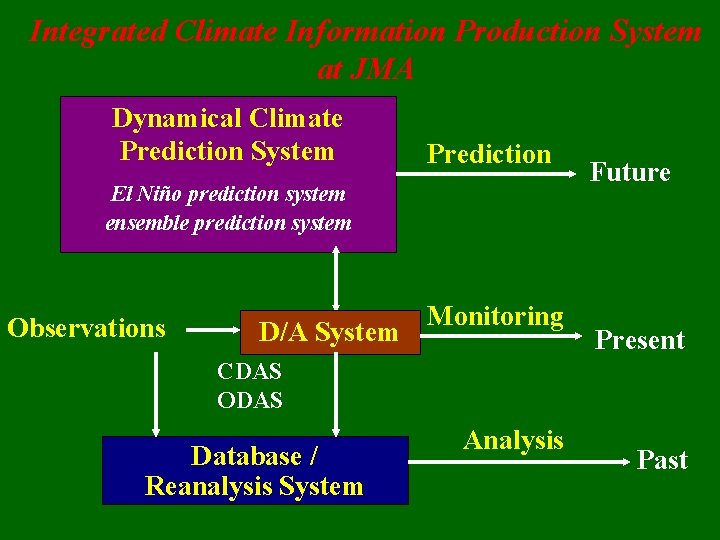
Integrated Climate Information Production System at JMA Dynamical Climate Prediction System Prediction El Niño prediction system ensemble prediction system Observations D/A System Monitoring Future Present CDAS ODAS Database / Reanalysis System Analysis Past
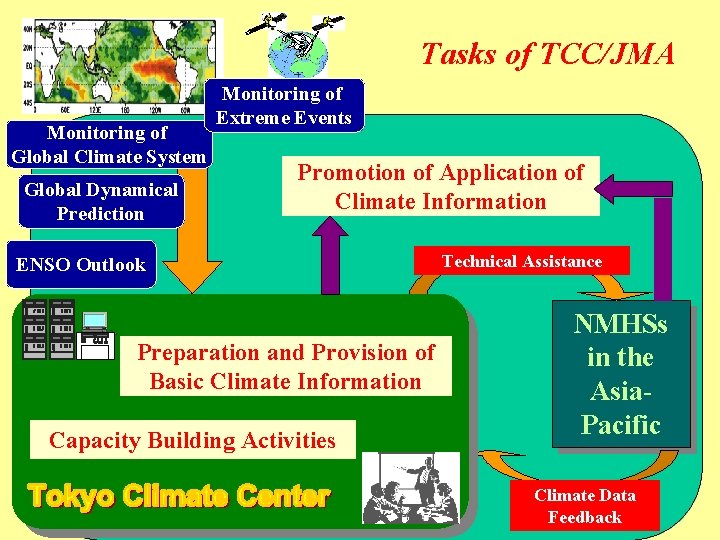
Tasks of TCC/JMA Monitoring of Global Climate System Global Dynamical Prediction Monitoring of Extreme Events Promotion of Application of Climate Information ENSO Outlook Preparation and Provision of Basic Climate Information Capacity Building Activities Technical Assistance NMHSs in the Asia. Pacific Climate Data Feedback
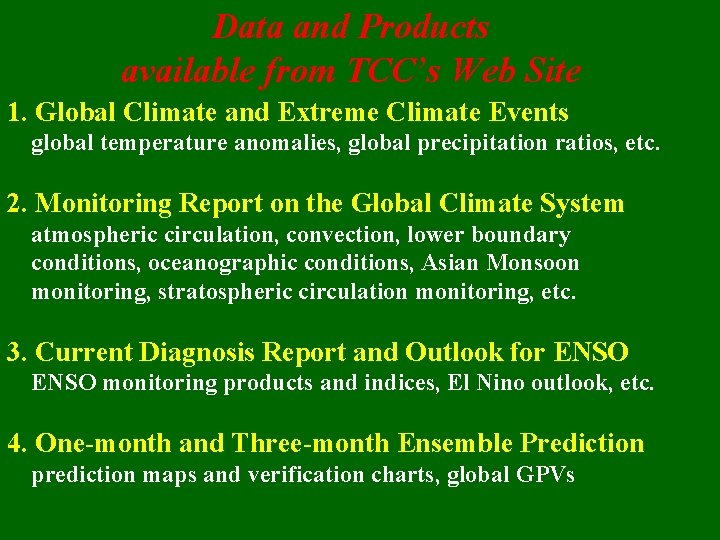
Data and Products available from TCC’s Web Site 1. Global Climate and Extreme Climate Events global temperature anomalies, global precipitation ratios, etc. 2. Monitoring Report on the Global Climate System atmospheric circulation, convection, lower boundary conditions, oceanographic conditions, Asian Monsoon monitoring, stratospheric circulation monitoring, etc. 3. Current Diagnosis Report and Outlook for ENSO monitoring products and indices, El Nino outlook, etc. 4. One-month and Three-month Ensemble Prediction prediction maps and verification charts, global GPVs
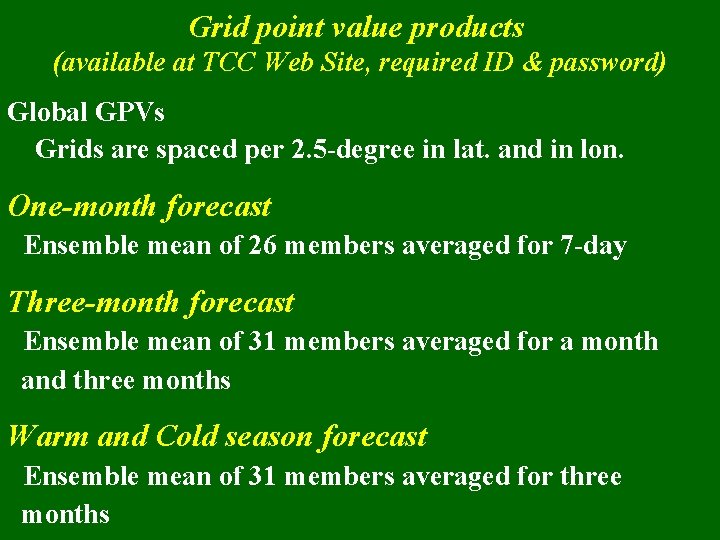
Grid point value products (available at TCC Web Site, required ID & password) Global GPVs Grids are spaced per 2. 5 -degree in lat. and in lon. One-month forecast Ensemble mean of 26 members averaged for 7 -day Three-month forecast Ensemble mean of 31 members averaged for a month and three months Warm and Cold season forecast Ensemble mean of 31 members averaged for three months
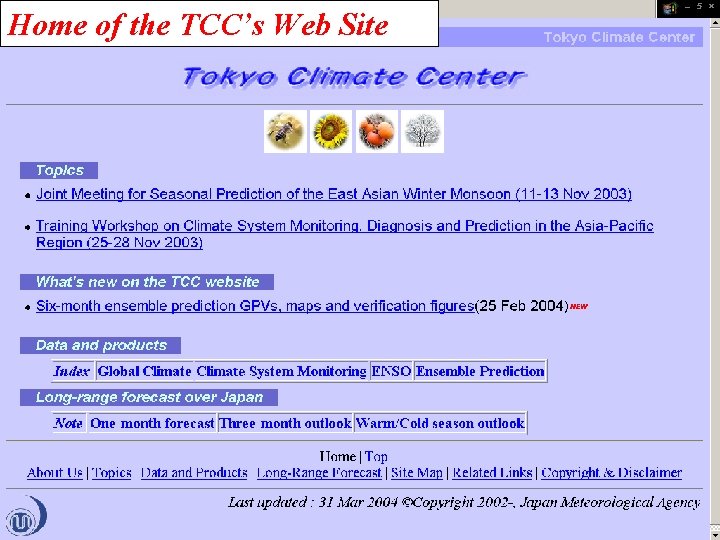
Home of the TCC’s Web Site
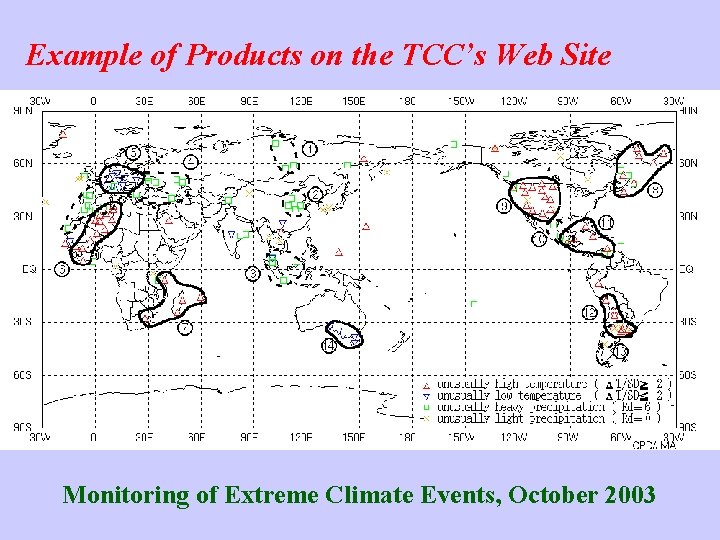
Example of Products on the TCC’s Web Site Monitoring of Extreme Climate Events, October 2003
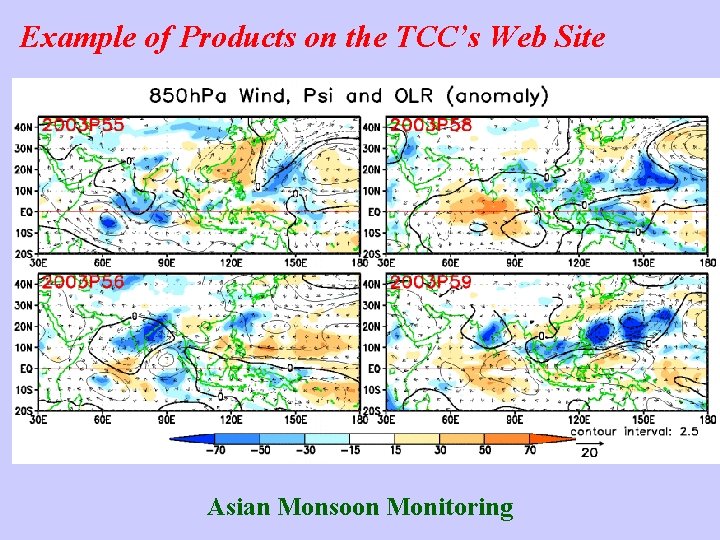
Example of Products on the TCC’s Web Site Asian Monsoon Monitoring
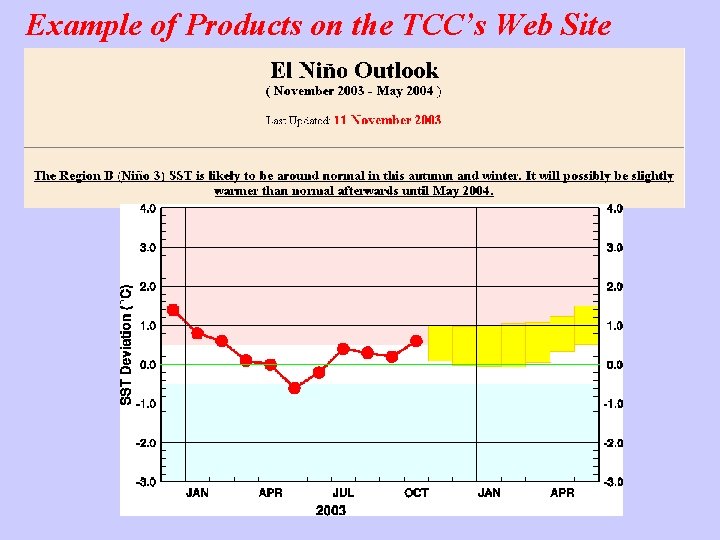
Example of Products on the TCC’s Web Site
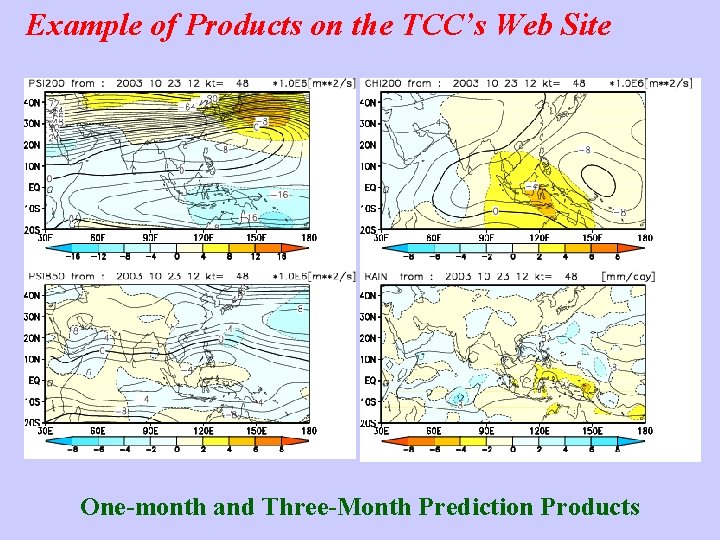
Example of Products on the TCC’s Web Site One-month and Three-Month Prediction Products
Conclusion 1. There is Growing Awareness of significance of climate information to cope with climate-related disasters. Effective Application should be enhanced but based on correct understanding of uncertainty of the information. 2. JMA develops and improves the Integrated Climate Information Production System (ICIRS). 3. NMHSs should prepare and deliver climate information. International Cooperation Framework should assist NMHSs. TCC contributes to such a Framework. 4. TCC improves and increases basic climate data and products available from the TCC Web Site. TCC will continue to hold workshops and Training Courses as capacity building activities.
- Slides: 24