
The activities are arranged from left not much
- Slides: 2
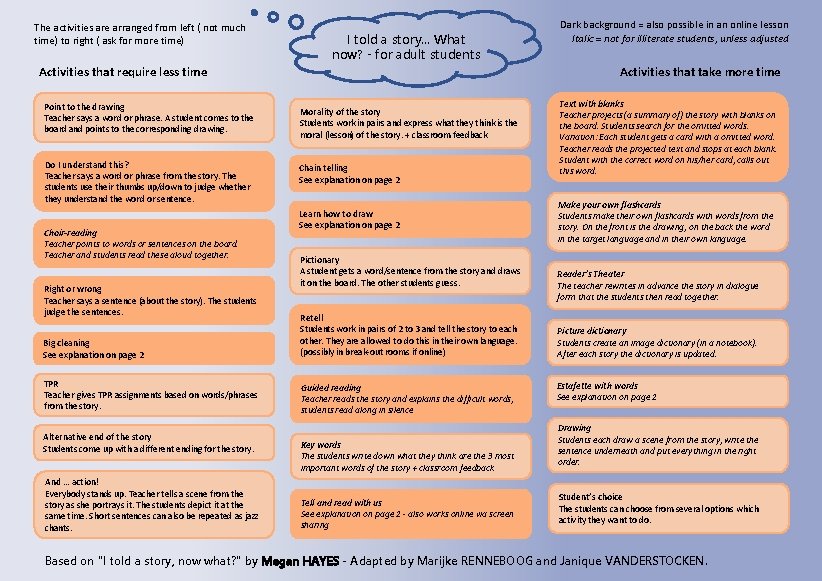
The activities are arranged from left ( not much time) to right ( ask for more time) I told a story. . . What now? - for adult students Activities that take more time Activities that require less time Point to the drawing Teacher says a word or phrase. A student comes to the board and points to the corresponding drawing. Do I understand this? Teacher says a word or phrase from the story. The students use their thumbs up/down to judge whether they understand the word or sentence. Choir-reading Teacher points to words or sentences on the board. Teacher and students read these aloud together. Right or wrong Teacher says a sentence (about the story). The students judge the sentences. Morality of the story Students work in pairs and express what they think is the moral (lesson) of the story. + classroom feedback Chain telling See explanation on page 2 Learn how to draw See explanation on page 2 Pictionary A student gets a word/sentence from the story and draws it on the board. The other students guess. Big cleaning See explanation on page 2 Retell Students work in pairs of 2 to 3 and tell the story to each other. They are allowed to do this in their own language. (possibly in break-out rooms if online) TPR Teacher gives TPR assignments based on words/phrases from the story. Guided reading Teacher reads the story and explains the difficult words, students read along in silence Alternative end of the story Students come up with a different ending for the story. And … action! Everybody stands up. Teacher tells a scene from the story as she portrays it. The students depict it at the same time. Short sentences can also be repeated as jazz chants. Dark background = also possible in an online lesson Italic = not for illiterate students, unless adjusted Key words The students write down what they think are the 3 most important words of the story + classroom feedback Tell and read with us See explanation on page 2 - also works online via screen sharing Text with blanks Teacher projects (a summary of) the story with blanks on the board. Students search for the omitted words. Variation: Each student gets a card with a omitted word. Teacher reads the projected text and stops at each blank. Student with the correct word on his/her card, calls out this word. Make your own flashcards Students make their own flashcards with words from the story. On the front is the drawing, on the back the word in the target language and in their own language. Reader’s Theater The teacher rewrites in advance the story in dialogue form that the students then read together. Picture dictionary Students create an image dictionary (in a notebook). After each story the dictionary is updated. Estafette with words See explanation on page 2 Drawing Students each draw a scene from the story, write the sentence underneath and put everything in the right order. Student’s choice The students can choose from several options which activity they want to do. Based on "I told a story, now what? " by Megan HAYES - Adapted by Marijke RENNEBOOG and Janique VANDERSTOCKEN.
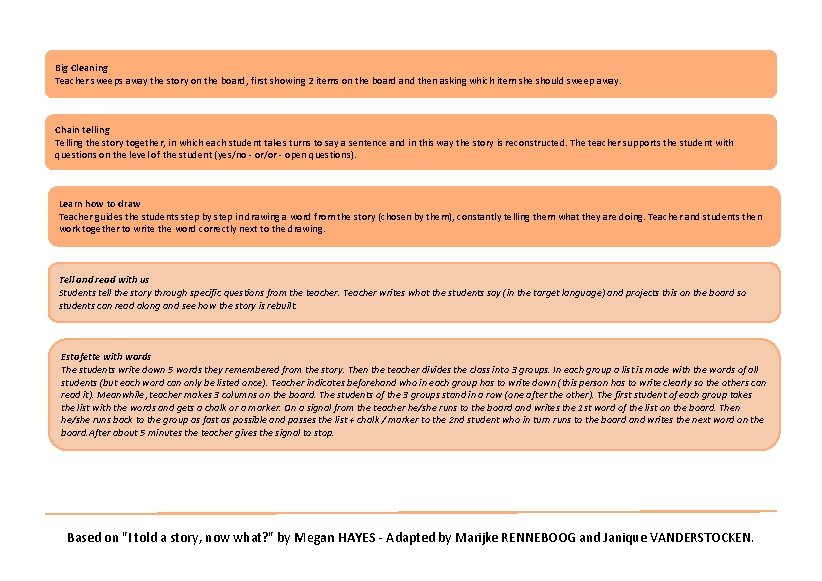
Big Cleaning Teacher sweeps away the story on the board, first showing 2 items on the board and then asking which item she should sweep away. Chain telling Telling the story together, in which each student takes turns to say a sentence and in this way the story is reconstructed. The teacher supports the student with questions on the level of the student (yes/no - or/or - open questions). Learn how to draw Teacher guides the students step by step in drawing a word from the story (chosen by them), constantly telling them what they are doing. Teacher and students then work together to write the word correctly next to the drawing. Tell and read with us Students tell the story through specific questions from the teacher. Teacher writes what the students say (in the target language) and projects this on the board so students can read along and see how the story is rebuilt. Estafette with words The students write down 5 words they remembered from the story. Then the teacher divides the class into 3 groups. In each group a list is made with the words of all students (but each word can only be listed once). Teacher indicates beforehand who in each group has to write down (this person has to write clearly so the others can read it). Meanwhile, teacher makes 3 columns on the board. The students of the 3 groups stand in a row (one after the other). The first student of each group takes the list with the words and gets a chalk or a marker. On a signal from the teacher he/she runs to the board and writes the 1 st word of the list on the board. Then he/she runs back to the group as fast as possible and passes the list + chalk / marker to the 2 nd student who in turn runs to the board and writes the next word on the board. After about 5 minutes the teacher gives the signal to stop. Based on "I told a story, now what? " by Megan HAYES - Adapted by Marijke RENNEBOOG and Janique VANDERSTOCKEN.