
The Active Diode A Current Driven Synchronous Rectifier
- Slides: 27
The Active Diode A Current Driven Synchronous Rectifier W 2 -tech Inc.
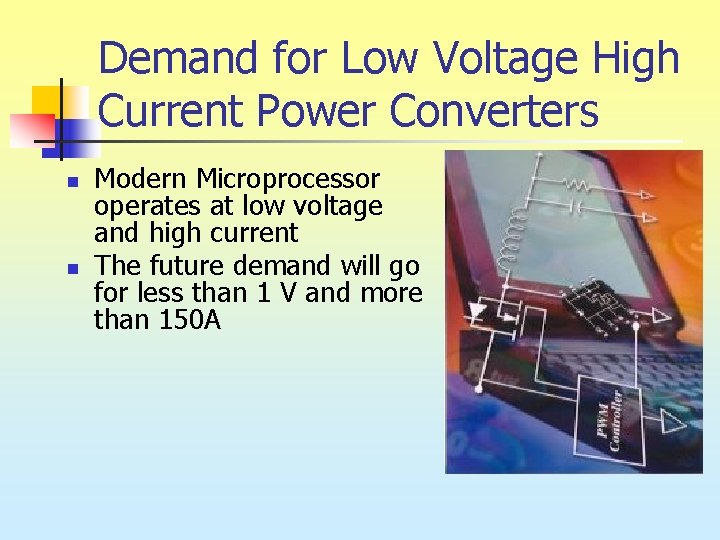
Demand for Low Voltage High Current Power Converters n n Modern Microprocessor operates at low voltage and high current The future demand will go for less than 1 V and more than 150 A
Reasons for low voltage & high current n n Switching time is shorter between close voltage levels Less loss due to capacitance IC sub micron technology requires low operating voltage Large number of devices need high current
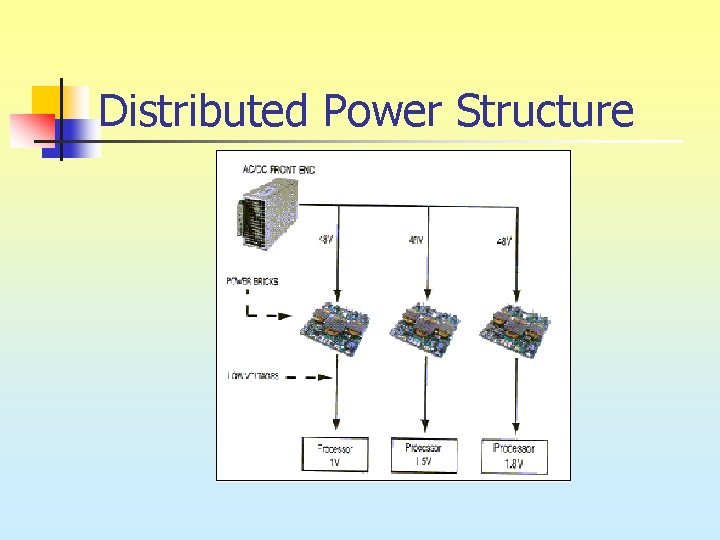
Distributed Power Structure
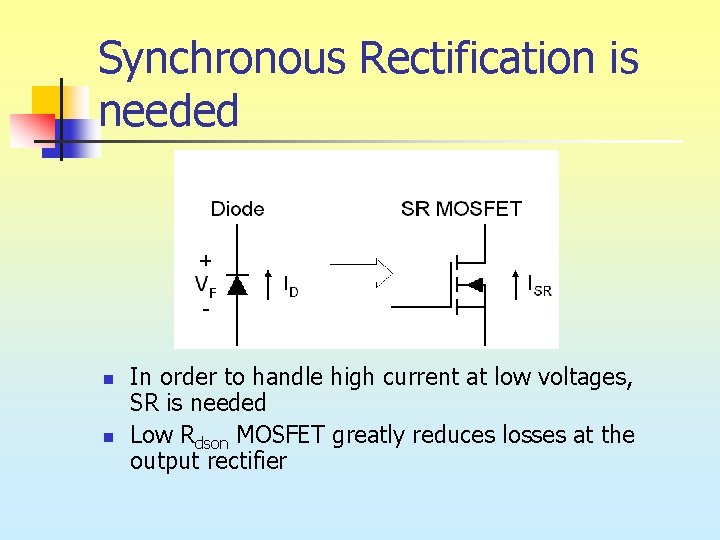
Synchronous Rectification is needed n n In order to handle high current at low voltages, SR is needed Low Rdson MOSFET greatly reduces losses at the output rectifier
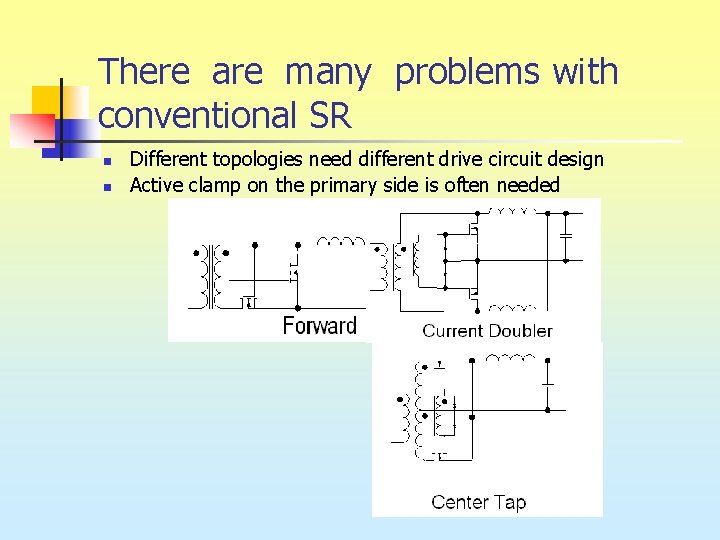
There are many problems with conventional SR n n Different topologies need different drive circuit design Active clamp on the primary side is often needed
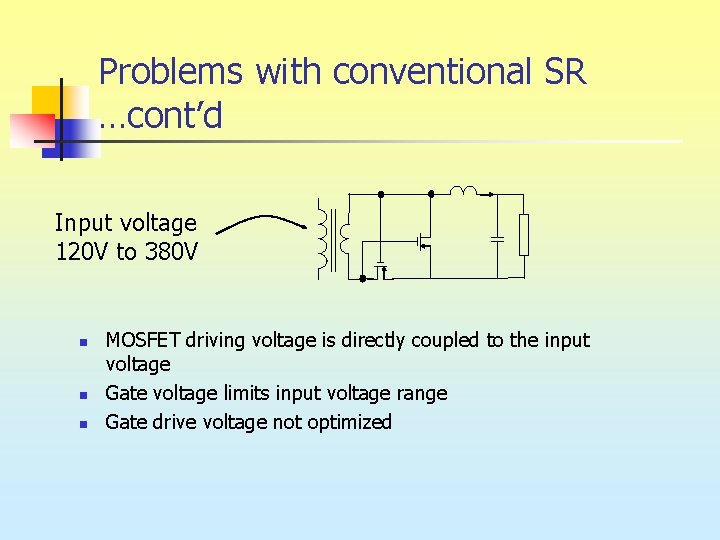
Problems with conventional SR …cont’d Input voltage 120 V to 380 V n n n MOSFET driving voltage is directly coupled to the input voltage Gate voltage limits input voltage range Gate drive voltage not optimized
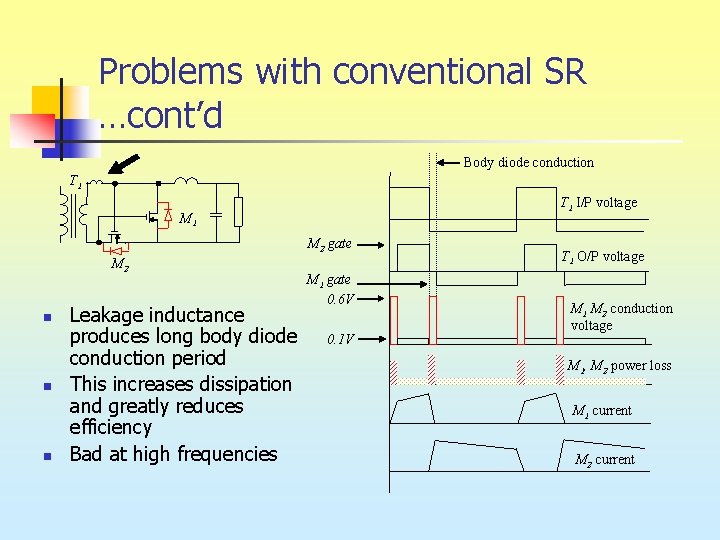
Problems with conventional SR …cont’d Body diode conduction T 1 I/P voltage M 1 M 2 gate M 2 n n n Leakage inductance produces long body diode conduction period This increases dissipation and greatly reduces efficiency Bad at high frequencies M 1 gate 0. 6 V 0. 1 V T 1 O/P voltage M 1 M 2 conduction voltage M 1, M 2 power loss M 1 current M 2 current
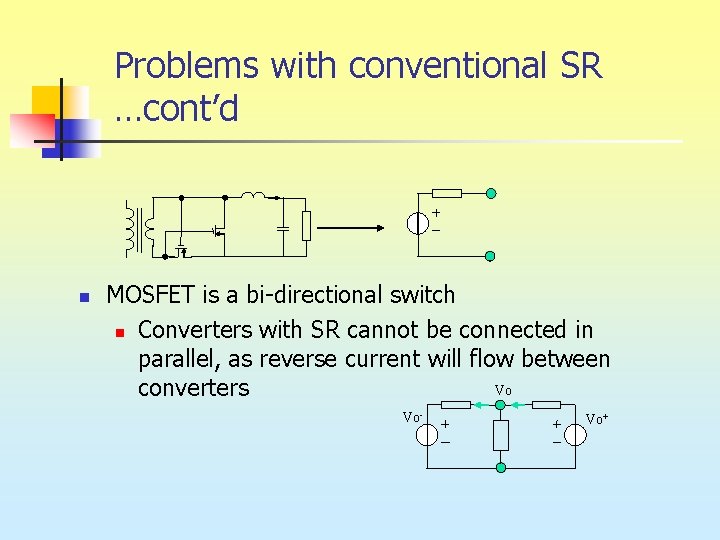
Problems with conventional SR …cont’d n MOSFET is a bi-directional switch n Converters with SR cannot be connected in parallel, as reverse current will flow between Vo converters Vo- Vo+
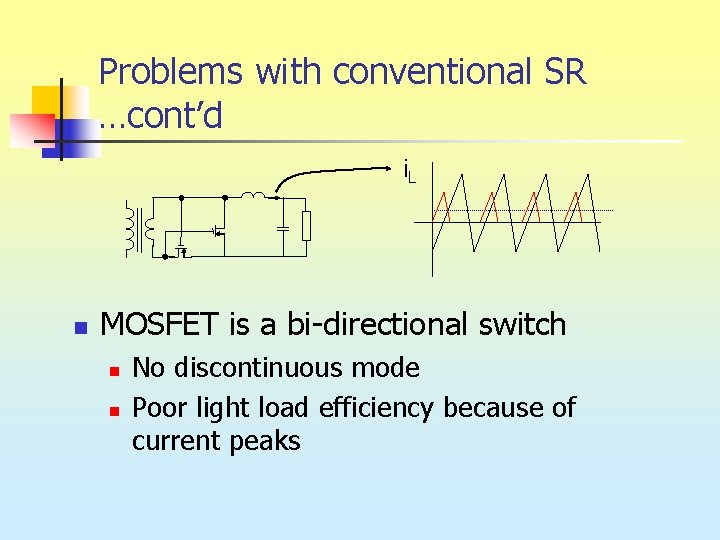
Problems with conventional SR …cont’d i. L n MOSFET is a bi-directional switch n n No discontinuous mode Poor light load efficiency because of current peaks
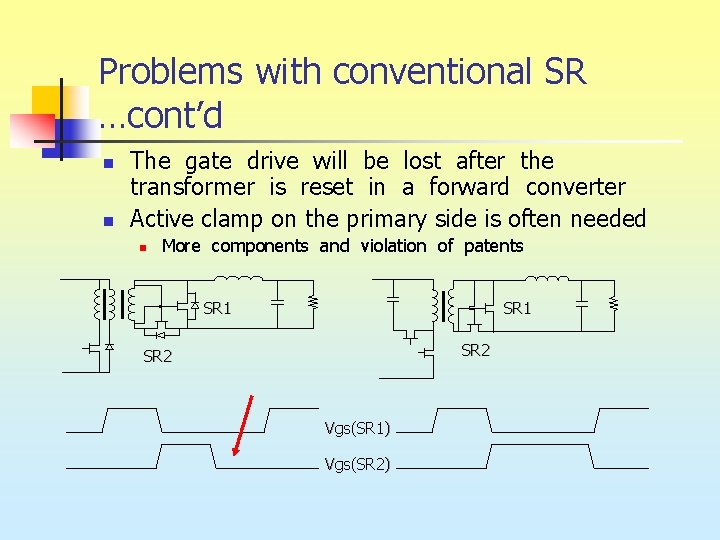
Problems with conventional SR …cont’d n n The gate drive will be lost after the transformer is reset in a forward converter Active clamp on the primary side is often needed n More components and violation of patents SR 1 SR 2 Vgs(SR 1) Vgs(SR 2)
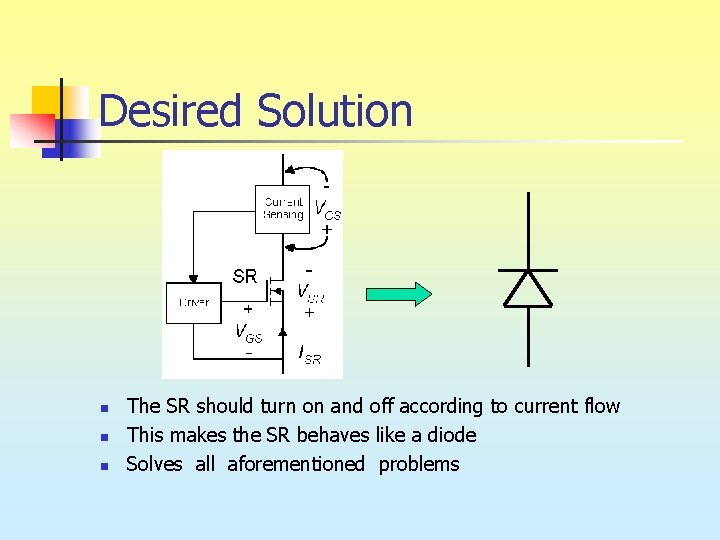
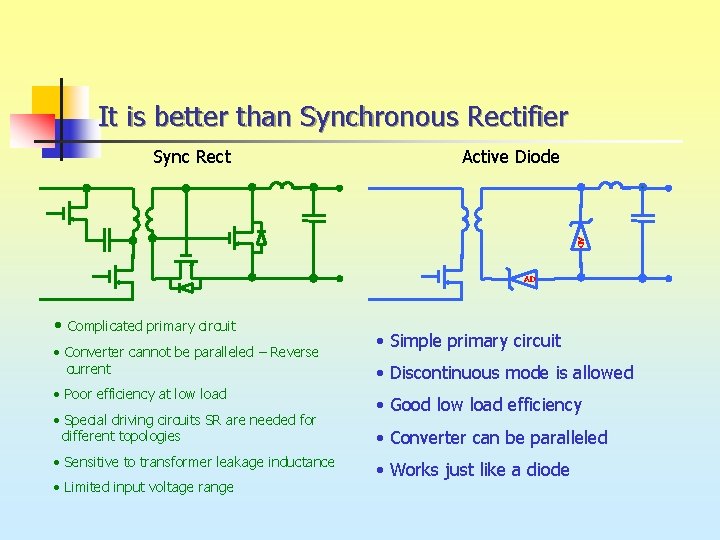
Desired Solution n The SR should turn on and off according to current flow This makes the SR behaves like a diode Solves all aforementioned problems
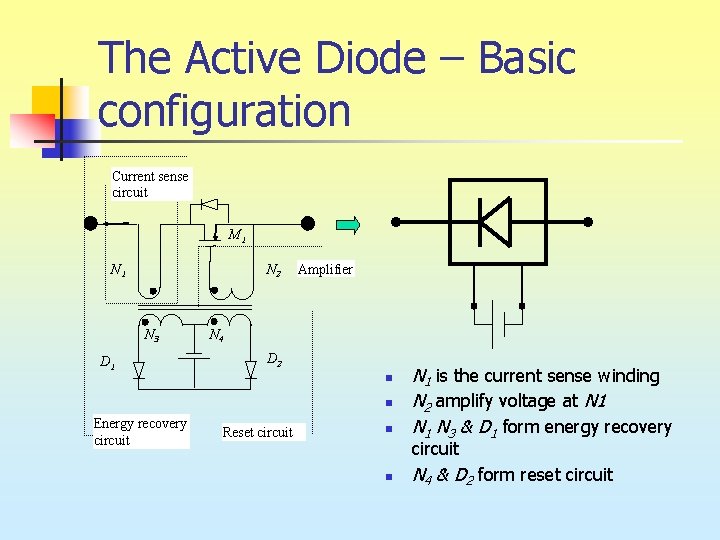
The Active Diode – Basic configuration Current sense circuit M 1 N 2 N 3 D 1 Amplifier N 4 D 2 n n Energy recovery circuit Reset circuit n N 1 is the current sense winding N 2 amplify voltage at N 1 N 3 & D 1 form energy recovery circuit n N 4 & D 2 form reset circuit
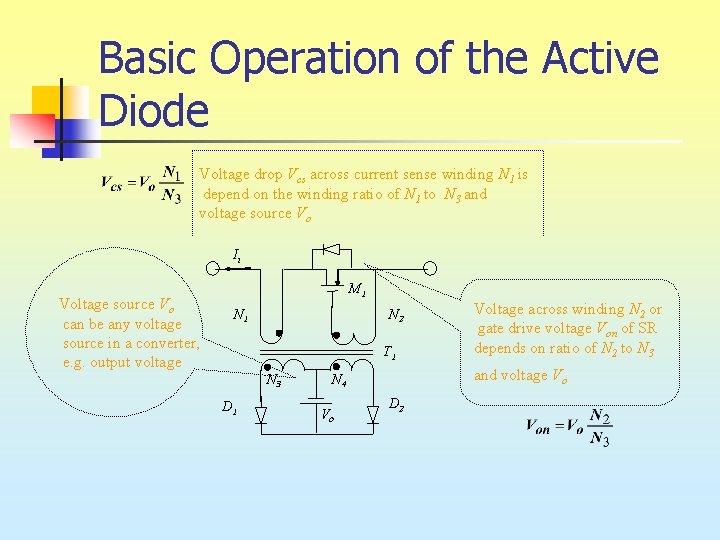
Basic Operation of the Active Diode Voltage drop Vcs across current sense winding N 1 is depend on the winding ratio of N 1 to N 3 and voltage source Vo Ii Voltage source Vo can be any voltage source in a converter, e. g. output voltage M 1 N 2 T 1 N 3 D 1 and voltage Vo N 4 Vo Voltage across winding N 2 or gate drive voltage Von of SR depends on ratio of N 2 to N 3 D 2
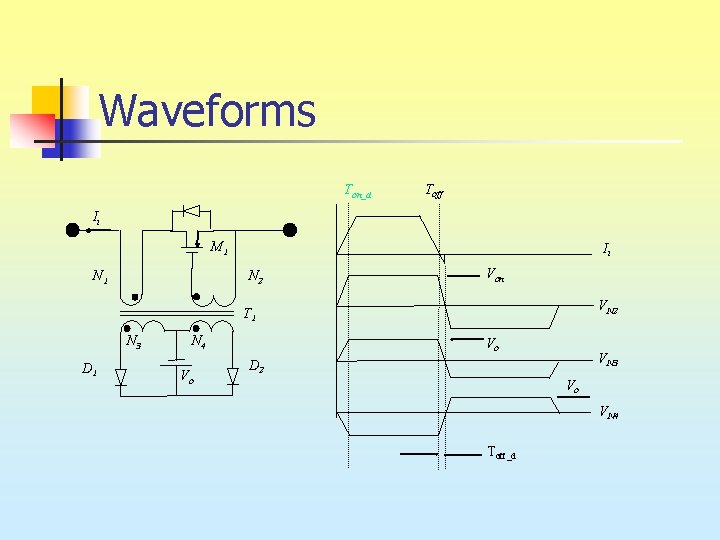
Waveforms Ton_d Toff Ii M 1 N 1 Ii N 2 Von VN 2 T 1 N 3 D 1 N 4 Vo Vo VN 3 D 2 Vo VN 4 Toff_d
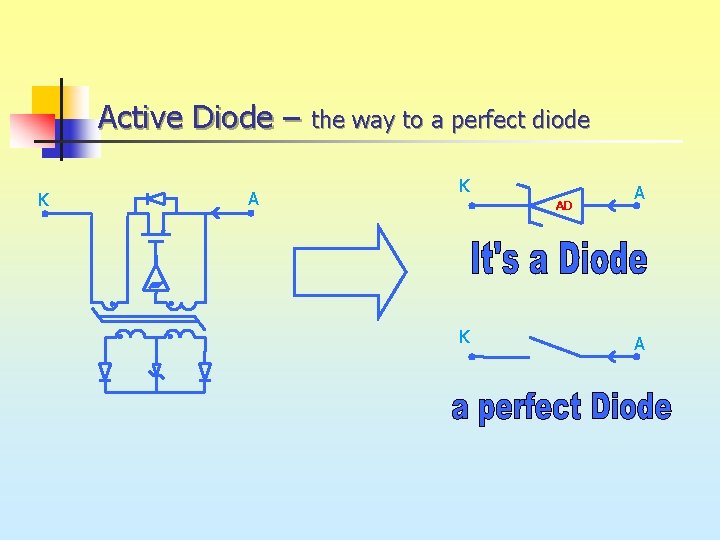
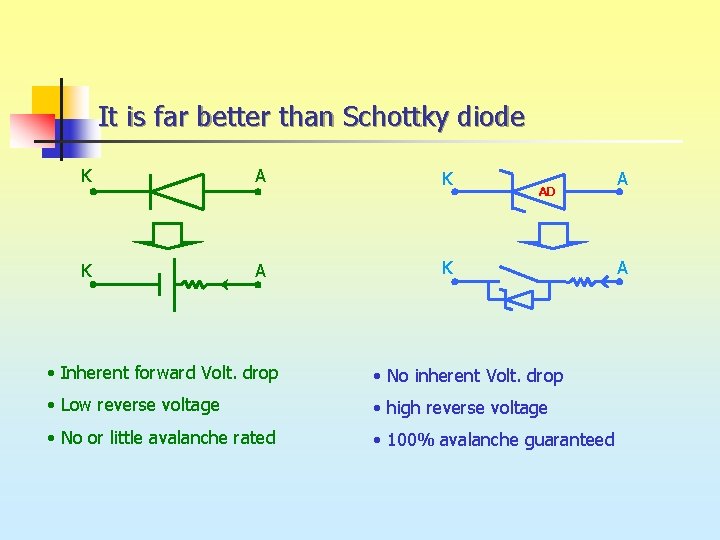
Active Diode – the way to a perfect diode K AD K A A
It is better than Synchronous Rectifier Sync Rect Active Diode AD AD • Complicated primary circuit • Converter cannot be paralleled – Reverse current • Poor efficiency at low load • Special driving circuits SR are needed for different topologies • Sensitive to transformer leakage inductance • Limited input voltage range • Simple primary circuit • Discontinuous mode is allowed • Good low load efficiency • Converter can be paralleled • Works just like a diode
It is far better than Schottky diode K A K AD • Inherent forward Volt. drop • No inherent Volt. drop • Low reverse voltage • high reverse voltage • No or little avalanche rated • 100% avalanche guaranteed A A
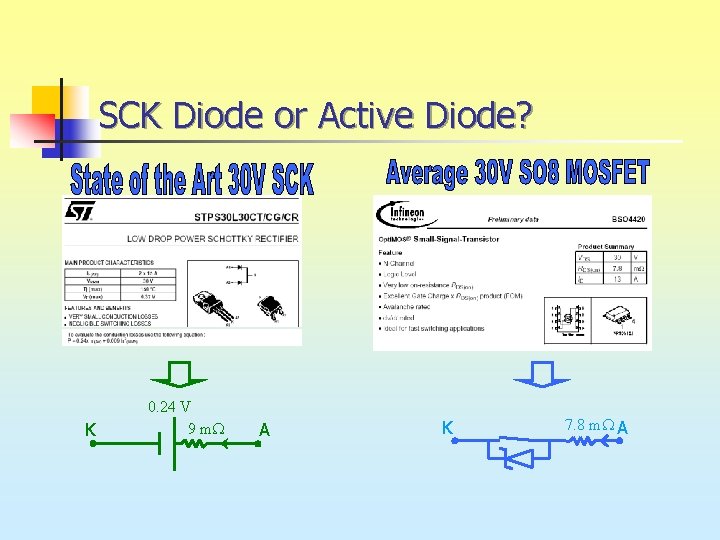
SCK Diode or Active Diode? K 0. 24 V 9 m A K 7. 8 m A
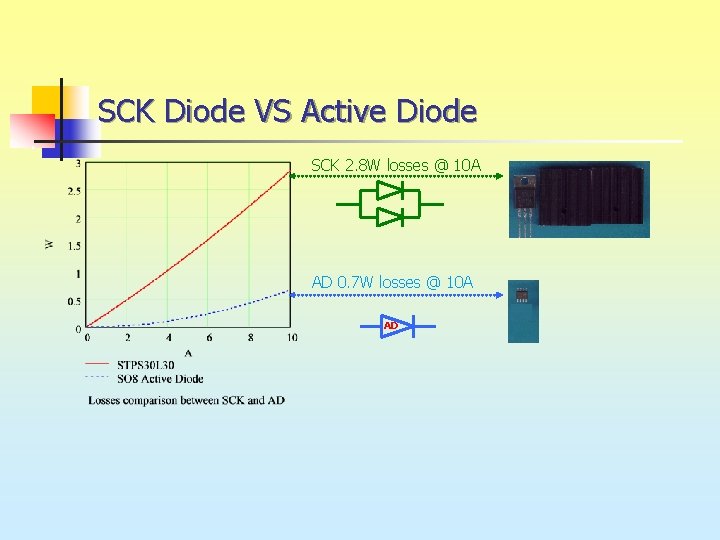
SCK Diode VS Active Diode SCK 2. 8 W losses @ 10 A AD 0. 7 W losses @ 10 A AD
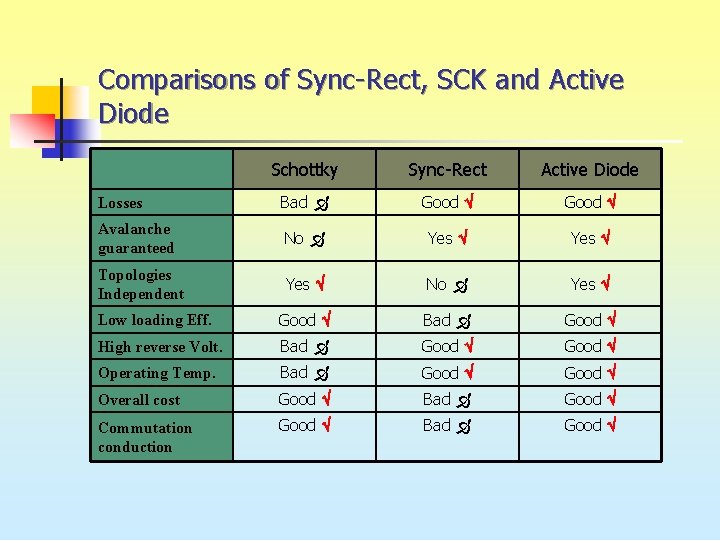
Comparisons of Sync-Rect, SCK and Active Diode Schottky Sync-Rect Active Diode Losses Bad Good Avalanche guaranteed No Yes Topologies Independent Yes No Yes Low loading Eff. Good Bad Good High reverse Volt. Bad Good Operating Temp. Bad Good Overall cost Good Bad Good Commutation conduction Good Bad Good
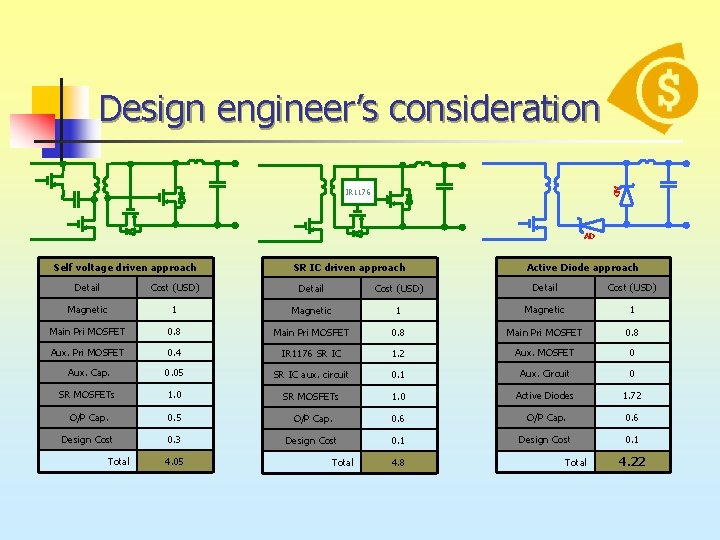
Design engineer’s consideration AD IR 1176 AD Self voltage driven approach SR IC driven approach Active Diode approach Detail Cost (USD) Magnetic 1 Main Pri MOSFET 0. 8 Aux. Pri MOSFET 0. 4 IR 1176 SR IC 1. 2 Aux. MOSFET 0 Aux. Cap. 0. 05 SR IC aux. circuit 0. 1 Aux. Circuit 0 SR MOSFETs 1. 0 Active Diodes 1. 72 O/P Cap. 0. 5 O/P Cap. 0. 6 Design Cost 0. 3 Design Cost 0. 1 Total 4. 05 Total 4. 8 Total 4. 22
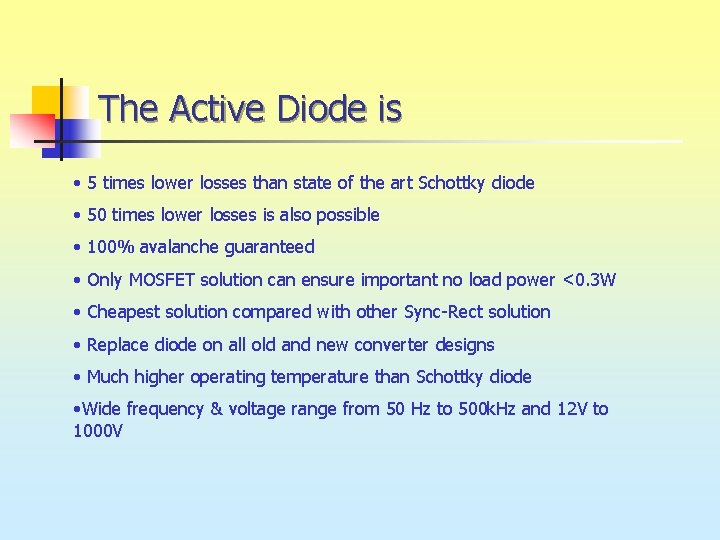
The Active Diode is • 5 times lower losses than state of the art Schottky diode • 50 times lower losses is also possible • 100% avalanche guaranteed • Only MOSFET solution can ensure important no load power <0. 3 W • Cheapest solution compared with other Sync-Rect solution • Replace diode on all old and new converter designs • Much higher operating temperature than Schottky diode • Wide frequency & voltage range from 50 Hz to 500 k. Hz and 12 V to 1000 V
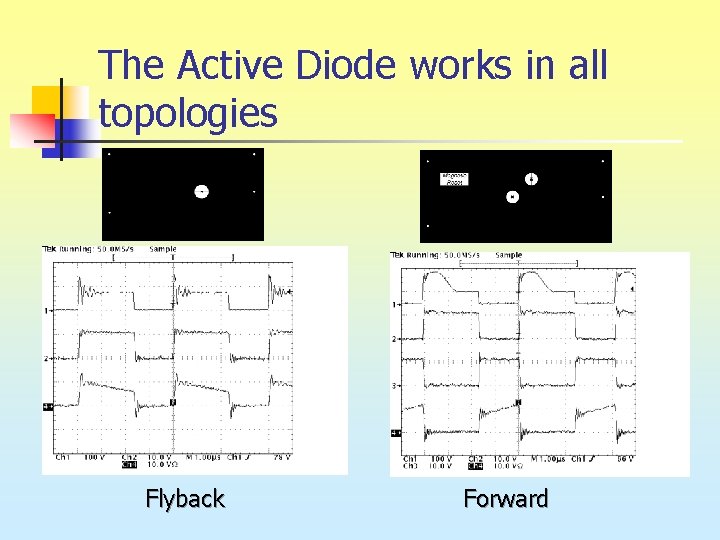
The Active Diode works in all topologies Flyback Forward
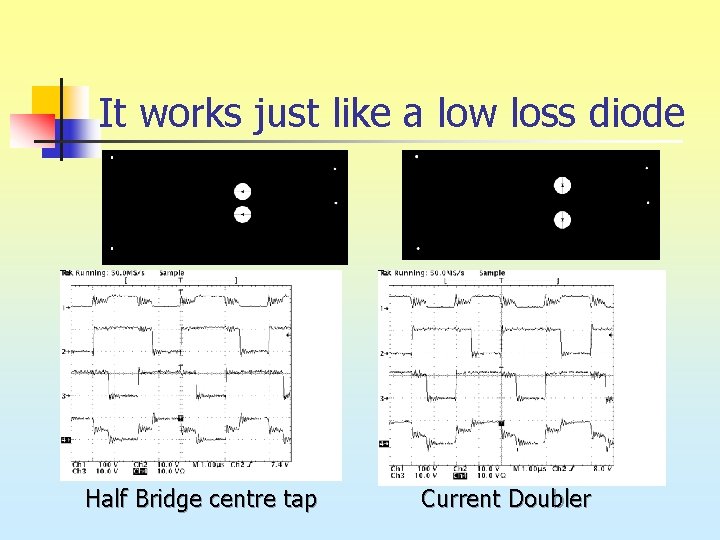
It works just like a low loss diode Half Bridge centre tap Current Doubler
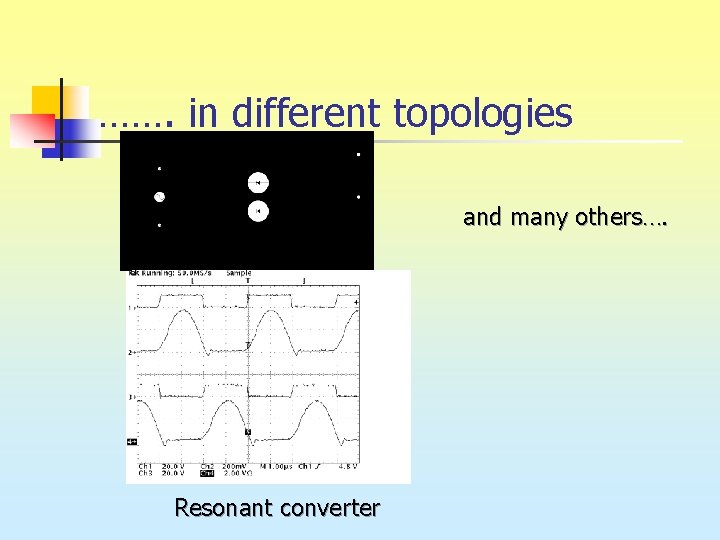
……. in different topologies and many others…. Resonant converter
Conclusions n n n A new “Active Diode” technology is presented A kind of current driven synchronous rectifier which solves many problems of the conventional Sync Rect Well proven by many converter designs