
The Action Mindset Managing Change OS 608 December
The Action Mindset: Managing Change OS 608 December 11, 2006 Fisher
Agenda n n n A model of organizational change Resistance to change Overcoming resistance to change
Importance of the Action Mindset n n The reason that we've fallen into this knowing-doing gap is this: Doing something actually requires doing something! It means tackling the hard work of making something happen. It's much easier and much safer to sit around and have intellectual conversations, to gather large databases, to invest in technical infrastructure -- and never actually implement anything. Alan Webber interview with Jeffrey Pfeffer, Fast Company, June 2000
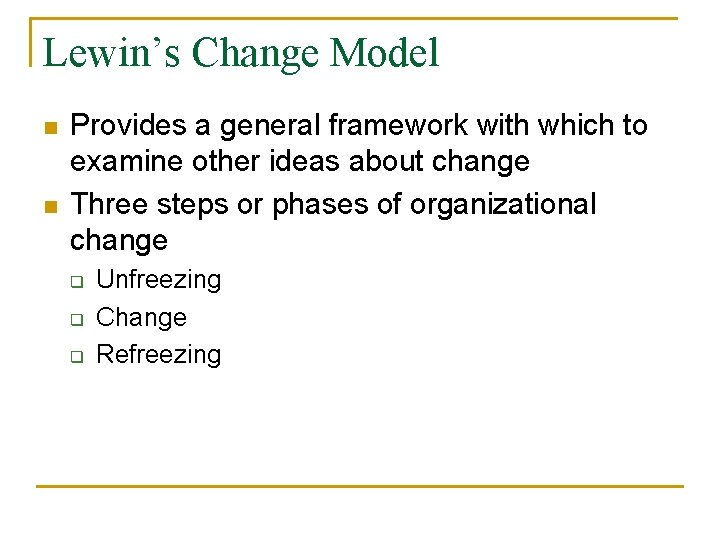
Lewin’s Change Model n n Provides a general framework with which to examine other ideas about change Three steps or phases of organizational change q q q Unfreezing Change Refreezing
Role of the Manager/Leader n Gosling and Mintzberg’s example of a chariot pulled by wild horses (p. 7) q q n “whipping the horses into a frenzy”? “holding a steady course”? Detecting the need for change q q Top-down, strategic Bottom-up, emergent
Logic vs. emotion in “unfreezing” stage n n Deutschmann suggests data and facts are not really persuasive in creating a need for change? Do you agree? Why or why not? Emotional appeals for change Why not fear? Isn’t fear an emotion? Cynicism often derails efforts to communicate the value of change.
Time Frame is important n Reason for change must be proximal q n Need early reinforcement of change q n Short term vs. long term thinking “short term wins” Providing immediate support for the change
Magnitude of Change n n n Incremental vs. framebreaking Incremental is often viewed as easier because less behavioral change is required. Deutschmann suggests framebreaking change is actually easier. Why?
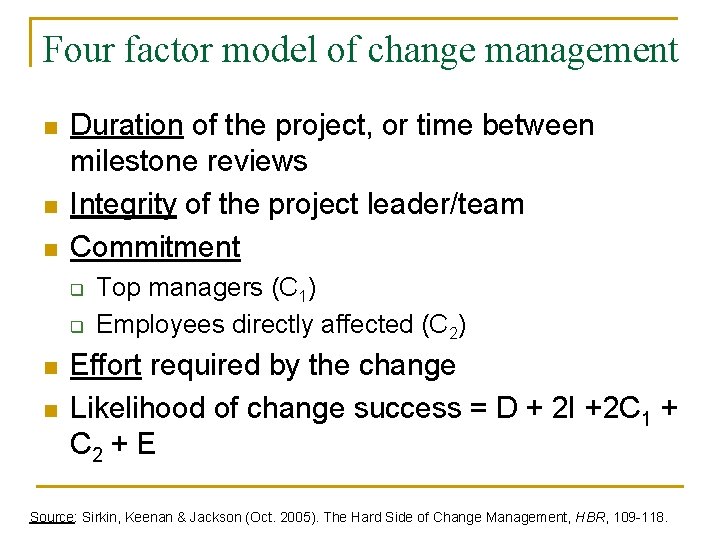
Four factor model of change management n n n Duration of the project, or time between milestone reviews Integrity of the project leader/team Commitment q q n n Top managers (C 1) Employees directly affected (C 2) Effort required by the change Likelihood of change success = D + 2 I +2 C 1 + C 2 + E Source: Sirkin, Keenan & Jackson (Oct. 2005). The Hard Side of Change Management, HBR, 109 -118.
External Change Agents n n What is the role of the external change agent? Is an external agent more or less effective in facilitating change?

For Wednesday n n Both sections will meet together at 11: 00 in 214 No new readings Course wrap up, evaluations Will discuss final exam further as needed
- Slides: 11