
THE ACT TIPS TRICKS AND SKILLS PART 2


- Slides: 43
THE ACT TIPS, TRICKS, AND SKILLS PART 2
Don’t freak out…. – While the act is not the most important thing in your entire life and is NOT the be-all and end-all of high school, it can be very helpful to you!
The ACT requires a very specific set of skills that you must master. This presentation is designed to help you identify those skills so that you may STUDY AND PERFECT THEM!
What do you already know?
The ACT does not hide information from you! – It is not sneaky! – It is not a trick! – It tests the same skills over and over again! – Go to ACT. ORG to find out more information. – There also many links on my portal (portal. com/guest/mcday) – YOU CAN STUDY!
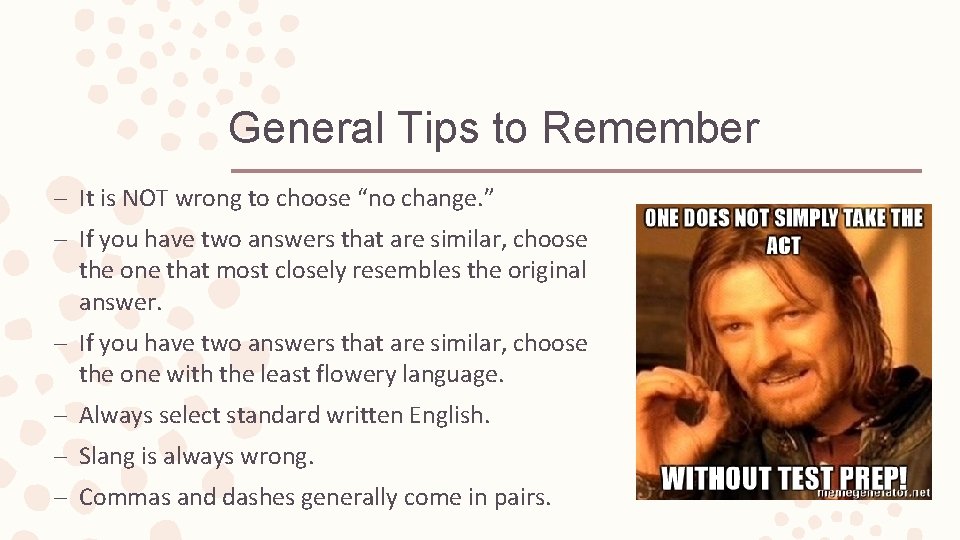
General Tips to Remember – It is NOT wrong to choose “no change. ” – If you have two answers that are similar, choose the one that most closely resembles the original answer. – If you have two answers that are similar, choose the one with the least flowery language. – Always select standard written English. – Slang is always wrong. – Commas and dashes generally come in pairs.
ACT English- 45 mins/75 questions BUT WHAT ARE THOSE SKILLS? !! You are stranded on a desert island you have only SEVEN skills to take along…. 7 s l l i k s
1. SENTENCE STRUCTURE
ACT English: Sentence Structure – There are NO ACT questions about simple sentences. – All are complex, compound/complex, or involve extra phrases. – The ACT LOVES COMPOUND SENTENCES.
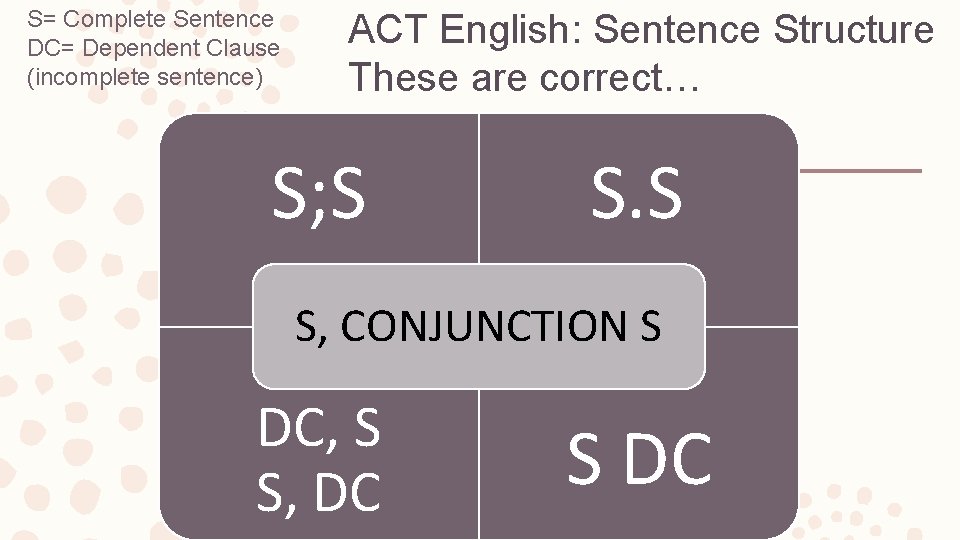
S= Complete Sentence DC= Dependent Clause (incomplete sentence) ACT English: Sentence Structure These are correct… S; S S, CONJUNCTION S DC, S S, DC S DC
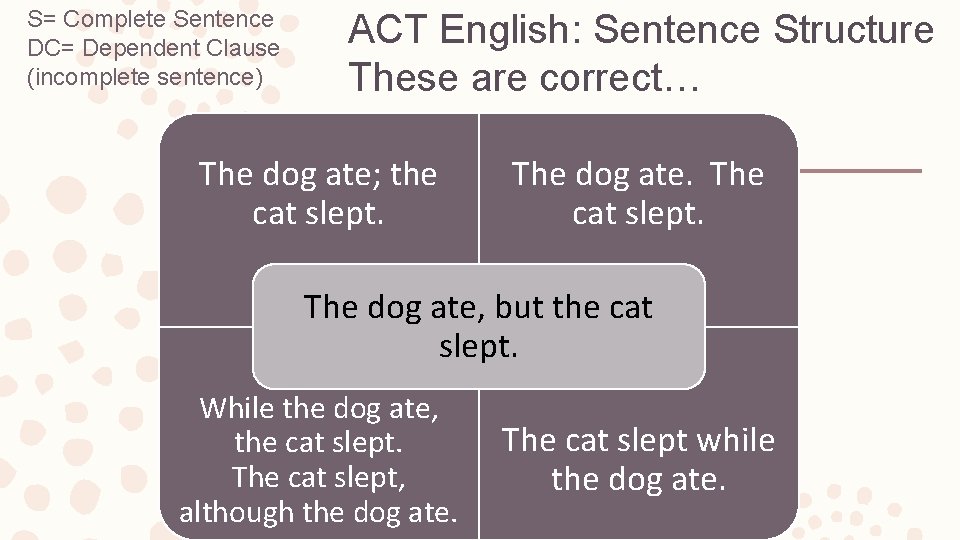
S= Complete Sentence DC= Dependent Clause (incomplete sentence) ACT English: Sentence Structure These are correct… The dog ate; the cat slept. The dog ate. The cat slept. The dog ate, but the cat slept. While the dog ate, the cat slept. The cat slept, although the dog ate. The cat slept while the dog ate.
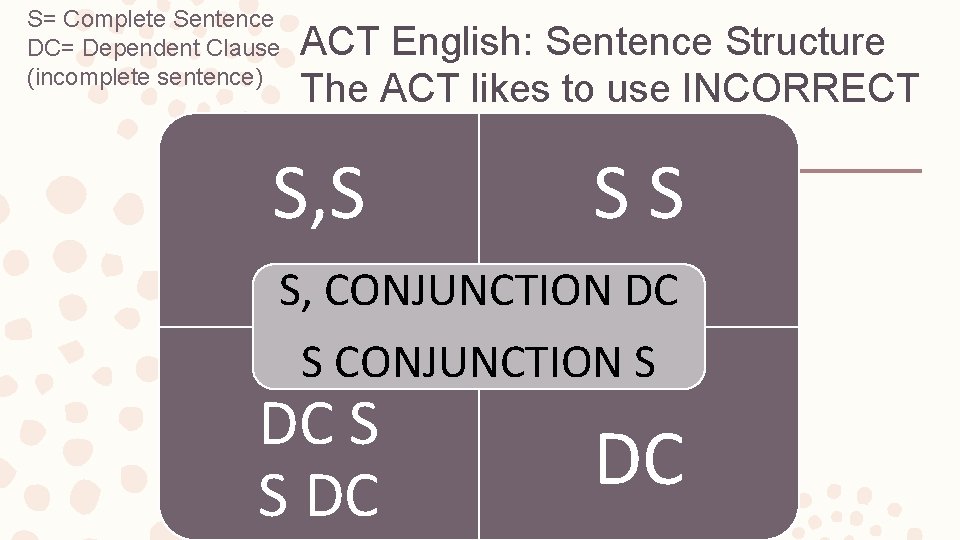
S= Complete Sentence DC= Dependent Clause (incomplete sentence) ACT English: Sentence Structure The ACT likes to use INCORRECT structures… S, S SS S, CONJUNCTION DC S CONJUNCTION S DC S S DC DC
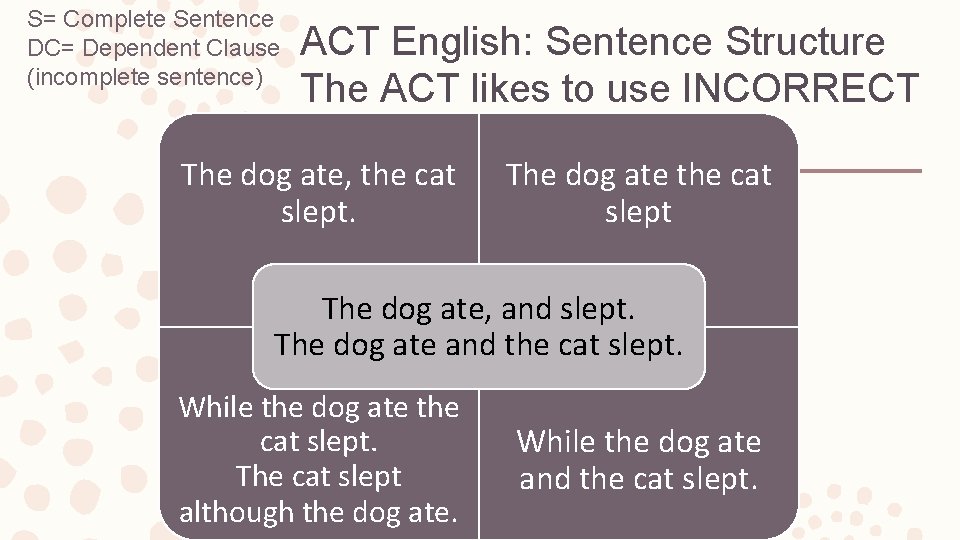
S= Complete Sentence DC= Dependent Clause (incomplete sentence) ACT English: Sentence Structure The ACT likes to use INCORRECT structures… The dog ate, the cat slept. The dog ate the cat slept The dog ate, and slept. The dog ate and the cat slept. While the dog ate the cat slept. The cat slept although the dog ate. While the dog ate and the cat slept.
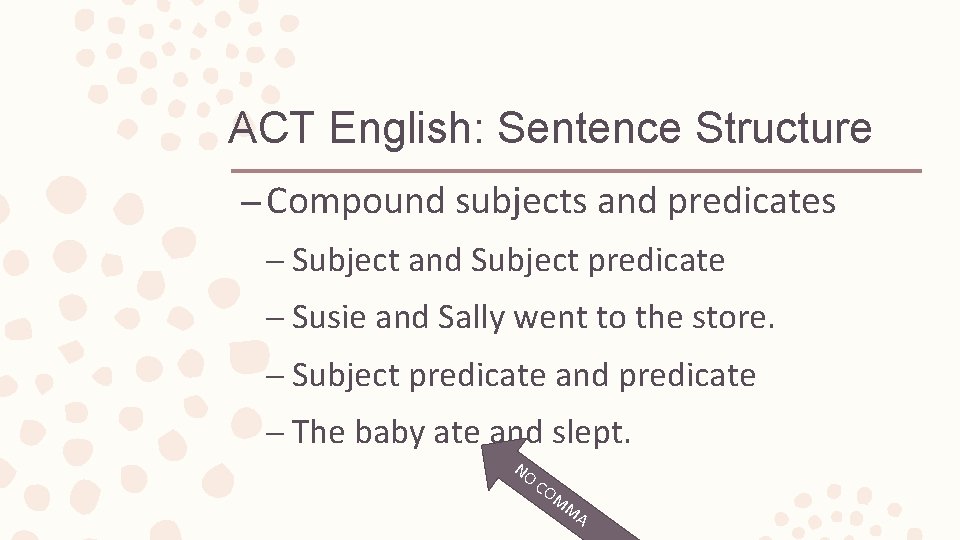
ACT English: Sentence Structure – Compound subjects and predicates – Subject and Subject predicate – Susie and Sally went to the store. – Subject predicate and predicate – The baby ate and slept. NO CO M M A
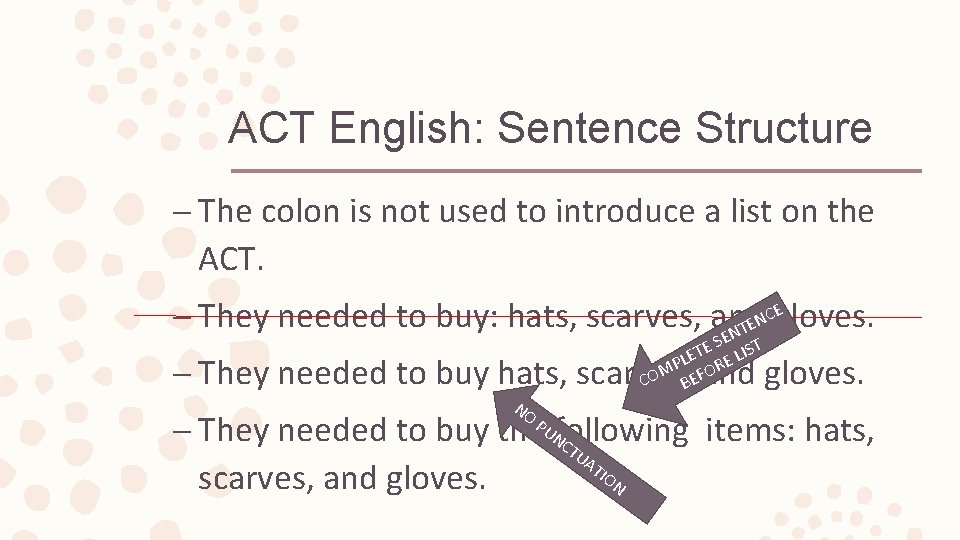
ACT English: Sentence Structure – The colon is not used to introduce a list on the ACT. E Cgloves. N – They needed to buy: hats, scarves, and E T EN E S LIST T E PL ORE M CO BEF – They needed to buy hats, scarves, and gloves. NO – They needed to buy the Nfollowing items: hats, CT UA TIO N scarves, and gloves. PU
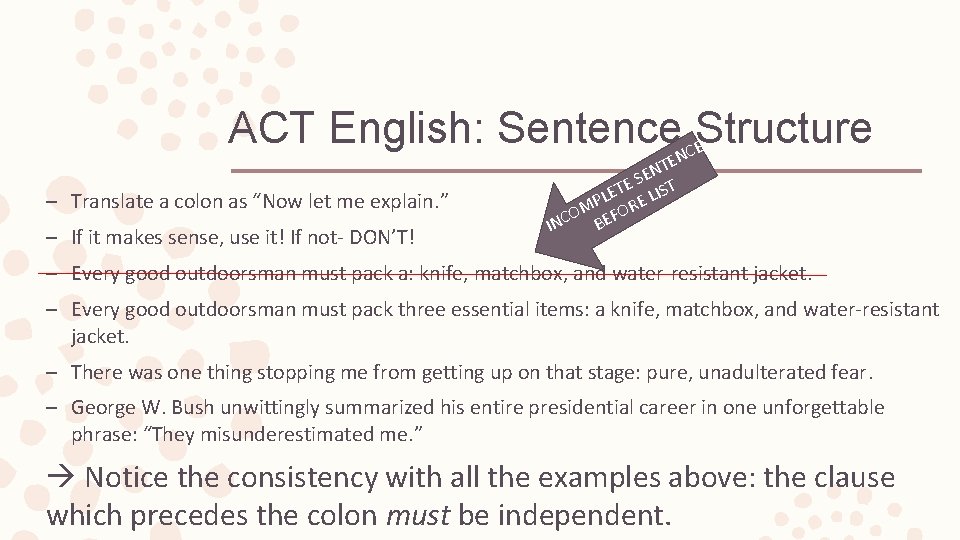
ACT English: Sentence. NCStructure E – Translate a colon as “Now let me explain. ” – If it makes sense, use it! If not- DON’T! TE N SE T LE E LIS P OM EFOR C B IN – Every good outdoorsman must pack a: knife, matchbox, and water-resistant jacket. – Every good outdoorsman must pack three essential items: a knife, matchbox, and water-resistant jacket. – There was one thing stopping me from getting up on that stage: pure, unadulterated fear. – George W. Bush unwittingly summarized his entire presidential career in one unforgettable phrase: “They misunderestimated me. ” Notice the consistency with all the examples above: the clause which precedes the colon must be independent.
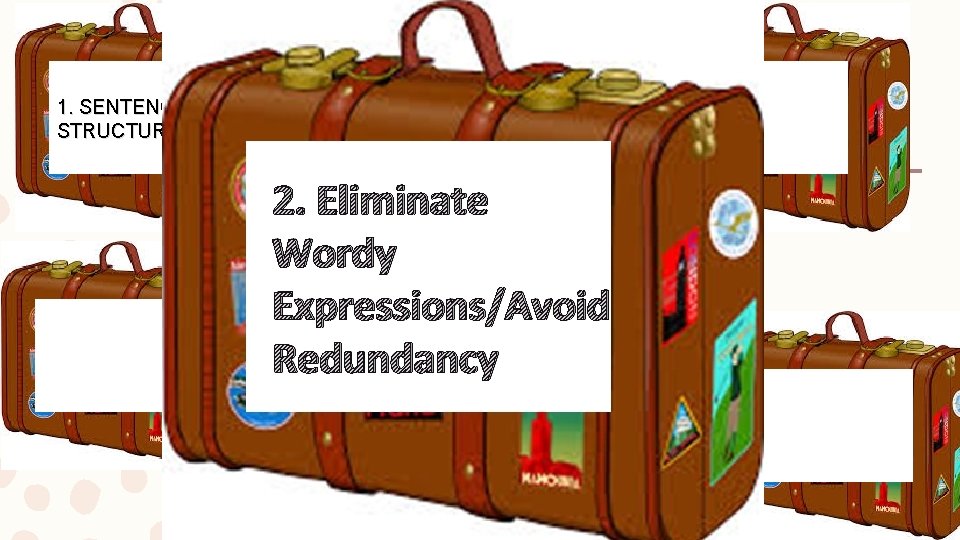
1. SENTENCE STRUCTURE 2. ELIMINATE WORDY EXPRESSIONS 2. Eliminate Wordy Expressions/Avoid Redundancy
ACT English – The shorter, the better! – CLEAR, DIRECT, AND CONSISE DICTION – CLEAR DICTION – NO FLUFF – The ACT hates long, fancy phrases and words. If they had to look a word up in thesaurus, it’s probably not the answer.
1. SENTENCE STRUCTURE 2. ELIMINATE WORDY EXPRESSIONS 3. Pick the EXACT word! Good Diction Matters! 3. PICK THE EXACT WORD!
ACT English – Pay close attention to transitional words and phrases – Pay close attention to prepositions – The ACT LOVES transitions
ACT English – Know different transition families, and use them correctly. – “and” – Adds information (furthermore, additionally, etc…) – “so” – Causation (therefore, consequently, etc…) – “but” – Contrasts (however, nevertheless, etc…)
1. SENTENCE STRUCTURE 4. FOLLOW DIRECTIONS PRECISELY! 2. ELIMINATE WORDY EXPRESSIONS 4. Follow Directions PRECISELY! 3. PICK THE EXACT WORD!
ACT English – The question is a set of directions to be followed EXACTLY. – The answer you choose should actually “Follow the Directions” – Note words such as “except”, “all”, etc.
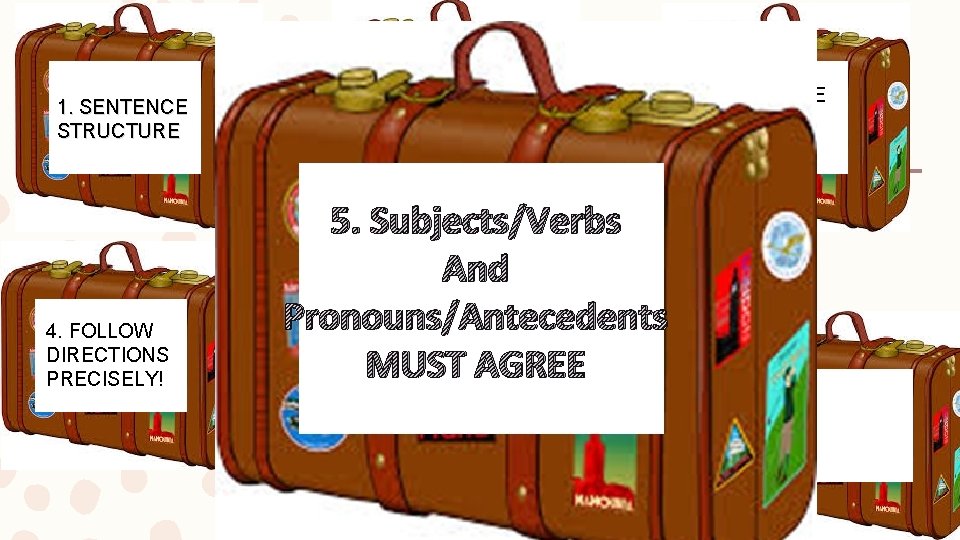
1. SENTENCE STRUCTURE 4. FOLLOW DIRECTIONS PRECISELY! 2. ELIMINATE WORDY EXPRESSIONS 5. Subjects/Verbs And Pronouns/Antecedents MUST AGREE 5. SUB/VERBS PRON/ANTEC. MUST AGREE 3. PICK THE EXACT WORD!
ACT English – CLASSIC ACT QUESTIONS! – These are DESIGNED to throw you off. – The subject will be way early in the sentence. – There will be MANY extra words between the subject and verb.
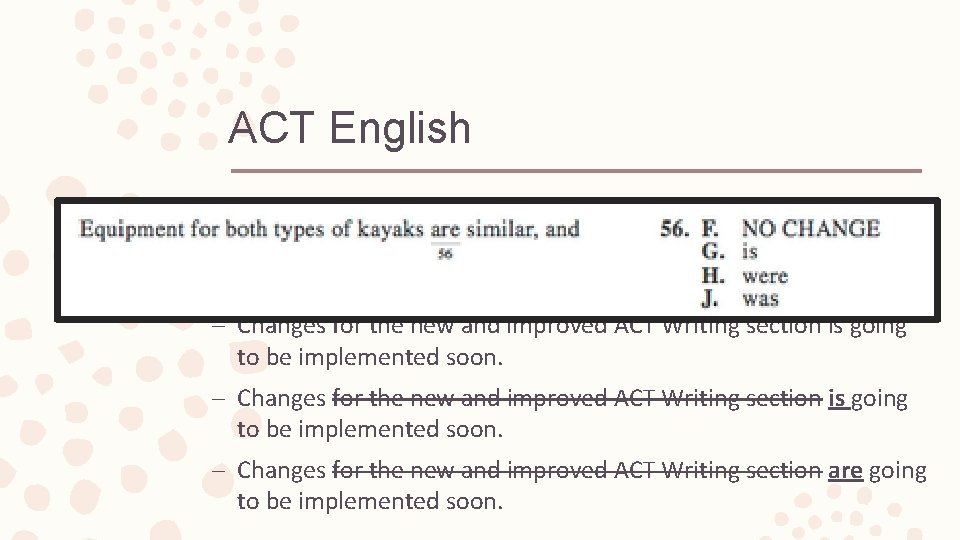
ACT English – Objects of the preposition are never the subjects of a sentence. – If there is a phrase between the subject and the verb, cross it out to find the subject. – Changes for the new and improved ACT Writing section is going to be implemented soon. – Changes for the new and improved ACT Writing section are going to be implemented soon.
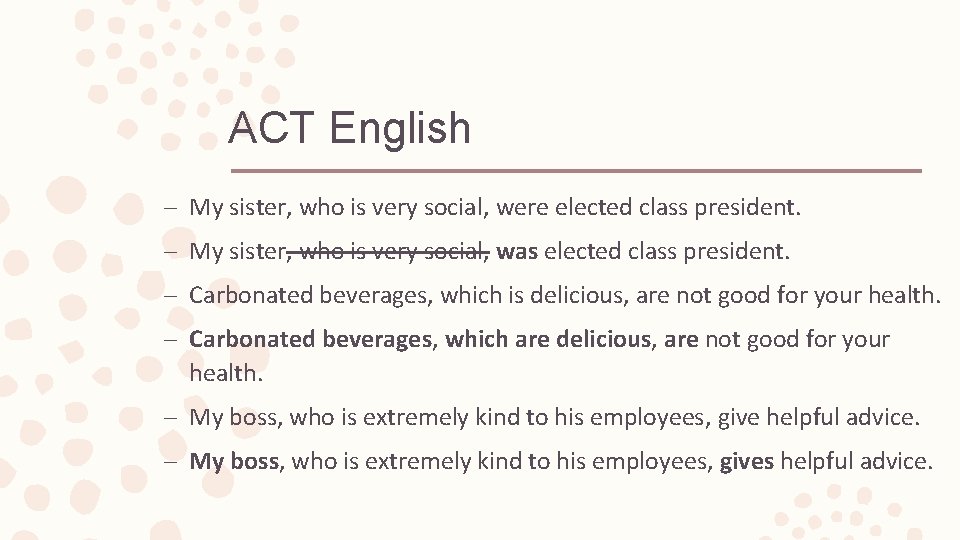
ACT English – My sister, who is very social, were elected class president. – My sister, who is very social, was elected class president. – Carbonated beverages, which is delicious, are not good for your health. – Carbonated beverages, which are delicious, are not good for your health. – My boss, who is extremely kind to his employees, give helpful advice. – My boss, who is extremely kind to his employees, gives helpful advice.
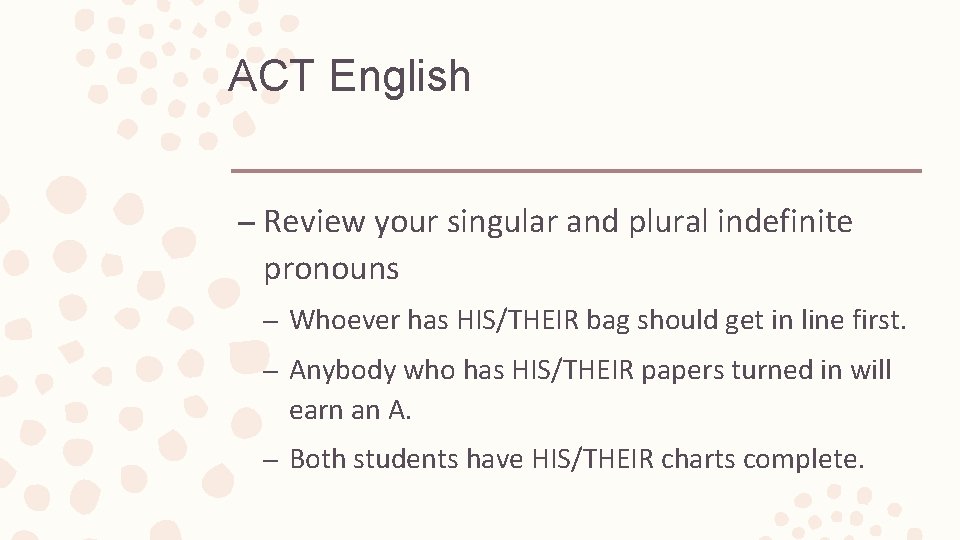
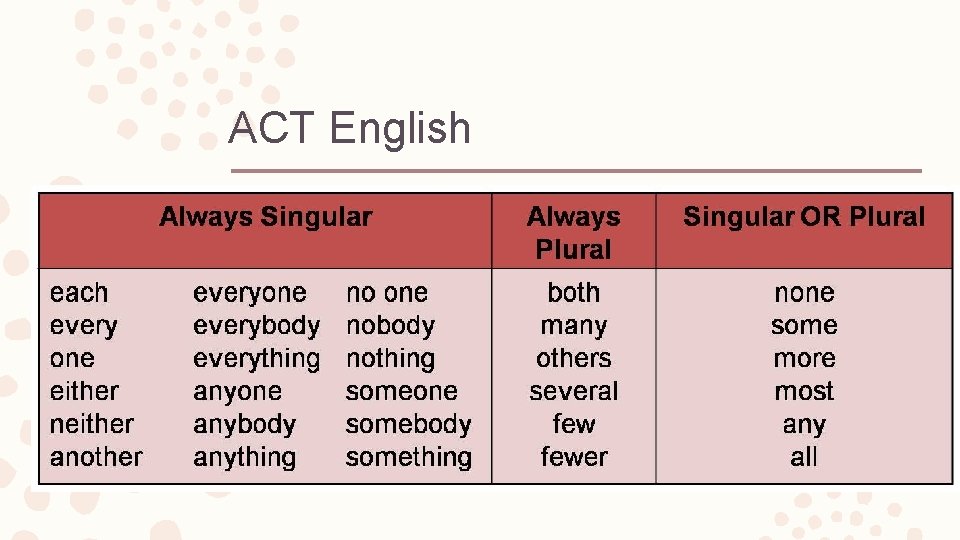
ACT English – Review your singular and plural indefinite pronouns – Whoever has HIS/THEIR bag should get in line first. – Anybody who has HIS/THEIR papers turned in will earn an A. – Both students have HIS/THEIR charts complete.
ACT English
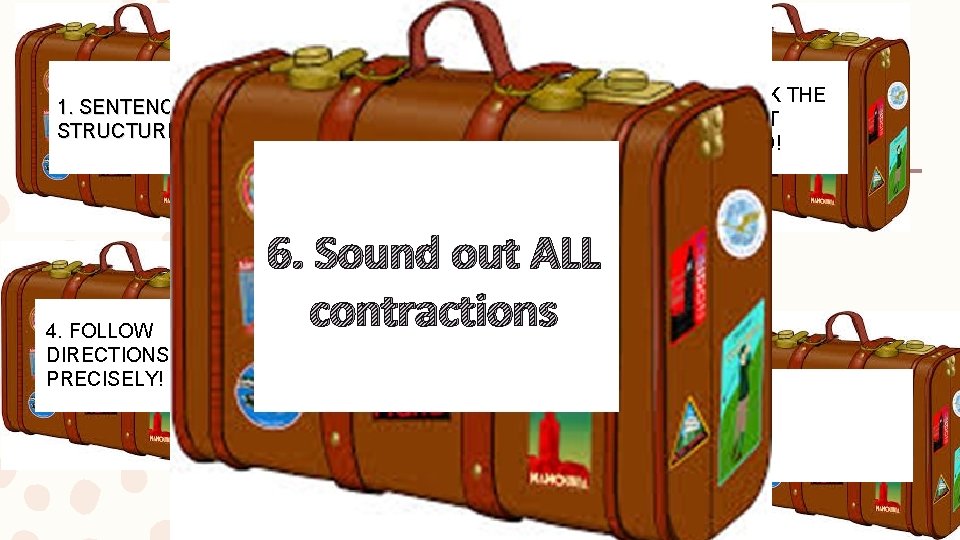
1. SENTENCE STRUCTURE 4. FOLLOW DIRECTIONS PRECISELY! 2. ELIMINATE WORDY EXPRESSIONS 3. PICK THE EXACT WORD! 6. Sound out ALL contractions 6. SOUND OUT ALL CONTRACTIONS 5. SUB/VERBS PRON/ANTEC. MUST AGREE
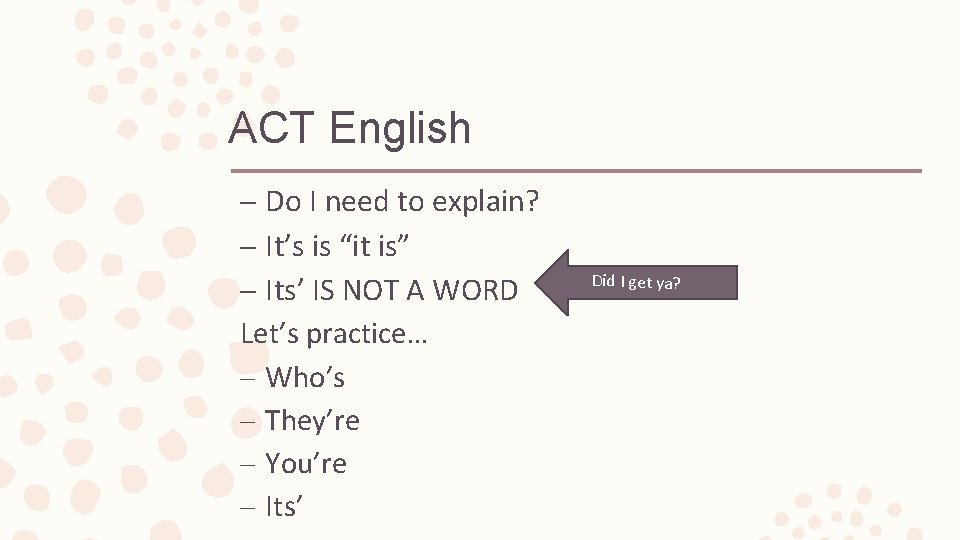
ACT English – Do I need to explain? – It’s is “it is” – Its’ IS NOT A WORD Let’s practice… – Who’s – They’re – You’re – Its’ Did I get ya?
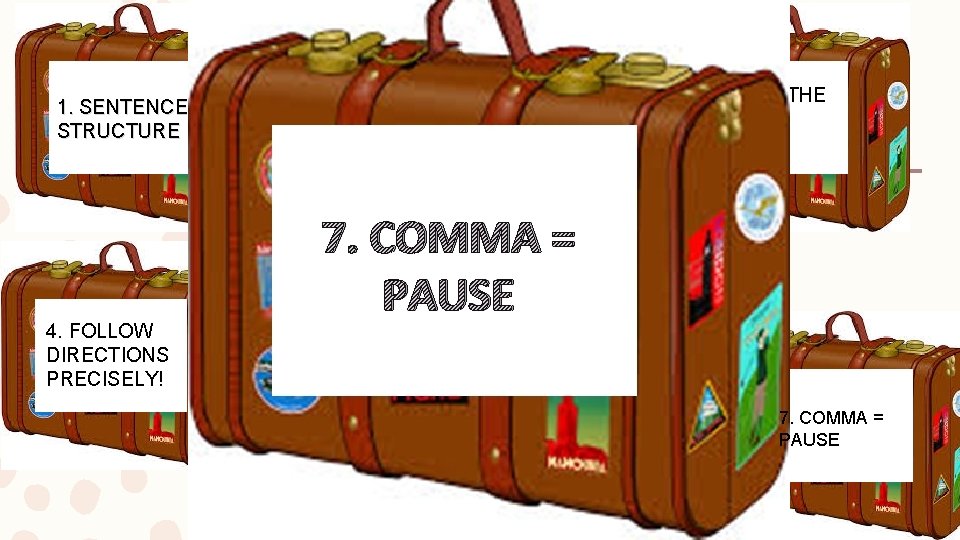
1. SENTENCE STRUCTURE 4. FOLLOW DIRECTIONS PRECISELY! 2. ELIMINATE WORDY EXPRESSIONS 3. PICK THE EXACT WORD! 7. COMMA = PAUSE 6. SOUND OUT ALL CONTRACTIONS 5. SUB/VERBS PRON/ANTEC. MUST AGREE 7. COMMA = PAUSE
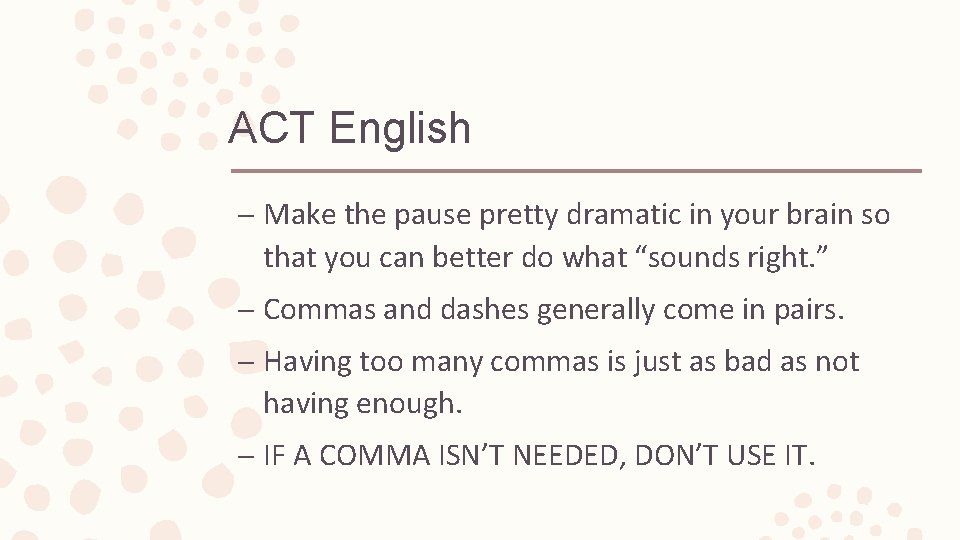
ACT English – Make the pause pretty dramatic in your brain so that you can better do what “sounds right. ” – Commas and dashes generally come in pairs. – Having too many commas is just as bad as not having enough. – IF A COMMA ISN’T NEEDED, DON’T USE IT.
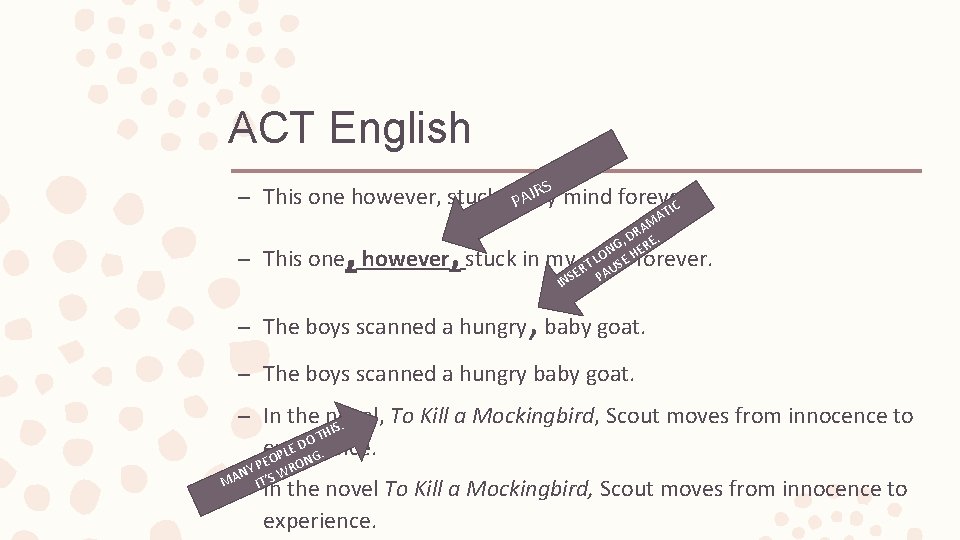
ACT English IRS mind forever. – This one however, stuck in. PAmy IC T , MA A R , D RE. G ON E HE L S T ER PAU S IN , – This one however stuck in my mind forever. , – The boys scanned a hungry baby goat. – In the novel, To Kill a Mockingbird, Scout moves from innocence to. S I H OT D experience. LE. EOP NG O P NY ’S WR A M IT – In the novel To Kill a Mockingbird, Scout moves from innocence to experience.
Reading Test: 40 questions, 35 minutes – You're asked to read several passages and answer questions that show your understanding of: – what is directly stated – statements with implied meanings – Specifically, you will use referring and reasoning skills to: – determine main ideas – locate and interpret significant details – understand sequences of events – make comparisons – comprehend cause-effect relationships – determine the meaning of context-dependent words, phrases, and statements – draw generalizations
Four types of reading selections – Prose Fiction (25%). Questions in this category are based on intact short stories or excerpts from short stories or novels. – Social Studies (25%). Questions in this category are based on passages in the content areas of anthropology, archaeology, biography, business, economics, education, geography, history, political science, psychology, and sociology. – Humanities (25%). Questions in this category are based on passages from memoirs and personal essays and in the content areas of architecture, art, dance, ethics, film, language, literary criticism, music, philosophy, radio, television, and theater. – Natural Sciences (25%). Questions in this category are based on passages in the content areas of anatomy, astronomy, biology, botany, chemistry, ecology, geology, medicine, meteorology, microbiology, natural history, physiology, physics, technology, and zoology.
Mastering the ACT: Reading Section – You do not have to read the passages in that order. – Read your favorite one FIRST. – Read the one you dread at the very end. – Adjust your time: Skim the passages for about 30 seconds eac – Passage 1 (your favorite): 10 minutes – Passage 2: 10 minutes – Passage 3: 10 minutes – Passage 4 (Least favorite): 5 minutes
Mastering the ACT: Reading Section – Intentionally choose your favorite passages. – TRY TO SCORE HIGH ON YOUR FAVORITE PASSAGES. – DO NOT GO OVER YOUR TIME LIMIT FOR EACH PASSAGE. – Jot down the starting times of each passage in your test booklet so you know when to move on. – DO NOT LEAVE ANY QUESTIONS BLANK. – For this to work, you must do REALLY well on the 3 favorite passages.
Mastering the ACT: Reading Section in 4 easy steps for your 3 favorite passages 1. Read just the first sentence. 2. Write in the top margin the time you must be DONE with the passage and questions. Remember: 10 minutes per passage! 3. Skim the questions first. It will help you understand the passage far better. 4. Skim or speed read the passage. 5. Read, answer, repeat for next passage.
Mastering the ACT: Reading Section in 4 easy steps for your least favorite passage 1. Scan the questions for single line references. Answer those first. 2. Then, scan the passage. Answer questions as best you can. 3. With 30 seconds left, answer the same letter choice for all questions you have left.
Reminders – Never leave an answer blank. – This will work only if you focus fully on the first 3 passage and get 9 or 10 right.
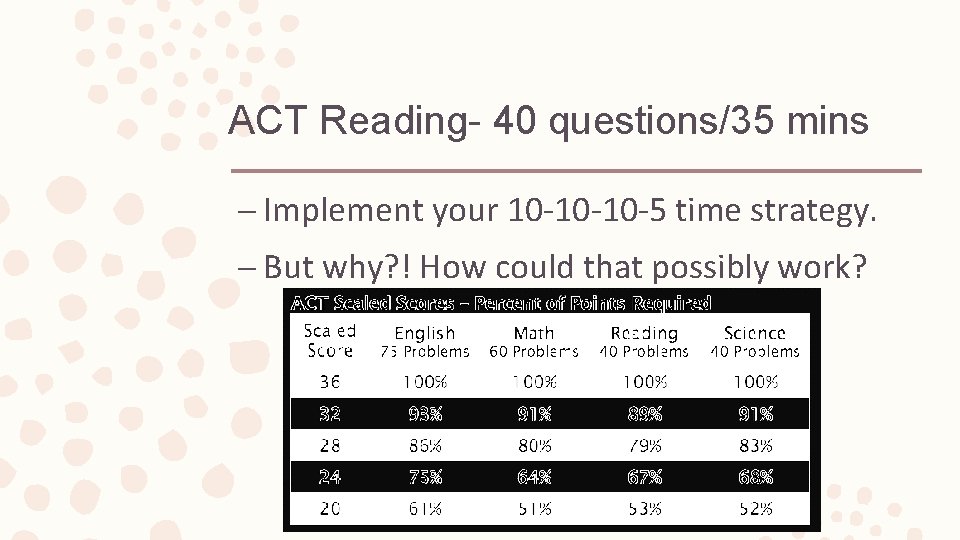
ACT Reading- 40 questions/35 mins – Implement your 10 -10 -10 -5 time strategy. – But why? ! How could that possibly work?