
The Academic Job Search applications interviews job talk
The Academic Job Search applications, interviews, job talk, teaching demonstration, negotiations Heather Macdonald, Jennifer Anderson, David Budd, Matthew Kirby, Rachel O’Brien, Rajul Pandya, Sara Rathburn, Joshua Villalobos On the Cutting Edge Preparing for an Academic Career Workshop http: //serc. carleton. edu/NAGTWorkshops/careerprep/jobsearch/index. html
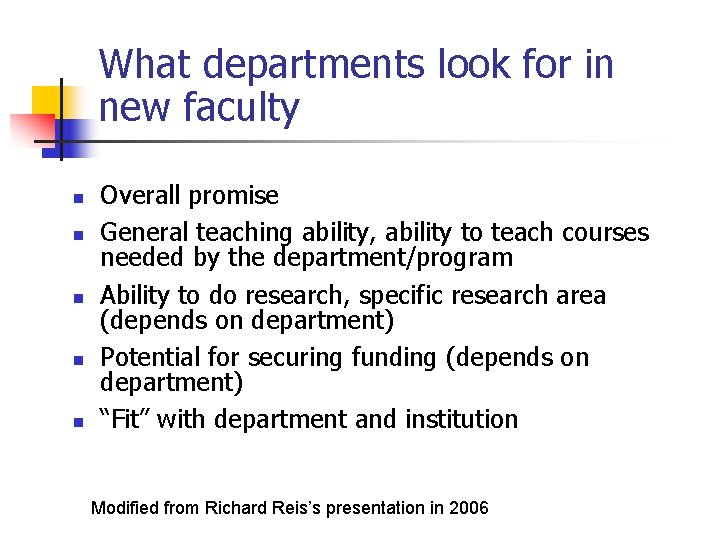
What departments look for in new faculty n n n Overall promise General teaching ability, ability to teach courses needed by the department/program Ability to do research, specific research area (depends on department) Potential for securing funding (depends on department) “Fit” with department and institution Modified from Richard Reis’s presentation in 2006
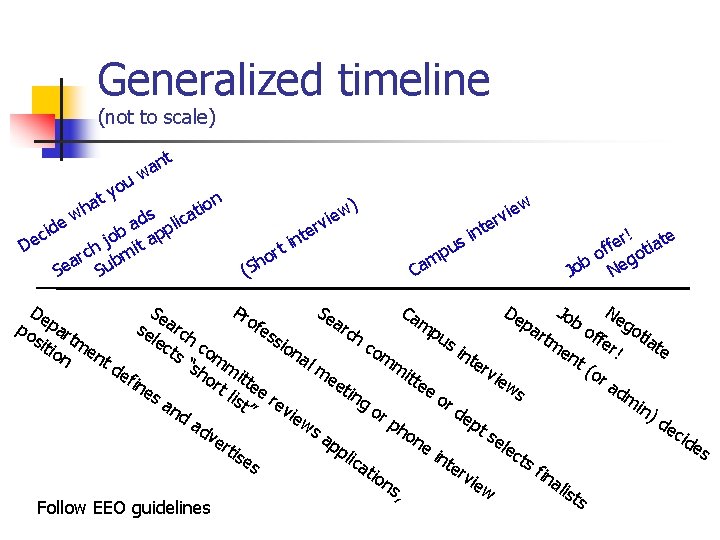
Generalized timeline (not to scale) o y at wh nt a uw ds lic e a d ci ob t app j e D rch bmi a Se Su n w ) o ati o h S ( r te n i t ie v r e w vie r m Ca pu nt i s er! tiate f f b o ego o J N Se Se De Jo Ne Pr Ca o b a a m pa fes rch se rch of goti p r u lec t fer sio at m s c c e o e i ts om ! na n m n t t e “s lm mi m de rv (o h i t t i e o ra fin e t t et e rt e e w e es dm ing s lis or an t” rev in) or de iew da de pt ph dv sa cid o se ne er p l es ec tis pli i n t es ca sf te tio rv ina iew ns lis , ts Follow EEO guidelines De po par sit tm ion en t
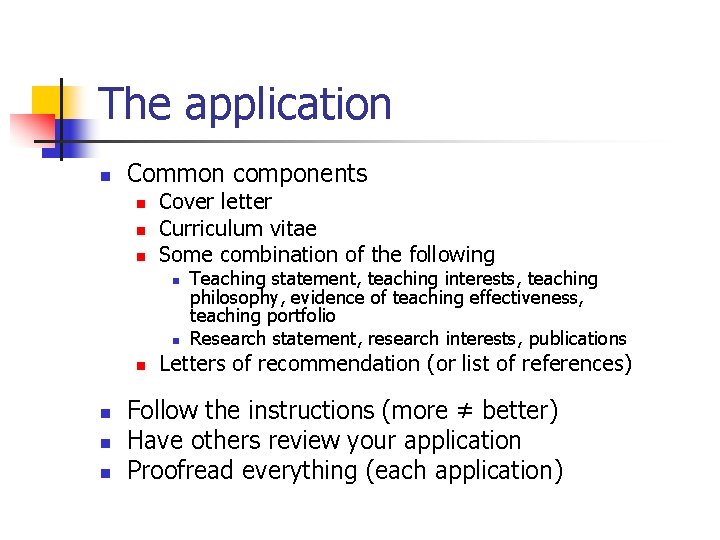
The application n Common components n n n Cover letter Curriculum vitae Some combination of the following n n n Teaching statement, teaching interests, teaching philosophy, evidence of teaching effectiveness, teaching portfolio Research statement, research interests, publications Letters of recommendation (or list of references) Follow the instructions (more ≠ better) Have others review your application Proofread everything (each application)
Customize applications n n n Additional time and effort May provide competitive advantage Customized statements in the cover letter (and possibly in teaching and/or research statement) Specific references to the institution, department, individuals where appropriate Might identify how you would complement their curriculum, research, other needs (but be careful)
Your references n n Familiar with your work (teaching, research) “Can you write me a positive recommendation? ” You can ask people to focus on a particular strength or aspect of you/your experience You may ask a reference to explain special circumstances: n n n Gaps in your CV, job changes, advisor complications Make sure they know the type of position Give plenty of time (2 weeks or more) and check with them before the deadline
Off-campus interviews n Short interviews n n n Professional meeting interviews Phone, teleconference, or Skype interviews Some tips n n Be engaging and enthusiastic Know the key points you want to make Provide specific examples Avoid spending too much time answering a given question
Campus interviews n Components n Individual or small-group sessions n n n n Individual faculty Groups of faculty Students Chair of search committee Department Chair Dean, Provost, and/or other administrator Teaching demonstration (depends on dept) Job talk (about your research) Meals, social gathering Be positive, interested, and professional Do your research and be prepared to ask questions Everything is part of the interview You are also interviewing them
Campus interviews at community colleges n Components n n n Meet with search committee (represents the college) and answer their questions (same questions for all campus interviewees) Meet with administrator(s) Give a teaching demonstration on specific topic (10 -30 minutes) Be positive, interested, professional Do your research and be prepared to ask questions
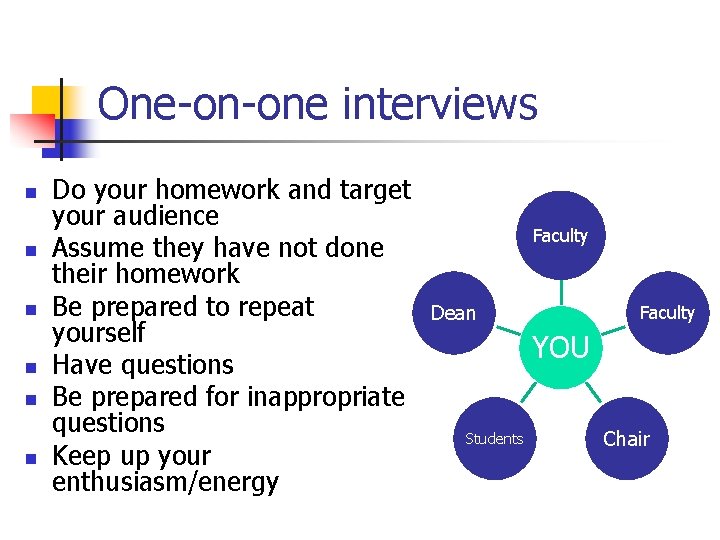
One-on-one interviews n n n Do your homework and target your audience Assume they have not done their homework Be prepared to repeat yourself Have questions Be prepared for inappropriate questions Keep up your enthusiasm/energy Faculty Dean Faculty YOU Students Chair

Interview questions

Insights from interview question session
The job talk n n Consider the audience Make it a story n n n Introduction to engage audience and provide context and significance Heart of the talk - showcase your research and include clear statement of research questions Strong end – conclusions and future plans Engaging visuals Watch the timing

Preparing for the job talk
Teaching demonstration n n n n Do what is asked; target your demo at the appropriate level Ask for clarification if needed Be yourself, choose something that lets you shine and that you know will work If it involves student interaction, keep it low-risk Have a clear goal that is more than telling the students about something Be able to explain why you did what you did Provide context if appropriate; if the lecture topic is up to you, consider providing a syllabus so your audience knows where your demonstration fits into your class Practice, practice, and time with students
Negotiating n n n What can be negotiated? The negotiation process (it varies) Strategies for negotiating

Questions?
- Slides: 17