
The Academic Competence Evaluation Scales ACES Rating scale


- Slides: 30
The Academic Competence Evaluation Scales (ACES) Rating scale technology for identifying students with academic difficulties and planning interventions to improve their functioning. Copyright © 2001 by The Psychological Corporation 1
Definition of Academic Competence v Academic competence is… a multidimensional construct composed of the skills, attitudes and behaviours of a learner that contribute to academic success in the classroom. Copyright © 2001 by The Psychological Corporation 2
Purpose and Uses of the ACES v Assess academic skills and enabling behaviours for students in grades k-12 and college v Facilitate planning and evaluation of classroom-based interventions for students experiencing academic difficulty Copyright © 2001 by The Psychological Corporation 3
ACES Overview v Three record forms: Teacher, Student and College Student Teacher Form appropriate for Grades k-12 u Student Form appropriate for Grades 6 -12 u College Student Form appropriate for students at 2 and 4 -year institutions u v v Technical Manual Scoring Assistant (Optional) Copyright © 2001 by The Psychological Corporation 4
ACES Teacher: Sample Items v Please see your copy of the ACES record form to review sample items. Copyright © 2001 by The Psychological Corporation 5
Companion Intervention Resources: AIMS v The Academic Intervention Monitoring System (AIMS) is a companion guidebook that describes effective intervention strategies for skills measured by the ACES. v The AIMS Forms are questionnaires designed to facilitate identification of specific instructional or learning tactics used by teachers, parents and students. Copyright © 2001 by The Psychological Corporation 6
Companion Intervention Monitoring Method: GAS v Goal Attainment Scaling (GAS) provides a quick and reliable method for assessing change in student skills during intervention. GASs are developed by users after completing the ACES. v Together, the ACES, AIMS & a GAS can be used as part of a 5 -step problem-solving process for developing and evaluating interventions for academic difficulties. Copyright © 2001 by The Psychological Corporation 7
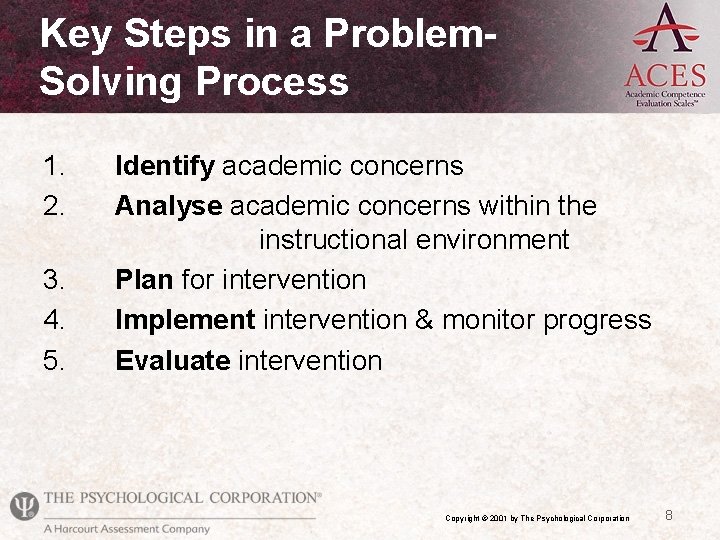
Key Steps in a Problem. Solving Process 1. 2. 3. 4. 5. Identify academic concerns Analyse academic concerns within the instructional environment Plan for intervention Implement intervention & monitor progress Evaluate intervention Copyright © 2001 by The Psychological Corporation 8
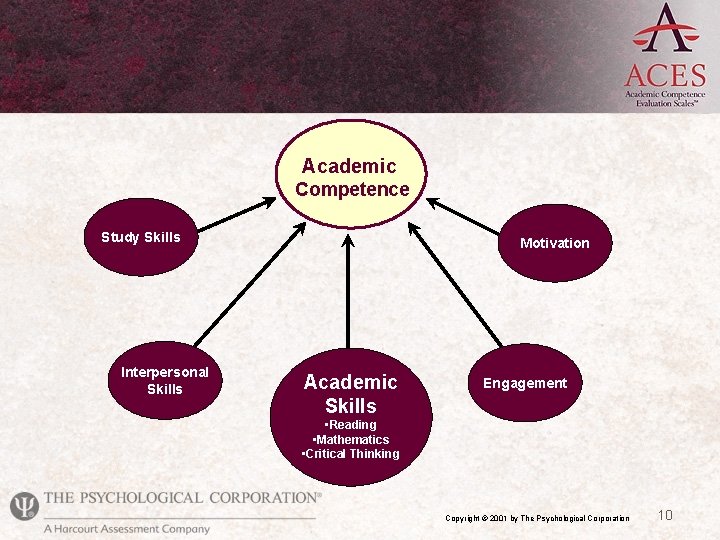
Model of Academic Competence v Research using the ACES has indicated that the skills, attitudes and behaviours contributing to academic competence fall into one of two domains: Academic Skills or Academic Enablers. (Di. Perna & Elliott, 1999) Copyright © 2001 by The Psychological Corporation 9
Academic Competence Study Skills Interpersonal Skills Motivation Academic Skills Engagement • Reading • Mathematics • Critical Thinking Copyright © 2001 by The Psychological Corporation 10
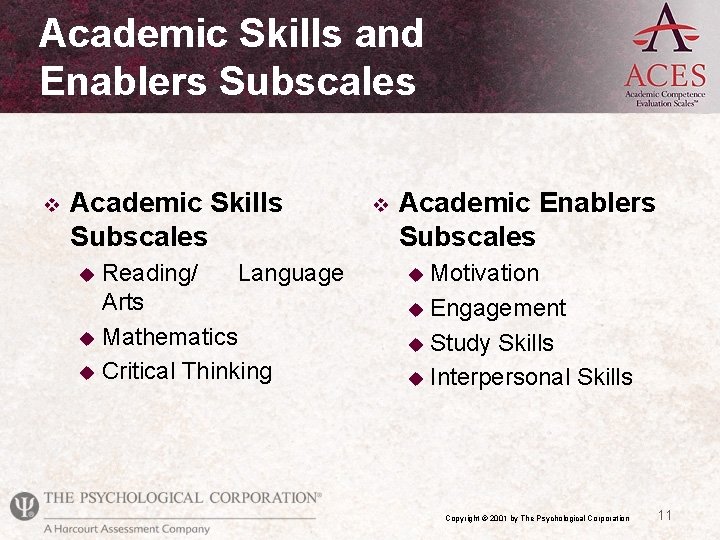
Academic Skills and Enablers Subscales v Academic Skills Subscales Reading/ Language Arts u Mathematics u Critical Thinking u v Academic Enablers Subscales Motivation u Engagement u Study Skills u Interpersonal Skills u Copyright © 2001 by The Psychological Corporation 11
Academic Skills and Enablers Subscales v Motivation reflects a student’s approach, persistence and level of interest regarding academic subjects v Engagement reflects attention and active participation in classroom activities Copyright © 2001 by The Psychological Corporation 12
Academic Enablers Subscales v Study skills are behaviours that facilitate the processing of new material and taking tests v Interpersonal skills include co-operative learning behaviours necessary to interact with others Copyright © 2001 by The Psychological Corporation 13
Teacher Judgements of Academic Performance v v Teachers are accurate in predicting students’ achievement on standardised tests and distinguishing between students with low or high academic performance. Key Studies on “teachers as tests” Hoge & Coladarci (1989) u Gresham, Mac Millan & Bocian (1997) u Demaray & Elliott (1998) u Copyright © 2001 by The Psychological Corporation 14
ACES-Teacher Form: Fast Facts v v v 2 scales: Academic Skills (33 items) & Academic Enablers (40 items) Requires less than 20 minutes to complete 2 ratings/item: Proficiency & Importance Competence ranges: Developing, Competent, & Advanced Worksheet for linking assessment results to interventions & creating a GAS Copyright © 2001 by The Psychological Corporation 15
ACES-Teacher: Standardisation Sample v 1000 students Four grade clusters: k-2, 3 -5, 6 -8, 9 -12 (n = 250 each) u Even distribution across sex u 64% Caucasian, 15% African American, 15% Hispanic, 6% Other Race u 9% students with disabilities, 19% students at-risk, 72% students with no identified concerns u Copyright © 2001 by The Psychological Corporation 16
ACES-Teacher: Evidence for Internal Structure v v Principal Components Analysis (PCA) including all 73 items yielded a 2 -factor solution: Academic Skills & Academic Enablers Separate PCAs of the 33 Academic Skills items and 40 Academic Enablers items yielded 3 - and 4 -factor solutions respectively 100% of items on the Academic Skill subscales had primary loadings >. 40 100% of items on the Academic Enablers subscales had primary loadings >. 40 Copyright © 2001 by The Psychological Corporation 17
ACES-Teacher: Evidence for Reliability v v Internal consistency co-efficients (Cronbach’s alphas) from. 94 -. 99 SEMs from 2. 46 -3. 07 for Academic Skills and 3. 63 -4. 73 for Academic Enablers Test-retest stability coefficients from. 88 -. 97 Inter-rater correlations from. 31 -. 65 Copyright © 2001 by The Psychological Corporation 18
ACES-Teacher: Evidence for Validity v v v Academic Skills - Iowa Test Basic Skills Composite correlations from. 66 -. 76 Academic Skills - Social Skills Rating System Academic Competence correlations from. 75 -. 80 Discriminant function analysis with known groups (students with no identified concerns vs. students at-risk or with disabilities) indicated the ACES correctly identified average of 86% of students across multiple samples Copyright © 2001 by The Psychological Corporation 19
Identifying Target Skills for Intervention v Teacher form includes worksheet to facilitate the use of assessment results to select and design interventions v Use ACES Behaviour Classification Scheme to identify strengths, performance problems and acquisition problems in academic skills and/or academic enablers Copyright © 2001 by The Psychological Corporation 20
ACES Behaviour Classification Scheme v Strengths Proficiency = 3, 4, or 5 u Importance = 2 or 3 u v Performance Problems Proficiency = 2 u Importance = 2 or 3 u v Acquisition Problems u u Proficiency = 1 Importance = 2 or 3 Copyright © 2001 by The Psychological Corporation 21
Analyse Environment & Plan Interventions v Analyse target skills within the context of the instructional environment (using AIMS Intervention Forms, observations, and/or interview) v Plan intervention based on the results of this analysis. (Consult AIMS Guidebook and other resources for intervention strategies. ) Copyright © 2001 by The Psychological Corporation 22
Monitor Intervention Progress v Develop Goal Attainment Scale (GAS) to monitor progress via teacher ratings v Implement intervention and collect GAS data to monitor effectiveness Copyright © 2001 by The Psychological Corporation 23
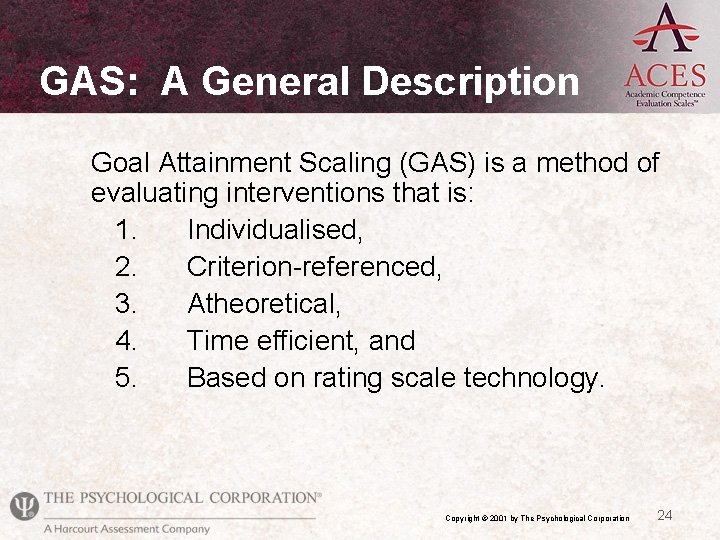
GAS: A General Description Goal Attainment Scaling (GAS) is a method of evaluating interventions that is: 1. Individualised, 2. Criterion-referenced, 3. Atheoretical, 4. Time efficient, and 5. Based on rating scale technology. Copyright © 2001 by The Psychological Corporation 24
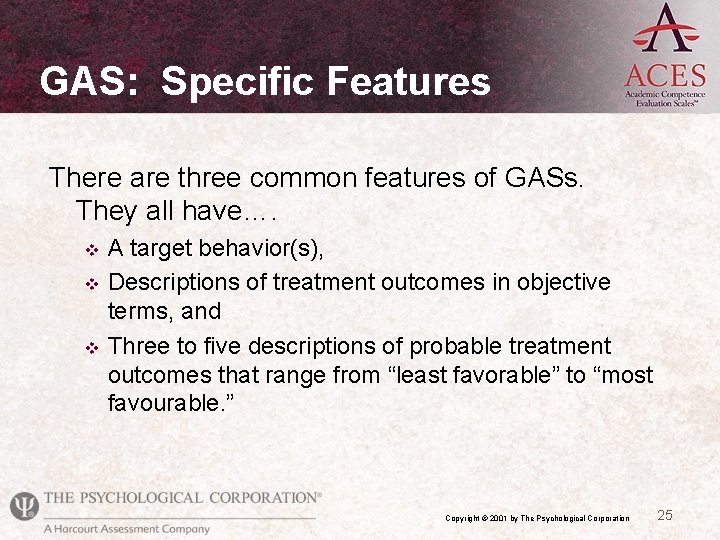
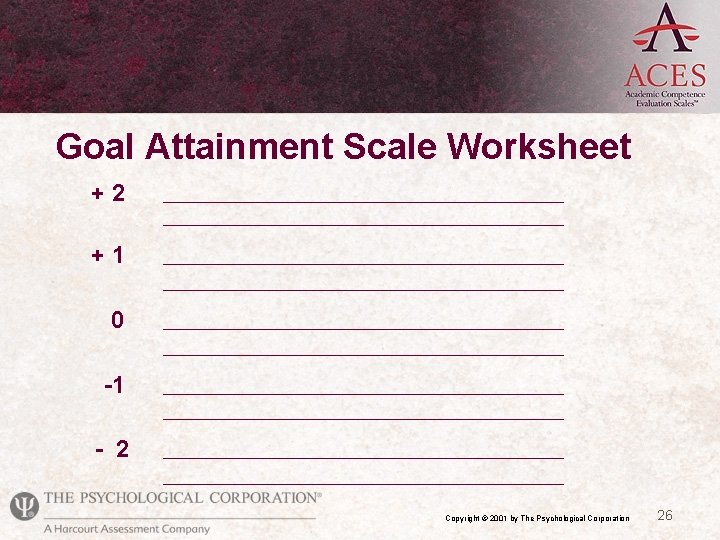
GAS: Specific Features There are three common features of GASs. They all have…. A target behavior(s), v Descriptions of treatment outcomes in objective terms, and v Three to five descriptions of probable treatment outcomes that range from “least favorable” to “most favourable. ” v Copyright © 2001 by The Psychological Corporation 25
Evaluate Intervention Outcomes ACES provides two methods for assessing the effects of an intervention: v v Visual analysis of GAS results Pretest & Posttest ACES ratings analysed using a Reliability Change Index (RCI = Post-test Mean-Pretest Mean/SEM) Copyright © 2001 by The Psychological Corporation 27
ACES: Key Points to Remember v v v Three forms: Teacher, Student, & College Assesses academic skills and enabling behaviors for students in Grades k-12 or college Designed to facilitate a pre-referral problem-solving process Research indicates strong evidence for internal structure, reliability and validity AIMS companion Guidebook and Intervention Forms to assist with intervention planning Copyright © 2001 by The Psychological Corporation 28
Summary Themes v Respects Teachers’ Knowledge v Solution Focused v Data-Drive & Theoretically Balanced Copyright © 2001 by The Psychological Corporation 29
References Demaray, M. K. , & Elliott, S. N. (1998). Teachers’ judgments of students’ academic functioning: A comparison of actual and predicted performances. School Psychology Quarterly, 13, 8 -24. Di. Perna, J. C. , & Elliott, S. N. (1999). Development and validation of the Academic Competence Evaluation Scales. Journal of Psychoeducational Assessment, 17, 207 -225. Gresham, F. M. , Mac. Millan, D. L. , & Bocian, K. M. (1997). Teachers as “tests”: Differential validity of teacher judgments in identifying students at-risk for learning difficulties. School Psychology Review, 26, 47 -60. Hoge, R. D. , & Coladarci, T. (1989). Teacher-based judgments of academic achievement: A review of literature. Review of Educational Research, 3, 297 -313. Copyright © 2001 by The Psychological Corporation 30