
The A B Cs of Goal Setting How
The A, B, C’s of Goal Setting How to Set Goals
Goal Setting • Before actions are taken, a goal must exist. • Two of the most satisfying pleasures human beings experience are accomplishment and achievement. • Goals are an integral part of conducting business successfully.
What is the Definition of a Goal? • “A Goal is an end toward you direct some specific Effort. ” • What are goals? – Action verbs – Measurable outcomes – Specific Dates for accomplishment – Cost and time constraints
How do you Set Goals? • When you answer the questions Who? What? When? How? And How much? Of a particular activity, you have the basic material for setting goals. • Goal setting is a sequence of events that leads to the creation of achievable goals that creates positive results
How Do You Set Goals • In order to create goals, It is important to know the difference between goals, missions and objectives. • What is a mission- A general statement that specifies the overall strategy or intent that governs the goals and objectives. – Defines your cause and provides direction for goals.
The A, B, C’s of Goal Setting • What are objectives – Objectives are tactics used to reach or achieve goals – A road map used to achieve the goal – They must be complementary to the goal and mission
Goal Setting is a Four-Step process • Step 1 - identify opportunities for goals. – Personal Desires • Go to Bahamas • Learn to play golf – Business Desires • Increase sales • Increase GP
These desires or opportunities fall under types of Goals • Concrete- new home, car, more money etc. • Intangible-Personal characteristics that should be developed or improved upon to better our lives. • Short-term- From a day, week, month or six months. • Long-term-Range from one year, five, ten years etc.
How to Set Goals Step-one • Let’s create a goal • “I want to sell $70, 000 in January. ” I want to be salesman of the month. • What type of goal is this? – Concrete • What is the Mission – To be salesman of the month

How to Set Goals Step- Two Writing Goal Statements • A goal statement answers: – What is to be accomplished – Who will be involved – When the activity will be completed – How much cost resources will be used
Writing Goal Statements Step- Two • The S. M. A. R. T. way to write a goal statement includes all the elements of a well-defined goal. – – – Specific- Detailed, particular or focused. Measurable-Quantifiable, comparable Action oriented-Performance produces results. Realistic-Practical, achievable Time and cost constrained-Regulated by time and resources
Writing Goal Statements Step -two • Let’s continue with our goal and write a goal statement using the S. M. A. R. T. process. – Identify the goal- Sell $70, 000 – Type of goal-Concrete – Mission- To be salesman of the month • “I will increase my monthly sales from $40, 000 to $70, 000 by January 31 st 2004. I will average 10 appointments a week. This will award me salesman of the month. ”
Writing Goal Statements Step- Two • • • Specific- Sell $70, 000 Measurable-From $40, 000 to $70, 000 Action-oriented- Increase, average Realistic-$70, 000 realistic. Time and cost constraint-By January 31, 2004, averaging ten appointments a week.
Develop Goals Step-Three • You should complete goal development for every goal statement created. There are five steps to developing goals. – – – 1. Classify goals by type 2. Prioritize within each type 3. Establish standards of performance 4. Identify obstacles to goal achievement 5. Determine “W. I. I. F. M.
Develop Goals Step-Three • Classify Goal Types – Concrete – Intangible – Short-term – Long term
Develop Goals Step-Three • Classify Goal Types – Essential- required for the operation of the business. Must do – Problem-solving-identifies a less than ideal condition and a proposed solution-ought to be done – Innovative-Nice to be done
Develop Goals Step-Three • Prioritize your goals – If you have more than one goal statement, determine which are the most important – Rank your goals within each type based on relative importance, time sequence, and cost/benefit relationship.
Develop Goals Step-Three • Establish standards of performance. They should include: – A time for review of progress-sales meetings – A quantitative method of determining progress-lead sheets looked at weekly # of appointments, closing ratios, average jobs • Minimal • Acceptable • Outstanding
Develop Goals Step-Three • Obstacles- Identify all obstacles that will prevent you from reaching your goals – Weather – Lead flow – Personal problems • Have a contingency plan for overcoming obstacles,
Develop Goals Step-Three • Determine W. I. I. F. M. – There must always be a personal motive to ensure goal achievement. – What are the rewards or personal recognition • • Money Plaques Status Promotion
Formulate Action Plans Step. Four • Create a Goal Action Form. It should include the following: – Block 1 -Write the Goal Statements created in step-two using the S. M. A. R. T. goal elements. – Block 2 Mission for this goal-What is the benefit, Why? opportunity identification. Include the W. I. I. F. M. Goal type
Formulate Action Plan Step. Four • Block 3 –Objectives -Road map. List specific objectives, measurable steps – – For example-Knock 30 doors per week Appointments/week Closing ratios Average job size • Deadlines-time limitation allowed for the completion of objectives and the goal.
Formulate Action Plan Step. Four • Block 4 Projected Result – These are the success indicators that indicate progress and/or completion of the objectives and the goal. • Immediate • Long-term • Block 5 Obstacles-List all the factors that may prevent you from achieving your goal. List a contingency plan.
Formulate Action Plan Step. Four • Block 6 Cost and Time constraint. Scheduled; regulated by time and resources to be expended. – January 31, 2004 – Ten appointments/week • Block 7 Person Responsible • Block 8 Completion date
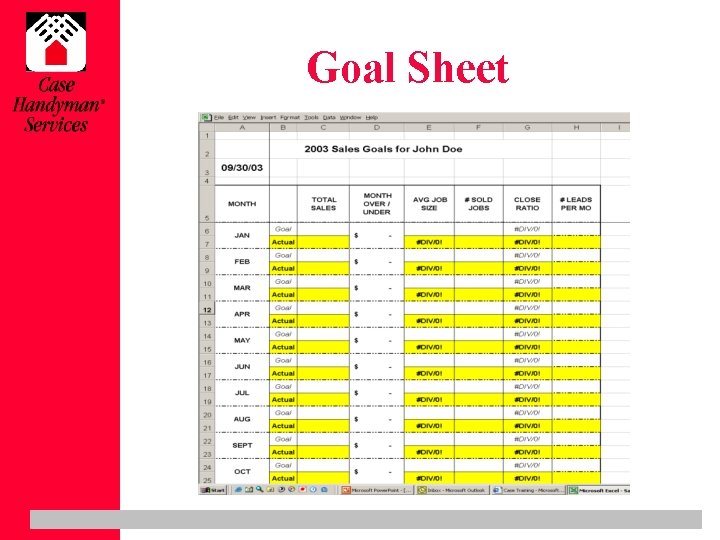
Goal Sheet

Q&A
- Slides: 26