
The 80 Lead ECG Body Surface Map Can

The 80 Lead ECG Body Surface Map: Can We Detect More STEMI Than with a 12 Lead ECG? James Hoekstra MD Professor and Chairman Department of Emergency Medicine

James Hoekstra, MD Disclosure Statement Affiliation/Financial Interest – Corporate Organizations, Manufacturers, Providers Consultant Heartscape Technologies, Sanofi, Schering Plough Grants/Research Support Heartscape Technologies Stock Shareholder None Other Financial or Material Support None Speaker’s Bureau BMS, Sanofi, Schering Plough, Genentech Employee None
Initial Chest Pain Assessment Risk determined in the ED by: • • • Assessment of anginal symptoms Physical examination CAD risk factors Cocaine/methamphetamine use Electrocardiogram Markers of Infarction/Ischemia

“Limitations” of the 12 -Lead ECG • • • Posterior MI Right Sided MI High Lateral MI Inferior MI LBBB and STEMI • In an all-comers CP population, 98% of ECGs are nondiagnostic
TRITON subset analysis evaluated occurrence of occult STEMI • TRITON–TIMI 38 evaluated prasugrel vs. clopidogrel in 13, 608 patients undergoing PCI – Follow up duration: 6 -15 months • Post-hoc analysis: 1, 198 patients with isolated anterior precordial ST segment depression (>1 mm) on 12 lead ECG – STEMI defined as TFG 0/1 and positive troponin Gibson CM. Circulation. Vol 118, Suppl. 2, 2008, presented at AHA, Nov, 2008.
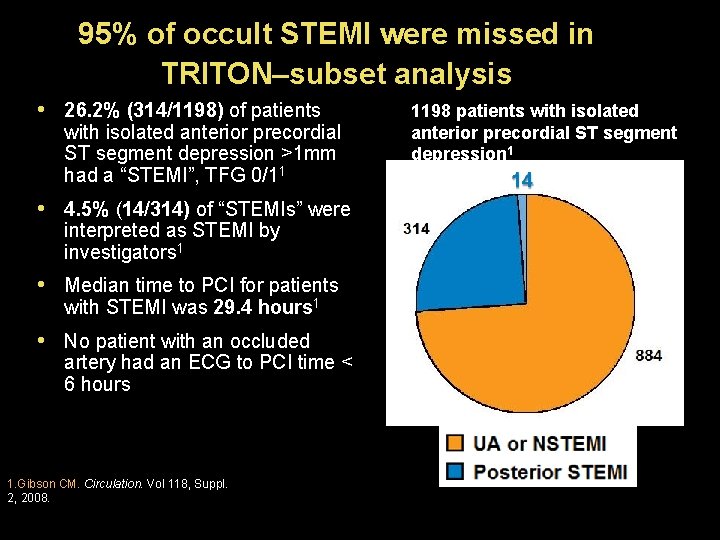
95% of occult STEMI were missed in TRITON–subset analysis • 26. 2% (314/1198) of patients with isolated anterior precordial ST segment depression >1 mm had a “STEMI”, TFG 0/11 • 4. 5% (14/314) of “STEMIs” were interpreted as STEMI by investigators 1 • Median time to PCI for patients with STEMI was 29. 4 hours 1 • No patient with an occluded artery had an ECG to PCI time < 6 hours 1. Gibson CM. Circulation. Vol 118, Suppl. 2, 2008. 1198 patients with isolated anterior precordial ST segment depression 1
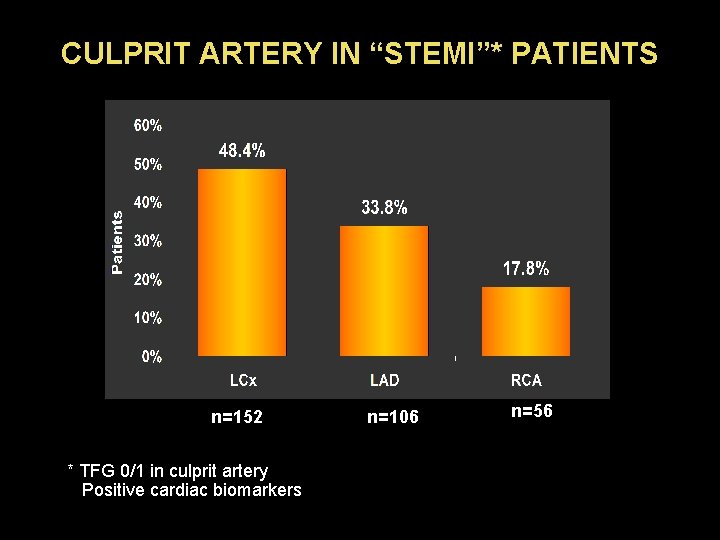
CULPRIT ARTERY IN “STEMI”* PATIENTS n=152 * TFG 0/1 in culprit artery Positive cardiac biomarkers n=106 n=56
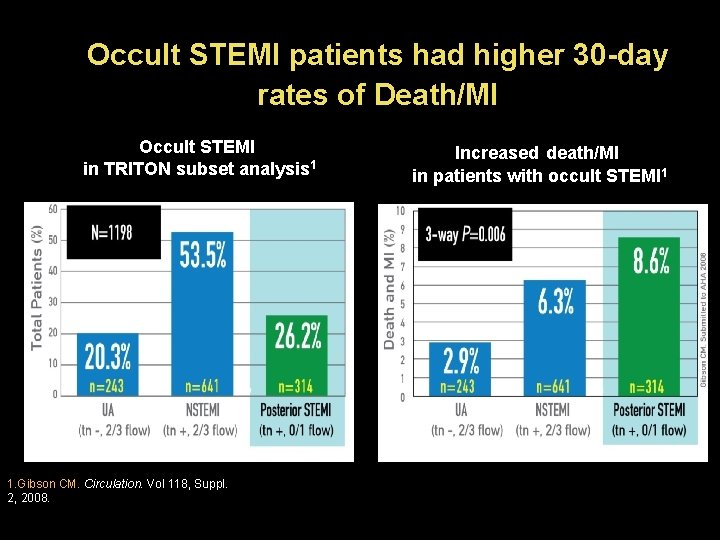
Occult STEMI patients had higher 30 -day rates of Death/MI Occult STEMI in TRITON subset analysis 1 1. Gibson CM. Circulation. Vol 118, Suppl. 2, 2008. Increased death/MI in patients with occult STEMI 1

The 80 -Lead ECG and Body Surface Mapping • More leads investigate more areas of the heart • Mapping allows computer generated pictures of ischemic areas • Computerized readings allow for more accurate interpretation

The PRIME ECG® Technology Single-patient Disposable Vest • Easily-applied, self-adhesive plastic strips containing 80 data collection points • Strips allow analysis of the heart’s electrical activity with 360 degrees of spatial resolution • Data from the 80 leads are processed into 3 -D color maps for easy visualization

Placement of the 80 Leads Provides a Comprehensive View of the Heart • 64 anterior and 16 posterior leads • Conventional V leads 1 -6 are marked
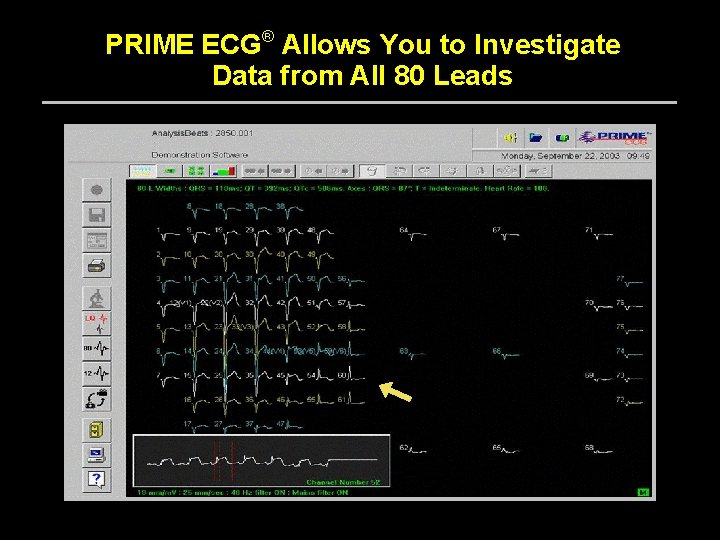
PRIME ECG® Allows You to Investigate Data from All 80 Leads • View a single 10 -second recording for leads of interest

PRIME ECG® Provides a 3 -D, Color-coded, Anatomically-referenced Visualization of the Injury ST-segment elevation and depression are translated into colors: Red = ST elevation Blue = ST depression Green = No deflection 3 -D Color Representation of the 80 -Lead ECG
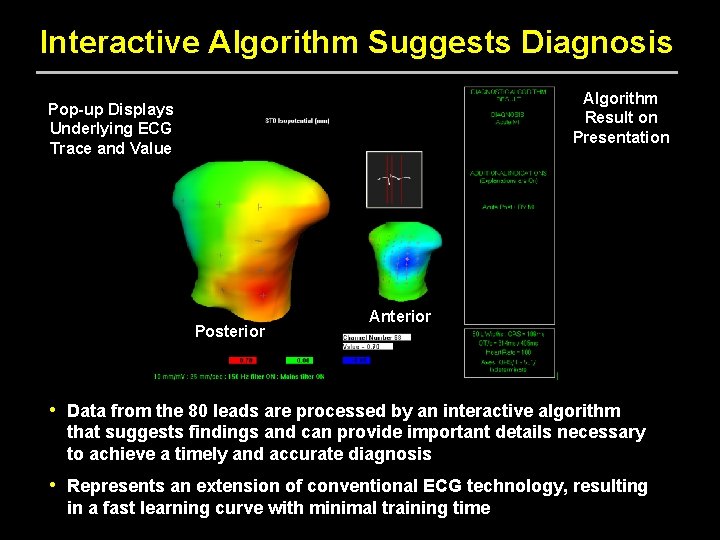
Interactive Algorithm Suggests Diagnosis Algorithm Result on Presentation Pop-up Displays Underlying ECG Trace and Value Posterior Anterior • Data from the 80 leads are processed by an interactive algorithm that suggests findings and can provide important details necessary to achieve a timely and accurate diagnosis • Represents an extension of conventional ECG technology, resulting in a fast learning curve with minimal training time
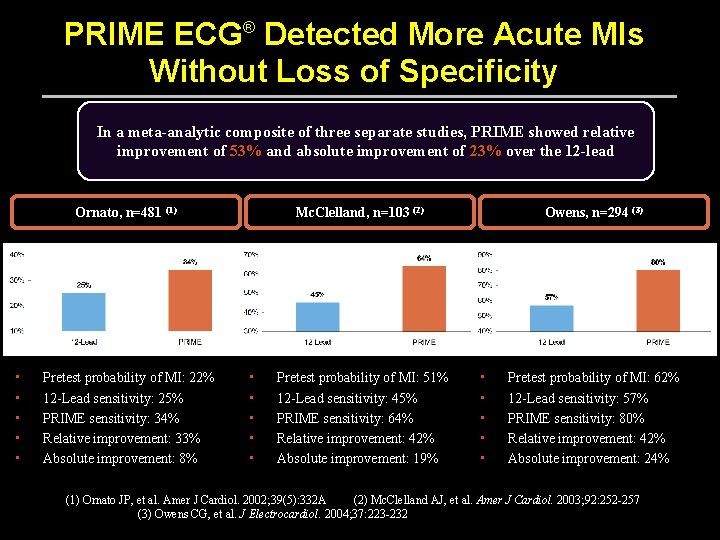
PRIME ECG® Detected More Acute MIs Without Loss of Specificity In a meta-analytic composite of three separate studies, PRIME showed relative improvement of 53% and absolute improvement of 23% over the 12 -lead Ornato, n=481 (1) • • • Pretest probability of MI: 22% 12 -Lead sensitivity: 25% PRIME sensitivity: 34% Relative improvement: 33% Absolute improvement: 8% Mc. Clelland, n=103 (2) • • • Pretest probability of MI: 51% 12 -Lead sensitivity: 45% PRIME sensitivity: 64% Relative improvement: 42% Absolute improvement: 19% Owens, n=294 (3) • • • Pretest probability of MI: 62% 12 -Lead sensitivity: 57% PRIME sensitivity: 80% Relative improvement: 42% Absolute improvement: 24% (1) Ornato JP, et al. Amer J Cardiol. 2002; 39(5): 332 A (2) Mc. Clelland AJ, et al. Amer J Cardiol. 2003; 92: 252 -257 (3) Owens CG, et al. J Electrocardiol. 2004; 37: 223 -232
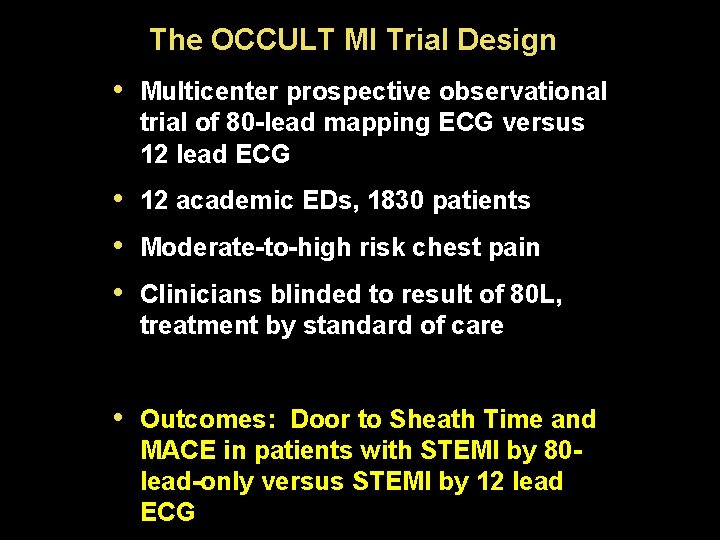
The OCCULT MI Trial Design • Multicenter prospective observational trial of 80 -lead mapping ECG versus 12 lead ECG • 12 academic EDs, 1830 patients • Moderate-to-high risk chest pain • Clinicians blinded to result of 80 L, treatment by standard of care • Outcomes: Door to Sheath Time and MACE in patients with STEMI by 80 lead-only versus STEMI by 12 lead ECG
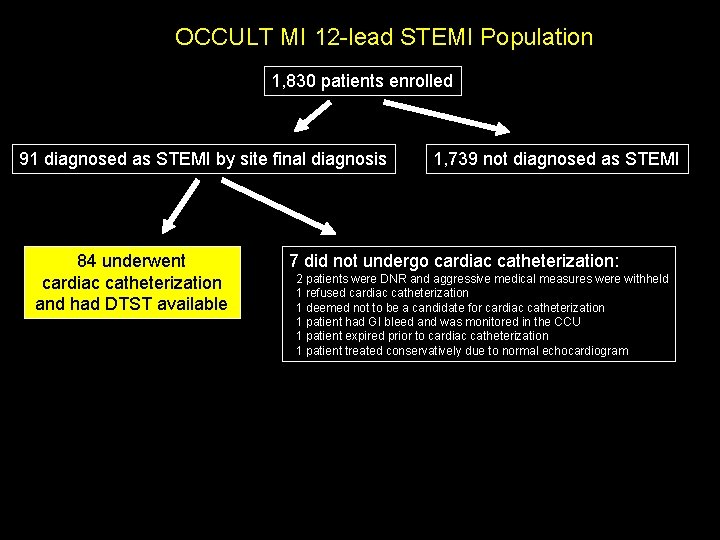
OCCULT MI 12 -lead STEMI Population 1, 830 patients enrolled 91 diagnosed as STEMI by site final diagnosis 84 underwent cardiac catheterization and had DTST available 1, 739 not diagnosed as STEMI 7 did not undergo cardiac catheterization: 2 patients were DNR and aggressive medical measures were withheld 1 refused cardiac catheterization 1 deemed not to be a candidate for cardiac catheterization 1 patient had GI bleed and was monitored in the CCU 1 patient expired prior to cardiac catheterization 1 patient treated conservatively due to normal echocardiogram
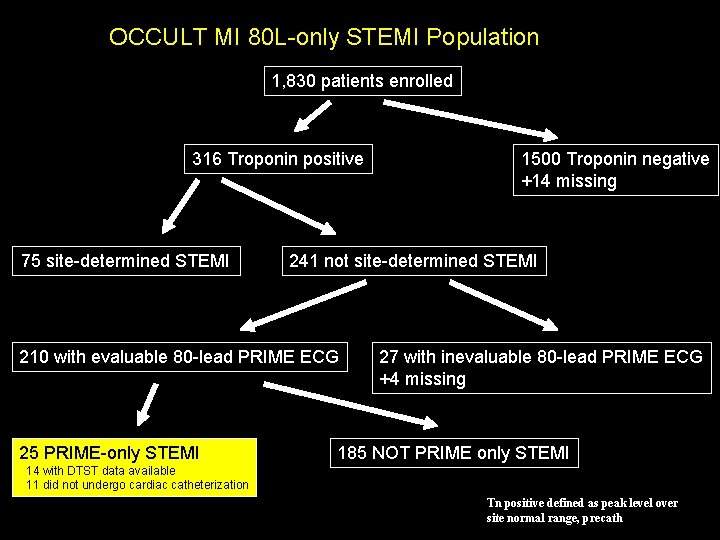
OCCULT MI 80 L-only STEMI Population 1, 830 patients enrolled 316 Troponin positive 75 site-determined STEMI 241 not site-determined STEMI 210 with evaluable 80 -lead PRIME ECG 25 PRIME-only STEMI 1500 Troponin negative +14 missing 27 with inevaluable 80 -lead PRIME ECG +4 missing 185 NOT PRIME only STEMI 14 with DTST data available 11 did not undergo cardiac catheterization Tn positive defined as peak level over site normal range, precath
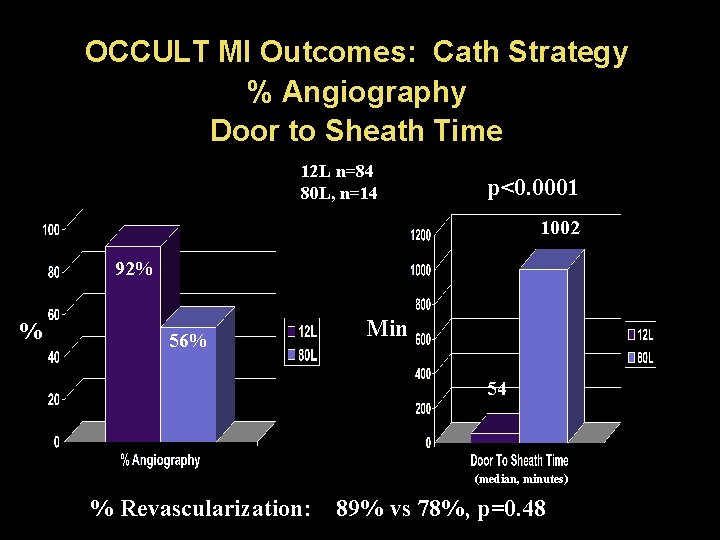
OCCULT MI Outcomes: Cath Strategy % Angiography Door to Sheath Time 12 L n=84 80 L, n=14 p<0. 0001 1002 92% % 56% Min 54 (median, minutes) % Revascularization: 89% vs 78%, p=0. 48
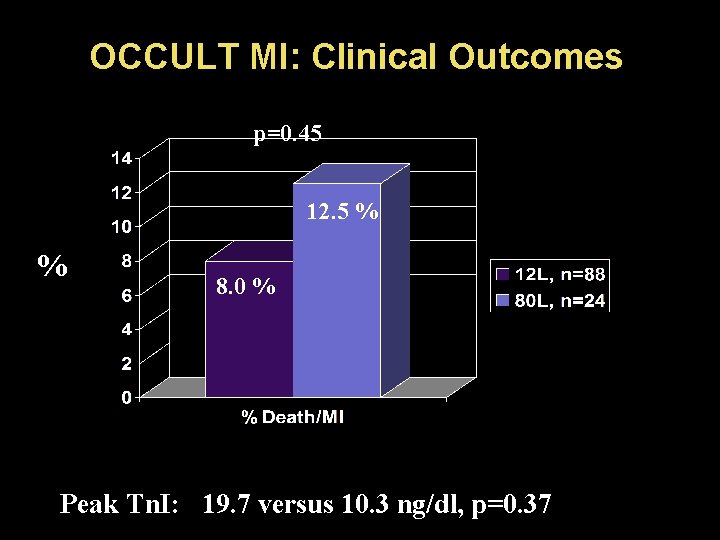
OCCULT MI: Clinical Outcomes p=0. 45 12. 5 % % 8. 0 % Peak Tn. I: 19. 7 versus 10. 3 ng/dl, p=0. 37
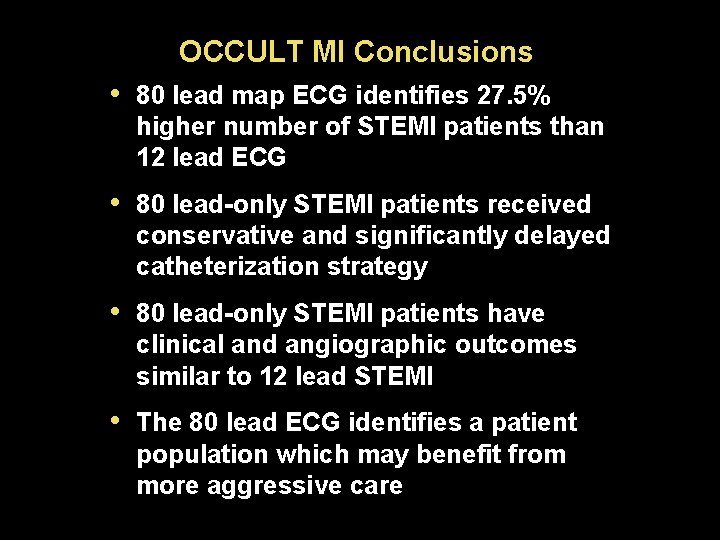
OCCULT MI Conclusions • 80 lead map ECG identifies 27. 5% higher number of STEMI patients than 12 lead ECG • 80 lead-only STEMI patients received conservative and significantly delayed catheterization strategy • 80 lead-only STEMI patients have clinical and angiographic outcomes similar to 12 lead STEMI • The 80 lead ECG identifies a patient population which may benefit from more aggressive care
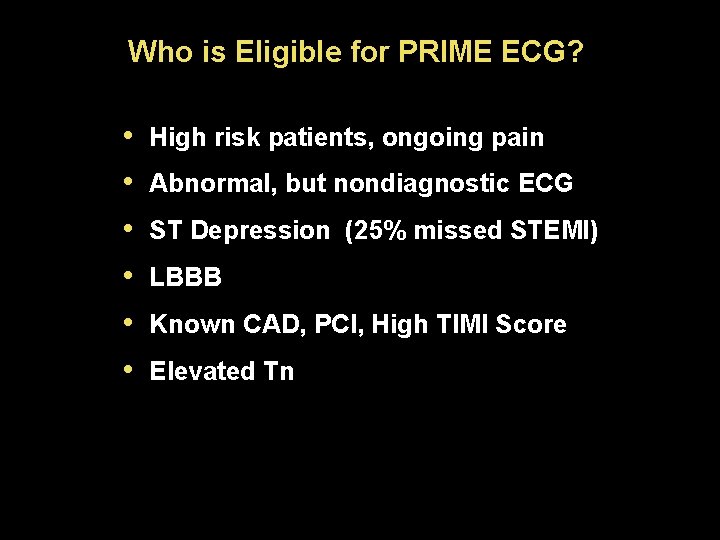
Who is Eligible for PRIME ECG? • • • High risk patients, ongoing pain Abnormal, but nondiagnostic ECG ST Depression (25% missed STEMI) LBBB Known CAD, PCI, High TIMI Score Elevated Tn
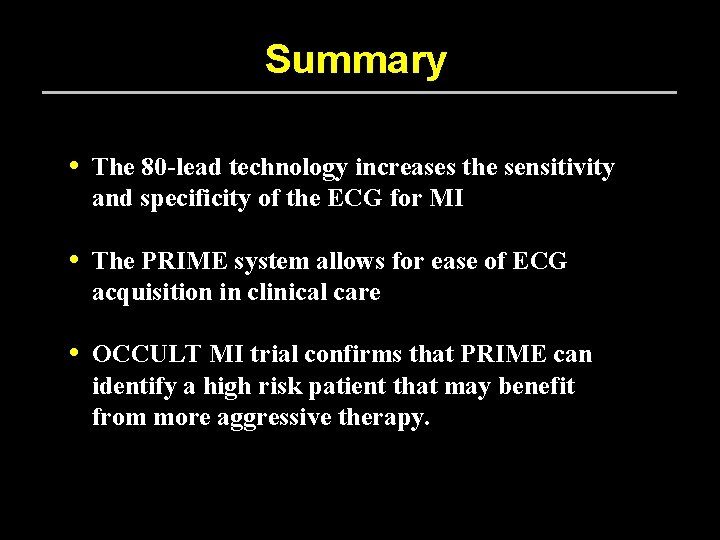
Summary • The 80 -lead technology increases the sensitivity and specificity of the ECG for MI • The PRIME system allows for ease of ECG acquisition in clinical care • OCCULT MI trial confirms that PRIME can identify a high risk patient that may benefit from more aggressive therapy.
- Slides: 23