
THE 8 PARTS OF SPEECH BY MR HOGAN
THE 8 PARTS OF SPEECH BY MR. HOGAN
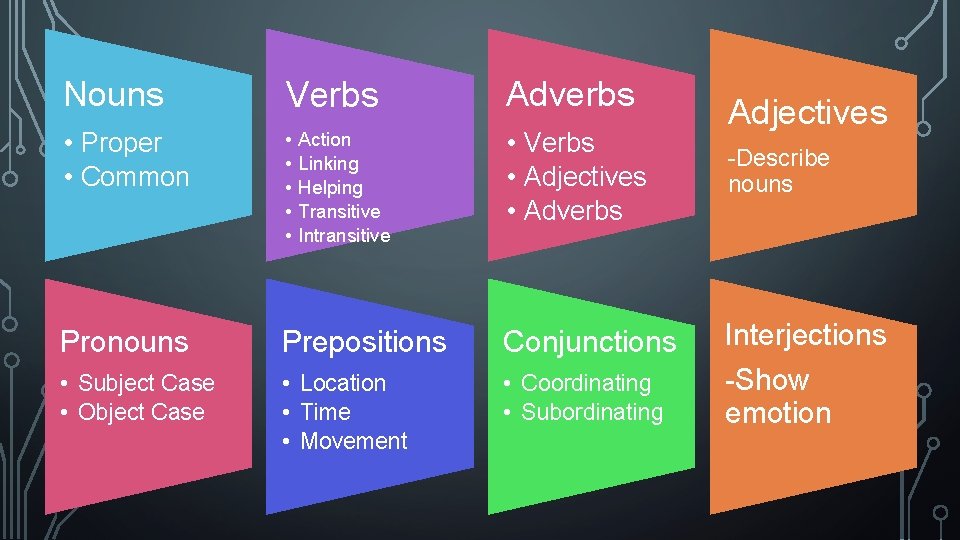
Nouns Verbs Adverbs • Proper • Common • • • Verbs • Adjectives • Adverbs Pronouns Prepositions Conjunctions • Subject Case • Object Case • Location • Time • Movement • Coordinating • Subordinating Action Linking Helping Transitive Intransitive Adjectives -Describe nouns Interjections -Show emotion
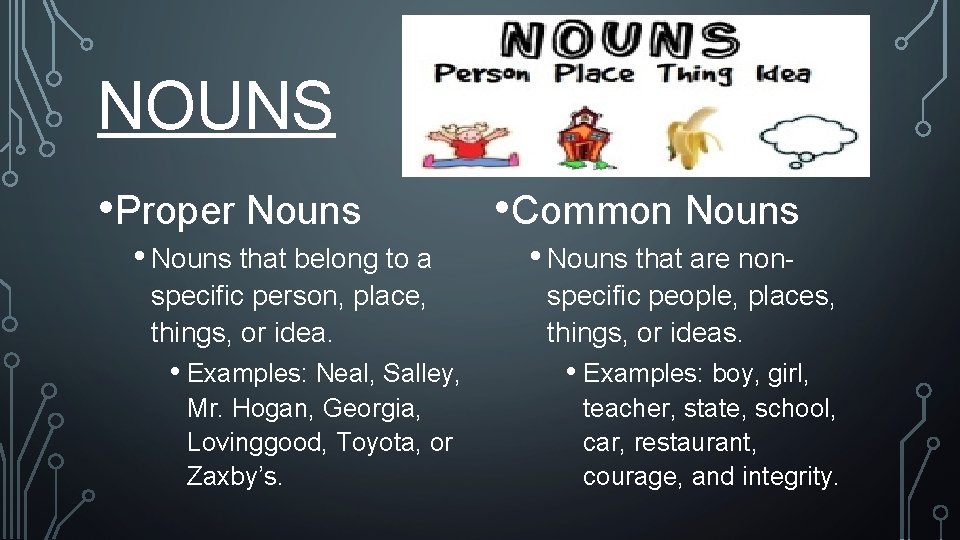
NOUNS • Proper Nouns • Nouns that belong to a specific person, place, things, or idea. • Examples: Neal, Salley, Mr. Hogan, Georgia, Lovinggood, Toyota, or Zaxby’s. • Common Nouns • Nouns that are nonspecific people, places, things, or ideas. • Examples: boy, girl, teacher, state, school, car, restaurant, courage, and integrity.
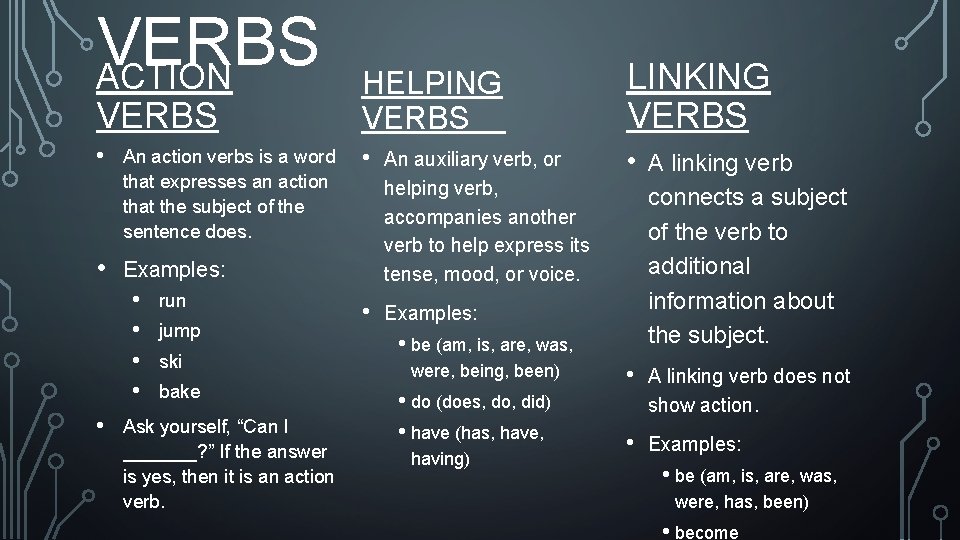
VERBS ACTION VERBS HELPING VERBS LINKING VERBS • An action verbs is a word that expresses an action that the subject of the sentence does. • • • Examples: An auxiliary verb, or helping verb, accompanies another verb to help express its tense, mood, or voice. • Examples: A linking verb connects a subject of the verb to additional information about the subject. • A linking verb does not show action. • Examples: • • • run jump ski bake Ask yourself, “Can I _______? ” If the answer is yes, then it is an action verb. • be (am, is, are, was, were, being, been) • do (does, do, did) • have (has, have, having) • be (am, is, are, was, were, has, been) • become
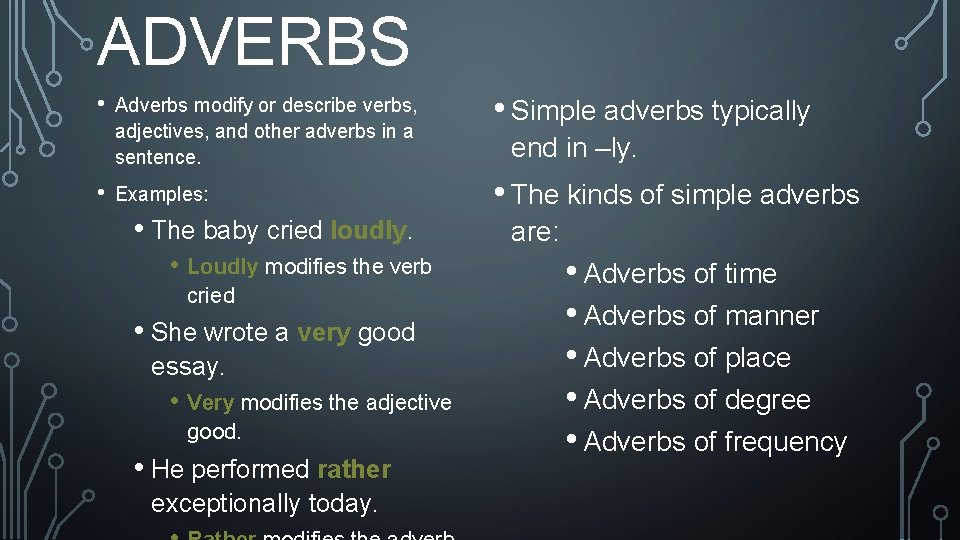
ADVERBS • • Adverbs modify or describe verbs, adjectives, and other adverbs in a sentence. Examples: • The baby cried loudly. • Loudly modifies the verb cried • She wrote a very good essay. • Very modifies the adjective good. • He performed rather exceptionally today. • Simple adverbs typically end in –ly. • The kinds of simple adverbs are: • Adverbs of time • Adverbs of manner • Adverbs of place • Adverbs of degree • Adverbs of frequency
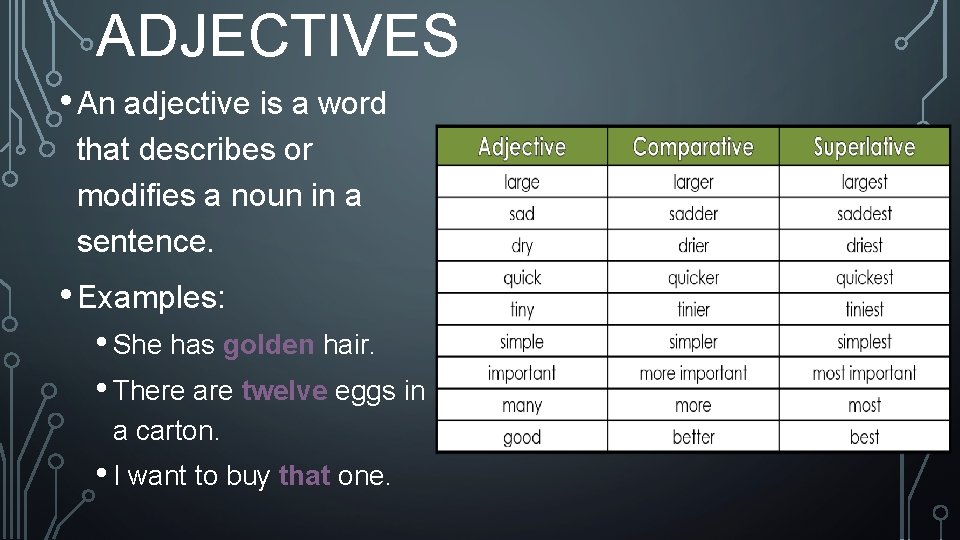
ADJECTIVES • An adjective is a word that describes or modifies a noun in a sentence. • Examples: • She has golden hair. • There are twelve eggs in a carton. • I want to buy that one.
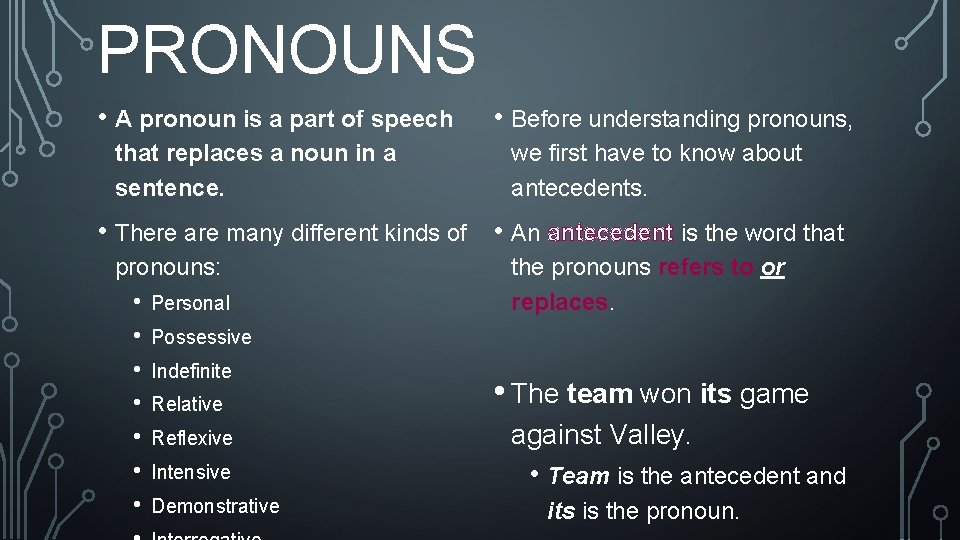
PRONOUNS • A pronoun is a part of speech that replaces a noun in a sentence. • Before understanding pronouns, we first have to know about antecedents. • There are many different kinds of • An antecedent is the word that pronouns: • • Personal the pronouns refers to or replaces. Possessive Indefinite Relative Reflexive Intensive Demonstrative • The team won its game against Valley. • Team is the antecedent and its is the pronoun.
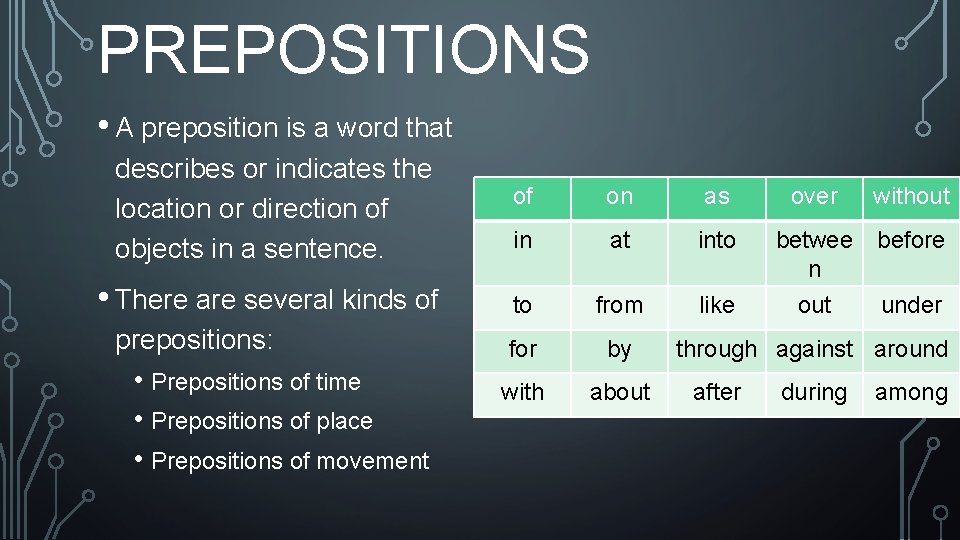
PREPOSITIONS • A preposition is a word that describes or indicates the location or direction of objects in a sentence. • There are several kinds of prepositions: • Prepositions of time • Prepositions of place • Prepositions of movement of on as over without in at into before to from like betwee n out for by with about under through against around after during among
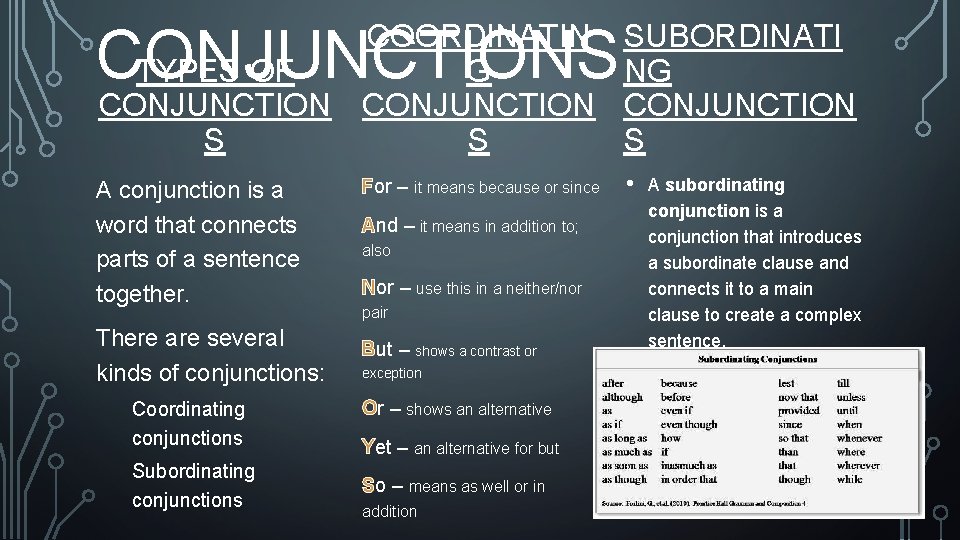
COORDINATIN TYPES OF G CONJUNCTION S S CONJUNCTIONS A conjunction is a word that connects parts of a sentence together. There are several kinds of conjunctions: Coordinating conjunctions Subordinating conjunctions For – it means because or since And – it means in addition to; also Nor – use this in a neither/nor pair But – shows a contrast or exception Or – shows an alternative Yet – an alternative for but So – means as well or in addition SUBORDINATI NG CONJUNCTION S • A subordinating conjunction is a conjunction that introduces a subordinate clause and connects it to a main clause to create a complex sentence. Examples:
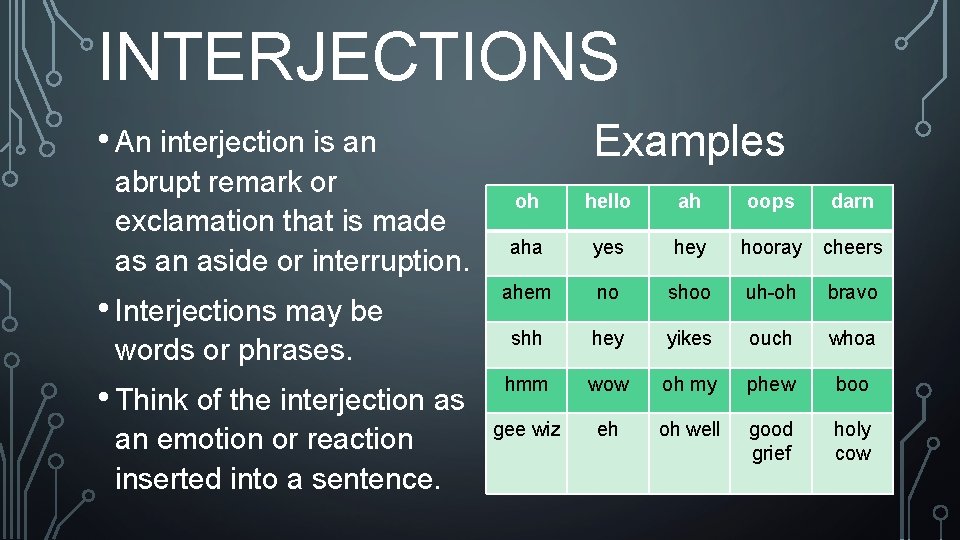
INTERJECTIONS Examples • An interjection is an abrupt remark or exclamation that is made as an aside or interruption. oh hello ah oops darn aha yes hey hooray cheers ahem no shoo uh-oh bravo shh hey yikes ouch whoa • Think of the interjection as hmm wow oh my phew boo an emotion or reaction inserted into a sentence. gee wiz eh oh well good grief holy cow • Interjections may be words or phrases.
- Slides: 10