
The 7 th International Young Naturalists Tournament Problem
The 7 th International Young Naturalists' Tournament Problem № 7 «Burning glass» Alina Nedikova Team «Element» Russia, Novosibirsk chnmk@mail. ru
The task Propose and test various methods to start a fire with a magnifying glass. Hypothesis If you change the characteristics of the collecting lens, you can influence the time of fire. 2
Aim of the study Get the fire by using the collecting lens in the shortest time. Objectives 1. Study theoretical material on the research topic. 2. Consider how to make fire with a magnifying glass. 3. Experimentally obtain conditions under which the time of firing of the tinder will be minimal. 4. Identify the most suitable tinder for effective fire with a magnifying glass. 5. Do conclusions on the results of work. 3
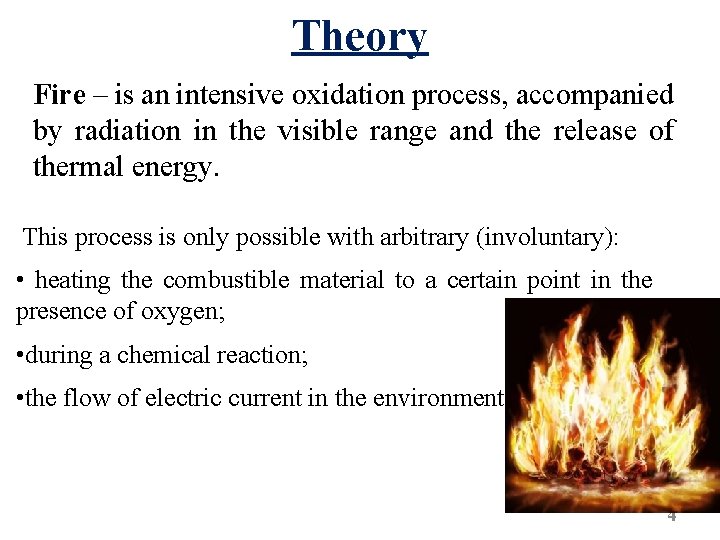
Theory Fire – is an intensive oxidation process, accompanied by radiation in the visible range and the release of thermal energy. This process is only possible with arbitrary (involuntary): • heating the combustible material to a certain point in the presence of oxygen; • during a chemical reaction; • the flow of electric current in the environment. 4
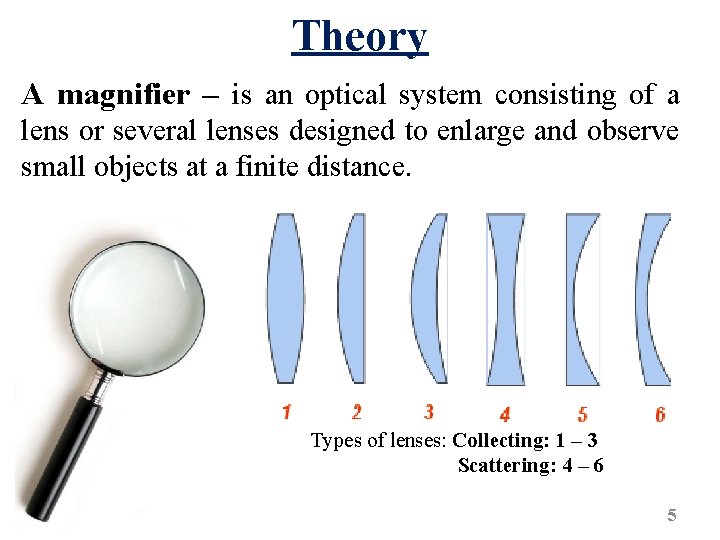
Theory A magnifier – is an optical system consisting of a lens or several lenses designed to enlarge and observe small objects at a finite distance. Types of lenses: Collecting: 1 – 3 Scattering: 4 – 6 5
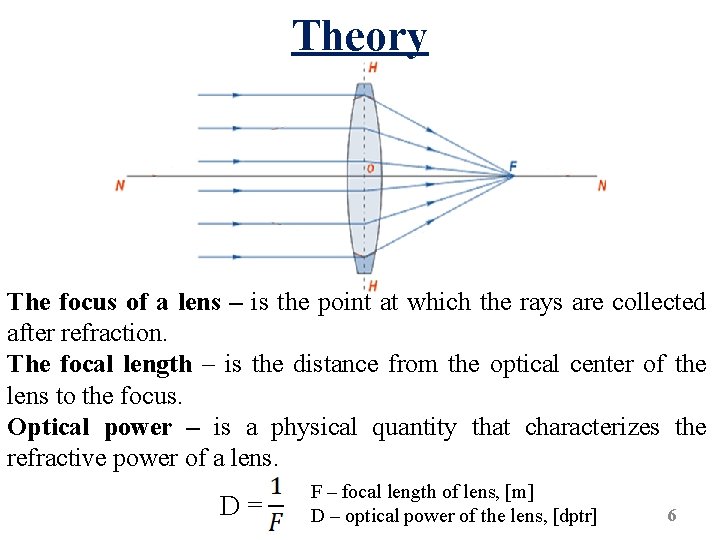
Theory The focus of a lens – is the point at which the rays are collected after refraction. The focal length – is the distance from the optical center of the lens to the focus. Optical power – is a physical quantity that characterizes the refractive power of a lens. D= F – focal length of lens, [m] D – optical power of the lens, [dptr] 6
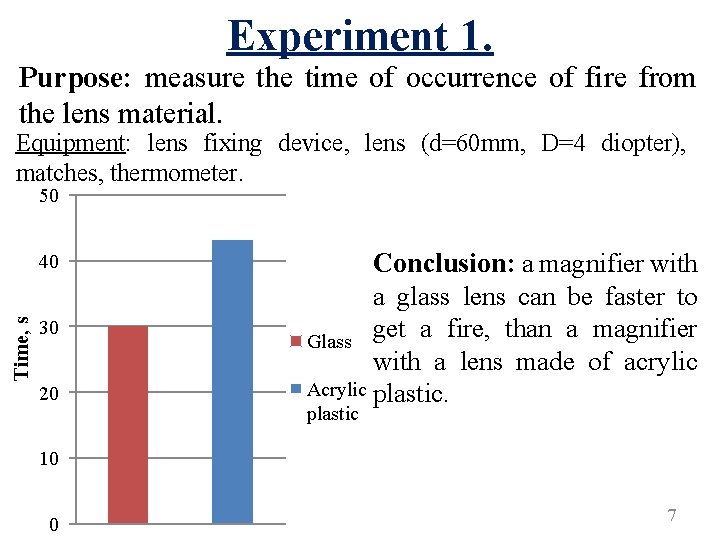
Experiment 1. Purpose: measure the time of occurrence of fire from the lens material. Equipment: lens fixing device, lens (d=60 mm, D=4 diopter), matches, thermometer. 50 Time, s 40 30 20 Conclusion: a magnifier with a glass lens can be faster to get a fire, than a magnifier Glass with a lens made of acrylic Acrylic plastic 10 0 7
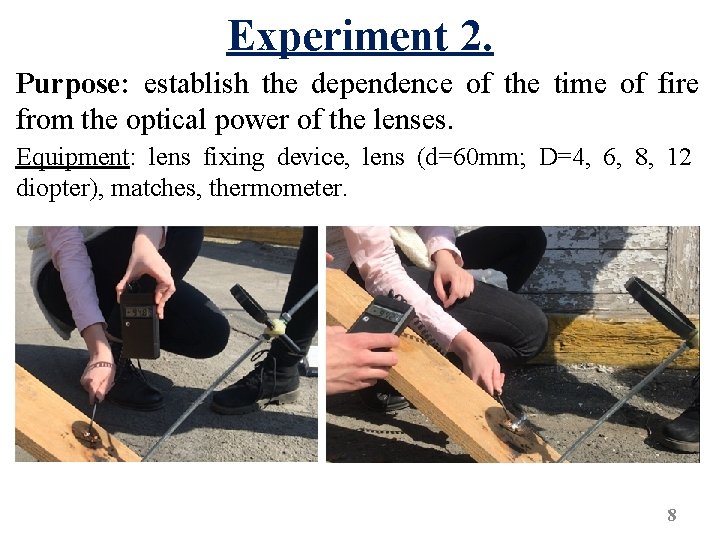
Experiment 2. Purpose: establish the dependence of the time of fire from the optical power of the lenses. Equipment: lens fixing device, lens (d=60 mm; D=4, 6, 8, 12 diopter), matches, thermometer. 8
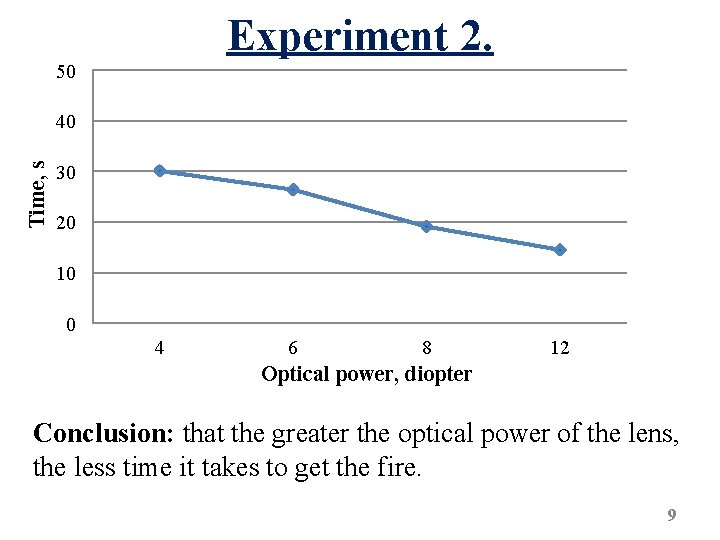
Experiment 2. 50 Time, s 40 30 20 10 0 4 6 8 12 Optical power, diopter Conclusion: that the greater the optical power of the lens, the less time it takes to get the fire. 9
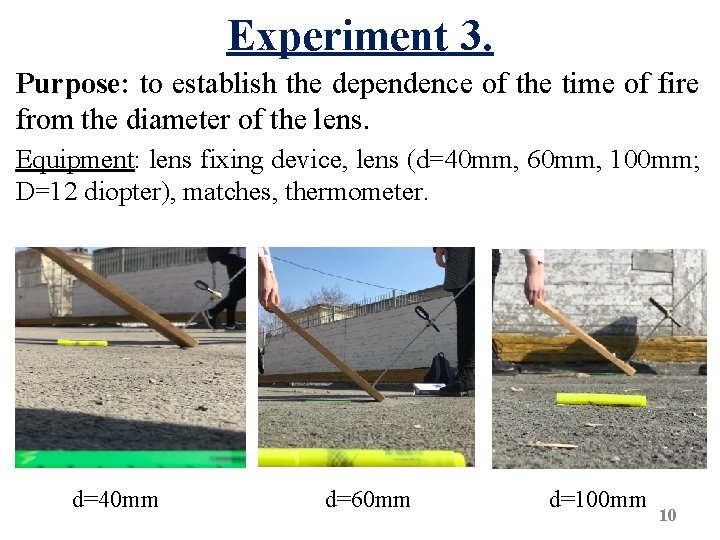
Experiment 3. Purpose: to establish the dependence of the time of fire from the diameter of the lens. Equipment: lens fixing device, lens (d=40 mm, 60 mm, 100 mm; D=12 diopter), matches, thermometer. d=40 mm d=60 mm d=100 mm 10
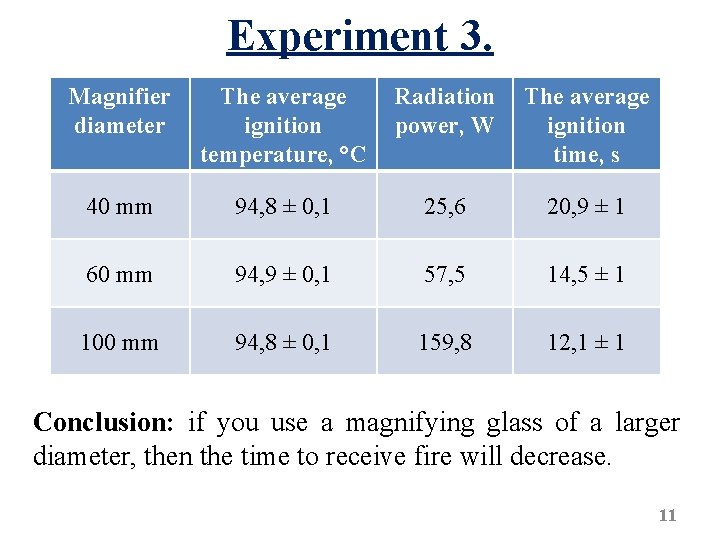
Experiment 3. Magnifier diameter The average ignition temperature, °С Radiation power, W The average ignition time, s 40 mm 94, 8 ± 0, 1 25, 6 20, 9 ± 1 60 mm 94, 9 ± 0, 1 57, 5 14, 5 ± 1 100 mm 94, 8 ± 0, 1 159, 8 12, 1 ± 1 Conclusion: if you use a magnifying glass of a larger diameter, then the time to receive fire will decrease. 11
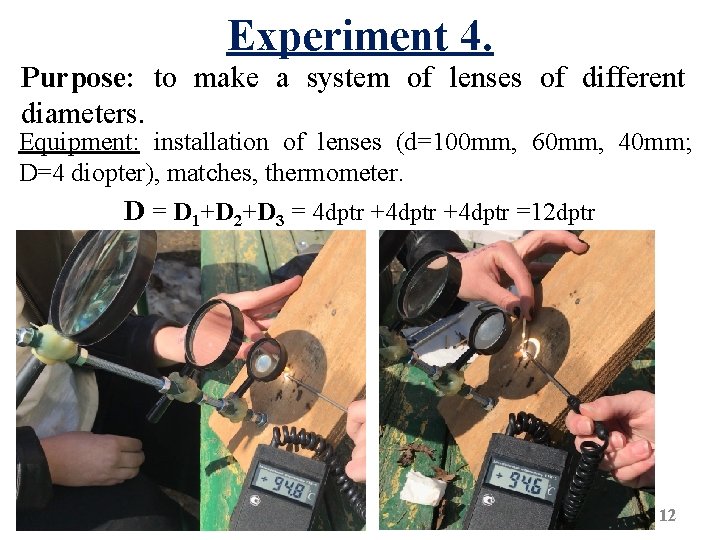
Experiment 4. Purpose: to make a system of lenses of different diameters. Equipment: installation of lenses (d=100 mm, 60 mm, 40 mm; D=4 diopter), matches, thermometer. D = D 1+D 2+D 3 = 4 dptr +4 dptr =12 dptr 12
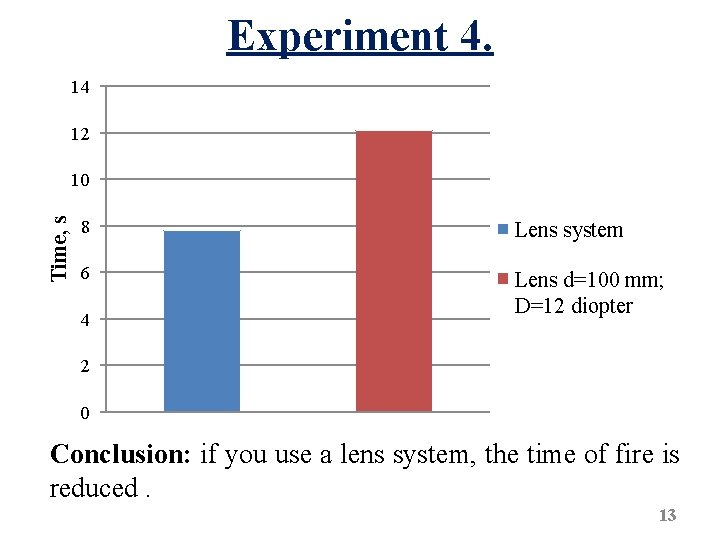
Experiment 4. 14 12 Time, s 10 8 Lens system 6 Lens d=100 mm; D=12 diopter 4 2 0 Conclusion: if you use a lens system, the time of fire is reduced. 13
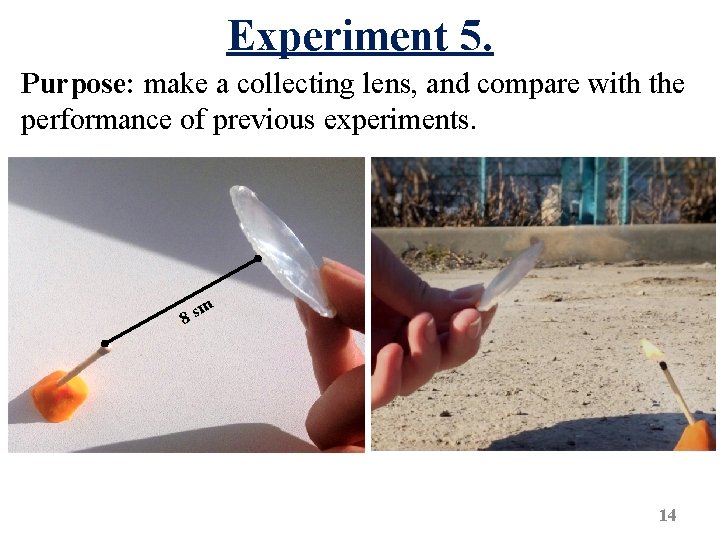
Experiment 5. Purpose: make a collecting lens, and compare with the performance of previous experiments. m 8 s 14
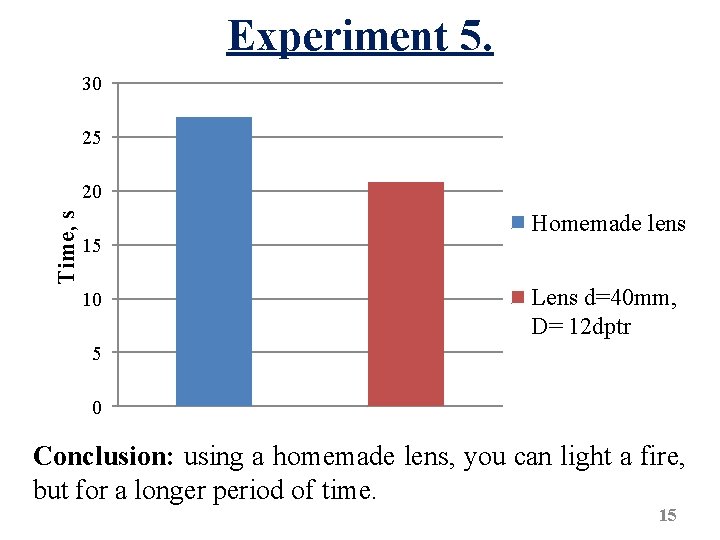
Experiment 5. 30 25 Time, s 20 15 10 Homemade lens Lens d=40 mm, D= 12 dptr 5 0 Conclusion: using a homemade lens, you can light a fire, but for a longer period of time. 15
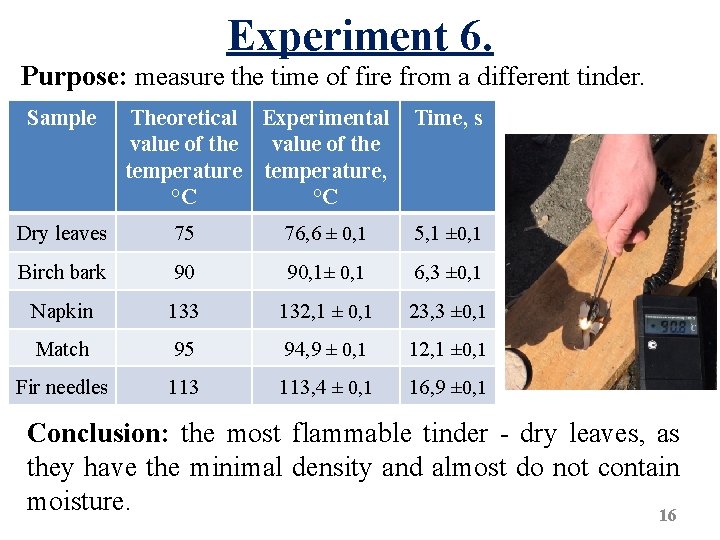
Experiment 6. Purpose: measure the time of fire from a different tinder. Sample Theoretical Experimental value of the temperature, °С °С Time, s Dry leaves 75 76, 6 ± 0, 1 5, 1 ± 0, 1 Birch bark 90 90, 1± 0, 1 6, 3 ± 0, 1 Napkin 133 132, 1 ± 0, 1 23, 3 ± 0, 1 Match 95 94, 9 ± 0, 1 12, 1 ± 0, 1 Fir needles 113, 4 ± 0, 1 16, 9 ± 0, 1 Conclusion: the most flammable tinder - dry leaves, as they have the minimal density and almost do not contain moisture. 16
Conclusions • In the course of the experimental part of the study, the properties of the lens that affect the time of receiving the fire were studied. • After conducting experiments, we found out that the tinder should be placed at the focal point of the lens. The time of appearance of fire depends on the material from which the lens is made, its optical power, as well as its diameter. • The minimum ignition time of a match will be when using a system of lenses - 7. 8 s. 17
References • The textbook "Physics-8", M. Peryshkin. Enlightenment, 2017 • Lens Brief - Copyright © 2005 -2019 Cambridge in Color • Lens focal length - A. Shapoval • https: //www. betaenergy. ru/insolation/novosibirsk/ • http: //optikarf. ru/lenses/ • http: //optica 100. ru/sovety/kak_podobrat_lupu • http: //glazzdorov. ru/ochki/kakie-vybrat-stekla-dlya-ochkov -plastik-ili-steklo. html • https: //brodude. ru/9 -sposobov-razzhech-ogon-bez-spichek/ • http: //chem 21. info/ 18
The 7 th International Young Naturalists' Tournament Problem № 7 «Burning glass» Alina Nedikova Team «Element» Russia, Novosibirsk chnmk@mail. ru
- Slides: 19