
The 7 th EAHSC The communitybased health program
The 7 th EAHSC The community-based health program perfomance improvement with motivational p 4 p strategies Kafwimi, Neema D-tree International www. d-tree. org
Outline 1. Introduction 2. Methodology 3. Results 4. Challenges 5. Lessons learnt 6. Takeaways

Pay for performance models-p 4 p • What is p 4 p? Transfer of money or material goods conditional on taking a measuarable action or achieving a pre-determined perfomance targert (Source: Oxman and Fretheim, 2008) Incentives on the supply side(providers) or the demand side (clients)

Pay for performance models: Objectives Improve quality and efficiency of care Promote positive health outcomes Increase uptake of services
Pay for performance models-p 4 p • What are the different types of p 4 p models? • Targeted performance criteria e. g. patient outcomes, visits done, no. of registrations etc. • Incentives vs. disincentives • How does p 4 p fit within community health programs? • Family planning community programs • Maternal and neonatal health programs • Infectious disease control programs
Case Study: Implementation of pay for performance model in community based family planning program
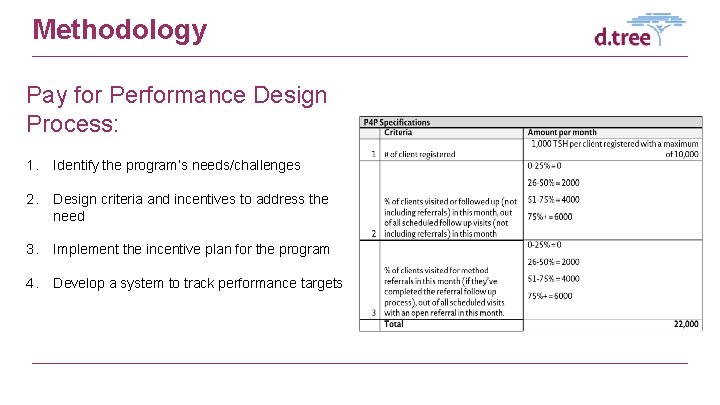
Methodology Pay for Performance Design Process: 1. Identify the program’s needs/challenges 2. Design criteria and incentives to address the need 3. Implement the incentive plan for the program 4. Develop a system to track performance targets
Program background Packard E 3 – Family planning • • Objective: Improve the quality of family planning counseling services and client satisfaction through the use of a mobile phone application. Location: Shinyanga, Tanzania Period: May 2014 - present Users: 240 CHWs, and 60 Supervisors Pathfinder PHE Family planning • • Objective: To increase uptake of family planning services through the use of a mobile phone application. Location: Kigoma, Katavi, Arusha and Manyara (Tanzania) Period: Oct 2018 - present Users: 176 CHWs, and 40 Supervisors
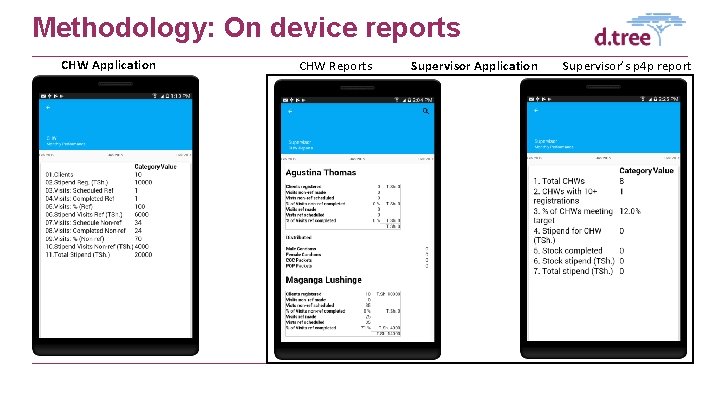
Methodology: On device reports CHW Application CHW Reports Supervisor Application Supervisor’s p 4 p report
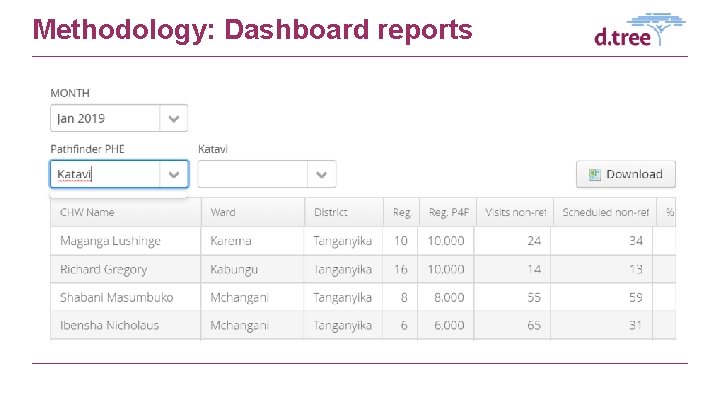
Methodology: Dashboard reports
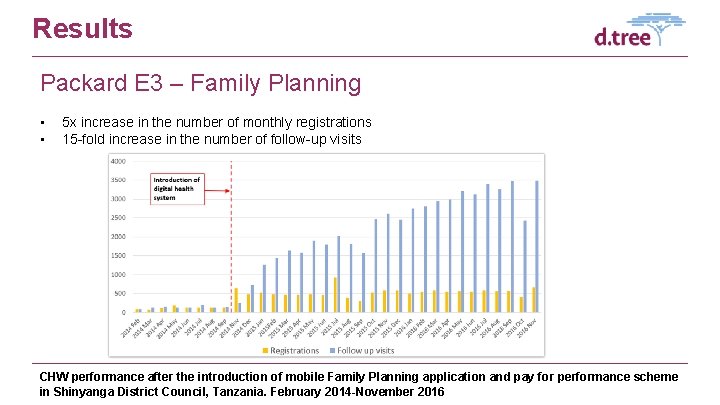
Results Packard E 3 – Family Planning • • 5 x increase in the number of monthly registrations 15 -fold increase in the number of follow-up visits CHW performance after the introduction of mobile Family Planning application and pay for performance scheme in Shinyanga District Council, Tanzania. February 2014 -November 2016
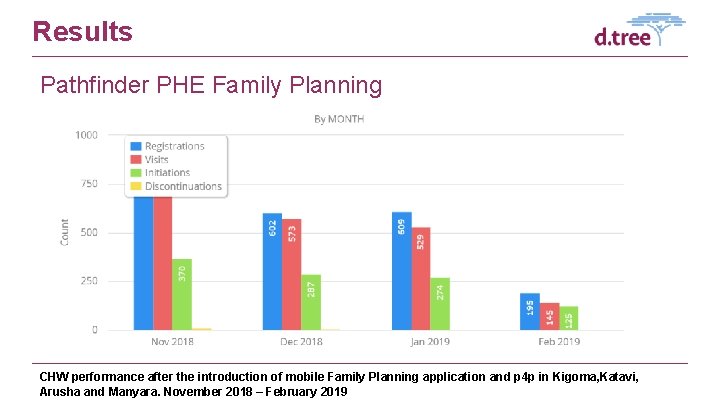
Results Pathfinder PHE Family Planning CHW performance after the introduction of mobile Family Planning application and p 4 p in Kigoma, Katavi, Arusha and Manyara. November 2018 – February 2019
Challenges 1. Involvement of different stakeholders with different conflicting perspectives on performance targets. 2. Gaming of the system by CHWs e. g. manipulating performance targets and fabricating data. Lessons Learnt 1. Listen to different perspectives and reach a consensus that’s reasonable and feasible on ground. 2. Develop a data integrity and quality assurance plan to identify suspicious data 3. Implement regular planned follow up visits with CHWs
Takeaways • A strong design process is key to a successful p 4 p model. • The model has proved to dramatically increase CHWs motivation and performance, resulting in improved health services delivery. The system show success across 800 CHWs, which indicate large potential for other programs to use performance based incentive schemes. • Considerations for program teams to include comprehensive pay-for-performance models in community health programs in order to achieve program targets.
Acknowledgements • Litner, Rebecca D-tree International • Kahamba, Gloria D-tree International • Mwaikokesya, Erika HJFMRI
- Slides: 15