
The 7 Components of Wellness Where did they
- Slides: 11
The 7 Components of Wellness
Where did they come from? Health used to be defined as the absence of disease In the early 90 s Sheldon Margen et al. (1992) proposed that health was more than the absence of disease It encompasses more including a balance between the physical, emotional and spiritual well being Specifically, it is a state of optimal health that includes…
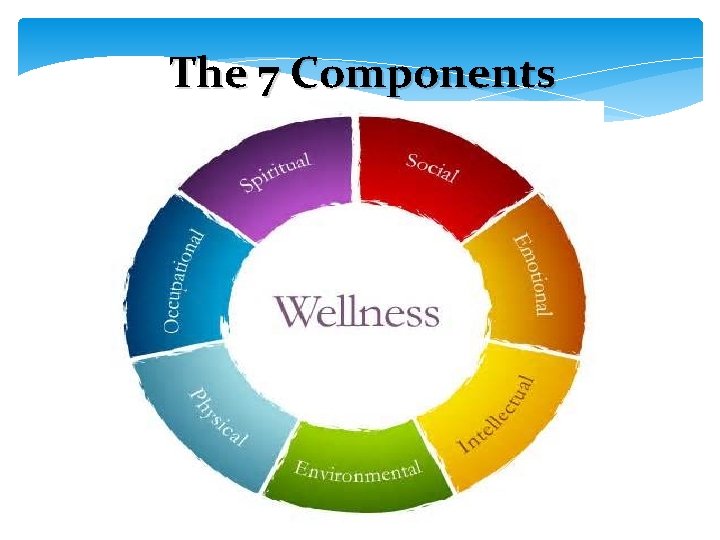
The 7 Components
SOCIAL The development and maintenance of interpersonal relationships How well we get along with others, appreciate and respect diversity, show care and concern, empathy, etc. How we engage with and relate to our communities
EMOTIONAL/MENTAL How we deal with daily life interactions and challenges How well we understand ourselves and our ability to handle stress, fear, sadness, anger, happiness, etc. What types of strategies we can use to develop a balance between the “highs and lows”
INTELLECTUAL How we keep our minds open to new ideas, experiences and understandings and how we might use them in pursuits of personal and/or group growth Engaging in ongoing brain based activities (reading, writing, expression, debating, etc. ) to enable our intellect to grow Life-long pursuit of challenges for personal fulfillment
ENVIRONMENTAL Engaging in socially responsible behaviours to protect and preserve the environments around us Recognizing the influence of our behaviours on the environment while aiming to have the least negative impact possible
PHYSICAL Embracing healthy choices/habits to ensure we can effectively function through daily routines without undue fatigue and/or injury Emphasizing healthy choices around diet, exercise, medical check ups while reducing/eliminating ‘health harming’ choices such as smoking, drugs, physical inactivity, etc. What we do to ensure our physical body functions efficiently
OCCUPATIONAL Involves feeling satisfied and/or personally fulfilled with the work we are involved with while finding a balance in life How much we feel we can contribute to the workplace/organization and/or greater society through our work
SPIRITUAL Establishing a personal sense of values to guide our thinking and actions Exploring a personal meaning and place in life It can be, but does not have to be a religion
QUESTIONS TO CONSIDER 1) How do you incorporate the different components into your lifestyle? 2) Is there one or more that are easiest to achieve? 3) Are there any that you have to more strategic and conscious about? 4) Do you presently incorporate any into your teaching? How so? 5) When you consider all the different components, which one poses the most challenge to address and incorporate with students?