
The 6 Traits of Writing 1 Read page
- Slides: 19
The 6 Traits of Writing 1. Read page 40 in Write Source. 2. List the 6 Traits and a brief definition of each. 3. Which trait do you think is most important and why?
Trait #1: Ideas Tip: Pick a topic that is not too broad and you have strong feelings about. (Something you love or hate)
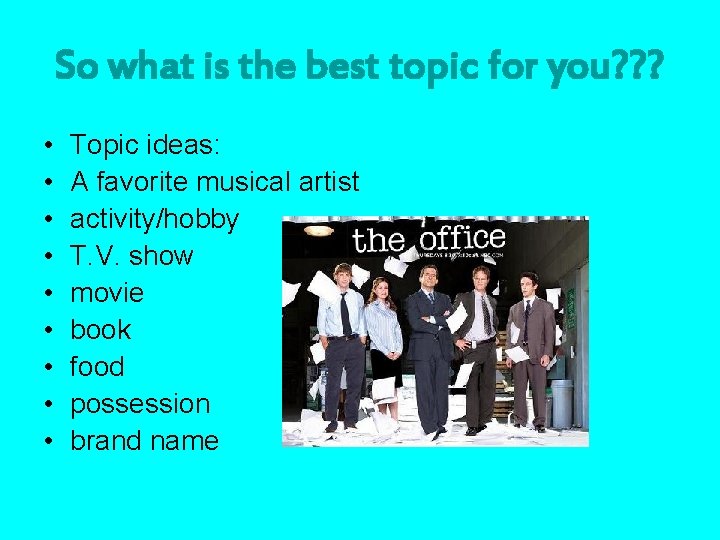
So what is the best topic for you? ? ? • • • Topic ideas: A favorite musical artist activity/hobby T. V. show movie book food possession brand name
Write your topic sentence. • In my opinion there is not a better TV comedy sitcom than the show The Office.
Different ways to prove your point/ support your topic: • • • Examples Facts Quotes Reasons Vivid Description Strong Verbs.
What do you do when you have to write on a topic you don’t have strong feelings about? ? ?
Boring topics…… or not? • • Life as a cabbage Noses Lint under the bed Sprinklers Door handles Cookie crumbs Watching grass grow • Staples • • The history of yarn Baskets Clocks Homework is great Watching paint dry Watching golf Hello Kitty
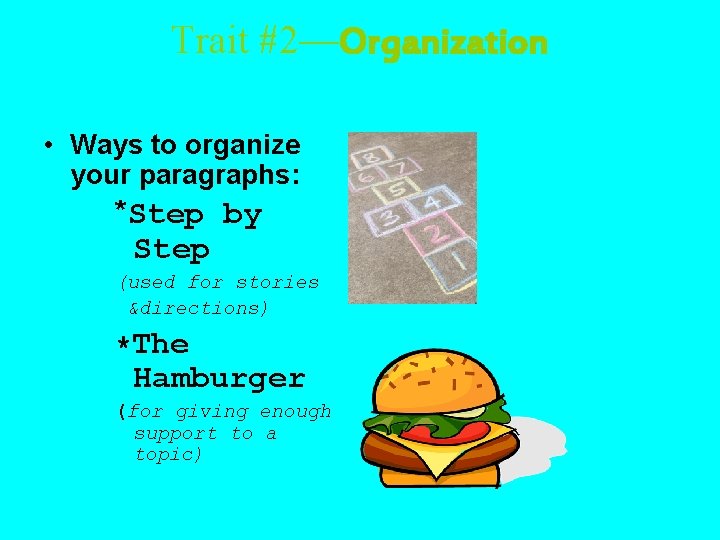
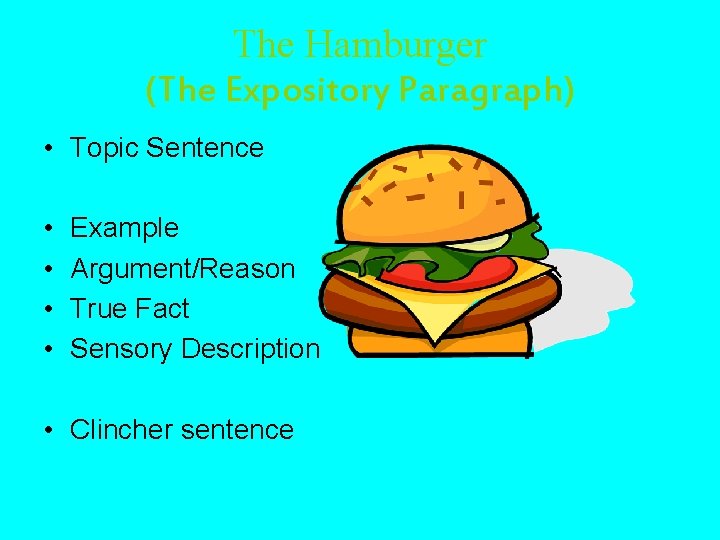
Trait #2—Organization • Ways to organize your paragraphs: *Step by Step (used for stories &directions) *The Hamburger (for giving enough support to a topic)
The Hamburger (The Expository Paragraph) • Topic Sentence • • Example Argument/Reason True Fact Sensory Description • Clincher sentence
The Write Source • List the 4 types/arrangements for paragraphs on p, 564 -567 • Explain what each one is and give and example of a topic that would work well for that type of paragraph.
Trait #3 DEVELOPING VOICE Definition: the special quality that attracts the reader to your writing • Tips to remember: • 1. Keep your purpose in mind 2. Show respect for your reader, 3. Engage their interest 4. Anticipate your readers questions. • Try 1 of these: • A letter of sincere apology, or sympathy. (4 sentences) • A written persuasive note convincing your parents to let you go to a concert. • A poem about an emotion. • A note to a teacher that explains why you should get a certain grade
Trait #4 –Word Choice • Tips--* Use Vivid Verbs • And, finally after a week of night, a feeble light did curdle the sky… (p. 72) – *Be specific rather than general Ulysses saw lots of ghosts in the underworld. Vs. …a huge ghost staring at Ulysses through empty eye sockets. He was giant skeleton. He wore a cloak of stiffened blood and a red plume upon his skull. (77) – *Describe Using your 5 senses. – Her eyes, like blue flame, burned these pictures out of his head. (66)
PRACTICE: • Skim through Ulysses and find another example of : • 1. Vivid Verbs • 2. Specific detail • 3. Sensory language • (Copy one of each on your paper)
PRACTICE CONTINUED: • Brainstorm with the class other vivid verbs for -– walk make speak think sit – Saunter – skip Brainstorm more specific words for these: house room face fight tree
Now Write: Fill in the chart to plan for your Ode Poem Sight Sound Touch Smell Taste Reminds me of:
Trait #5 Sentence fluency • Good Writing=Sentences that vary in length +structure, but flows together as a whole. • Tip: Read Aloud what you’ve written!
Sentence Fluency continued…. • PRACTICE: Free write for 3 minutes about a problem you see around you. It can be a personal problem or a problem that is effects many people. Describe all sides of it. • ANALYZE YOUR WRITING: Make 3 columns • First Word # of Words/Sentence Verbs Complete sentence fragment and run-on worksheets.
Writing Trait #6 --Conventions • What to check for : • Punctuation— • • End of sentences? Commas? Apostrophes? Quotations • Capitalizaton— • Beginning of sentences? • All proper nouns (names of things)
Conventions continued • Spelling- • Used spell check? • Homonyms? (there, their, they’re) • Grammar— • Correct form of verb (ate, had eaten) • Subject verb agreement? (the dog barks, the dogs bark)