
The 6 Methods of Characterization 6 different ways

- Slides: 17
The 6 Methods of Characterization 6 different ways of looking at a character in a story
Two Types Direct Characterization Indirect Characterization • When the author specifically describes a character in written text. • Ex- “She was completely unafraid of what others might think of her. ” • When the reader uses a characters actions or words to make an inference about a character • Ex- “She held her head high amid the laughter, looked directly into Hillari’s sneering face and smiled. ”
1. Physical Description • Always Direct Characterization • The most common way of describing a character. • Identifies anything physical about the character. • Includes height, skin, hair and eye color, short/tall, skinny/fat, wear glasses? , how he/she walks/stands, anything physical about the character.
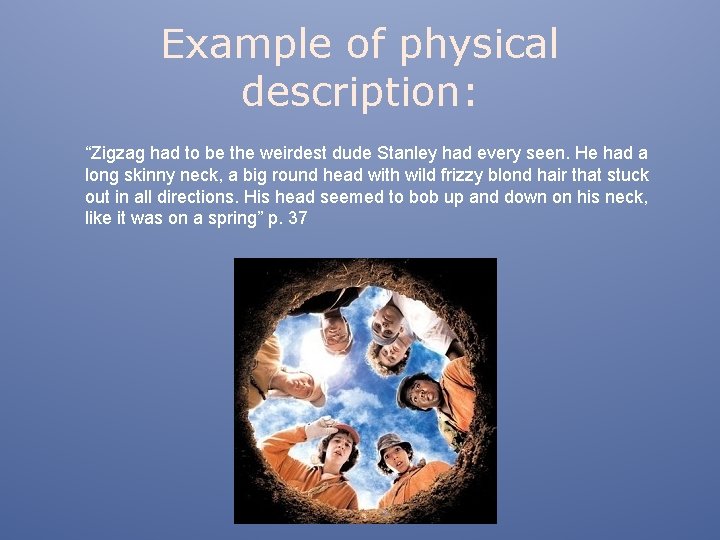
Example of physical description: “Zigzag had to be the weirdest dude Stanley had every seen. He had a long skinny neck, a big round head with wild frizzy blond hair that stuck out in all directions. His head seemed to bob up and down on his neck, like it was on a spring” p. 37
2. Attitude • How a character feels about his/her life and the events in the story. • How does the character feel about what’s happening to him? • Similar to how you may describe your attitude if you were in a similar situation.
Example of attitude/appearance: “All of them had something else in common. Despite their awful luck, they always remained hopeful. As Stanley’s father liked to say, “I learn from failure. ” p. 9
3. Says • The way in which a character talks. Also called Dialogue • Dialogue includes the characters choice of words and dialect. • It also includes the tone and diction of the character when he/she speaks. • Is the character serious? Sarcastic? Shy? Obnoxious? Ignorant? Etc…all these qualities can be conveyed through the characters dialogue.
Example of dialogue: As Stanley made his way across the room, he tripped over an outstretched leg. “Hey, watch it!” said an orange lump on a chair. “You watch it, ” muttered Stanley. “What’d you say? ” the lump demanded. “Nothin’, ” said Stanley
Example of dialogue con’t: From this we can see that Stanley doesn’t like being pushed around, but he doesn’t have the confidence to stand up to the bully. He’d rather not cause any trouble.
4. Thoughts • The thoughts of a character can only be analyzed if we are inside the head of the character. • Thoughts can tell us how a character REALLY feels, even if it’s different then how he’s acting
Example of thoughts: “Next to it was another sign which declared that it was a violation of the Texas Penal Code to bring guns, explosives, weapons, drugs or alcohol onto the premises. As Stanley read the sign, he couldn’t help but think, “WELL DUH!”
5. Reactions of Others • How do other characters treat your character? What do other characters do when he speaks? Walks in a room? • Reactions include talking and emotions • Character reactions can tell you if the character you are analyzing is liked or disliked, popular, honest, trust-worthy etc…
Example of Reactions of others: Mr. Pendanski looked form one boy to another. “You’re all special in your own way, ” he said. “You’ve all got something to offer. You have to think about what you want to do, then do it. Even you, Zero. You’re not completely worthless. ” The smile was not gone from Zero’s face. “What do you want to do with your life? ” Mr. Pendanski asked him. Zero’s mouth was shut tight. As he glared at Mr. Pendanski, his dark eyes seemed to expand. P. 58
6. Actions • “Actions speak louder than words. ” • You can tell a lot about a character from how they act and react to situations and other characters. • Are they kind? Cruel? Fair? A hard worker? Brave?
Example of Actions: He smiled. It was a family joke. Whenever anything went wrong, they always blamed Stanley’s no-good-dirtyrotten-pig-stealing-greatgrandfather. Supposedly, he had a great-great grandfather who had stolen a pig from a one-legged Gypsy, and she put a curse on him and all his decendents. Stanley and his family didn’t believe in curse, of course, but whenever anything went wrong, it felt good to have someone to blame.
Using the 6 methods to describe a character • Use these 6 methods of characterization when writing a description of a character in the stories you read. By looking at all 6 methods you can give an in-depth description of the character instead of a flat description that includes only basic information.