
The 6 Levels of Organization of the Human
- Slides: 10
The 6 Levels of Organization of the Human Body: The arrangement of specialized parts within a living thing is referred to as levels of organization. The levels become more complex as the levels increase.
Organelles—the 1 st level of organization • Work inside a cell and effect only the cell – Examples: mitochondria, nucleus
Cells—the 2 nd Level • Cells are made of organelles. • Cells are the building blocks of tissues. • Many cells work together to make up a tissue.
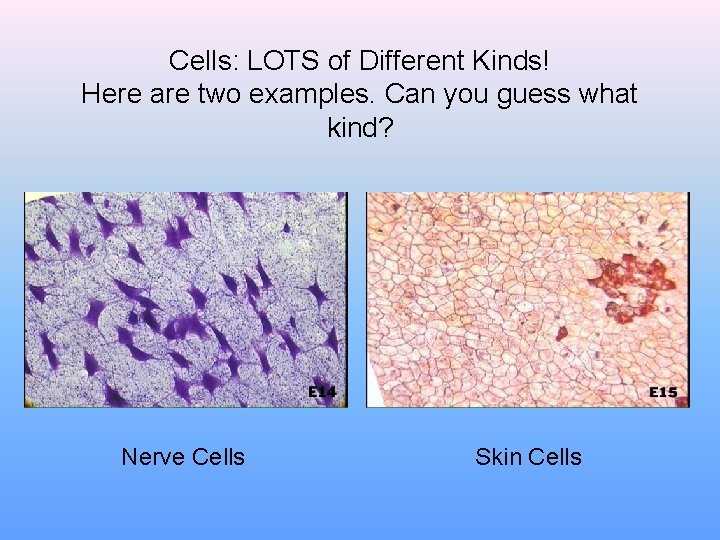
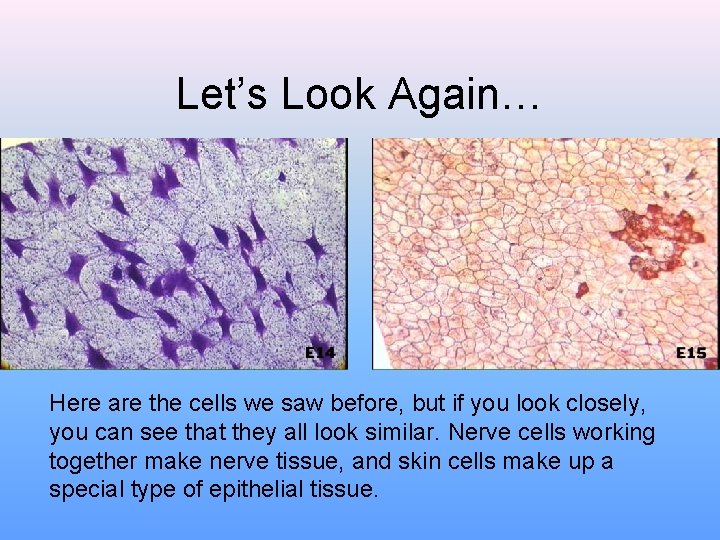
Cells: LOTS of Different Kinds! Here are two examples. Can you guess what kind? Nerve Cells Skin Cells
Tissues—the 3 rd level • In any multi-cellular organism, cells rarely work alone. • Cells that are similar in structure and function are usually joined together to form tissues. • Tissues have specialized functions and including many types including connective, muscle, epithelial, nerve, bone, etc.
Let’s Look Again… Here are the cells we saw before, but if you look closely, you can see that they all look similar. Nerve cells working together make nerve tissue, and skin cells make up a special type of epithelial tissue.
4 Basic Tissue Types—this isn’t all of them Connective tissue connects and supports parts of the body. Blood, fat, ligaments, cartilage, bones, and tendons are all connective tissues. Epithelial tissue covers and lines the surfaces of your body and organs, inside and out. They primarily serve as protective barriers. Skin is one example. Nervous tissue carries messages back and forth between the brain and every other part of the body. The brain, spinal cord, and nerves are made up of nerve tissue. Muscle tissue can contract, or shorten, enabling your body to move.
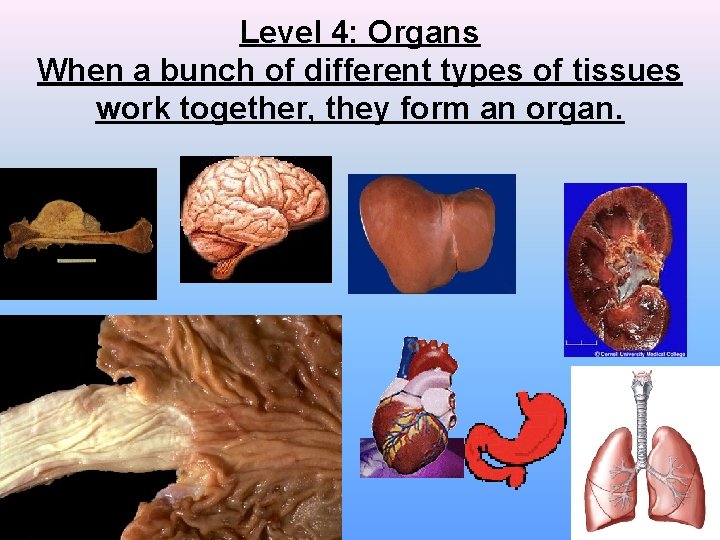
Level 4: Organs When a bunch of different types of tissues work together, they form an organ.
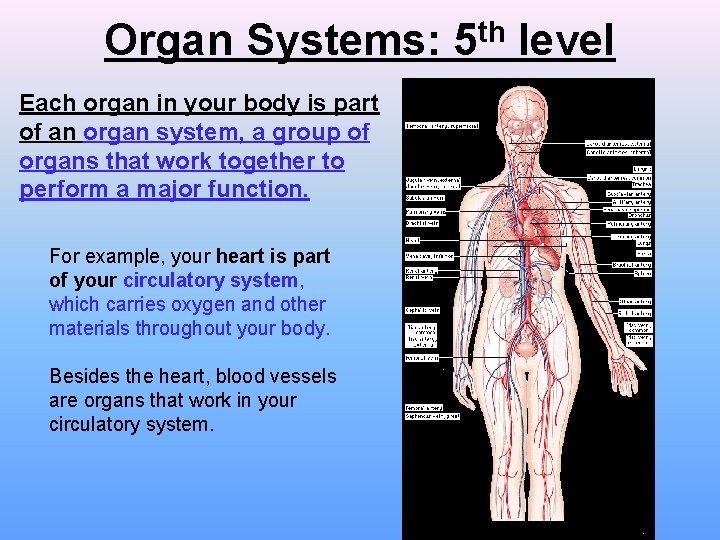
Organ Systems: 5 th level Each organ in your body is part of an organ system, a group of organs that work together to perform a major function. For example, your heart is part of your circulatory system, which carries oxygen and other materials throughout your body. Besides the heart, blood vessels are organs that work in your circulatory system.
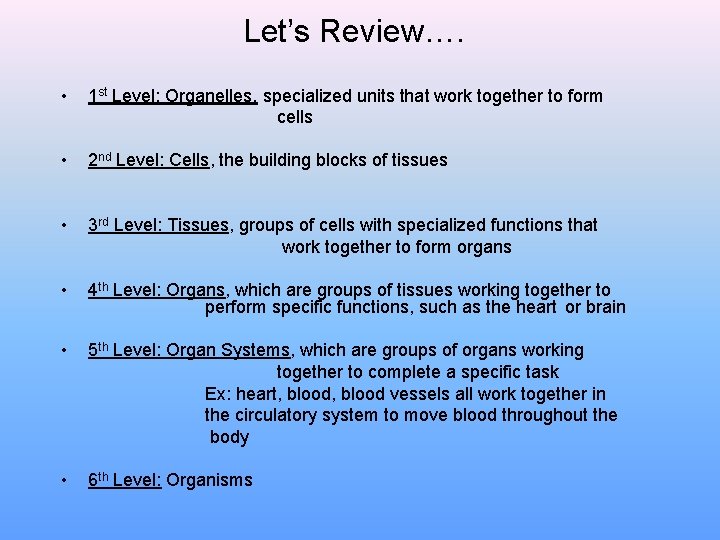
Let’s Review…. • 1 st Level: Organelles, specialized units that work together to form cells • 2 nd Level: Cells, the building blocks of tissues • 3 rd Level: Tissues, groups of cells with specialized functions that work together to form organs • 4 th Level: Organs, which are groups of tissues working together to perform specific functions, such as the heart or brain • 5 th Level: Organ Systems, which are groups of organs working together to complete a specific task Ex: heart, blood vessels all work together in the circulatory system to move blood throughout the body • 6 th Level: Organisms