
The 6 d F Galaxy Redshift Survey Status

- Slides: 21
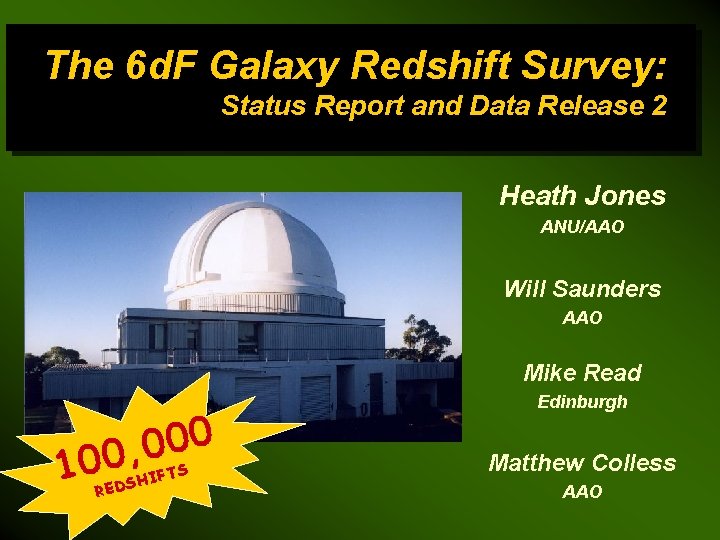
The 6 d. F Galaxy Redshift Survey: Status Report and Data Release 2 Heath Jones ANU/AAO Will Saunders AAO Mike Read 0 0 0 , 0 0 1 RED TS SHIF Edinburgh Matthew Colless AAO
The 6 d. F Galaxy Survey: n The 6 d. FGS is designed to be the first of a new generation of combined z+v-surveys, combining… NIR-selected redshift survey of the local universe Peculiar velocity survey using FP distances Additional redshift surveys of other ‘interesting’ source samples.
The 6 d. F Galaxy Survey: n The 6 d. FGS is designed to be the first of a new generation of combined z+v-surveys, combining… NIR-selected redshift survey of the local universe Peculiar velocity survey using FP distances Additional redshift surveys of other ‘interesting’ source samples. n Survey strategy… n survey whole southern sky with |b|>10° n primary z-survey: 2 MASS galaxies to Ktot<12. 75 n secondary samples: H<13, J<13. 75, r<15. 6, b<16. 75 n 11 additional samples: radio, X-ray, IRAS… n v-survey: ~15, 000 brightest early-type galaxies
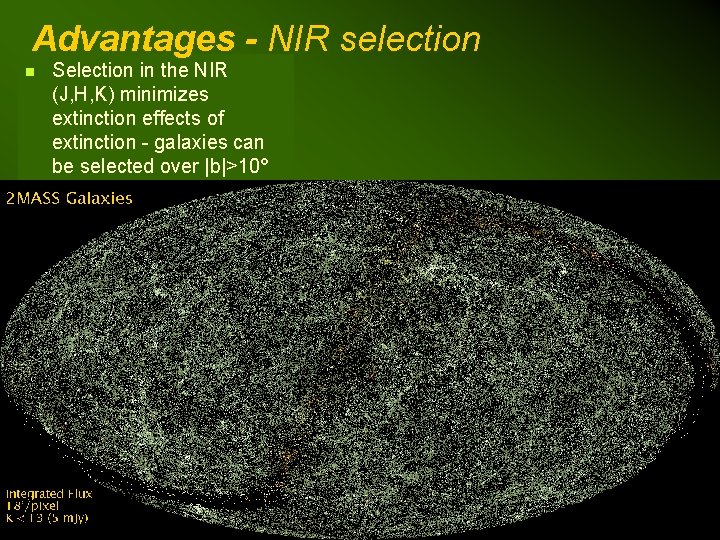
Advantages - NIR selection n Selection in the NIR (J, H, K) minimizes extinction effects of extinction - galaxies can be selected over |b|>10°
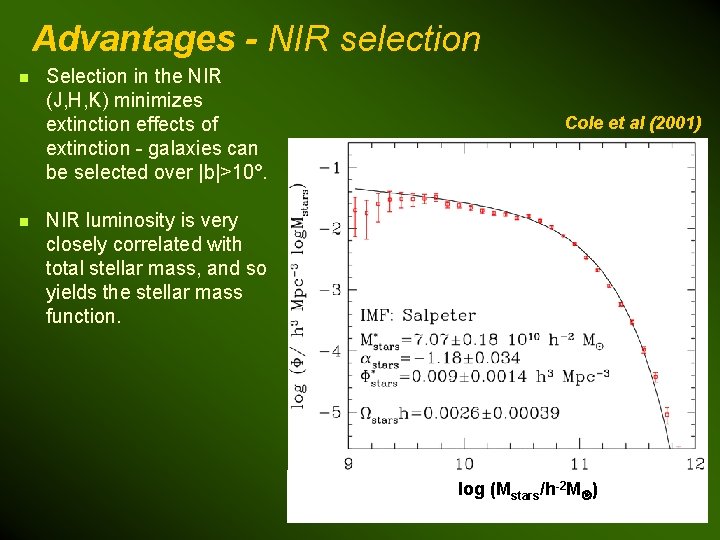
Advantages - NIR selection n n Selection in the NIR (J, H, K) minimizes extinction effects of extinction - galaxies can be selected over |b|>10°. Cole et al (2001) NIR luminosity is very closely correlated with total stellar mass, and so yields the stellar mass function. log (Mstars/h-2 M )
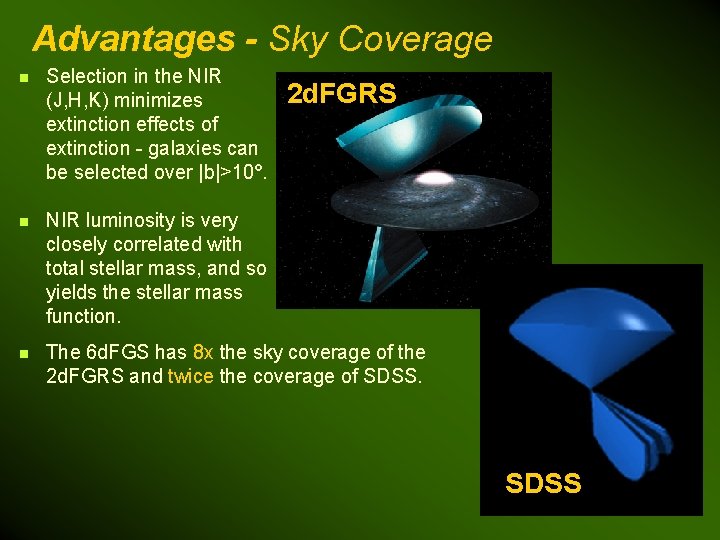
Advantages - Sky Coverage n Selection in the NIR (J, H, K) minimizes extinction effects of extinction - galaxies can be selected over |b|>10°. n NIR luminosity is very closely correlated with total stellar mass, and so yields the stellar mass function. n The 6 d. FGS has 8 x the sky coverage of the 2 d. FGRS and twice the coverage of SDSS. 2 d. FGRS SDSS
Advantages - NIR selection n Selection in the NIR (J, H, K) minimizes extinction effects of extinction - galaxies can be selected over |b|>10°. n NIR luminosity is very closely correlated with total stellar mass, and so yields the stellar mass function. n The 6 d. FGS has 8 x the sky coverage of the 2 d. FGRS and twice the coverage of SDSS. n Traditionally, most redshift surveys have been optically selected and therefore favoured late-type galaxies. In contrast, the NIR selection of 6 d. FGS is biased towards the redder early-type galaxies needed for the Peculiar Velocity Survey.
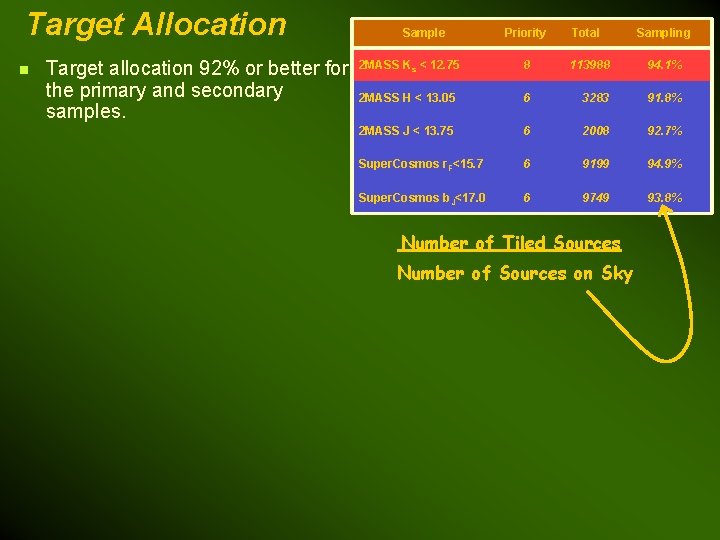
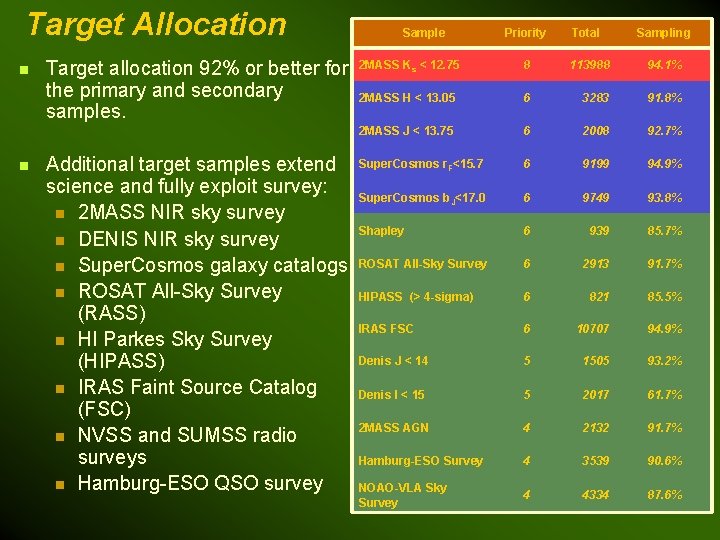
Target Allocation n Target allocation 92% or better for the primary and secondary samples. Sample Priority Total Sampling 2 MASS Ks < 12. 75 8 113988 94. 1% 2 MASS H < 13. 05 6 3283 91. 8% 2 MASS J < 13. 75 6 2008 92. 7% Super. Cosmos r. F<15. 7 6 9199 94. 9% Super. Cosmos b. J<17. 0 6 9749 93. 8% Number of Tiled Sources Number of Sources on Sky
Target Allocation n n Target allocation 92% or better for the primary and secondary samples. Additional target samples extend science and fully exploit survey: n 2 MASS NIR sky survey n DENIS NIR sky survey n Super. Cosmos galaxy catalogs n ROSAT All-Sky Survey (RASS) n HI Parkes Sky Survey (HIPASS) n IRAS Faint Source Catalog (FSC) n NVSS and SUMSS radio surveys n Hamburg-ESO QSO survey Sample Priority Total Sampling 2 MASS Ks < 12. 75 8 113988 94. 1% 2 MASS H < 13. 05 6 3283 91. 8% 2 MASS J < 13. 75 6 2008 92. 7% Super. Cosmos r. F<15. 7 6 9199 94. 9% Super. Cosmos b. J<17. 0 6 9749 93. 8% Shapley 6 939 85. 7% ROSAT All-Sky Survey 6 2913 91. 7% HIPASS (> 4 -sigma) 6 821 85. 5% IRAS FSC 6 10707 94. 9% Denis J < 14 5 1505 93. 2% Denis I < 15 5 2017 61. 7% 2 MASS AGN 4 2132 91. 7% Hamburg-ESO Survey 4 3539 90. 6% NOAO-VLA Sky Survey 4 4334 87. 6%
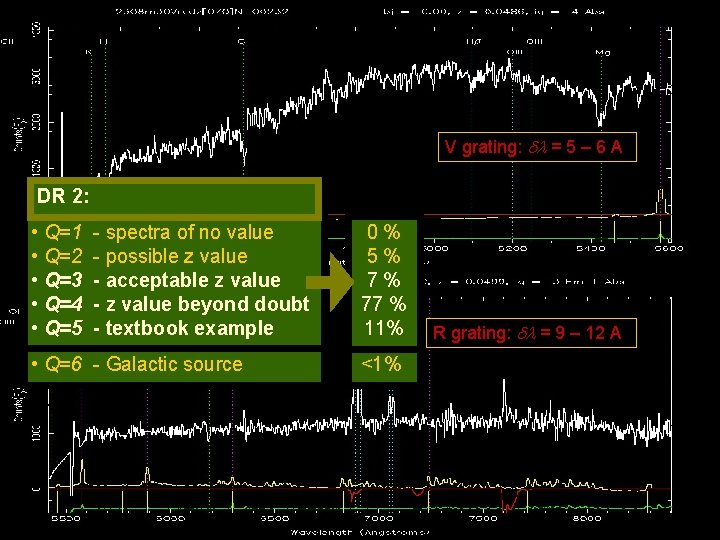
V grating: dl = 5 – 6 A DR 2: • Q=1 • Q=2 • Q=3 • Q=4 • Q=5 - spectra of no value - possible z value - acceptable likely z value - z value beyonddoubt - textbook example • Q=6 - Galactic source 0% 5% 7% 77 % 11% <1% R grating: dl = 9 – 12 A
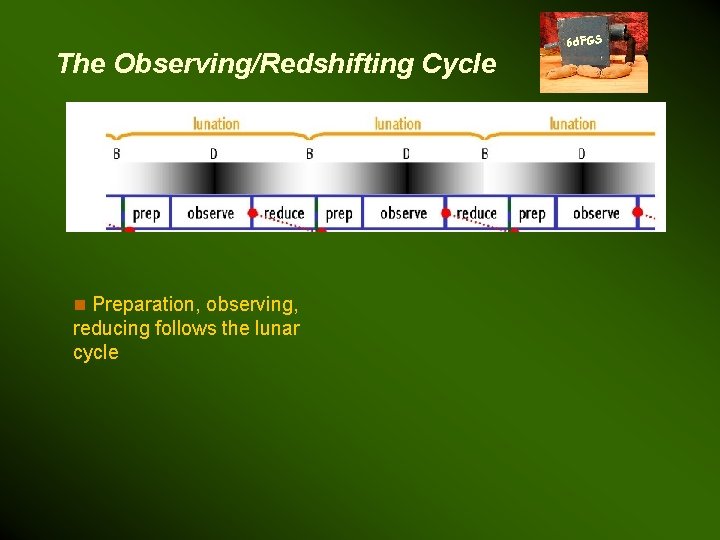
The Observing/Redshifting Cycle n Preparation, observing, reducing follows the lunar cycle 6 d. FGS
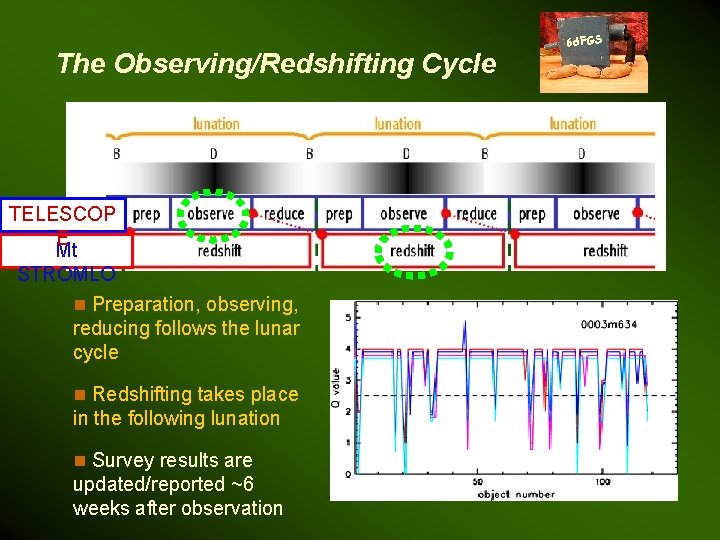
The Observing/Redshifting Cycle TELESCOP E Mt STROMLO n Preparation, observing, reducing follows the lunar cycle n Redshifting takes place in the following lunation n Survey results are updated/reported ~6 weeks after observation 6 d. FGS
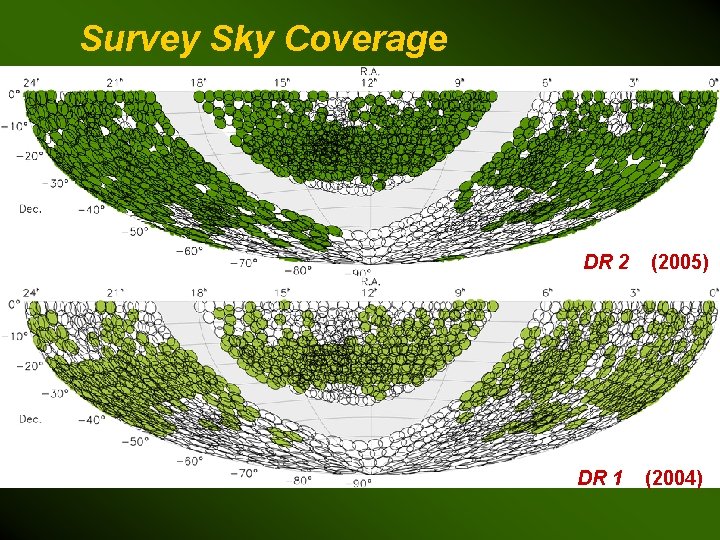
6 d. FGS 2 nd Data Release: April 2005 n Jan 2002 – October 2004 for public release 89211 spectra; 83014 unique redshifts; 936 fields n 36540 more redshifts (37163 more spectra) than DR 1 DR 2 n 6 d. FGS Online Database: http: //www-wfau. roe. ac. uk/6 d. FGS/ n Searchable using either SQL query commands or a WWW form n Each source has its own multi-extension FITS file, including 6 d. F spectrum, br. JHK imaging, redshift and photometric information n The different target catalogues are also online, fully searchable and inter-
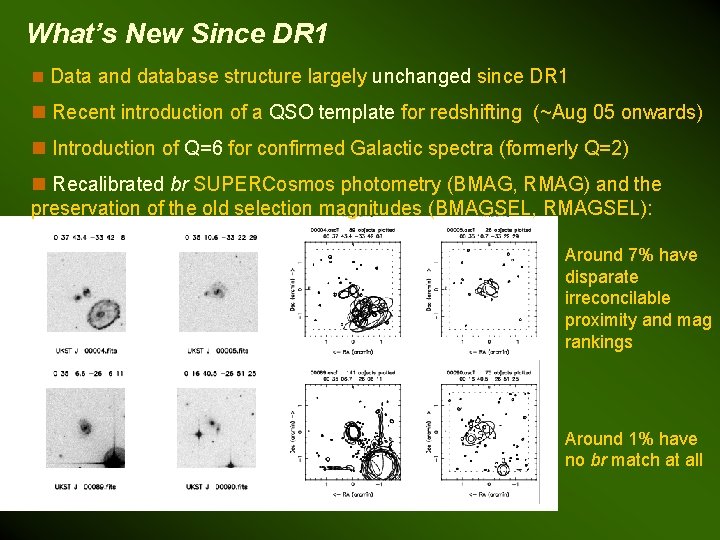
What’s New Since DR 1 n Data and database structure largely unchanged since DR 1 n Recent introduction of a QSO template for redshifting (~Aug 05 onwards) n Introduction of Q=6 for confirmed Galactic spectra (formerly Q=2) n Recalibrated br SUPERCosmos photometry (BMAG, RMAG) and the preservation of the old selection magnitudes (BMAGSEL, RMAGSEL): Around 7% have disparate irreconcilable proximity and mag rankings Around 1% have no br match at all
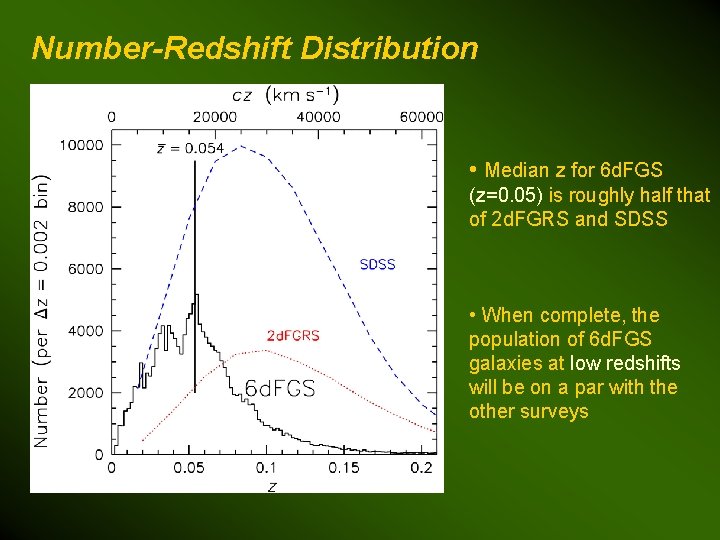
Number-Redshift Distribution • Median z for 6 d. FGS (z=0. 05) is roughly half that of 2 d. FGRS and SDSS • When complete, the population of 6 d. FGS galaxies at low redshifts will be on a par with the other surveys
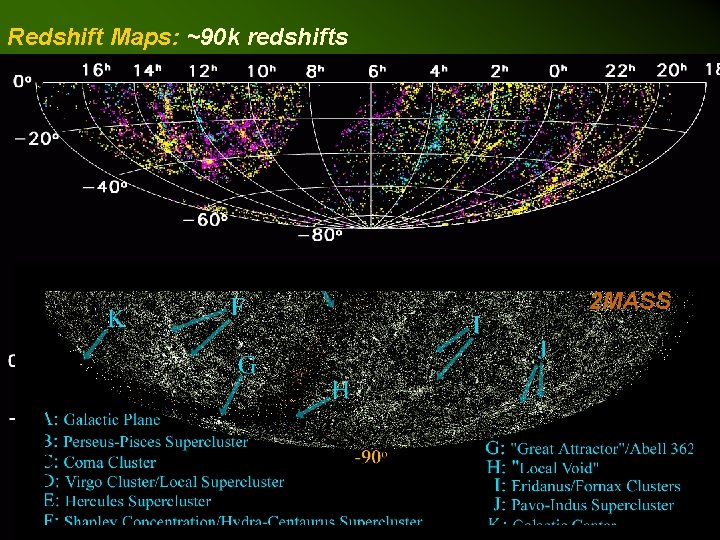
Redshift Maps: ~90 k redshifts 2 MASS
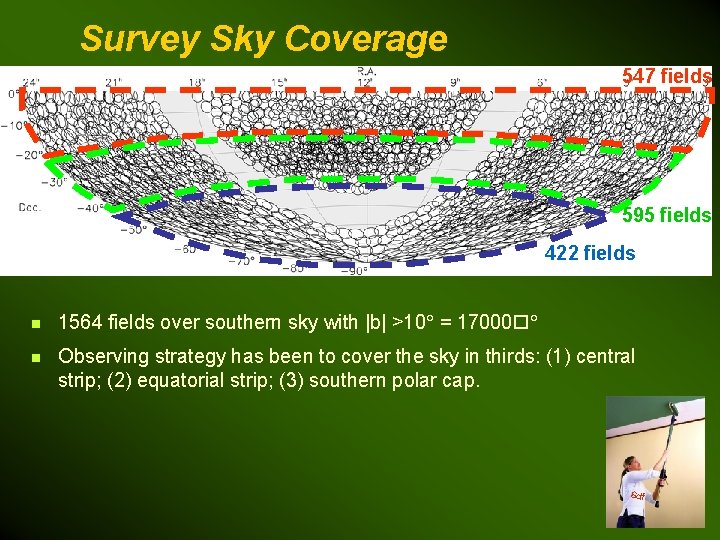
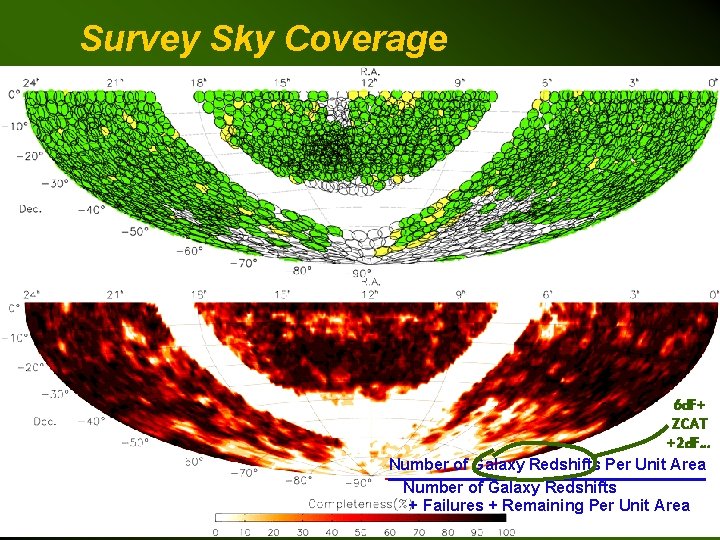
Survey Sky Coverage 547 fields 595 fields 422 fields n 1564 fields over southern sky with |b| >10 = 17000 n Observing strategy has been to cover the sky in thirds: (1) central strip; (2) equatorial strip; (3) southern polar cap. 6 df
Survey Sky Coverage n n n 1564 fields over southern sky with |b|>10 = 17000 Observing strategy has been to cover the sky in thirds: (1) central strip; (2) equatorial strip; (3) southern polar cap. 1375 fields observed to date – 936 fields from January 02 to October 04 constituting the Second Data Release 6 d. F+ ZCAT +2 d. F… Number of Galaxy Redshifts Per Unit Area Number of Galaxy Redshifts 6 df + Failures + Remaining Per Unit Area
Survey Sky Coverage DR 2 (2005) DR 1 (2004)
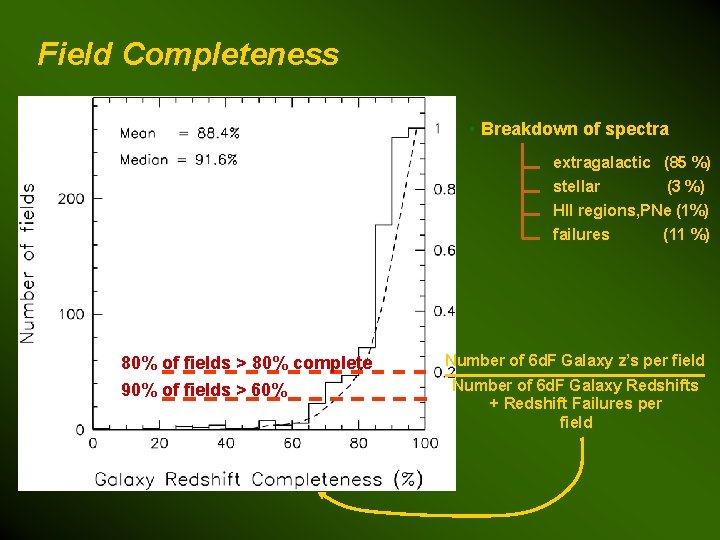
Field Completeness • Breakdown of spectra extragalactic (85 %) stellar (3 %) HII regions, PNe (1%) failures (11 %) 80% of fields > 80% complete 90% of fields > 60% Number of 6 d. F Galaxy z’s per field Number of 6 d. F Galaxy Redshifts + Redshift Failures per field
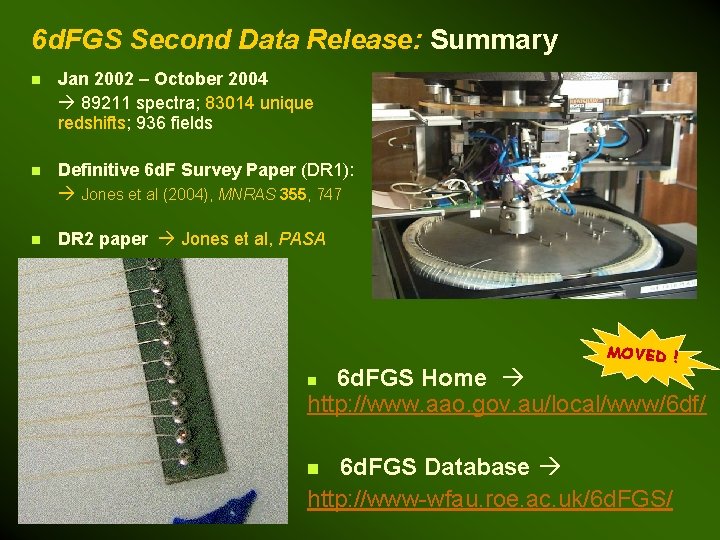
6 d. FGS Second Data Release: Summary n Jan 2002 – October 2004 89211 spectra; 83014 unique redshifts; 936 fields n Definitive 6 d. F Survey Paper (DR 1): Jones et al (2004), MNRAS 355, 747 n DR 2 paper Jones et al, PASA MOVED ! 6 d. FGS Home http: //www. aao. gov. au/local/www/6 df/ n 6 d. FGS Database http: //www-wfau. roe. ac. uk/6 d. FGS/ n