
The 504 Process PLEASANTS COUNTY SCHOOLS TRAINING FOR

- Slides: 48
The 504 Process PLEASANTS COUNTY SCHOOLS TRAINING FOR ADMINISTRATORS AND COORDINATORS JUNE 9, 2016 PRESENTED BY KIMBERLY KEHRER, DIRECTOR OF SPECIAL PROGRAMS Training Materials and Slides taken from the WV CASE Conference Presented on Thursday March 10, 2016 by Rick Boothby, Esq.
Today’s Outcomes… Administrators and Coordinators will: §Understand the Section 504 Process §Be proactive in child find as it relates to 504 eligibility §Know how to avoid trouble with OCR §Be able to complete the Pleasants County Schools 504 documents
Before we get started… §When a complaint is filed, OCR will enforce these laws as OCR chooses to interpret these laws. §OCR’s “Dear Colleague” letters, decisions, and other guidance matter. §OCR often requires A LOT!!! §Regardless of time, staff, and money, we MUST comply with the law. §Understanding the OCR’s and the Courts’ interpretation of the law will give clear direction and some peace of mind when push comes to shove.
Section 504 of the Rehabilitation Act of 1973 §Section 504 is a federal non-discrimination statute that prohibits discrimination on the basis of disability. § “No otherwise qualified individual with a disability…shall, solely by reason of her or his disability, be excluded from participation in, be denied the benefits of, or be subjected to discrimination under any program or activity receiving Federal financial assistance…” § 29 U. S. C. § 794(a) §Part D of Section 504 contains specific provisions applicable to any educational program that receives federal funding.
Section 504 in Schools §Section 504 is a civil rights statute. It prohibits discrimination against “any person who: (i) has a physical or mental impairment which substantially limits one or more major life activities; (ii) has a record of such an impairment; or (iii) is regarded as having such an impairment. ” ***The last two only apply to claims of discrimination and not to eligibility for services or the provision of FAPE.
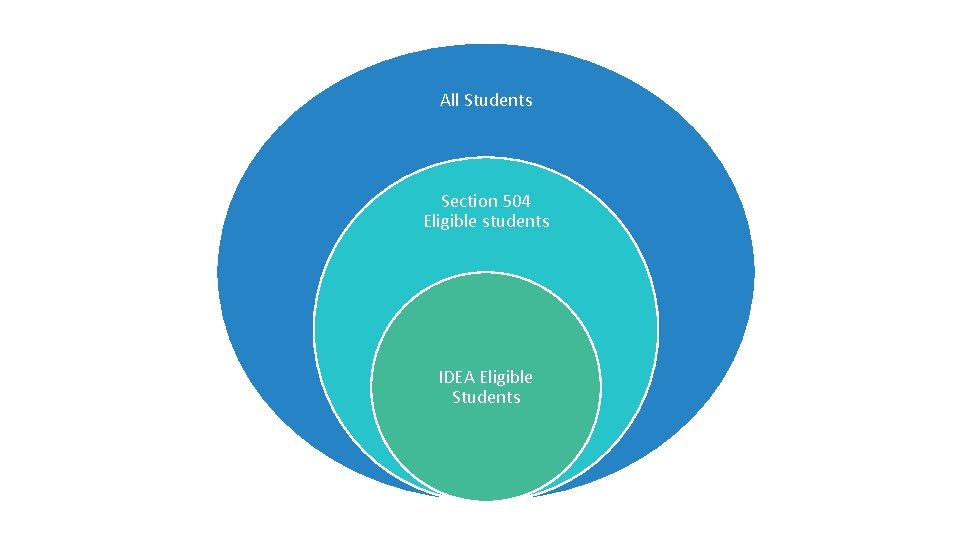
IDEA vs. Section 504 Eligibility §Under IDEA, a child must have a disability listed in the IDEA, must be failing to make effective progress as a result of that disability, and must require special education and/or related services to make effective progress in school §Under Section 504, a child needs only to be found to have a mental or physical impairment that substantially limits a major life activity (not necessarily learning) to be entitled to the protections of Section 504. §Section 504 applies to all students on IEPs.
All Students Section 504 Eligible students IDEA Eligible Students
The 504 Coordinator §School districts must designate at least one Section 504 Coordinator. §The 504 Coordinator(s) must: ◦ Be knowledgeable about the requirements of Section 504; and ◦ Have authority, knowledge and skills to carry out these responsibilities. Pleasants County Schools complies with this requirement as follows: § District Coordinator – Kim Kehrer § School Coordinator(s) – Principal or Designee
Section 504 – Child Find Every year, each school district must: §Identify and locate students with disabilities residing in the district (whether or not they are receiving a public education); and Pleasants County Schools comply with this requirement through collaboration with Birth to 3; Pre-K enrollment and registration; screening offered to parents of any student with possible delays; collaboration with private school. §Notify parents/guardians of children with disabilities of the district’s duties under Section 504. Pleasants County Schools comply with this requirement through the provision of Form C, page 5, in the PCS 504 Manual.
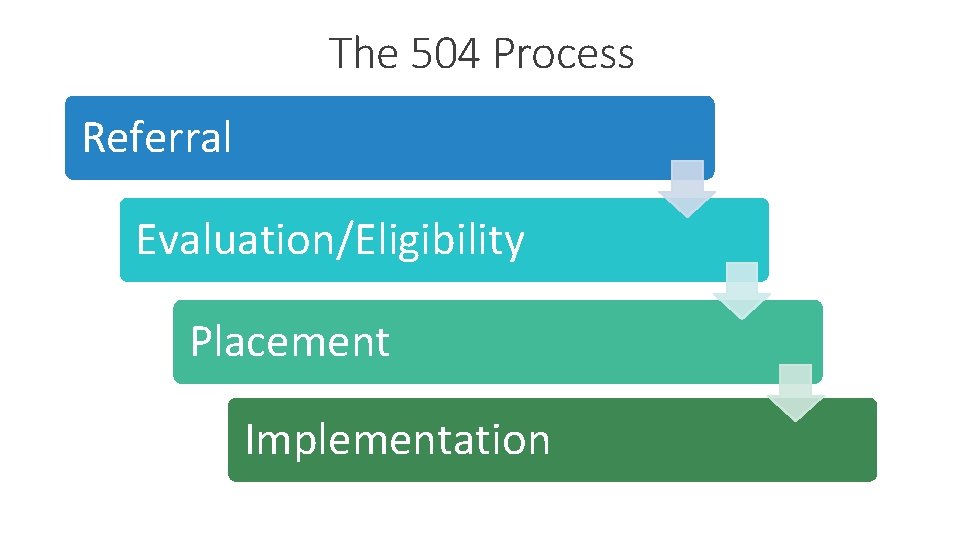
The 504 Process Referral Evaluation/Eligibility Placement Implementation
Does every struggling student need to be referred for a 504 evaluation? No. If a student is struggling but there is no reason to suspect that the student has a disability, regular education interventions or referral to the SAT is appropriate. Students who the district has reason to suspect may need special education or related services due to a disability must be referred for an evaluation.
What if PCS receives a physician’s statement indicating that the “student has a disability and requires a 504 plan”? ØQuestion: Does the student automatically qualify for a 504 plan? ØAnswer: No. A physician's statement, standing alone, is not definitive evidence of eligibility. A physician’s statement is persuasive information for the 504 Team to consider.
When do schools need to refer a student for a 504 evaluation immediately? 1. The parent/guardian requests an evaluation and there is reason to suspect that the child has a disability. 2. The student is found to have a a disability but to be ineligible under the IDEA. 3. Teacher observations, student behavior, or other information (e. g. , notice of a diagnosis from a parent) leads the district to suspect that the student has a mental or physical impairment which substantially limits a major life activity.
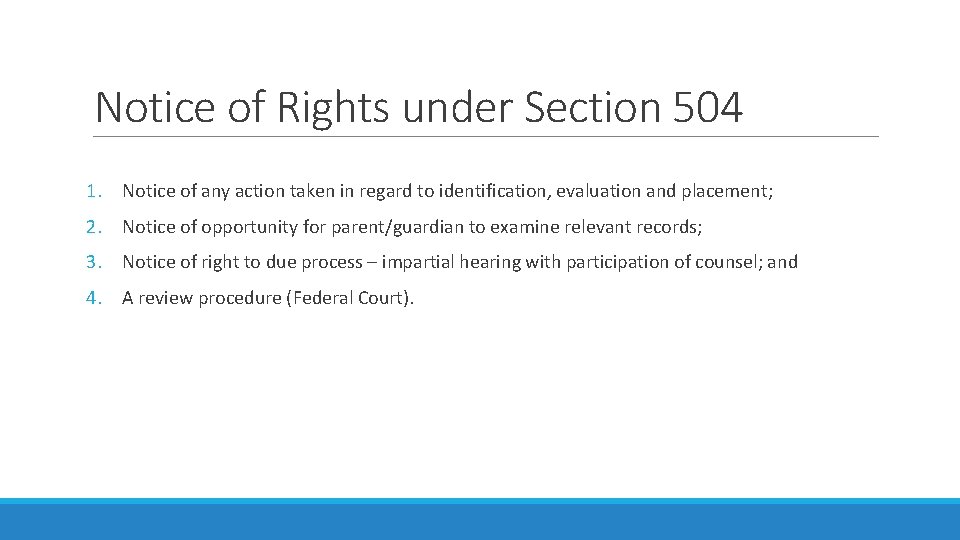
Notice of Rights under Section 504 1. Notice of any action taken in regard to identification, evaluation and placement; 2. Notice of opportunity for parent/guardian to examine relevant records; 3. Notice of right to due process – impartial hearing with participation of counsel; and 4. A review procedure (Federal Court).
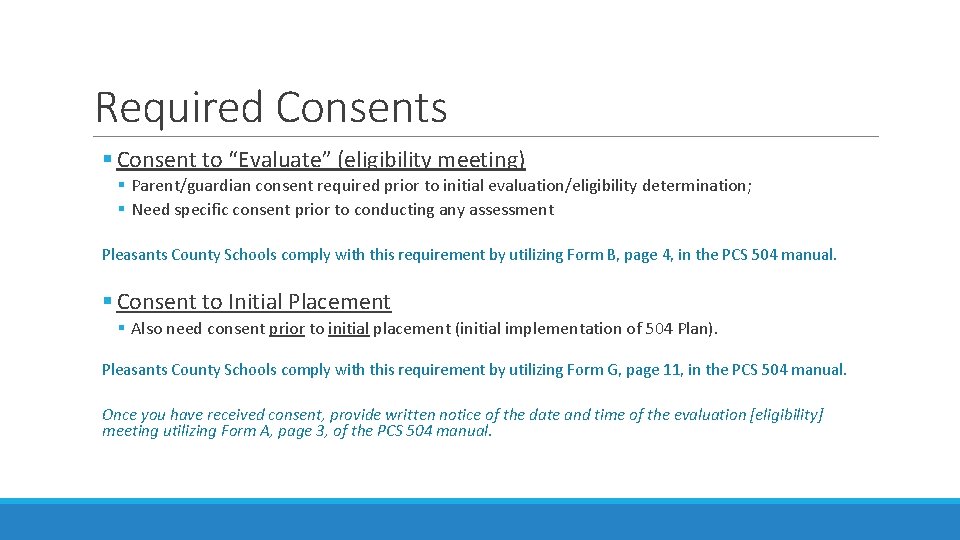
Required Consents § Consent to “Evaluate” (eligibility meeting) § Parent/guardian consent required prior to initial evaluation/eligibility determination; § Need specific consent prior to conducting any assessment Pleasants County Schools comply with this requirement by utilizing Form B, page 4, in the PCS 504 manual. § Consent to Initial Placement § Also need consent prior to initial placement (initial implementation of 504 Plan). Pleasants County Schools comply with this requirement by utilizing Form G, page 11, in the PCS 504 manual. Once you have received consent, provide written notice of the date and time of the evaluation [eligibility] meeting utilizing Form A, page 3, of the PCS 504 manual.
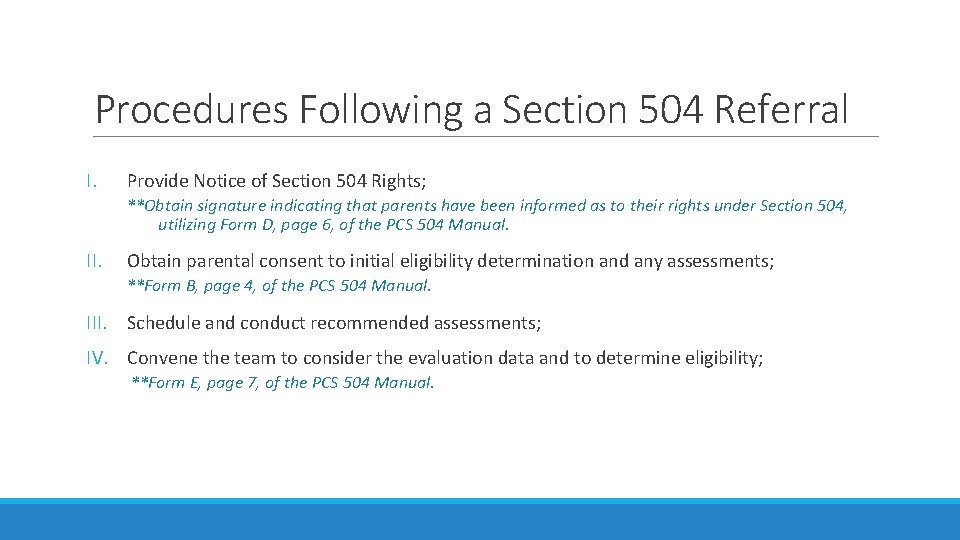
Procedures Following a Section 504 Referral I. Provide Notice of Section 504 Rights; **Obtain signature indicating that parents have been informed as to their rights under Section 504, utilizing Form D, page 6, of the PCS 504 Manual. II. Obtain parental consent to initial eligibility determination and any assessments; **Form B, page 4, of the PCS 504 Manual. III. Schedule and conduct recommended assessments; IV. Convene the team to consider the evaluation data and to determine eligibility; **Form E, page 7, of the PCS 504 Manual.
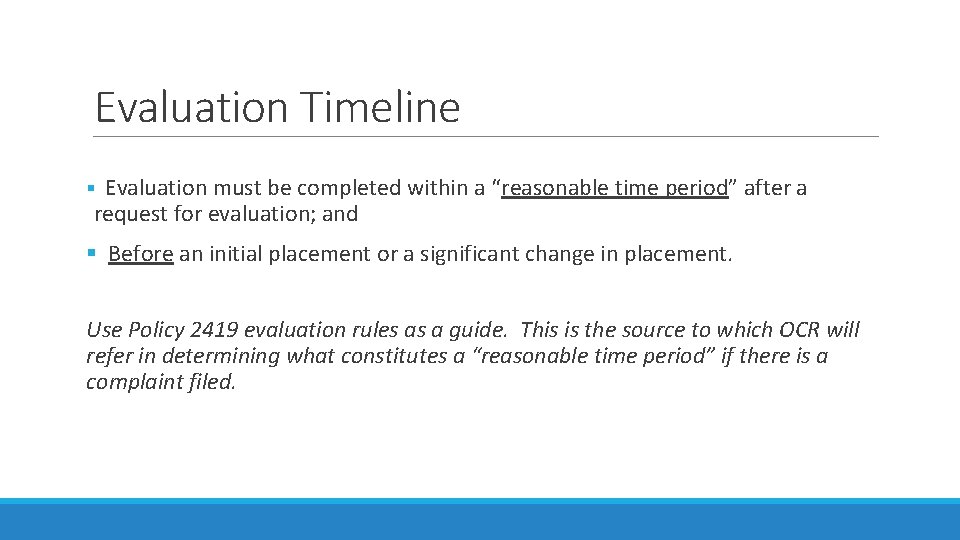
Evaluation Timeline § Evaluation must be completed within a “reasonable time period” after a request for evaluation; and § Before an initial placement or a significant change in placement. Use Policy 2419 evaluation rules as a guide. This is the source to which OCR will refer in determining what constitutes a “reasonable time period” if there is a complaint filed.
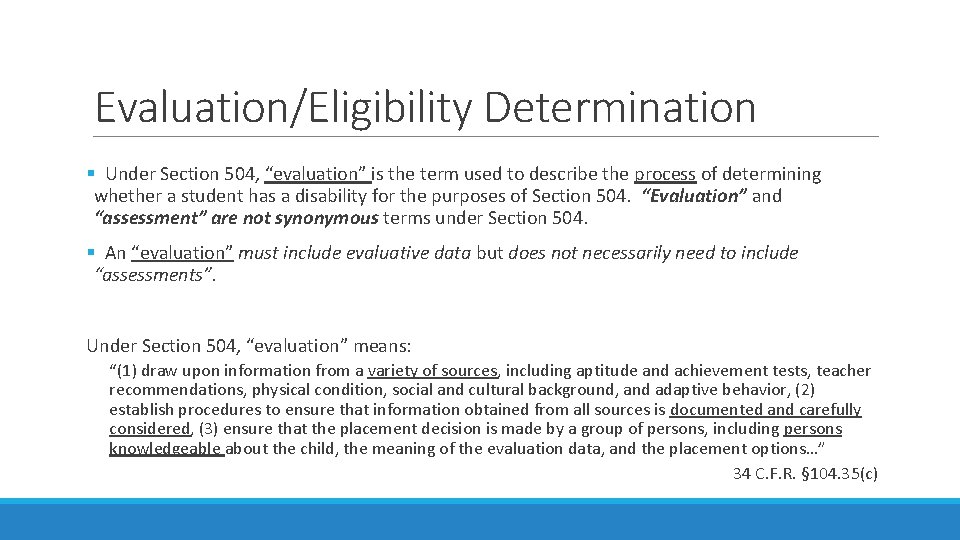
Evaluation/Eligibility Determination § Under Section 504, “evaluation” is the term used to describe the process of determining whether a student has a disability for the purposes of Section 504. “Evaluation” and “assessment” are not synonymous terms under Section 504. § An “evaluation” must include evaluative data but does not necessarily need to include “assessments”. Under Section 504, “evaluation” means: “(1) draw upon information from a variety of sources, including aptitude and achievement tests, teacher recommendations, physical condition, social and cultural background, and adaptive behavior, (2) establish procedures to ensure that information obtained from all sources is documented and carefully considered, (3) ensure that the placement decision is made by a group of persons, including persons knowledgeable about the child, the meaning of the evaluation data, and the placement options…” 34 C. F. R. § 104. 35(c)
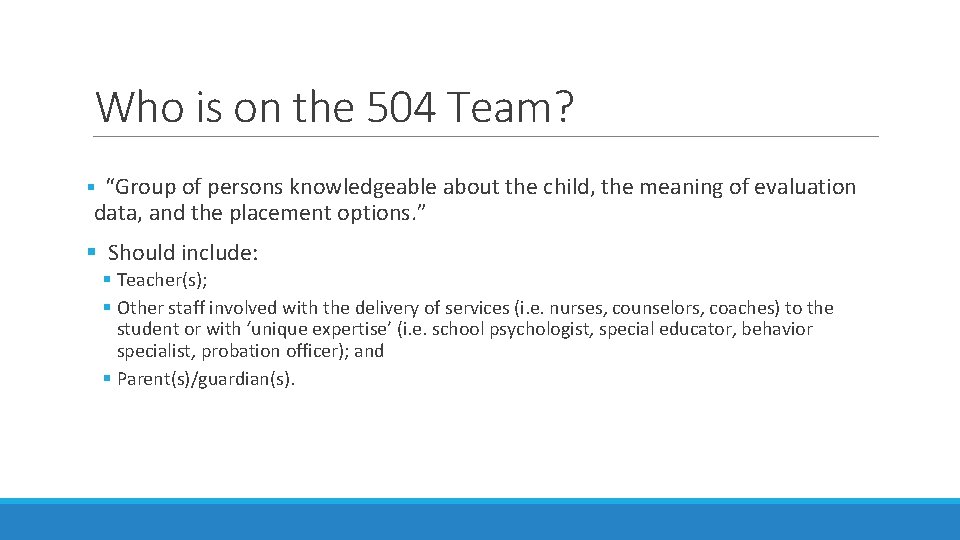
Who is on the 504 Team? § “Group of persons knowledgeable about the child, the meaning of evaluation data, and the placement options. ” § Should include: § Teacher(s); § Other staff involved with the delivery of services (i. e. nurses, counselors, coaches) to the student or with ‘unique expertise’ (i. e. school psychologist, special educator, behavior specialist, probation officer); and § Parent(s)/guardian(s).
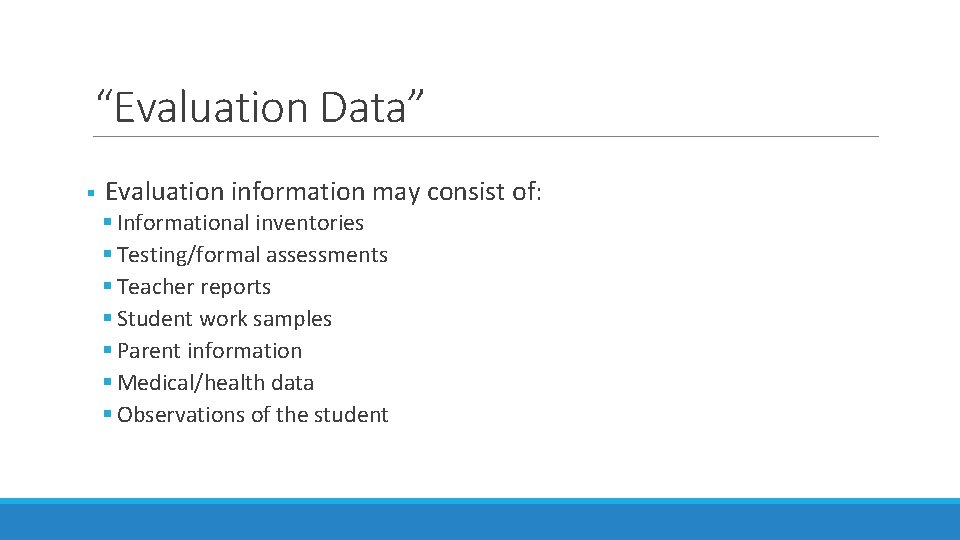
“Evaluation Data” § Evaluation information may consist of: § Informational inventories § Testing/formal assessments § Teacher reports § Student work samples § Parent information § Medical/health data § Observations of the student
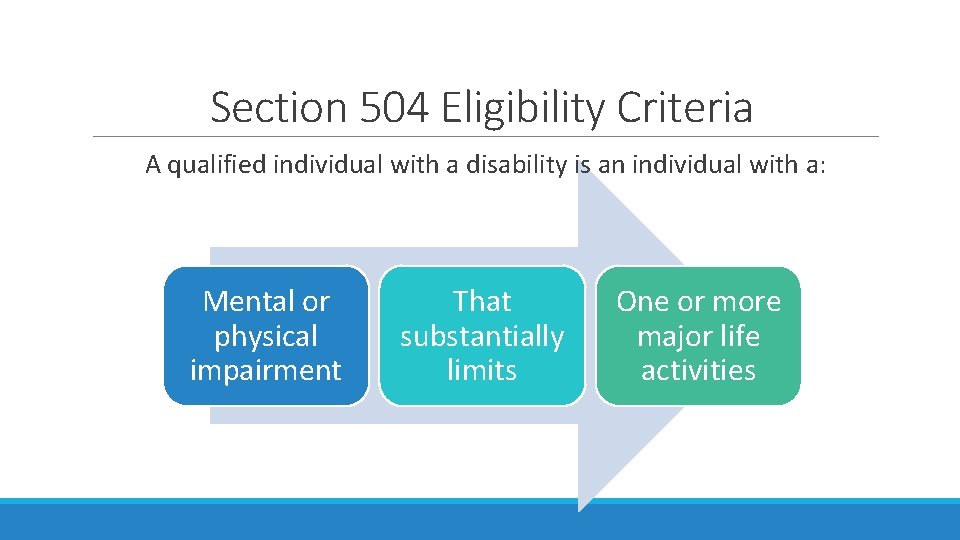
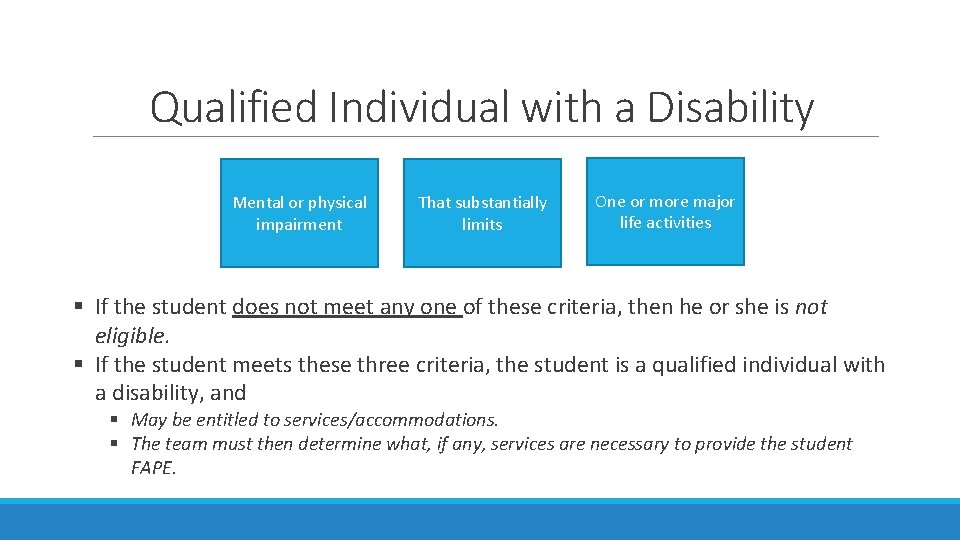
Section 504 Eligibility Criteria A qualified individual with a disability is an individual with a: Mental or physical impairment That substantially limits One or more major life activities
ADA Amendments Act of 2008 Intentionally broadened the definition of who is “disabled” and eligible for services under Section 504. Ø ØStudents who in the past have been found to not have a disability under Section 504, may now be found to have a disability under Section 504.
Does the student have a physical or mental impairment? § Any physiological disorder or condition, cosmetic disfigurement, or anatomical loss affecting one or more of the following body systems: neurological; musculoskeletal; special sense organs; respiratory, including speech organs; cardiovascular; reproductive; digestive; genito-urinary; hemic and lymphatic; skin. § Any mental or psychological disorder such as mental retardation; organic brain syndrome; emotional or mental illness; specific learning disabilities.
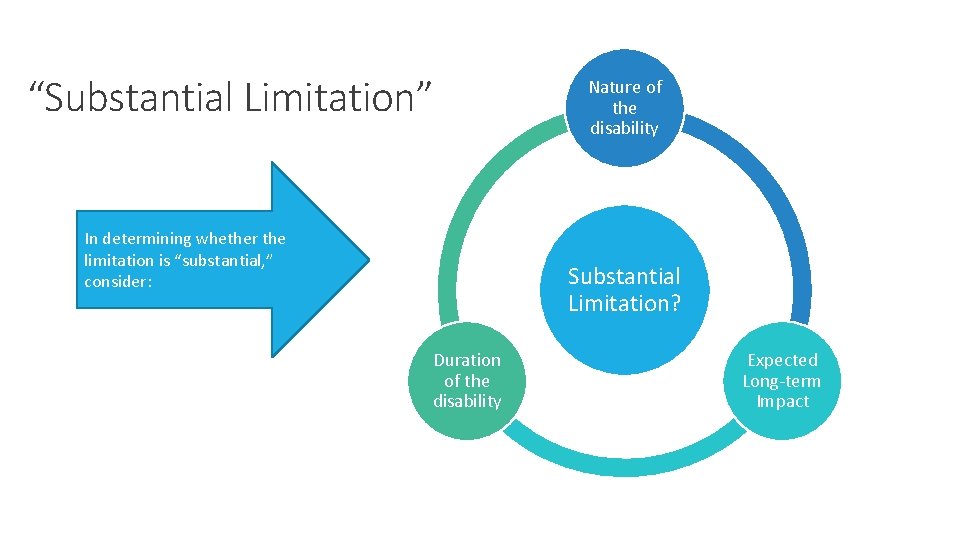
“Substantial Limitation” In determining whether the limitation is “substantial, ” consider: Nature of the disability Substantial Limitation? Duration of the disability Expected Long-term Impact
Cannot Consider Mitigating Measures Availability or ameliorative effects of mitigating measures (aside from ordinary eyeglasses) may not be considered in determining whether the individual is substantially limited, such as: § § Medication § Mobility devices § Prosthetics § Hearing aids § Assistive technology **Must ask whether the student would be substantially limited by his/her disability without the mitigating measure (i. e. the student with ADHD without medication. )
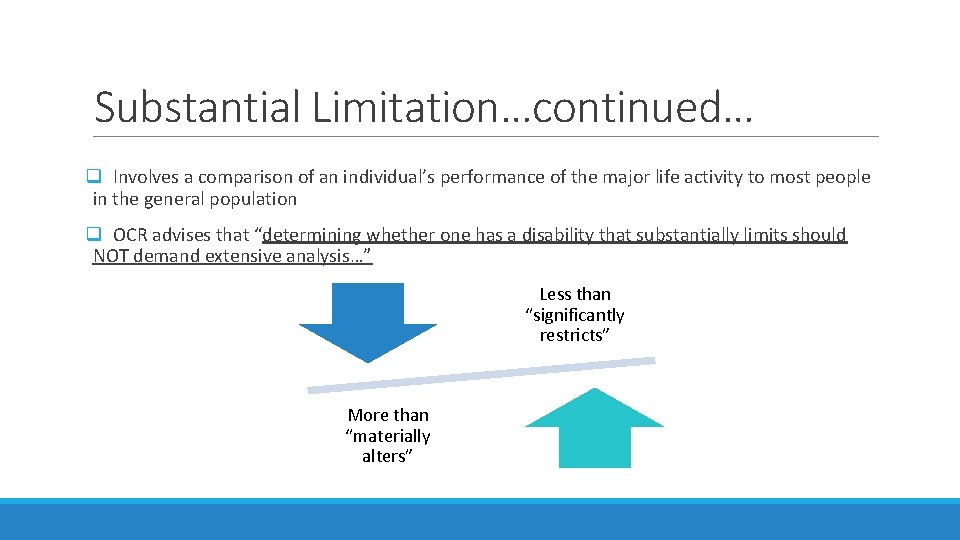
Substantial Limitation…continued… q Involves a comparison of an individual’s performance of the major life activity to most people in the general population q OCR advises that “determining whether one has a disability that substantially limits should NOT demand extensive analysis…” Less than “significantly restricts” More than “materially alters”
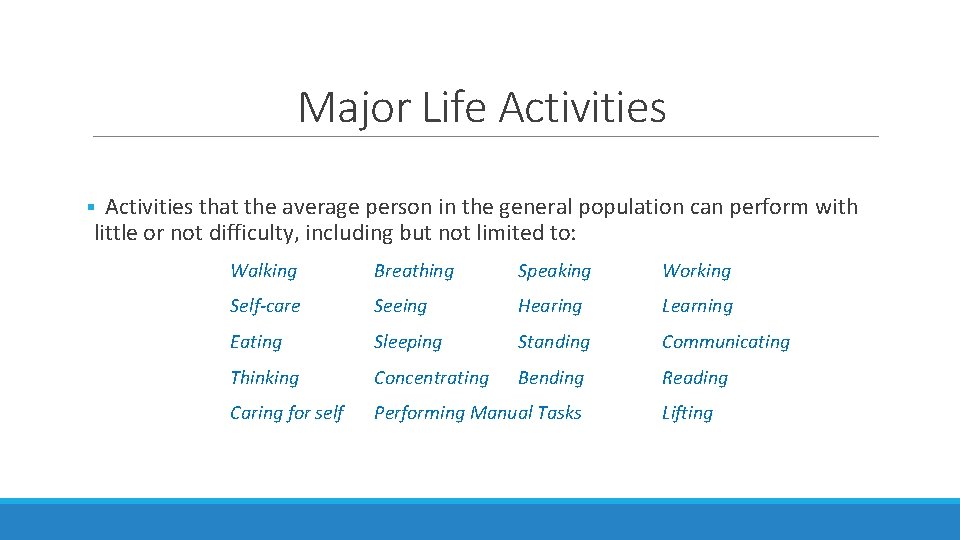
Major Life Activities § Activities that the average person in the general population can perform with little or not difficulty, including but not limited to: Walking Breathing Speaking Working Self-care Seeing Hearing Learning Eating Sleeping Standing Communicating Thinking Concentrating Bending Reading Caring for self Performing Manual Tasks Lifting
Episodic or Transitory Conditions § Episodic Conditions: Impairments that are episodic or in remission are considered disabilities if impairment would substantially limit a major life activity when in an active state. § Examples: cancer, multiple sclerosis, epilepsy, inflammatory bowel disease § Transitory Conditions: An impairment with an actual or expected duration of 6 months or less does not generally qualify as a disability. § “Impairments that last only for a short period of time are typically not covered, although they may be covered if sufficiently severe. ” 29 C. F. R. Part 1630, app.
Temporary Impairments There is no specific rule as to what constitutes an “extended period of time” such that a temporary impairment qualifies as a disability. § § Given that districts are required to make an individualized determination of a student’s eligibility, and given the ADA’s broadening of the eligibility standard, err on the side of caution in evaluation whether an impairment will last long enough to qualify.
Qualified Individual with a Disability Mental or physical impairment That substantially limits One or more major life activities § If the student does not meet any one of these criteria, then he or she is not eligible. § If the student meets these three criteria, the student is a qualified individual with a disability, and § May be entitled to services/accommodations. § The team must then determine what, if any, services are necessary to provide the student FAPE.
Section 504 FAPE § Provision of regular or special education and related aids and services designed to meet the student’s needs as adequately as the needs of non-disabled students are met. § Consider mitigating measures when determining FAPE. § Implementation of a plan under IDEA meets this standard. **Typically this would be FAPE “accommodations” within the general education classroom, but nothing in Section 504 prohibits the provision of related services.
Components of the 504 Plan § There is no explicit requirement in Section 504 that there be a written plan (hard to believe, but it’s true); § However, having one is strongly recommended…and in PCS…it is REQUIRED! § Section 504 plans typically include: § § Name of student and team members Identification of the student’s impairment Summary of how the impairment substantially limits the major life activity(ies) Statement of the accommodations to be provided (placement) §There is no required format and OCR offers no model forms or samples. ***Pleasants County Schools utilizes Form F, pages 8 -9, to document the plan. In addition, Form F Attachment, page 10, is utilized to document GSA accommodations.
Types of Accommodations § Accommodations are individualized based on the student needs, specific circumstances, extent of limitations, types of limitations, etc. PCS 504 Manual contains a comprehensive, but not exhaustive, list of accommodations the team may choose to utilize on pages 12 -32. § § General Accommodations Examples § Specific Disability Accommodation Examples § Specific Deficit Accommodation Examples
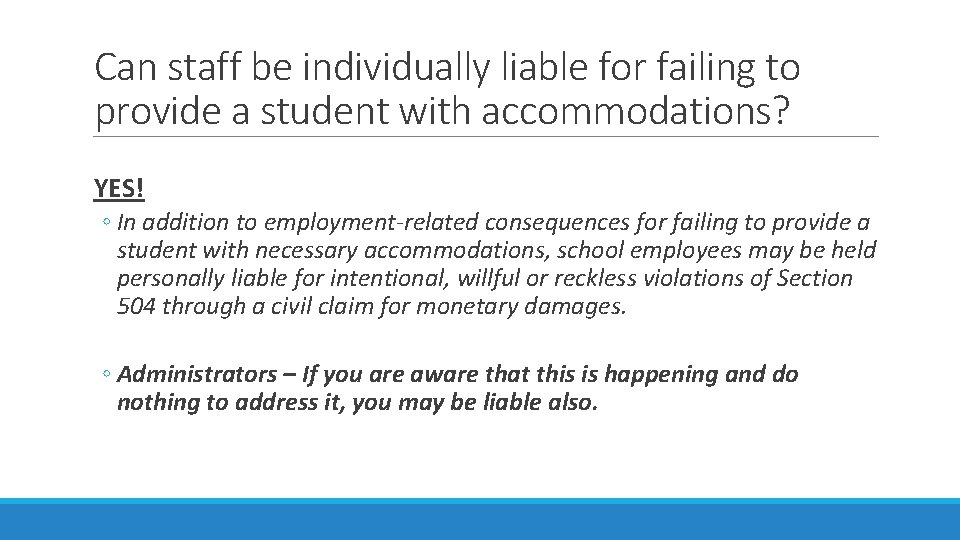
Can staff be individually liable for failing to provide a student with accommodations? YES! ◦ In addition to employment-related consequences for failing to provide a student with necessary accommodations, school employees may be held personally liable for intentional, willful or reckless violations of Section 504 through a civil claim for monetary damages. ◦ Administrators – If you are aware that this is happening and do nothing to address it, you may be liable also.
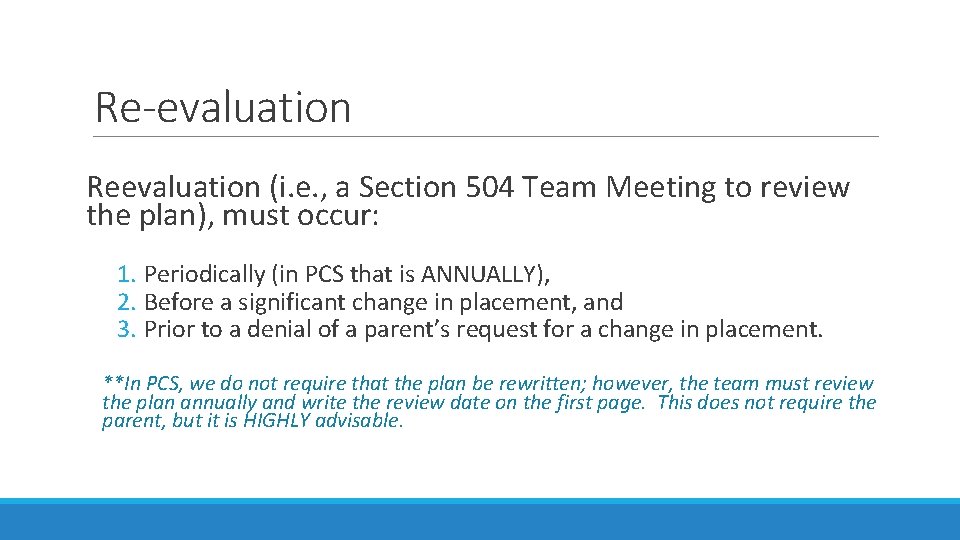
Re-evaluation Reevaluation (i. e. , a Section 504 Team Meeting to review the plan), must occur: 1. Periodically (in PCS that is ANNUALLY), 2. Before a significant change in placement, and 3. Prior to a denial of a parent’s request for a change in placement. **In PCS, we do not require that the plan be rewritten; however, the team must review the plan annually and write the review date on the first page. This does not require the parent, but it is HIGHLY advisable.
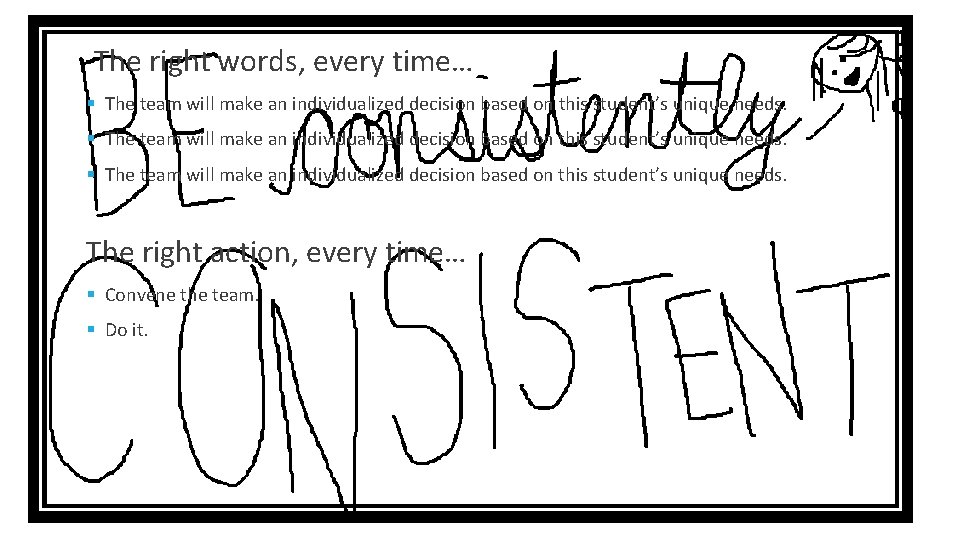
The right words, every time… § The team will make an individualized decision based on this student’s unique needs. The right action, every time… § Convene the team. § Do it.
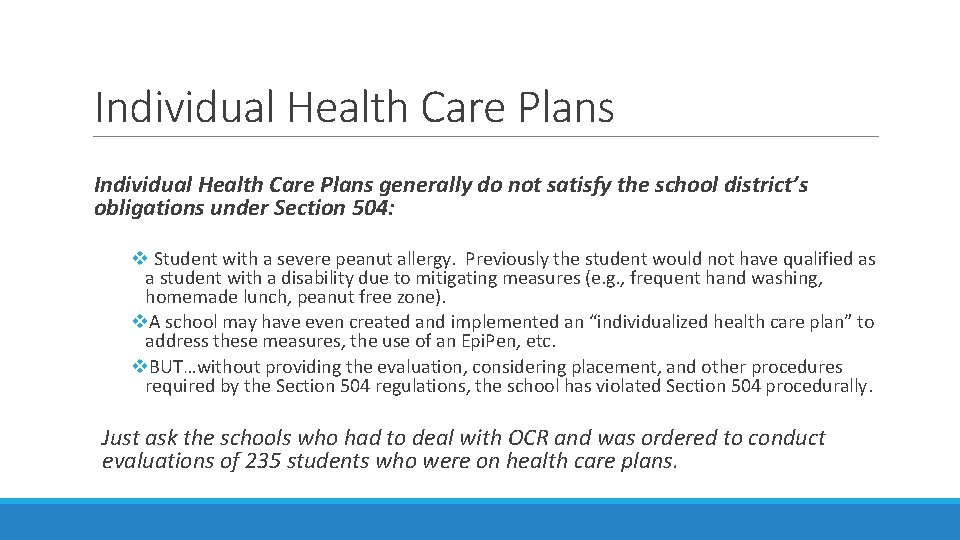
Individual Health Care Plans generally do not satisfy the school district’s obligations under Section 504: v Student with a severe peanut allergy. Previously the student would not have qualified as a student with a disability due to mitigating measures (e. g. , frequent hand washing, homemade lunch, peanut free zone). v. A school may have even created and implemented an “individualized health care plan” to address these measures, the use of an Epi. Pen, etc. v. BUT…without providing the evaluation, considering placement, and other procedures required by the Section 504 regulations, the school has violated Section 504 procedurally. Just ask the schools who had to deal with OCR and was ordered to conduct evaluations of 235 students who were on health care plans.
Case Law Examples Ø Student with asthma was on an “asthma action plan”. Ø His 3 rd quarter PE grade dropped from an A to a D because the student failed to run a mile in the required time. Ø The report card included the comment “lack of effort” as the reason. Ø Parents requested a 504 and were denied. Ø OCR found a violation of FAPE. Ø Sanctions included changes to the PE grade; removal of comments on report card; train personnel including substitutes; review all health care plans and Asthma Action Plans for Section 504 compliance and eligibility; a plan to identify the student’s triggers, a peak flow meter and schedule for use, and several accommodations.
Case Law Examples Ø School district in Virginia had a bad 504 Policy which provided: Ø“where a child is already passing his/her classes (without modifications) he/she is likely receiving educational benefit and in no need of 504 accommodations regardless of whether they are performing to their potential. By definition, a person who is succeeding in regular education does not have a disability which substantially limits the ability to learn. ” Ø The parents of a student with severe tree nut allergies in the first grade requested a 504 in addition to a Health Care Plan. Ø OCR found this policy to be in non-compliance with 504 as it “incorrectly attributed a student’s academic performance as the determining factor as to whether a student has a disability. ” Ø The point – the child is disabled; it does not matter that his academic needs were being met. Ø He needed a 504 plan.
Post-Concussion Syndrome § May be a disability under 504. § Does the impairment substantially limit a major life activity? § Even if the impairment is expected to last less then six month, it may still be substantially limiting. § Case-by-case basis depending on the individual symptoms. § The more severe the symptoms, the sooner we should make the referral. § If the student is put on a 504 Plan, the when the symptoms subside, reconsider eligibility through an evaluation. § Can only terminate 504 services through the 504 process. Districts cannot create selfterminating Section 504 Plans.
Absenteeism and Disability Ø Middle school student with Celiac disease had approximately 30 absences over the course of the school year. Ø OCR found that the district failed to reevaluate the student to determine whether he required a change in disability-related placement as a result of his chronic absenteeism. Ø Remember: an IEP and/or a Health Care Plan in itself is not sufficient to ensure FAPE. Ø Reevaluation of a student is necessary as circumstances evolve. Ø Team needs to meet and evaluate Ø Student is chronically absent: Ø What effect is this having? Ø Should the plan be modified?
Consequences of Failing to Comply wit the Substantive and Procedural Requirements of Section 504 State and Federal Complaints and Hearings ØUS Department of Education, Office of Civil Rights ØState Department of Education ØCivil Suits with monetary damages
Participation in Nonacademic and Extracurricular Services and Activities 34 C. F. R. Section 104. 37 § “A recipient of federal funds from the US DOE shall provide non-academic and extracurricular services and activities in such a manner as is necessary to afford handicapped students an equal opportunity for participation in such services or activities. ” § “Equal opportunity for participation” means schools must provide reasonable modifications in order to provide disabled students with an equal opportunity to participate.
U. S. DOE. OCR Dear Colleague Letter, 60 IDELR 167 (OCR 2013) Ø School districts must make reasonable modifications and provide those aids and services that are necessary to ensure an equal opportunity to participate, unless the school district can show that doing so would be a fundamental alteration to its program. Ø School may adopt safety standards, but still has to consider, on an individualized basis, whether safe participation can be assured through modifications or the provision of aids and services. Ø What is reasonable? ØHearing impaired student on the track team? ØStudent with one hand on the swimming team?
Can schools “cut” students with disabilities from athletic teams? § Every student with a disability is not guaranteed a spot on an athletic team for which other students must try out. § Schools may require a level of skill or ability for participation in a competitive program or activity. § However, a school district must make reasonable modifications to its policies, practices, or procedures, whenever such modifications are necessary to ensure an equal opportunity to participate.
Service Animals § Required by law (Title II) to accommodate students with service animals. § A public entity is required to permit an individual with a disability to be accompanied by the individual’s service animal in all areas of a school where students without disabilities are allowed to go. § A public entity is not allowed to ask for information regarding the extent of an individual’s disability or require documentation that the service animal has been trained. § Defined as “a dog (or a miniature horse) trained to do work or perform tasks for a person with a disability”. § Therapy/comfort pets do not meet the criteria under the ADA. § ADA requires that he service animal be ‘under the control” of the handler at all times.
Service Animal Inquiries § Only two questions are allowed: § Is the service animal required becaus 3 e of a disability? § What work or task has the service animal been trained to perform? § And you can’t even ask that if it is “readily apparent’ that an animal is trained to do work or perform tasks for a person with a disability (i. e. seeing eye dog. ) §It is never permissible to ask about the nature or extent of a person’s disability.
Questions? Concerns? Resignations? ? ?