
The 5 Types of Writing Type One Capture
- Slides: 10
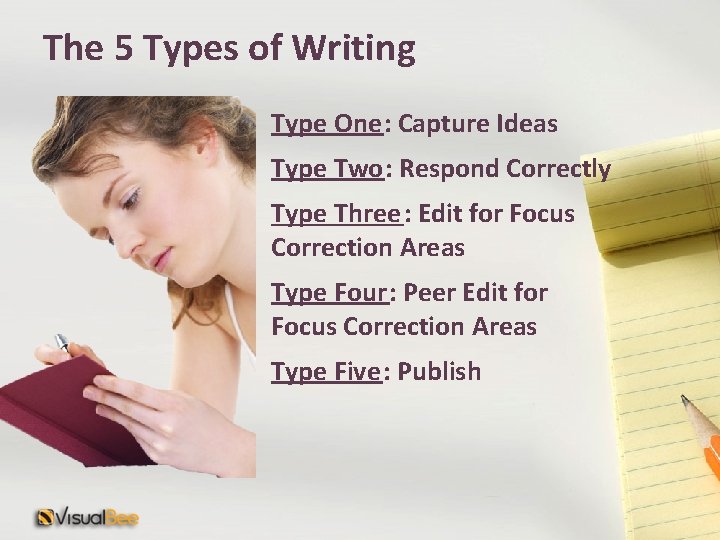
The 5 Types of Writing Type One: Capture Ideas Type Two: Respond Correctly Type Three : Edit for Focus Correction Areas Type Four: Peer Edit for Focus Correction Areas Type Five: Publish
John Collins Writing Program TYPE 3: Writing has content and meets up to 3 specific standards called Focus Correction Areas. It is read aloud and reviewed by the writer. TYPE 4: TYPE 3 writing that is read aloud and critiqued by another (teacher, peer) TYPE 5: Writing of publishable quality
• • Type 3 Has content and meets up to 3 specific standards called Focus Correction Areas (FCAs) Type 3 (and Type 4) move students from recording ideas to refining them Student must create a draft; revising and editing are done on the draft by the writer Is read aloud by the writer
More About Type 3 Things that differentiate Type 2 from Type 3: • Not timed • Not a mandated number of lines • Focus correcting • Oral reading & editing
Type 3’s FORM: Can take any form (picture with a caption, poster, paragraph, vocabulary card, sentence, essay, letter) AUDIENCE(S) : The student (reads it aloud to her/himself) and the teacher (who will read & evaluate it based on FCAs). ORAL READING: The student reads his/her draft from beginning to end without stopping to fix anything. On the second read he/she evaluates his/her writing based on the following questions:
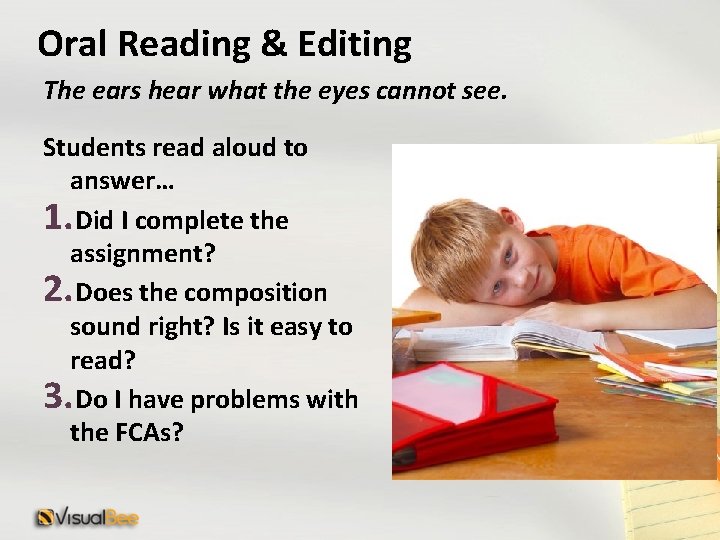
Oral Reading & Editing The ears hear what the eyes cannot see. Students read aloud to answer… 1. Did I complete the assignment? 2. Does the composition sound right? Is it easy to read? 3. Do I have problems with the FCAs?
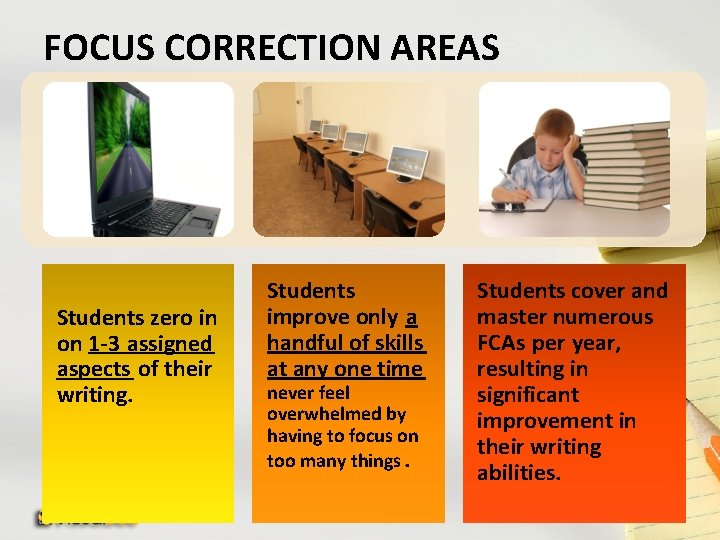
FOCUS CORRECTION AREAS Students zero in on 1 -3 assigned aspects of their writing. Students improve only a handful of skills at any one time never feel overwhelmed by having to focus on too many things. Students cover and master numerous FCAs per year, resulting in significant improvement in their writing abilities.
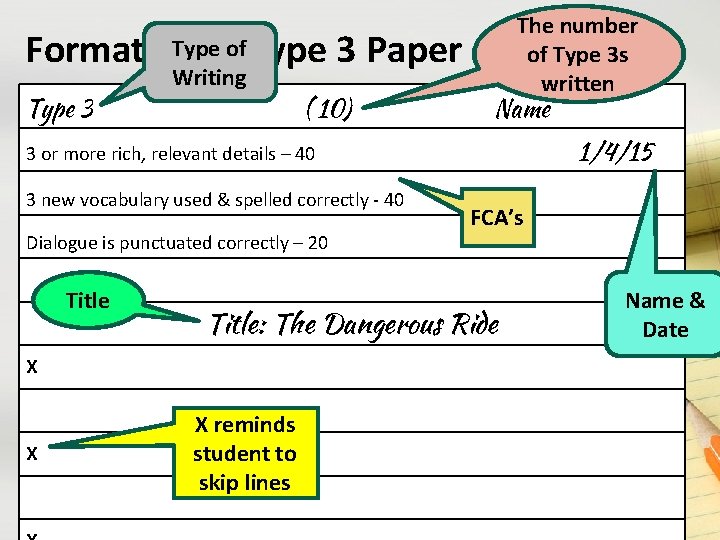
Typea of Type 3 Paper Formatting Type 3 Writing ( 10) The number of Type 3 s written Name 1/4/15 3 or more rich, relevant details – 40 3 new vocabulary used & spelled correctly - 40 Dialogue is punctuated correctly – 20 Title: The Dangerous Ride X X FCA’s X reminds student to skip lines Name & Date
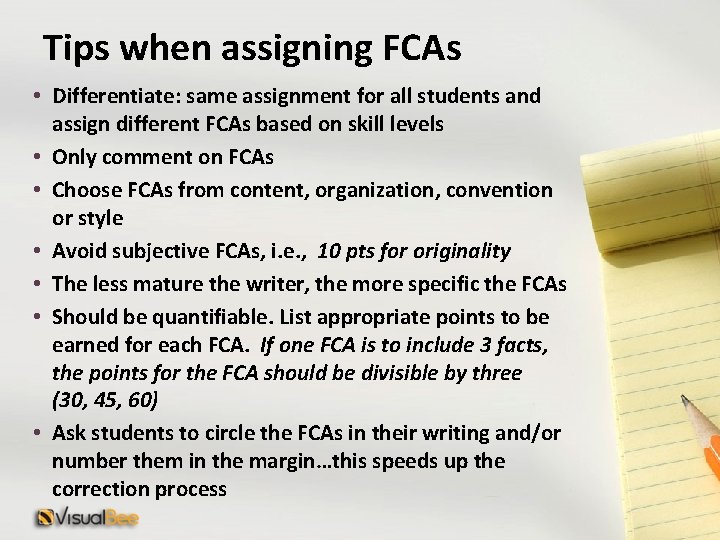
Tips when assigning FCAs • Differentiate: same assignment for all students and assign different FCAs based on skill levels • Only comment on FCAs • Choose FCAs from content, organization, convention or style • Avoid subjective FCAs, i. e. , 10 pts for originality • The less mature the writer, the more specific the FCAs • Should be quantifiable. List appropriate points to be earned for each FCA. If one FCA is to include 3 facts, the points for the FCA should be divisible by three (30, 45, 60) • Ask students to circle the FCAs in their writing and/or number them in the margin…this speeds up the correction process
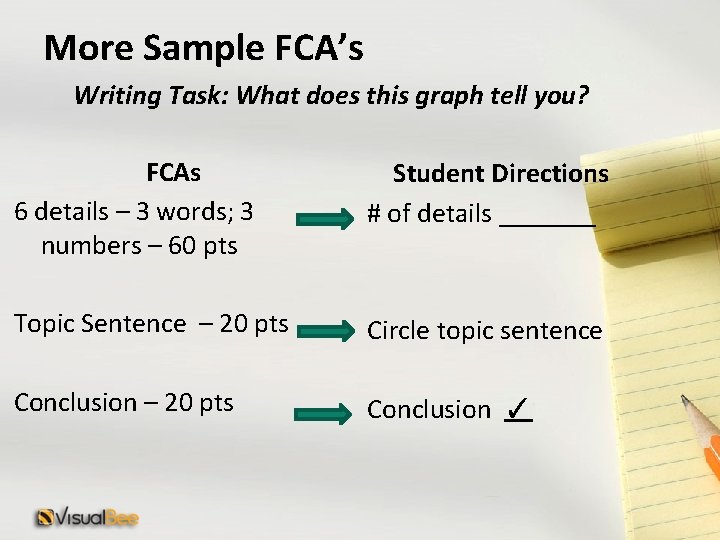
More Sample FCA’s Writing Task: What does this graph tell you? FCAs 6 details – 3 words; 3 numbers – 60 pts Student Directions # of details _______ Topic Sentence – 20 pts Circle topic sentence Conclusion – 20 pts Conclusion ✓