
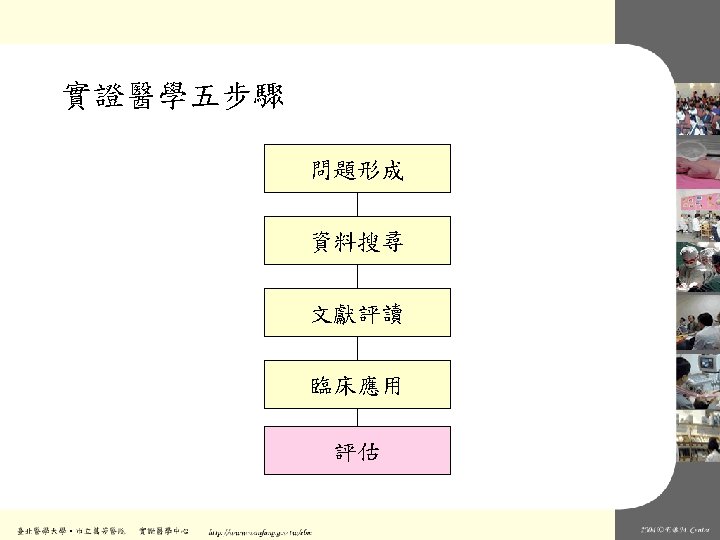
The 5 th step in practicing EBM is
The 5 th step in practicing EBM is self-evaluation. (Ch. 8, p. 205) Evidence-based medicine-How to practice and teach EBM—Sharon E. Straus, et al, 4 th ed. 2011
Reflective practice 省思 John Dewey (1933): ”reflective thought” 約翰‧杜威( 1933 ):“深思反省的思維” 1) State of uncertainty due to a difficulty in understanding an event or solving a problem一種不確定的狀態,源自於一事件的難以瞭解或是難以解決 2) Definition of the difficulty by understanding the nature of the problem根據 常識,問題本身自有其難度在 3) Occurrence of a possible solution, through inductive reasoning經由歸納性 4) Rational elaboration of ideas produced through abstract, deductive thought focusing on implications經由著重在應用的理論推演下所產生的合理解 推斷,可能有解決方案 5) Testing resulting hypotheses by overt or imaginative action藉由顯而易見 或是想像事件來檢測假設結果 Donald Schön (1983): “reflective practitioner” ”省思實踐者“ – – Reflection-on-action對於事件的省思 Reflection-in-action進行中的省思
Reflection: “considering the larger context, the meaning, and the implications of an experience or action” 省思:“更深入去細想一經驗或事件的來龍去 脈,意義,及所牽連的事項” • Reflection-on-action對於事件的省思 – Understanding what just happened了解剛發生什麼事 – Example: “How do you think that went? ”舉例:“你認為如何 會發生呢?” • Reflection-in-action進行中的省思 – Simultaneously performing while making continuous adjustments according to what you discern about the process在進行過程中當察覺到有其需要,一方面進行,同時 持續作修正 – Example: 舉例: • The baseball pitcher棒球投手 • The jazz musician爵士樂手 Schön, 1983
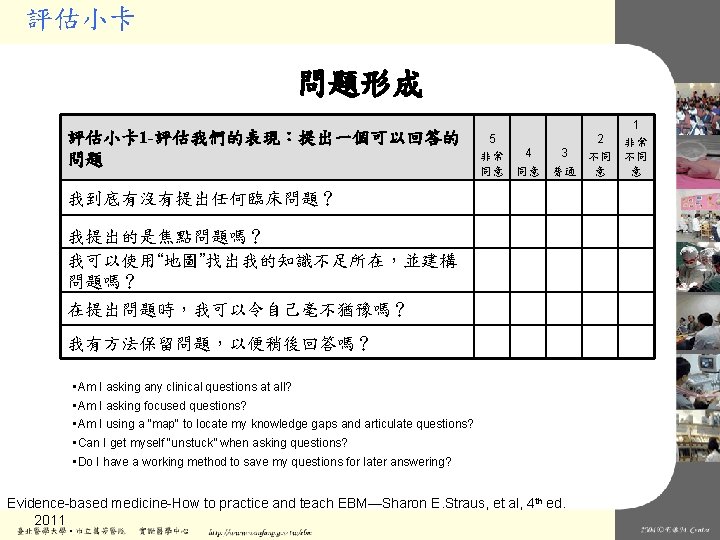
評估小卡 問題形成 評估小卡 1 -評估我們的表現:提出一個可以回答的 問題 5 非常 同意 4 同意 3 普通 我到底有沒有提出任何臨床問題? 我提出的是焦點問題嗎? 我可以使用“地圖”找出我的知識不足所在,並建構 問題嗎? 在提出問題時,我可以令自己毫不猶豫嗎? 我有方法保留問題,以便稍後回答嗎? • Am I asking any clinical questions at all? • Am I asking focused questions? • Am I using a "map" to locate my knowledge gaps and articulate questions? • Can I get myself “unstuck” when asking questions? • Do I have a working method to save my questions for later answering? Evidence-based medicine-How to practice and teach EBM—Sharon E. Straus, et al, 4 th ed. 2011 2 不同 意 1 非常 不同 意
問題形成-1 • 我到底有沒有提出任何臨床問題? – Am I asking any clinical questions at all? • 我提出的是焦點問題嗎? – Am I asking focused questions? • 我可以使用“地圖”找出我的知識不足所在,並 建構問題嗎? – Am I using a "map" to locate my knowledge gaps and articulate questions? Evidence-based medicine-How to practice and teach EBM—Sharon E. Straus, et al, 4 th ed.
問題形成-2 • 在提出問題時,我可以令自己毫不猶豫 嗎? – Can I get myself “unstuck” when asking questions? • 我有方法保留問題,以便稍後回答嗎? – Do I have a working method to save my questions for later answering? Evidence-based medicine-How to practice and teach EBM—Sharon E. Straus, et al, 4 th ed.
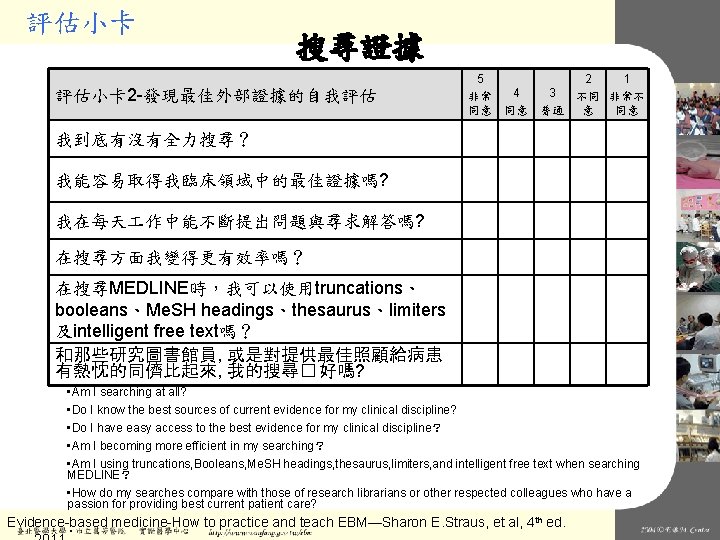
評估小卡 搜尋證據 評估小卡 2 -發現最佳外部證據的自我評估 5 非常 同意 4 同意 3 普通 2 1 不同 非常不 意 同意 我到底有沒有全力搜尋? 我能容易取得我臨床領域中的最佳證據嗎? 我在每天 作中能不斷提出問題與尋求解答嗎? 在搜尋方面我變得更有效率嗎? 在搜尋MEDLINE時,我可以使用truncations、 booleans、Me. SH headings、thesaurus、limiters 及intelligent free text嗎? 和那些研究圖書館員, 或是對提供最佳照顧給病患 有熱忱的同儕比起來, 我的搜尋� 好嗎? • Am I searching at all? • Do I know the best sources of current evidence for my clinical discipline? • Do I have easy access to the best evidence for my clinical discipline? • Am I becoming more efficient in my searching? • Am I using truncations, Booleans, Me. SH headings, thesaurus, limiters, and intelligent free text when searching MEDLINE? • How do my searches compare with those of research librarians or other respected colleagues who have a passion for providing best current patient care? Evidence-based medicine-How to practice and teach EBM—Sharon E. Straus, et al, 4 th ed.
搜尋證據-1 • 我到底有沒有全力搜尋? – Am I searching at all? • 我知道在我的臨床領域中現有的最佳證據來源 嗎? – Do I know the best sources of current evidence for my clinical discipline? • 我能容易取得我臨床領域中的最佳證據嗎? – Do I have easy access to the best evidence for my clinical discipline? Evidence-based medicine-How to practice and teach EBM—Sharon E. Straus, et al, 4 th ed.
搜尋證據-2 • 在搜尋方面我變得更有效率嗎? – Am I becoming more efficient in my searching? • 在搜尋MEDLINE時,我可以使用truncations、 booleans、Me. SH headings、thesaurus、limiters及 intelligent free text嗎? – Am I using truncations, Booleans, Me. SH headings, thesaurus, limiters, and intelligent free text when searching MEDLINE? • 和那些研究圖書館員, 或是熱心提供最佳照顧給病患的 同儕比起來, 我的搜尋夠好嗎? – How do my searches compare with those of research librarians or other respected colleagues who have a passion for providing best current patient care? Evidence-based medicine-How to practice and teach EBM—Sharon E. Straus, et al, 4 th ed.
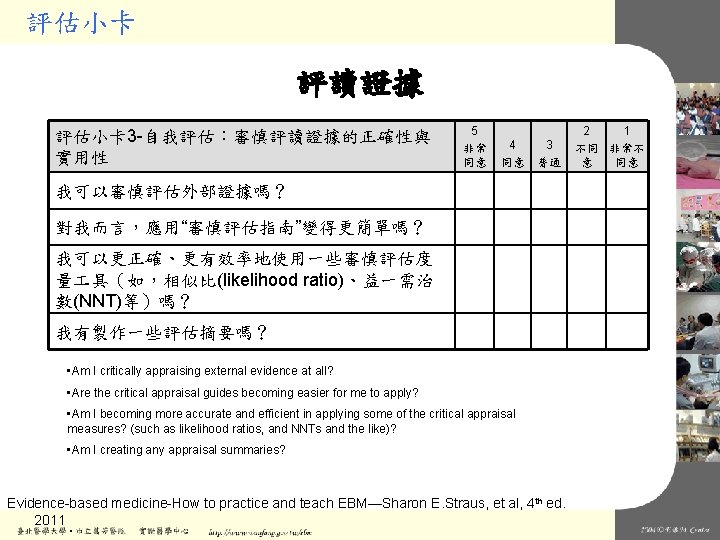
評估小卡 評讀證據 評估小卡 3 -自我評估:審慎評讀證據的正確性與 實用性 5 非常 同意 4 同意 3 普通 我可以審慎評估外部證據嗎? 對我而言,應用“審慎評估指南”變得更簡單嗎? 我可以更正確、更有效率地使用一些審慎評估度 量 具(如,相似比(likelihood ratio)、益一需治 數(NNT)等)嗎? 我有製作一些評估摘要嗎? • Am I critically appraising external evidence at all? • Are the critical appraisal guides becoming easier for me to apply? • Am I becoming more accurate and efficient in applying some of the critical appraisal measures? (such as likelihood ratios, and NNTs and the like)? • Am I creating any appraisal summaries? Evidence-based medicine-How to practice and teach EBM—Sharon E. Straus, et al, 4 th ed. 2011 2 1 不同 非常不 意 同意
評讀證據-1 • 我可以審慎評估外部證據嗎? – Am I critically appraising external evidence at all? • 我現在更容易應用“審慎評估指南”了嗎? – Are the critical appraisal guides becoming easier for me to apply? Evidence-based medicine-How to practice and teach EBM—Sharon E. Straus, et al, 4 th ed. 2011
評讀證據-2 • 我可以更正確、更有效率地使用一些審慎評估 度量 具(如,相似比(likelihood ratio)、益一 需治數(NNT)之類)嗎? – Am I becoming more accurate and efficient in applying some of the critical appraisal measures? (such as likelihood ratios, and NNTs and the like)? • 我有製作一些評估摘要嗎? – Am I creating any appraisal summaries? Evidence-based medicine-How to practice and teach EBM—Sharon E. Straus, et al, 4 th ed. 2011
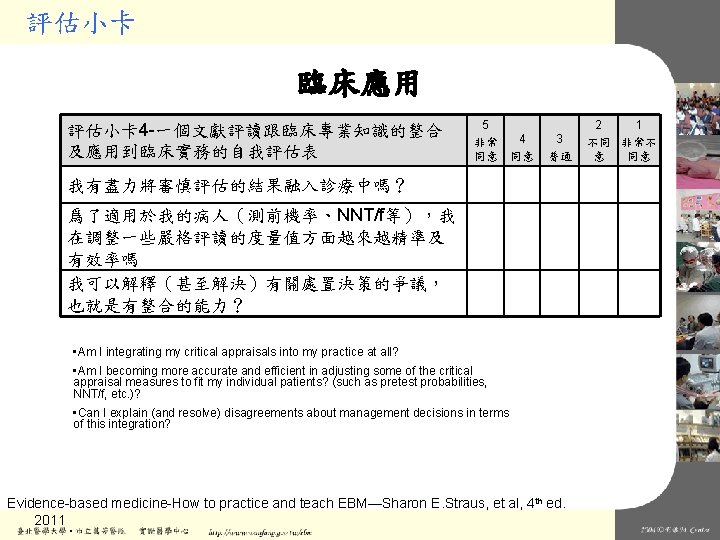
評估小卡 臨床應用 評估小卡 4 -一個文獻評讀跟臨床專業知識的整合 及應用到臨床實務的自我評估表 5 非常 同意 4 同意 3 普通 我有盡力將審慎評估的結果融入診療中嗎? 爲了適用於我的病人(測前機率、NNT/f等),我 在調整一些嚴格評讀的度量值方面越來越精準及 有效率嗎 我可以解釋(甚至解決)有關處置決策的爭議, 也就是有整合的能力? • Am I integrating my critical appraisals into my practice at all? • Am I becoming more accurate and efficient in adjusting some of the critical appraisal measures to fit my individual patients? (such as pretest probabilities, NNT/f, etc. )? • Can I explain (and resolve) disagreements about management decisions in terms of this integration? Evidence-based medicine-How to practice and teach EBM—Sharon E. Straus, et al, 4 th ed. 2011 2 1 不同 非常不 意 同意
臨床應用-1 • 我有盡力將審慎評估的結果融入 作中嗎? – Am I integrating my critical appraisals into my practice at all? • 爲了適用於我的病人(測前機率、NNT/f等), 我在調整一些嚴格評讀的度量值方面越來越精 準及有效率嗎 – Am I becoming more accurate and efficient in adjusting some of the critical appraisal measures to fit my individual patients? (such as pretest probabilities, NNT/f, etc. )? Evidence-based medicine-How to practice and teach EBM—Sharon E. Straus, et al, 4 th ed. 2011
臨床應用-2 • 我可以解釋(而且解決)關於管理決策 的爭議,也就是有整合的能力嗎? – Can I explain (and resolve) disagreements about management decisions in terms of this integration? Evidence-based medicine-How to practice and teach EBM—Sharon E. Straus, et al, 4 th ed. 2011
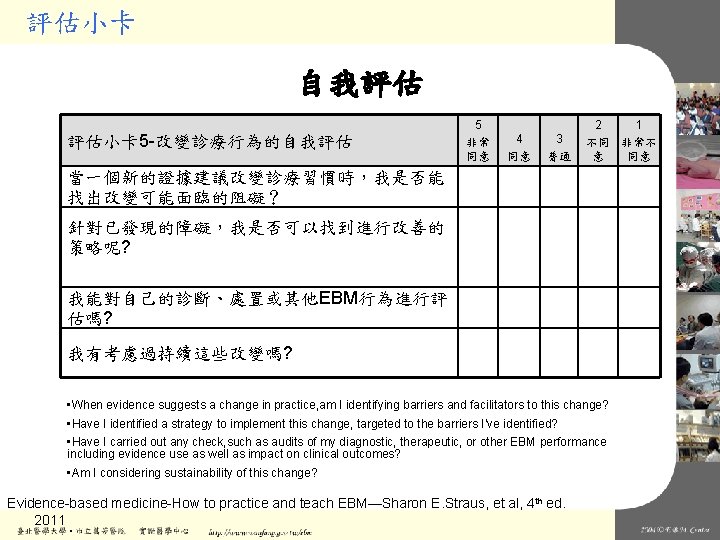
評估小卡 自我評估 評估小卡 5 -改變診療行為的自我評估 5 非常 同意 4 同意 3 普通 2 1 不同 非常不 意 同意 當一個新的證據建議改變診療習慣時,我是否能 找出改變可能面臨的阻礙? 針對已發現的障礙,我是否可以找到進行改善的 策略呢? 我能對自己的診斷、處置或其他EBM行為進行評 估嗎? 我有考慮過持續這些改變嗎? • When evidence suggests a change in practice, am I identifying barriers and facilitators to this change? • Have I identified a strategy to implement this change, targeted to the barriers I’ve identified? • Have I carried out any check, such as audits of my diagnostic, therapeutic, or other EBM performance including evidence use as well as impact on clinical outcomes? • Am I considering sustainability of this change? Evidence-based medicine-How to practice and teach EBM—Sharon E. Straus, et al, 4 th ed. 2011
自我評估-1 • 當一個新的證據建議改變診療習慣時,我是否 能找出改變可能面臨的阻力及助力? – When evidence suggests a change in practice, am I identifying barriers and facilitators to this change? • 針對已發現的障礙,我是否可以找到進行改善 的策略呢? – Have I identified a strategy to implement this change, targeted to the barriers I’ve identified? Evidence-based medicine-How to practice and teach EBM—Sharon E. Straus, et al, 4 th ed. 2011
自我評估-2 • 我能對自己的診斷、處置或其他EBM行 為進行評估嗎? – Have I carried out any check, such as audits of my diagnostic, therapeutic, or other EBM performance including evidence use as well as impact on clinical outcomes? • 我有考慮過持續這些改變嗎? – Am I considering sustainability of this change? Evidence-based medicine-How to practice and teach EBM—Sharon E. Straus, et al, 4 th ed. 2011
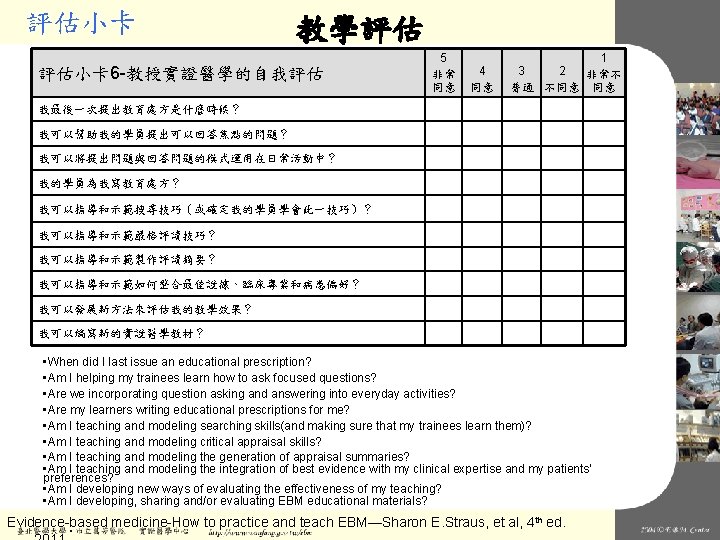
評估小卡 教學評估 評估小卡 6 -教授實證醫學的自我評估 5 非常 同意 4 同意 1 3 2 非常不 普通 不同意 同意 我最後一次提出教育處方是什麼時候? 我可以幫助我的學員提出可以回答焦點的問題? 我可以將提出問題與回答問題的模式運用在日常活動中? 我的學員為我寫教育處方? 我可以指導和示範搜尋技巧(或確定我的學員學會此一技巧)? 我可以指導和示範嚴格評讀技巧? 我可以指導和示範製作評讀摘要? 我可以指導和示範如何整合最佳證據、臨床專業和病患偏好? 我可以發展新方法來評估我的教學效果? 我可以編寫新的實證醫學教材? • When did I last issue an educational prescription? • Am I helping my trainees learn how to ask focused questions? • Are we incorporating question asking and answering into everyday activities? • Are my learners writing educational prescriptions for me? • Am I teaching and modeling searching skills(and making sure that my trainees learn them)? • Am I teaching and modeling critical appraisal skills? • Am I teaching and modeling the generation of appraisal summaries? • Am I teaching and modeling the integration of best evidence with my clinical expertise and my patients' preferences? • Am I developing new ways of evaluating the effectiveness of my teaching? • Am I developing, sharing and/or evaluating EBM educational materials? Evidence-based medicine-How to practice and teach EBM—Sharon E. Straus, et al, 4 th ed.
教學評估-1 • 我上次提出教育處方是什麼時候? – When did I last issue an educational prescription? • 我可以幫助我的學員提出可以回答焦點的問題 ? – Am I helping my trainees learn how to ask focused questions? • 我可以將提出問題與回答問題的模式運用在日 常活動中? – Are we incorporating question asking and answering into everyday activities? Evidence-based medicine-How to practice and teach EBM—Sharon E. Straus, et al, 4 th ed.
教學評估-2 • 我的學員會寫教育處方給我嗎? – Are my learners writing educational prescriptions for me? • 我可以指導和示範搜尋技巧(或確定我 的學員學會此一技巧)? – Am I teaching and modeling searching skills(and making sure that my trainees learn them)? Evidence-based medicine-How to practice and teach EBM—Sharon E. Straus, et al, 4 th ed.
教學評估-3 • 我可以指導和示範嚴格評讀技巧? – Am I teaching and modeling critical appraisal skills? • 我可以指導和示範製作評讀摘要? – Am I teaching and modeling the generation of appraisal summaries? • 我可以指導和示範如何整合最佳證據、臨床專 業和病患偏好? – Am I teaching and modeling the integration of best evidence with my clinical expertise and my patients' preferences? Evidence-based medicine-How to practice and teach EBM—Sharon E. Straus, et al, 4 th ed.
教學評估-4 • 我可以發展新方法來評估我的教學效果 ? – Am I developing new ways of evaluating the effectiveness of my teaching? • 我可以編寫新的實證醫學教材? – Am I developing, sharing and/or evaluating EBM educational materials? Evidence-based medicine-How to practice and teach EBM—Sharon E. Straus, et al, 4 th ed.
- Slides: 26