
The 5 Selling Steps Purpose 1 Create an

- Slides: 11
The 5 Selling Steps
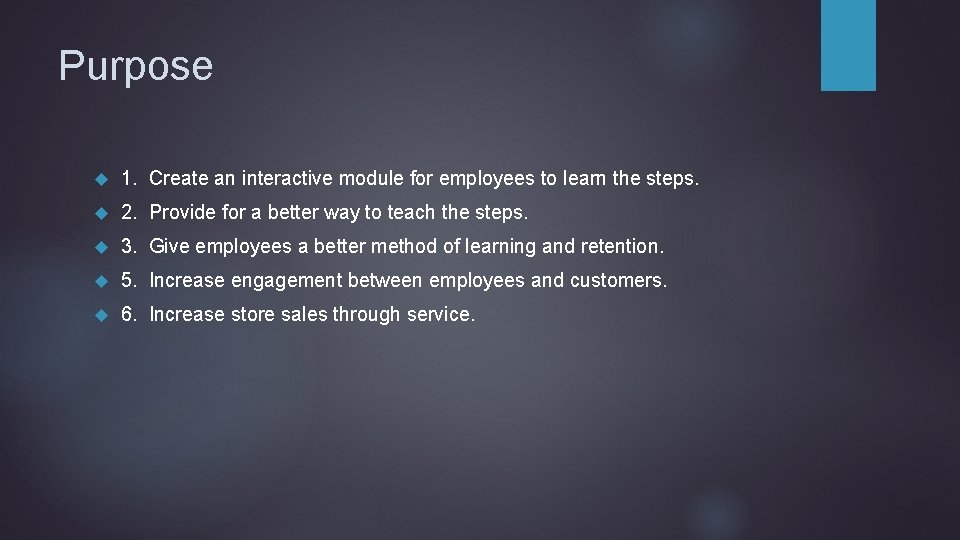
Purpose 1. Create an interactive module for employees to learn the steps. 2. Provide for a better way to teach the steps. 3. Give employees a better method of learning and retention. 5. Increase engagement between employees and customers. 6. Increase store sales through service.
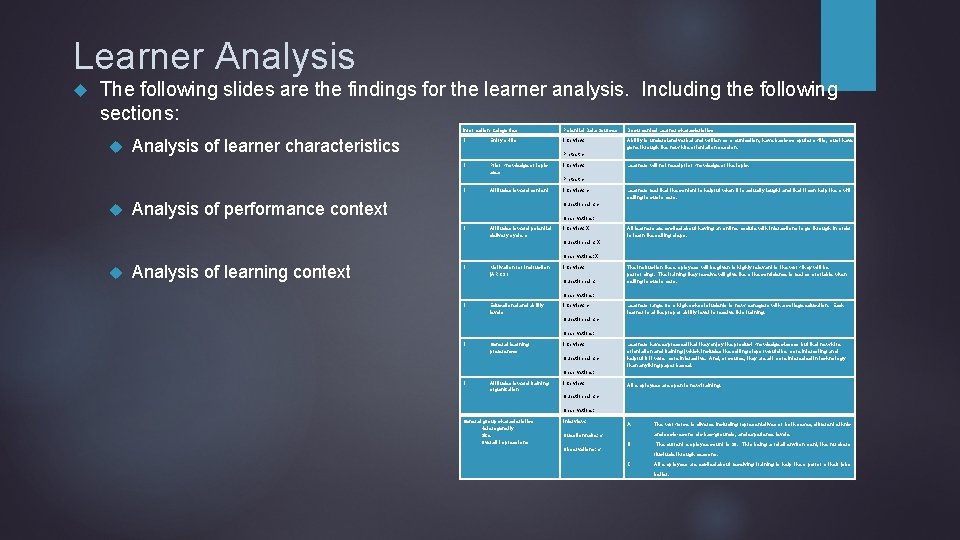
Learner Analysis The following slides are the findings for the learner analysis. Including the following sections: Analysis of learner characteristics Information Categories Potential Data Sources Documented Learner characteristics 1. Entry skills Interview: Ability to understand verbal and written communication, have basic computer skills, must have gone through the new hire orientation session. 1. Prior knowledge of topic area 1. Attitudes toward content Pretest: x Interview: Learners will not need prior knowledge of the topic. Pretest: x Analysis of performance context Interview: x Learners feel that the content is helpful when it is actually taught and that it can help them will selling to customers. Questionnaire: x Observations: 1. Attitudes toward potential delivery system Interview: X All learners are excited about having an online module with interactions to go through in order to learn the selling steps. Questionnaire: X Observations: X Analysis of learning context 1. Motivation for instruction (ARCS) Interview: Questionnaire: The instruction the employees will be given is highly relevant to the work they will be performing. The training they receive will give them the confidence to feel comfortable when selling to customers. Observations: 1. Educational and ability levels Interview: x Learners range from high school students to new managers with a college education. Each learner is at the proper ability level to receive this training. Questionnaire: x Observations: 1. General learning preferences Interview: Questionnaire: x Learners have expressed that they enjoy the product knowledge classes but that new hire orientation and training (which includes the selling steps) would be more interesting and helpful if it were more interactive. And, of course, they are all more interested in technology than anything paper based. Observations: 1. Attitudes toward training organization Interview: All employees are open to new training. Questionnaire: x Observations: General group characteristics Heterogeneity Size Overall impressions Interview: A. Observations: x The workforce is diverse including representatives of both sexes, different ethnic and socio-economic backgrounds, and experience levels. Questionnaire: x B. The current employee count is 30. This being a retail environment, the numbers fluctuate through seasons. C. All employees are excited about receiving training to help them perform their jobs better.
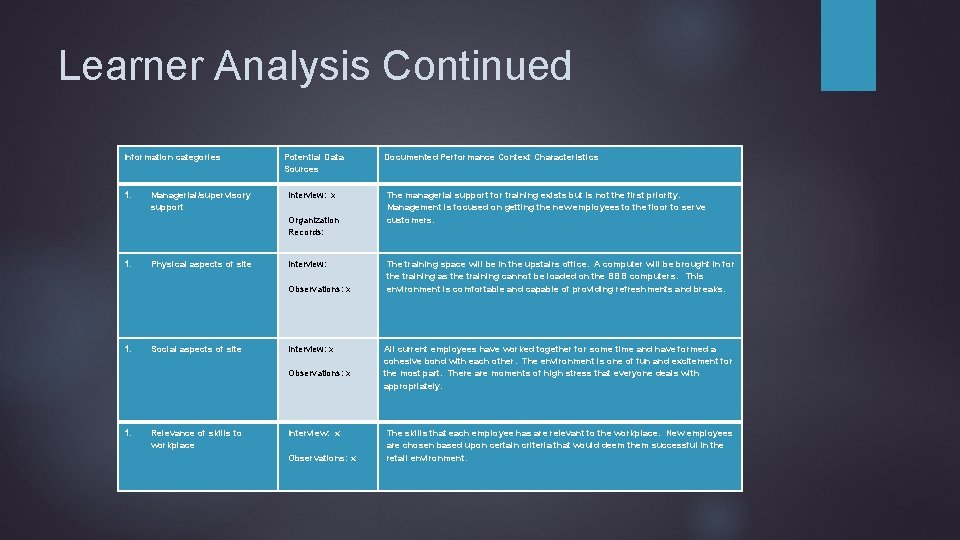
Learner Analysis Continued Information categories 1. Managerial/supervisory support Potential Data Sources Interview: x Organization Records: 1. Physical aspects of site Interview: Observations: x 1. Social aspects of site Interview: x Observations: x 1. Relevance of skills to workplace Interview: x Observations: x Documented Performance Context Characteristics The managerial support for training exists but is not the first priority. Management is focused on getting the new employees to the floor to serve customers. The training space will be in the upstairs office. A computer will be brought in for the training as the training cannot be loaded on the BBB computers. This environment is comfortable and capable of providing refreshments and breaks. All current employees have worked together for some time and have formed a cohesive bond with each other. The environment is one of fun and excitement for the most part. There are moments of high stress that everyone deals with appropriately. The skills that each employee has are relevant to the workplace. New employees are chosen based upon certain criteria that would deem them successful in the retail environment.
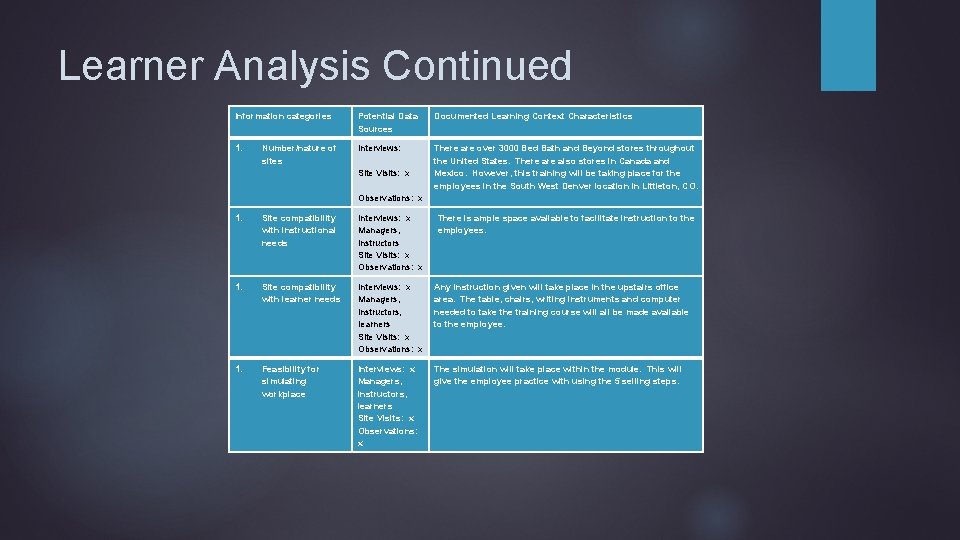
Learner Analysis Continued Information categories Potential Data Sources Documented Learning Context Characteristics 1. Interviews: There are over 3000 Bed Bath and Beyond stores throughout the United States. There also stores in Canada and Mexico. However, this training will be taking place for the employees in the South West Denver location in Littleton, CO. Number/nature of sites Site Visits: x Observations: x 1. Site compatibility with instructional needs Interviews: x Managers, instructors Site Visits: x Observations: x 1. Site compatibility with learner needs Interviews: x Managers, instructors, learners Site Visits: x Observations: x Any instruction given will take place in the upstairs office area. The table, chairs, writing instruments and computer needed to take the training course will all be made available to the employee. 1. Feasibility for simulating workplace Interviews: x Managers, instructors, learners Site Visits: x Observations: x The simulation will take place within the module. This will give the employee practice with using the 5 selling steps. There is ample space available to facilitate instruction to the employees.
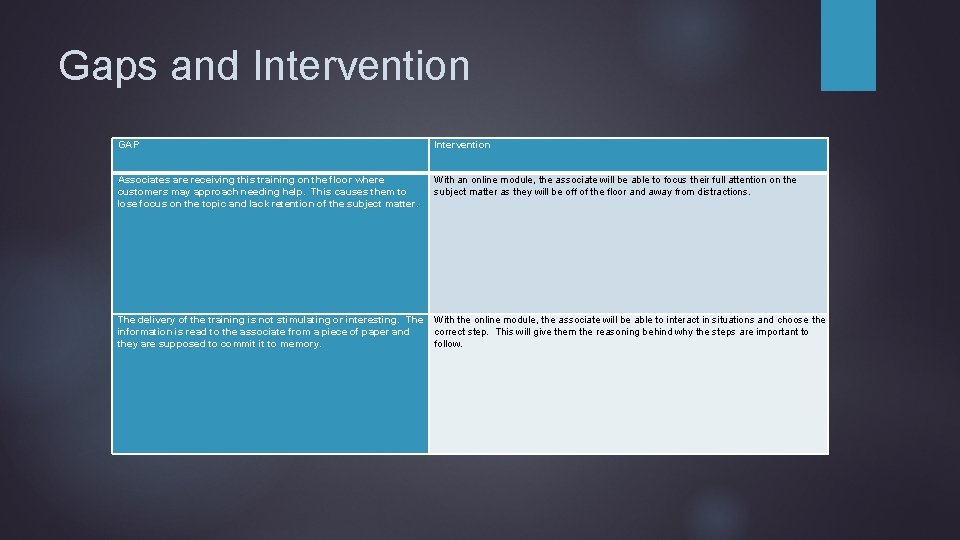
Gaps and Intervention GAP Intervention Associates are receiving this training on the floor where customers may approach needing help. This causes them to lose focus on the topic and lack retention of the subject matter. With an online module, the associate will be able to focus their full attention on the subject matter as they will be off of the floor and away from distractions. The delivery of the training is not stimulating or interesting. The information is read to the associate from a piece of paper and they are supposed to commit it to memory. With the online module, the associate will be able to interact in situations and choose the correct step. This will give them the reasoning behind why the steps are important to follow.
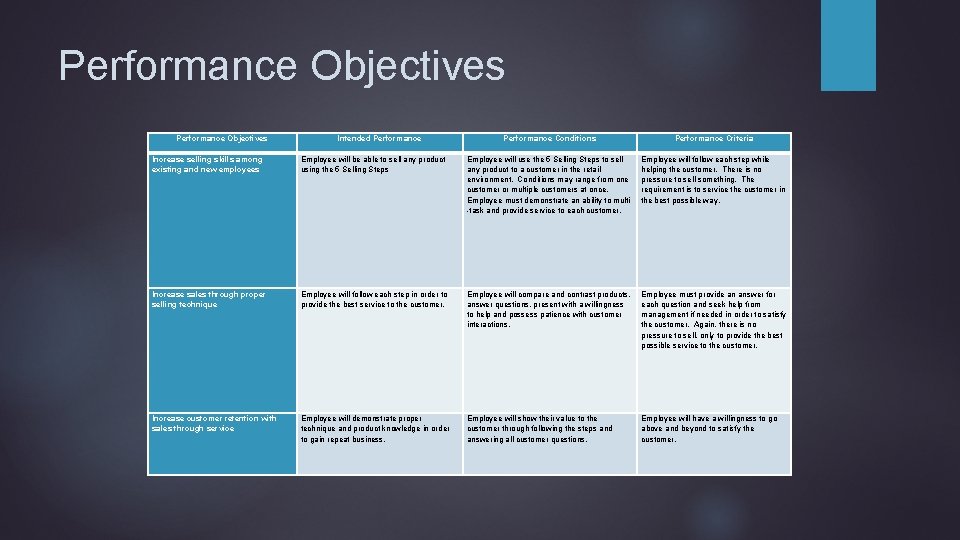
Performance Objectives Intended Performance Conditions Performance Criteria Increase selling skills among existing and new employees Employee will be able to sell any product using the 5 Selling Steps Employee will use the 5 Selling Steps to sell any product to a customer in the retail environment. Conditions may range from one customer or multiple customers at once. Employee must demonstrate an ability to multi -task and provide service to each customer. Employee will follow each step while helping the customer. There is no pressure to sell something. The requirement is to service the customer in the best possible way. Increase sales through proper selling technique Employee will follow each step in order to provide the best service to the customer. Employee will compare and contrast products, answer questions, present with a willingness to help and possess patience with customer interactions. Employee must provide an answer for each question and seek help from management if needed in order to satisfy the customer. Again, there is no pressure to sell, only to provide the best possible service to the customer. Increase customer retention with sales through service Employee will demonstrate proper technique and product knowledge in order to gain repeat business. Employee will show their value to the customer through following the steps and answering all customer questions. Employee will have a willingness to go above and beyond to satisfy the customer.
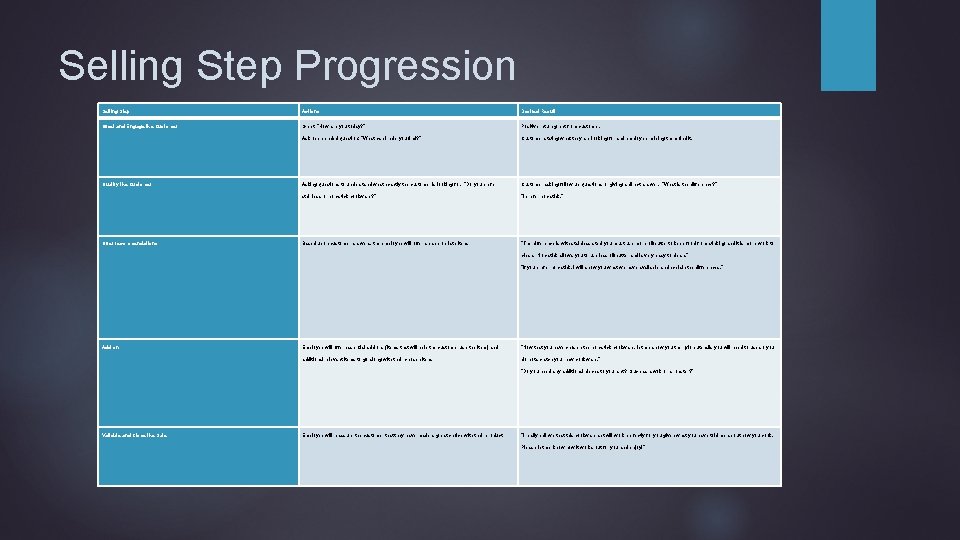
Selling Step Progression Selling Step Actions Desired Result Greet and Engage the Customer Greet: “How are you today? ” Positive return greet from customer. Ask open ended question: “What can I help you find? ” Customer stating what they are looking for and employee helping them find it. Asking questions to understand what exactly the customer is looking for. “Do you prefer Customer asking follow up questions or giving a direct answer. “What is the difference? ” stainless or non-stick cookware? ” “I prefer non-stick. ” Based upon customer answers, the employee will offer an appropriate item. “The difference is with stainless steel you must use more oil/butter to keep food from sticking and it is more work to Qualify the Customer Offer recommendations clean. Non-stick allows you to use less oil/butter and is very easy to clean. ” “If you prefer non-stick, I will show you what we have available and explain the differences. ” Add on Employee will offer essential add ons (items that will help the customer use the item) and “Now that you have chosen the non-stick cookware, let me show you the nylon utensils you will need to use so you additional relevant items to go along with their chosen item. do not scratch your new cookware. ” “Do you need any additional pieces to your set? Such as a wok or a roaster? ” Validate and Close the Sale Employee will reassure the customer that they have made a great choice with their product. “I really believe that this cookware set will work perfectly for you given what you have told me about how you cook. Please let me know how it works out for you and enjoy!”
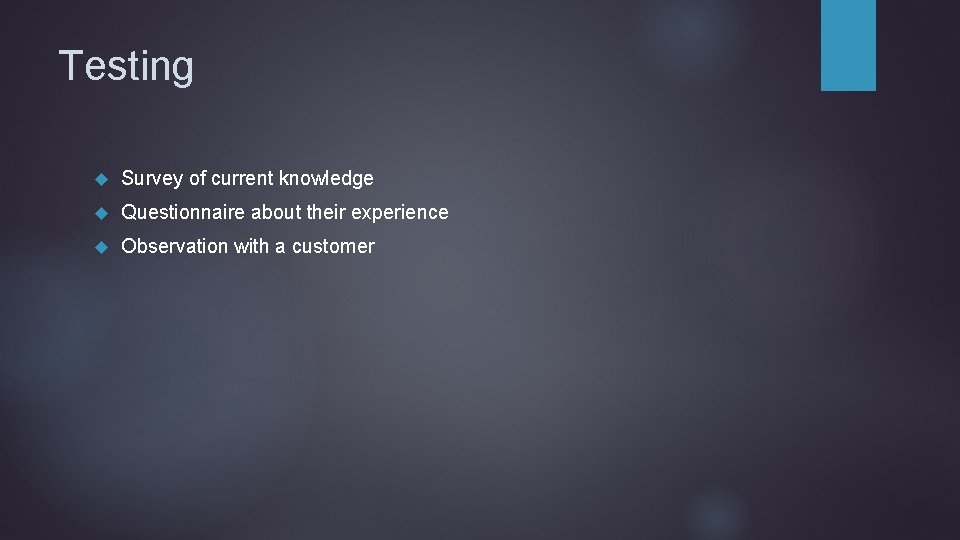
Testing Survey of current knowledge Questionnaire about their experience Observation with a customer
Instructional Strategy Learner interaction Simulation Matching Observation
References Clark, R. C. , & Mayer, R. E. (2003). E-Learning and the science of instruction: Proven guidelines for consumers and designers of multimedia learning. San Francisco, CA: Jossey-Bass/Pfeiffer.