
The 5 Principles of Model Based Systems Engineering
The 5 Principles of Model Based Systems Engineering James Towers Object Flow Ltd Chair INCOSE UK MBSE Working Group The 5 Principles of MBSE 1

The 3 Evils (from Holt & Perry) The 5 Principles of MBSE 2
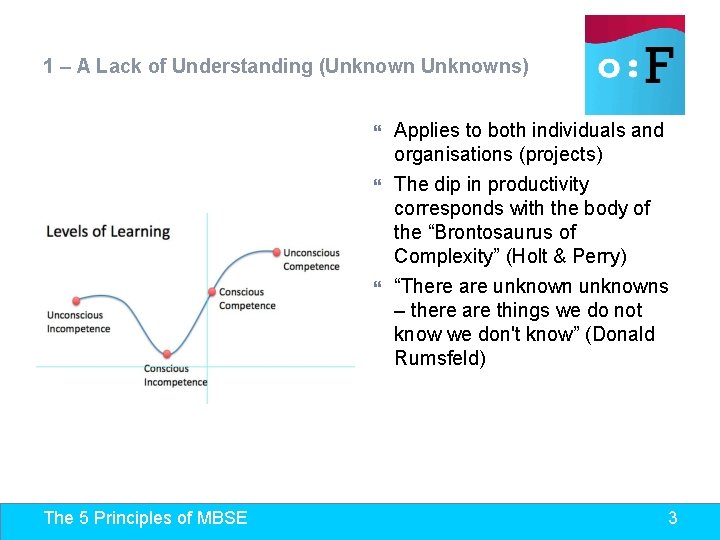
1 – A Lack of Understanding (Unknowns) Applies to both individuals and organisations (projects) The dip in productivity corresponds with the body of the “Brontosaurus of Complexity” (Holt & Perry) “There are unknowns – there are things we do not know we don't know” (Donald Rumsfeld) The 5 Principles of MBSE 3
2 - Complexity (Plus Simplicity, Complicated and Chaotic) We often use the word complex as a synonym for ‘difficult’ or ‘no recognisable pattern’ We should make a distinction between how we define structures and behaviour We can define at least 4 different behaviours of systems Simple = easily knowable Complicated = not simple, but still knowable Complex = not fully knowable, but reasonably predictable Chaotic = neither knowable nor predictable Each of the 3 spaces (Problem, Solution & Project) can behave in a different way (and at different points in time) The 5 Principles of MBSE 4
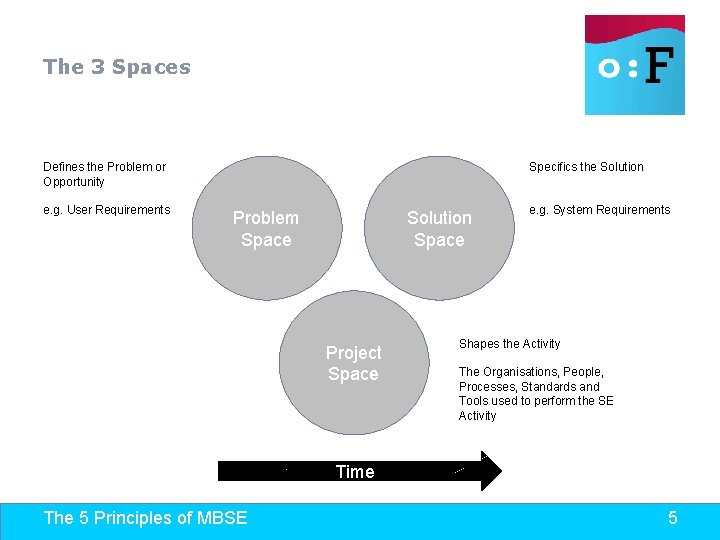
The 3 Spaces Defines the Problem or Opportunity e. g. User Requirements Specifics the Solution Problem Space Solution Space Project Space e. g. System Requirements Shapes the Activity The Organisations, People, Processes, Standards and Tools used to perform the SE Activity Time The 5 Principles of MBSE 5
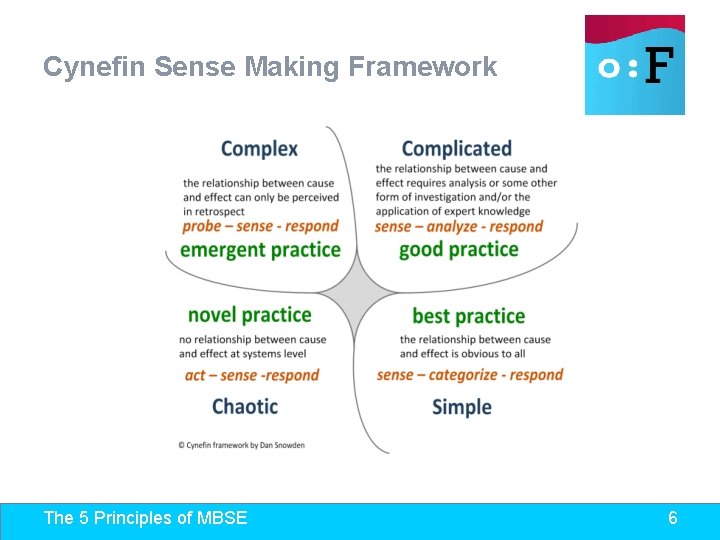
Cynefin Sense Making Framework The 5 Principles of MBSE 6
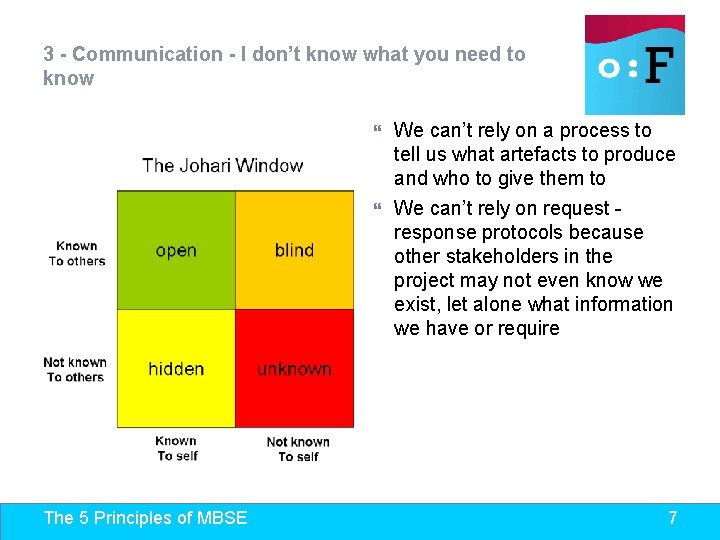
3 - Communication - I don’t know what you need to know The 5 Principles of MBSE We can’t rely on a process to tell us what artefacts to produce and who to give them to We can’t rely on request response protocols because other stakeholders in the project may not even know we exist, let alone what information we have or require 7
The 5 Principles of MBSE 8

1 – Modelling is more than just drawing The 5 Principles of MBSE 9
2 – Each View has a defined purpose and scope There’s a temptation when building models to first model everything you know and then model everything you discover It’s important to remember that every model is in someway incomplete, and it’s this incompleteness that makes it valuable (See Principle 3). Knowing what to omit requires you to know what its purpose is If someone wanted to know how far it was from Tooting Bec to Edgware then consulting the Tube map would be pointless (it wasn’t built for that purpose) Purposes include Synthesis, Analysis, Specification, Communication and others Scopes include the Problem, Solution and Project Spaces and others The 5 Principles of MBSE 10

3 – The Model adds value The Model is insightful: It can be queried in ways unconnected sources can’t. It can be navigated, thus allowing us to discover its content without prior knowledge of what to expect. The Model is more accessible, quicker, cheaper, controllable, adaptable or less risky (in a safety, security and financial sense) to construct and/or interrogate than the real world. The Model is pragmatic: The degree to which it conforms to any of these principles is decided based on risk. The 5 Principles of MBSE 11
4 – The Model is of sufficient quality The Model is: Concise Consistent It doesn’t contradict itself Coherent It records one fact in one place (Model Element) Its parts produce a unified whole Correct – It can be Verified and Validated based on defined criteria It uses abstraction to allow imprecision without inaccuracy The 5 Principles of MBSE 12

5 – The Model is constructed from the most appropriate elements Where appropriate the Model is constructed using recognisable and documented patterns May be public or proprietary, general or domain-specific The Model uses the most appropriate languages, paradigms & topologies Languages may include natural language (text), mathematics, general purpose graphical languages (UML, Sys. ML), domain-specific languages and others Paradigms may include functional, object-oriented, symbolic, logical and others Topologies may include graphs, trees, matrices, tables, natural-language (requirements boilerplates) and others The 5 Principles of MBSE 13
The 4 Enablers The 5 Principles of MBSE 14
1 - Architectural Frameworks May be public or proprietary, general or domain-specific Architectural Frameworks enable MBSE by: Ensuring the Model is coherent and consistent, by providing architectural rules and syntax Help us manage complexity and clarify what is important by the use of information portioning and hiding Helps us identify omissions Provides traceability & navigability Aids communication as may be common across multiple projects Define ontologies and standardises concepts The 5 Principles of MBSE 15
2 - Process Frameworks provide guidelines and principles that allow us to generate a customised process Where appropriate the Enterprise uses recognisable and documented process patterns The Project Team follows a defined System Engineering Process based on one or more of the Process Frameworks All activities within the process involve the Model. All newly discovered Systems Engineering knowledge is recorded in the Model. The Model is shared in a controlled manner Configuration / Version Control Access Control – although the default is open The 5 Principles of MBSE 16
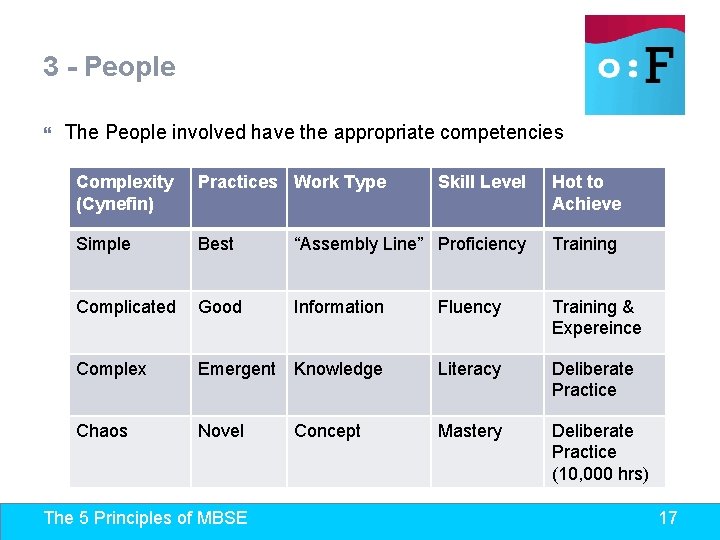
3 - People The People involved have the appropriate competencies Complexity (Cynefin) Practices Work Type Skill Level Hot to Achieve Simple Best “Assembly Line” Proficiency Training Complicated Good Information Fluency Training & Expereince Complex Emergent Knowledge Literacy Deliberate Practice Chaos Novel Mastery Deliberate Practice (10, 000 hrs) The 5 Principles of MBSE Concept 17
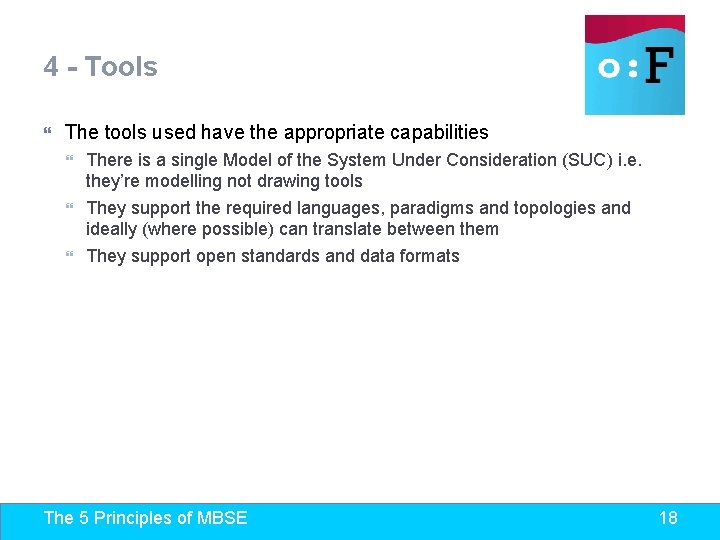
4 - Tools The tools used have the appropriate capabilities There is a single Model of the System Under Consideration (SUC) i. e. they’re modelling not drawing tools They support the required languages, paradigms and topologies and ideally (where possible) can translate between them They support open standards and data formats The 5 Principles of MBSE 18

Questions The 5 Principles of MBSE 19
Acknowledgments Thanks to the following for their contributions, either directly of via published work Tom Riley (Thales) Jon Holt and Simon Perry (Atego) Dave Snowden (Cognative Edge) The 5 Principles of MBSE 20
- Slides: 20