
THE 5 CS OF CREDIT REAL WORLD APPLICATIONS
- Slides: 19
THE 5 C’S OF CREDIT REAL WORLD APPLICATIONS
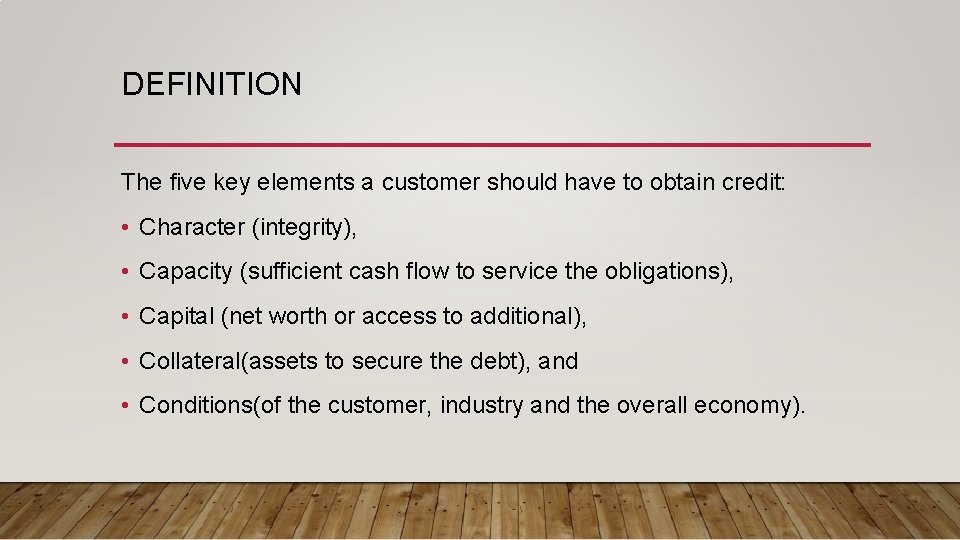
DEFINITION The five key elements a customer should have to obtain credit: • Character (integrity), • Capacity (sufficient cash flow to service the obligations), • Capital (net worth or access to additional), • Collateral(assets to secure the debt), and • Conditions(of the customer, industry and the overall economy).
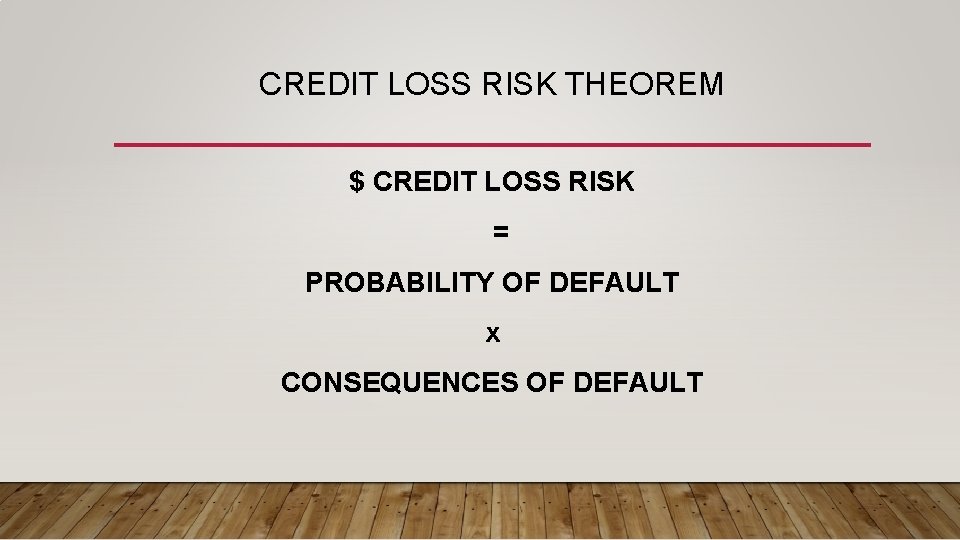
CREDIT LOSS RISK THEOREM $ CREDIT LOSS RISK = PROBABILITY OF DEFAULT x CONSEQUENCES OF DEFAULT
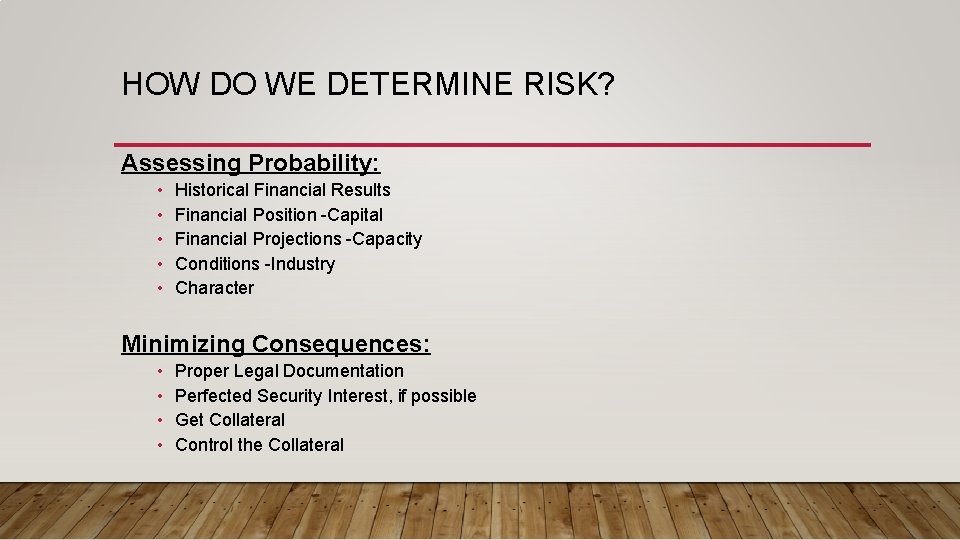
HOW DO WE DETERMINE RISK? Assessing Probability: • • • Historical Financial Results Financial Position -Capital Financial Projections -Capacity Conditions -Industry Character Minimizing Consequences: • • Proper Legal Documentation Perfected Security Interest, if possible Get Collateral Control the Collateral
CREDIT MATCHING PRINCIPLE • Length and Type of Debt matches the useful life of the asset it is financing • Miss-matched debt causes business failures or impedes growth capability. • Fin-Tech Lenders (aka Merchant Cash Advance) use algorithms not based on matching principle. • Everybody needs to be paid from their slot in the cash-to-cash cycle, in theory.
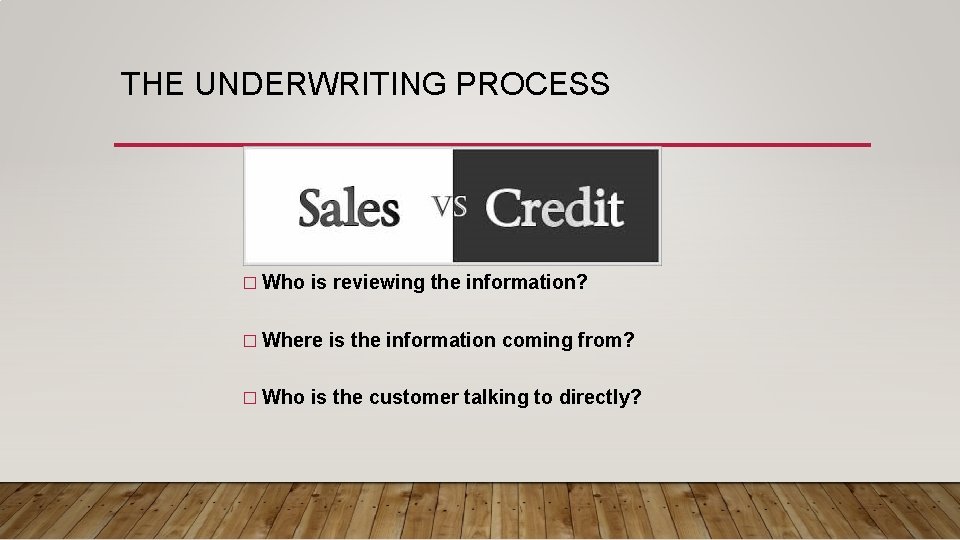
THE UNDERWRITING PROCESS � Who is reviewing the information? � Where is the information coming from? � Who is the customer talking to directly?
RED FLAGS FOR SALES • Prospect rejects an onsite visit. • Owner or key principals not present and only available via email • Personnel is not present relative to revenue levels. • Prospect won’t let the sales person past the conference room. • Little or no inventory on hand. • Piles of returned goods in the warehouse. • Visible paperwork on desks with different company name/logo.
ANOTHER “C”: COMMON SENSE • Who do they sell to? • What is going on in their industry? • What is the legal structure? • Who owns the business? • Who runs the business? • What is the owner’s experience / background? • How is the business performing financially? • Does the information presented match their ‘story’? Does it make sense?
RESEARCH AND REVIEW Secretary of State Searches: review the history, are there related names, commonalities? Does everything match? Credit reporting and information listed (locations, owners, prior companies, public filings…) Pacer or other searches Domain name searches The Internet: company, owners, key employees, related companies Google Earth or Google Maps: location, location… Social Media
CHARACTER – OWNER CREDIT � Owner / Officer Credit � Who is running the business? � What does their credit and background show? � What experience do they have in the business? � What are your tools? � Background checks � Credit reports � Tax returns � Personal financial statements � The Internet
BACKGROUND BASICS � What does their personal credit look like? Do they pay their bills? Do they have significant delinquencies? Are there public filings for liens/judgments? � What does their background report say? Do they have other public filings noted including UCCs on prior companies, tax liens, judgments, etc. ? Have they had a number of other businesses that are no longer in existence? This may be a sign of their ‘business management experience’. Do they have criminal filings? What have they done in ‘bad’ situations in the past?
CAPITAL AND CAPACITY Financial Statements • Evaluate if the company has the resources needed to access capital or raise more capital if needed. • Are the statements internal, reviewed, compiled or audited? • Who are the Stakeholders? Everybody gets an asset allocation. • Perform Key Ratio Analysis • Study the Working Capital situation.
WORKING CAPITAL ISSUES If a service business…. • What encumbers Accounts Receivable? What is leverage if Bank Line or other secureds? • What is left over for Accounts Payable? If a products business. . . • What encumbers A/R and Inventory, relative to secured debt? • What percentage of Inventory is still in Accounts Payable? • Does your proposed additional credit exposure fit into the picture?
LINES OF CREDIT, ABL AND FACTORING • Factoring doesn’t mean they are troubled. Rates go down to a couple points over prime. • Factoring may be treated as off balance sheet. They will show no debt and should show very little A/R. • Asset Based Lending (ABL) is about facility length, availability and usage. May be listed in both current and long-term liabilities if a 3 -year contract. • Both ABL and working capital lines of credit have covenants. These can be life or death for your customer/prospect. • Undrawn Availability is best liquidity measuring stick.
CASH FLOW VS EBITDA • Traditional cash flow measurement of Net Income and add back non-cash charges such as depreciation. Measure against Current Portion of Long Term Debt. • EBITDA or Earnings Before Interest, Taxes, Depreciation Amortization is now a favorite reported item. Measure against Debt Service Coverage (including interest). • Watch for growth in EBITDA – it does not mean greater health. • Capacity means being able to service both debt service and trade exposure.
CONDITIONS • Use NAICS codes and sort your customers • Measure and manage industry concentrations • Who is your customer’s customer? What if you see your customer listed as a large unsecured creditor in a bankruptcy? • What industries are starting to extend-out terms again? • What is the difference between extended terms and cash flow problems? • The payment industry is growing rapidly
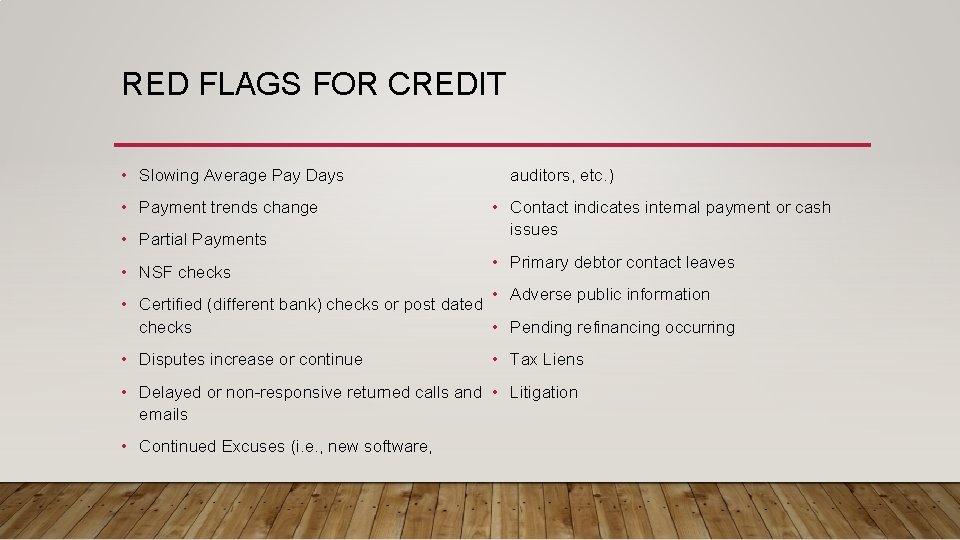
RED FLAGS FOR CREDIT • Slowing Average Pay Days • Payment trends change • Partial Payments • NSF checks auditors, etc. ) • Contact indicates internal payment or cash issues • Primary debtor contact leaves • Adverse public information • Certified (different bank) checks or post dated checks • Pending refinancing occurring • Disputes increase or continue • Tax Liens • Delayed or non-responsive returned calls and • Litigation emails • Continued Excuses (i. e. , new software,
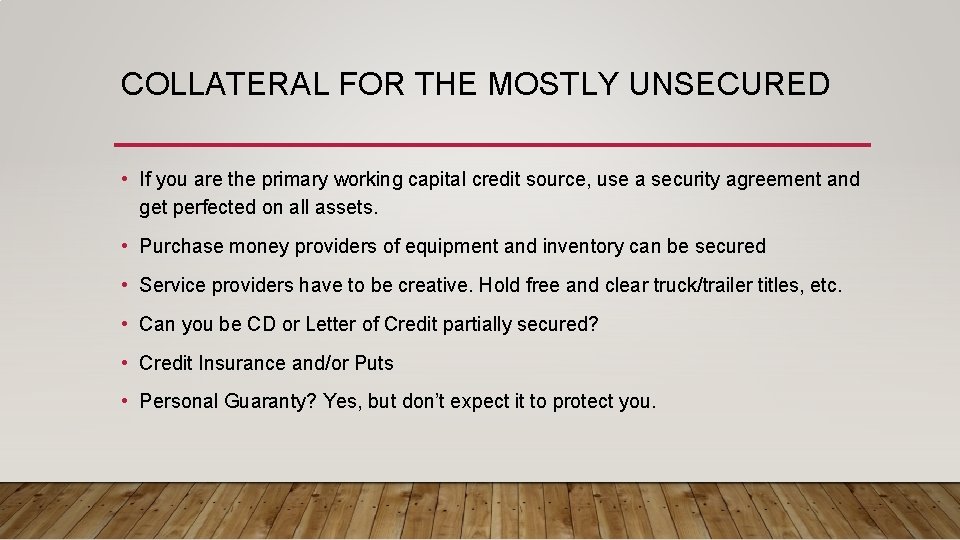
COLLATERAL FOR THE MOSTLY UNSECURED • If you are the primary working capital credit source, use a security agreement and get perfected on all assets. • Purchase money providers of equipment and inventory can be secured • Service providers have to be creative. Hold free and clear truck/trailer titles, etc. • Can you be CD or Letter of Credit partially secured? • Credit Insurance and/or Puts • Personal Guaranty? Yes, but don’t expect it to protect you.
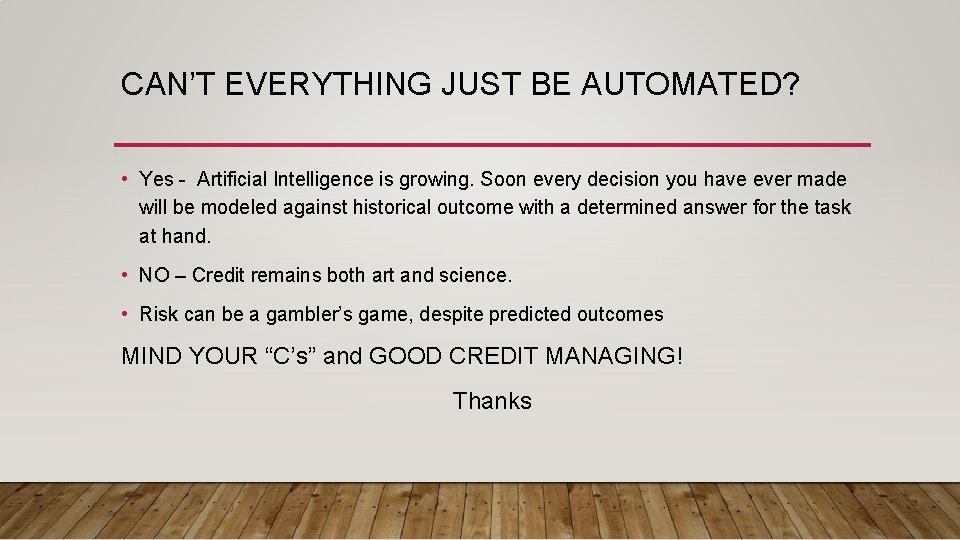
CAN’T EVERYTHING JUST BE AUTOMATED? • Yes - Artificial Intelligence is growing. Soon every decision you have ever made will be modeled against historical outcome with a determined answer for the task at hand. • NO – Credit remains both art and science. • Risk can be a gambler’s game, despite predicted outcomes MIND YOUR “C’s” and GOOD CREDIT MANAGING! Thanks