
The 5 Canons of Rhetoric and Aristotles Classic
- Slides: 36
The 5 Canons of Rhetoric and Aristotle’s Classic Model A. P Language and Composition The Art of Persuasion
Rhetoric • Every time we use language--in speech or in writing-we engage in a rhetorical act. • Another way of saying this would be to say that all communication is rhetorical. • Whenever we use language, we have an intention--a message to communicate or a goal to achieve. • All of us behave rhetorically every time we use language. In fact, a useful modern definition of rhetoric is simply the intentional use of language to influence an audience.
History of Rhetoric During the 4 th century B. C. , Aristotle wrote the Rhetoric in which he defined rhetoric as discovering all available means of persuasion on a topic. Thus, for Aristotle, rhetoric has a clear persuasive function, but also an epistemic function--it serves as a way to discover what is known and what can be known about a subject.
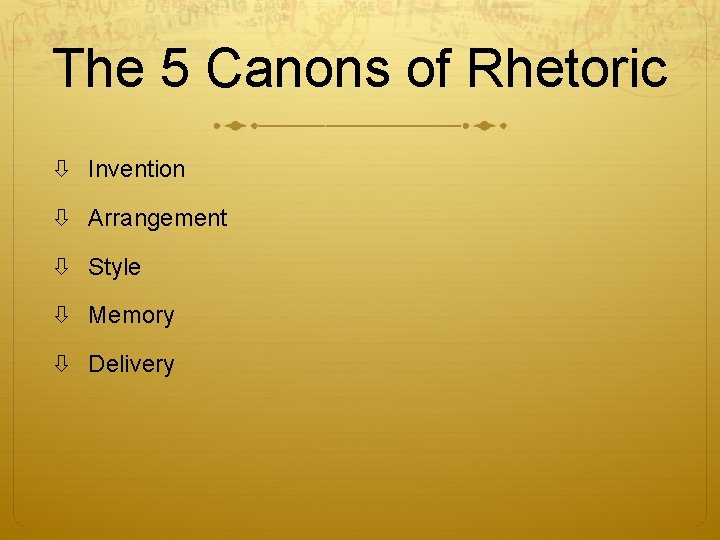
The 5 Canons of Rhetoric Invention Arrangement Style Memory Delivery
Canon # 1 Invention (Inventio) Invention In the canon of invention, a writer is looking for a starting point—how to come up with what he or she wants to write. Invention is the art of finding arguments in any situation and developing material. Determining the Rhetorical Situation: purpose (exigence), audience, and constraints
Canon #2 Arrangement (Dispositio) In the second canon, the writer accomplishes his or her purpose using Patterns of Arrangement aka Rhetorical Modes. More than one pattern can, and usually does, appear in essays. Principles of arrangement help a writer plan order, structure, and support the parts of the piece of writing. More on this later…
Patterns of Arrangement Exemplification Compare/Contrast Cause/Effect Classification Process Analysis Definition Narration
Canon #3 Style (Elecutio) In the third canon, writers make choices regarding words, phrases, and sentences. Conscious choice about stylistic decisions in writing can help writers reflect themselves, communicate meaning, and influence readers. What does this include? ? Schemes and Tropes: Diction, syntax, tone, figurative language, EPL, etc. all depending on the situation…
Canon #4 Memory (Memoria) “Fixing” the words and proofs in the mind, an art of recall Classically, the memorization of speeches Using mnemonic devices (using ideas that are familiar to recall ideas and words that are unfamiliar)
Canon #5 Delivery (Pronuntio) Includes: Stylistic choices in speeches (voice inflection) Setting off words in writing The look of the final published product—the medium of publication: written, visual, spoken The sound of the final delivered presentation
Write in the st 21 Century Writing is one of the world’s oldest technologies Writing is both visual and verbal Writing is multilingual Writing can reach massive audiences (in a very short time) Writing is primarily public from: p 27 EDW
When Writing an Argument You are attempting to convince readers of something… Change their minds Urge them to do something Address a problem where no simple solution exists
Six Elements of Classical Argument (Goes With Canon #2) 1) Exordium/Introduction: captures attention of audience; urges audience to consider your case 2) Narratio/Statement of Background: narrates the key facts and/or events leading up to your case 3) Divisio/Proposition: states the position you are taking, based on the information you’ve already presented, and sets up the structure of the rest of your argument
Six Elements of Classical Argument (Cont. ) 4) Confirmatio/Proof: discusses your reasons for your position and provides evidence to support each reason 5) Confutatio/Refutation: anticipates opposing viewpoints; then demonstrates why your approach is the only acceptable one (i. e. better than your opponents’) 6) Peroratio/Conclusion: summarizes your most important points and can include appeals to feelings or values (pathos)
When Writing an Argument Who is your audience? Scholars? Fellow Students? Collegues? Children? Write to your particular audience
When Writing an Argument Shape your appeal to your audience Establish common ground Respect your audience’s interests and views Choose examples the audience can relate to Use language appropriate to your audience
Audience p 27 EDW What is your topic or message? What is your relationship to your audience? What are your values & beliefs? Your audience’s? You & your audience’s background knowledge? Time and space limitations? Purpose? Appropriate level of language?
What do you the language you use to do? Analyze? Classify? Compare? Contrast? Define? Describe? Discuss? Explain? Survey? Prove?
The Argument p 70 EDW “…all language has an argumentative edge. ” Do not assume that all writers agree with you! “What one [person] might call a massive demonstration another might call a noisy protest, and yet another an angry march…”
Analyzing the Argument p 71 EDW What is the main issue (stasis) What emotional, ethical and logical appeals can you use? How can you establish your credibility? What sources do you have? How current and reliable are they? Does your thesis reflect your claim accurately? How can you use visuals to support your argument?
When Writing an Argument Stasis Theory (stasis = stand) Did the act occur? How is the act defined? How important or serious is the act? What actions should be taken as a result of this act?
When Writing an Argument Reason : : Logic Emotion : : Values Character : : Credibility : : Ethics LOGOS : : PATHOS : : ETHOS
Logos : : Pathos : : Ethos Logos The appeal to reason (logic) Pathos The appeal to emotion (values) Ethos The appeal to character (ethics)
When Writing an Argument Logos : : reason “The facts don’t lie” Use of evidence Trustworthy sources Clearly defined terms
When Writing an Argument Pathos : : emotion of the reader Reminds us of deeply held values Stirs reader’s emotions Creates a strong emotional appeal
When Writing an Argument Ethos : : character of the writer The credibility, moral character, and goodwill of the writer (ethics) Knowledgeable on the subject? Trustworthy? In the best interest of the audience?
When Writing an Argument Identify the elements of an argument Most arguments share a claim, reasons for that claim, warrants (assumptions) which connect the claim to the reasons, evidence (facts, credible opinions, examples, statistics), and qualifiers (limiting of the claim)
When Writing an Argument Identify the elements of an argument Claim Reasons, for that claim Warrants or assumptions, which connect the claim to the reasons Evidence, facts, credible opinions, examples, statistics Qualifiers, limits of the claim
When Writing an Argument Recognize Fallacies Serious Flaws Barriers to common ground and understanding Pages 74 -76 The Everyday Writer Emotional, ethical, logical fallacies
Recognizing Fallacies Emotional Bandwagon appeal, flattery, in-crowd appeal, veiled threats, false analogies Ethical Ad hominem, guilt by association, false authority Logical Begging the question, post hoc fallacy, non sequitur, either-or, hasty generalization, oversimplification
When Writing an Argument Demonstrating Knowledge Using credible sources Demonstrating Fairness Considering the other side in your paper adds to your credibility
Organizing an Argument The Classical System 1. Introduction 2. Background 3. Lines of Argument 4. Alternative arguments 5. Conclusion
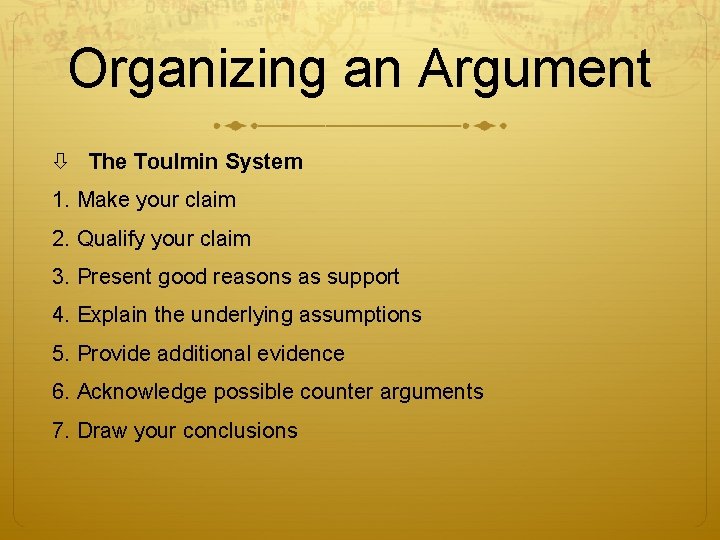
Organizing an Argument The Toulmin System 1. Make your claim 2. Qualify your claim 3. Present good reasons as support 4. Explain the underlying assumptions 5. Provide additional evidence 6. Acknowledge possible counter arguments 7. Draw your conclusions
When Making Presentations of your finished Arguments Know your material Practice, practice Helps you be more comfortable on presentation day Make Eye Contact Adds to your credibility Lets the listeners know your stuff
The 5 Canons of Rhetoric Invention Arrangement Style Memory Delivery
When Making Presentations of your finished Arguments Who is your audience? How should you dress?