
The 4 Types of Governments Autocracy Dictatorships Oneperson
- Slides: 6
The 4 Types of Governments
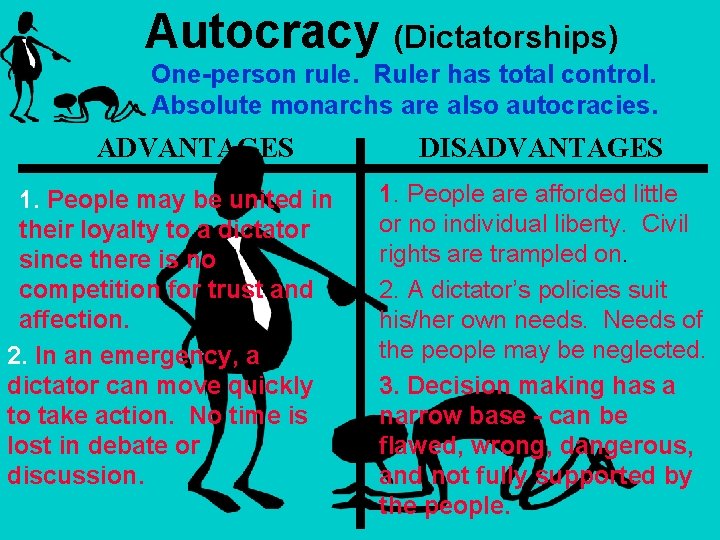
Autocracy (Dictatorships) One-person rule. Ruler has total control. Absolute monarchs are also autocracies. ADVANTAGES 1. People may be united in their loyalty to a dictator since there is no competition for trust and affection. 2. In an emergency, a dictator can move quickly to take action. No time is lost in debate or discussion. DISADVANTAGES 1. People are afforded little or no individual liberty. Civil rights are trampled on. 2. A dictator’s policies suit his/her own needs. Needs of the people may be neglected. 3. Decision making has a narrow base - can be flawed, wrong, dangerous, and not fully supported by the people.
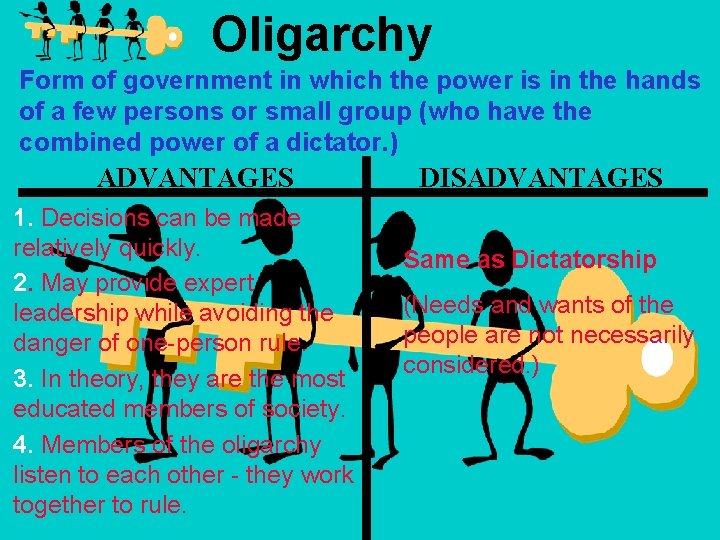
Oligarchy Form of government in which the power is in the hands of a few persons or small group (who have the combined power of a dictator. ) ADVANTAGES 1. Decisions can be made relatively quickly. 2. May provide expert leadership while avoiding the danger of one-person rule. 3. In theory, they are the most educated members of society. 4. Members of the oligarchy listen to each other - they work together to rule. DISADVANTAGES Same as Dictatorship (Needs and wants of the people are not necessarily considered. )
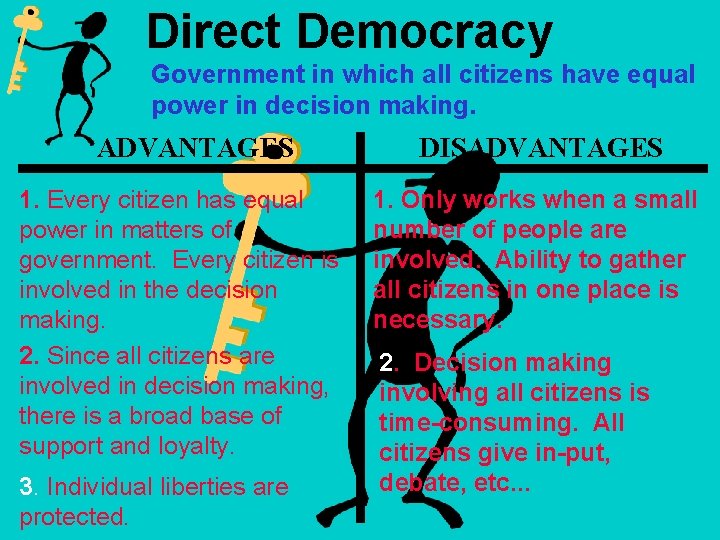
Direct Democracy Government in which all citizens have equal power in decision making. ADVANTAGES 1. Every citizen has equal power in matters of government. Every citizen is involved in the decision making. 2. Since all citizens are involved in decision making, there is a broad base of support and loyalty. 3. Individual liberties are protected. DISADVANTAGES 1. Only works when a small number of people are involved. Ability to gather all citizens in one place is necessary. 2. Decision making involving all citizens is time-consuming. All citizens give in-put, debate, etc. . .
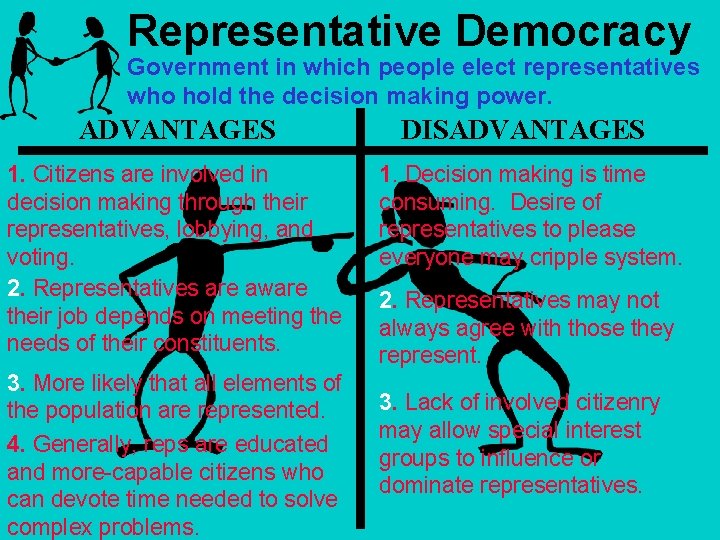
Representative Democracy Government in which people elect representatives who hold the decision making power. ADVANTAGES 1. Citizens are involved in decision making through their representatives, lobbying, and voting. 2. Representatives are aware their job depends on meeting the needs of their constituents. 3. More likely that all elements of the population are represented. 4. Generally, reps are educated and more-capable citizens who can devote time needed to solve complex problems. DISADVANTAGES 1. Decision making is time consuming. Desire of representatives to please everyone may cripple system. 2. Representatives may not always agree with those they represent. 3. Lack of involved citizenry may allow special interest groups to influence or dominate representatives.
Discussion Question: Critics argue that the low voter turnout in recent national elections is a weakness in our democratic system. Do you agree or disagree? Explain your viewpoint.