
The 4 Basic Tissues Of all the cells
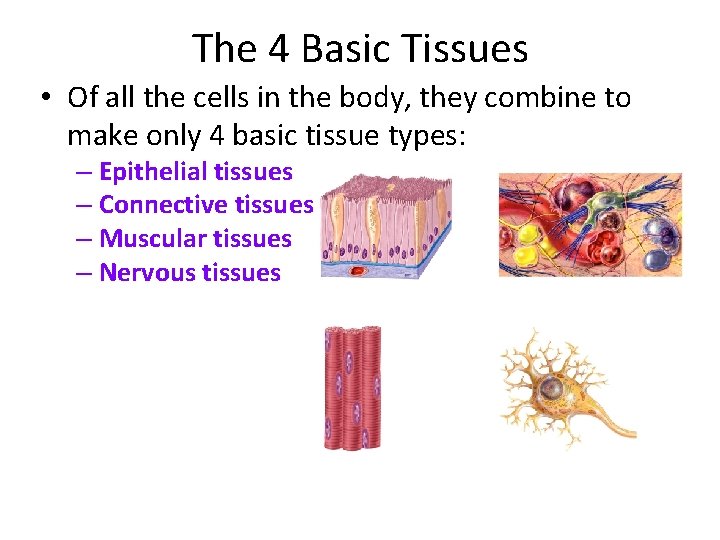
The 4 Basic Tissues • Of all the cells in the body, they combine to make only 4 basic tissue types: – Epithelial tissues – Connective tissues – Muscular tissues – Nervous tissues
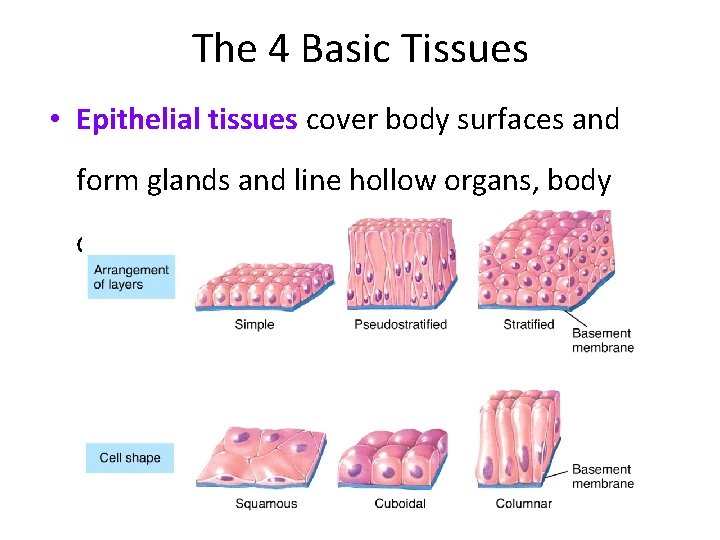
The 4 Basic Tissues • Epithelial tissues cover body surfaces and form glands and line hollow organs, body cavities, and ducts.

The 4 Basic Tissues • Connective tissues (C. T. ) protect, support, and bind organs. – Fat is a type of C. T. that stores energy. – Red blood cells, white blood cells, and platelets are all C. T.

The 4 Basic Tissues • Muscular tissues generate the physical force needed to make body structures move. They also generate heat used by the body. • Nervous tissues detect changes in the body and respond by generating nerve impulses.

The 4 Basic Tissues • Tissues of the body develop from three primary germ layers: Endoderm, Mesoderm, and Ectoderm – Epithelial tissues from all three germ layers – C. T. and muscle are derived from mesoderm. – Nervous tissue develops from ectoderm.
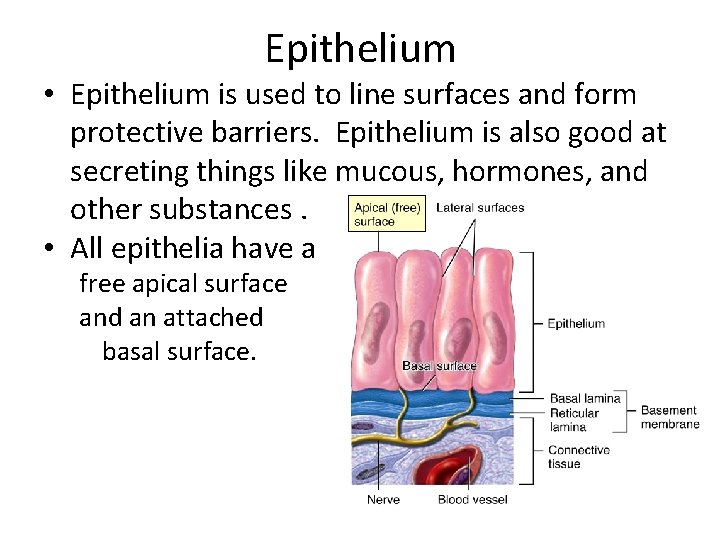
Epithelium • Epithelium is used to line surfaces and form protective barriers. Epithelium is also good at secreting things like mucous, hormones, and other substances. • All epithelia have a free apical surface and an attached basal surface.
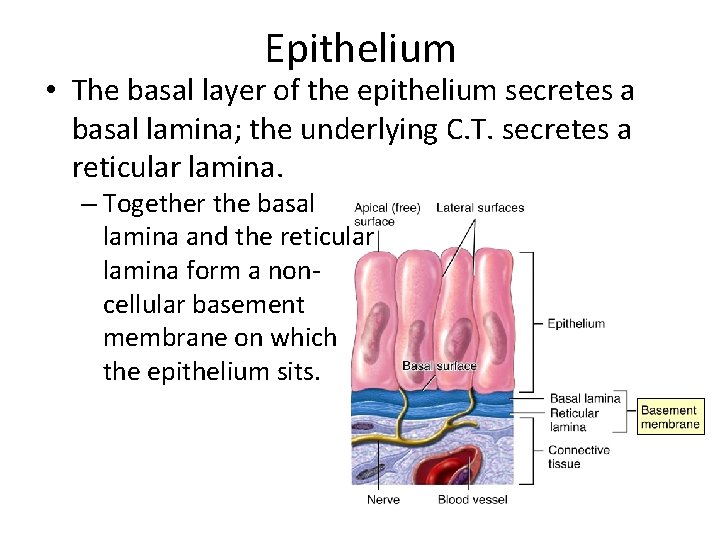
Epithelium • The basal layer of the epithelium secretes a basal lamina; the underlying C. T. secretes a reticular lamina. – Together the basal lamina and the reticular lamina form a noncellular basement membrane on which the epithelium sits.
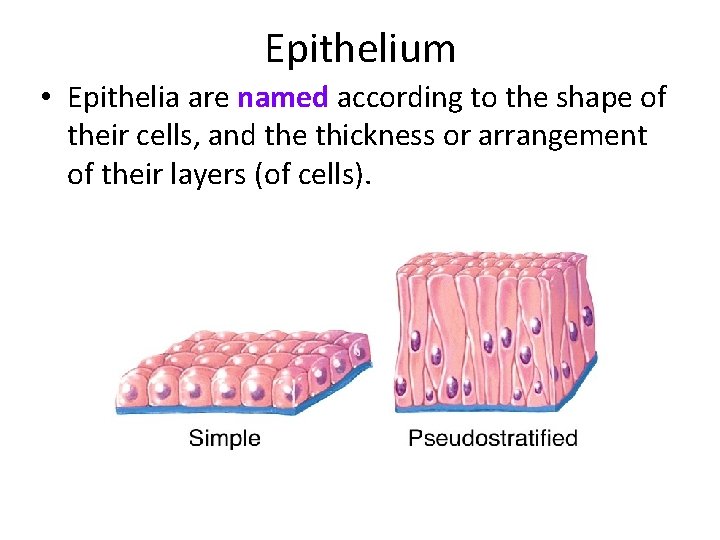
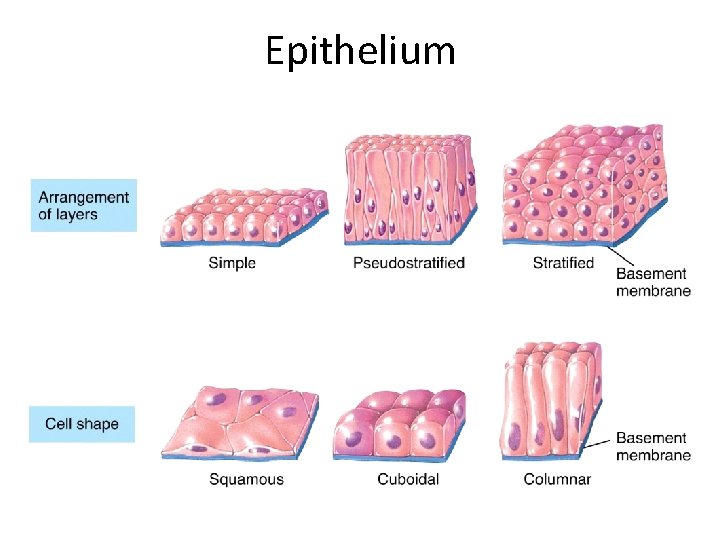
Epithelium • Epithelia are named according to the shape of their cells, and the thickness or arrangement of their layers (of cells).
Epithelium
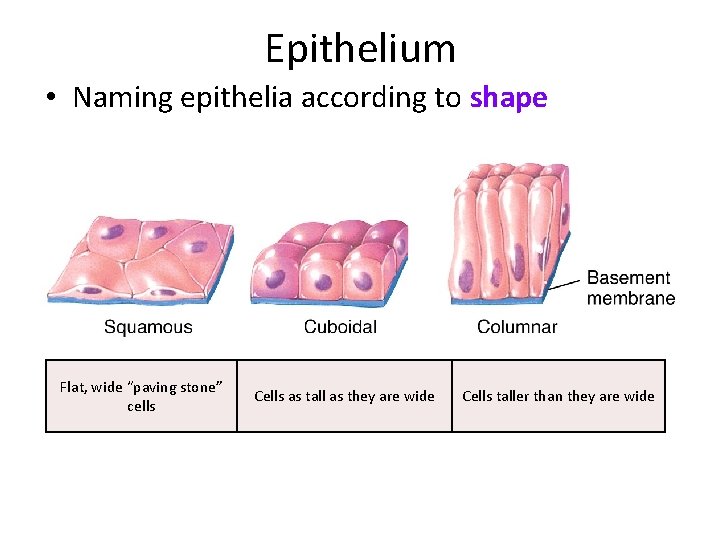
Epithelium • Naming epithelia according to shape Flat, wide “paving stone” cells Cells as tall as they are wide Cells taller than they are wide
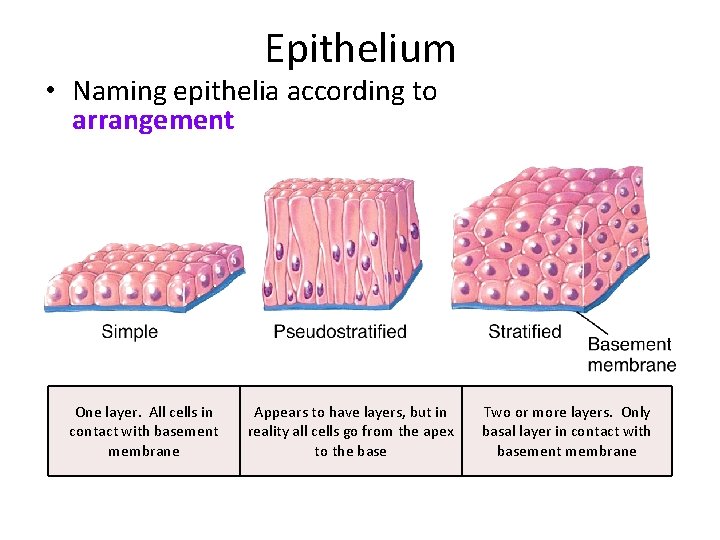
Epithelium • Naming epithelia according to arrangement One layer. All cells in contact with basement membrane Appears to have layers, but in reality all cells go from the apex to the base Two or more layers. Only basal layer in contact with basement membrane
Epithelium • Naming epithelia – Three different cell shapes x three different cell arrangements = nine possibilities. Two of these are not used. Add transitional (cells that change shape), and we’re back up to eight possible combinations. – If different shapes are present in layers of cells, the epithelium is always named by the shape of cells in the apical (outermost) layer.
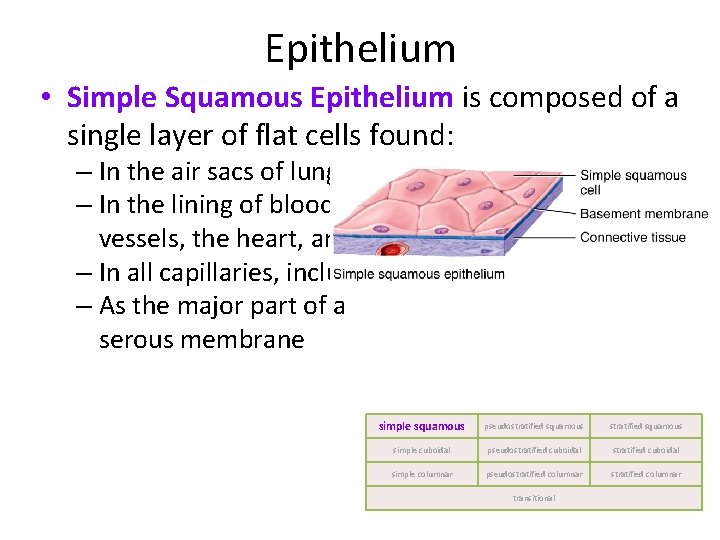
Epithelium • Simple Squamous Epithelium is composed of a single layer of flat cells found: – In the air sacs of lungs – In the lining of blood vessels, the heart, and lymphatic vessels – In all capillaries, including those of the kidney – As the major part of a serous membrane simple squamous pseudostratified squamous simple cuboidal pseudostratified cuboidal simple columnar pseudostratified columnar transitional
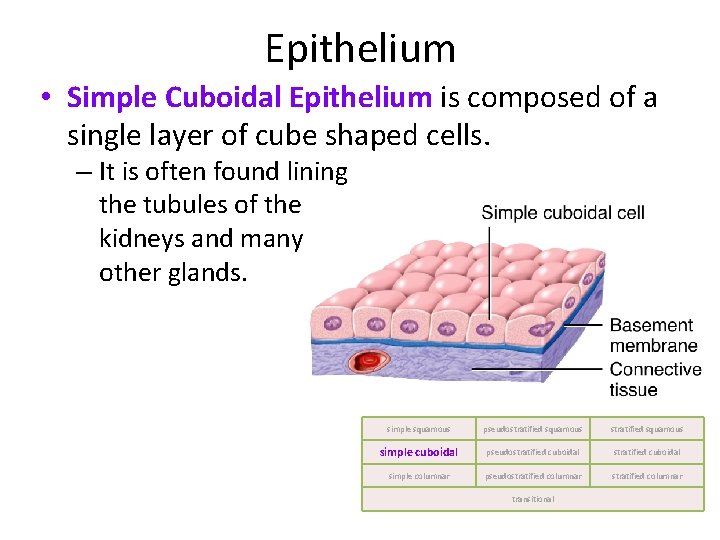
Epithelium • Simple Cuboidal Epithelium is composed of a single layer of cube shaped cells. – It is often found lining the tubules of the kidneys and many other glands. simple squamous pseudostratified squamous simple cuboidal pseudostratified cuboidal simple columnar pseudostratified columnar transitional
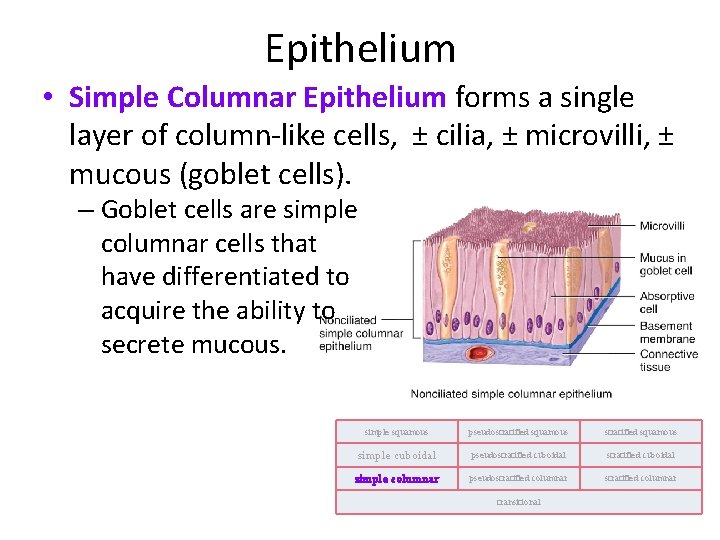
Epithelium • Simple Columnar Epithelium forms a single layer of column-like cells, ± cilia, ± microvilli, ± mucous (goblet cells). – Goblet cells are simple columnar cells that have differentiated to acquire the ability to secrete mucous. simple squamous pseudostratified squamous simple cuboidal pseudostratified cuboidal simple columnar pseudostratified columnar transitional
- Slides: 15