
The 37 th Forum for Behavioral Science in
The 37 th Forum for Behavioral Science in Family Medicine Integrating Behavioral Science Into Precepting: A Collaborative Model Maureen Healy, LCSW, MPH Kristie Adebayo, MD, MSW Department of Family Medicine Bronx-Lebanon Hospital Center Bronx, NY Sponsored by The Medical College of Wisconsin
The 37 th Forum for Behavioral Science in Family Medicine Disclosures No disclosures Sponsored by The Medical College of Wisconsin
The 37 th Forum for Behavioral Science in Family Medicine Goals and Objectives 1. Discuss the purpose, opportunities, and challenges of precepting in the outpatient clinic as a behavioral science educator 2. Describe the different approaches and teaching methods of precepting 3. Describe and practice the collaborative model of precepting to adapt to each site Sponsored by The Medical College of Wisconsin
The 37 th Forum for Behavioral Science in Family Medicine Agenda • Introductions and rationale • Presentation and large group discussion of precepting models • Presentation of sample model • Small Group discussion and role plays • Large Group discussion to wrap up Sponsored by The Medical College of Wisconsin
The 37 th Forum for Behavioral Science in Family Medicine OMG How do I do my job? Sponsored by The Medical College of Wisconsin
The 37 th Forum for Behavioral Science in Family Medicine Introductions Where are you from? How does your program teach behavioral science to residents in the outpatient setting? Do you precept residents? Sponsored by The Medical College of Wisconsin
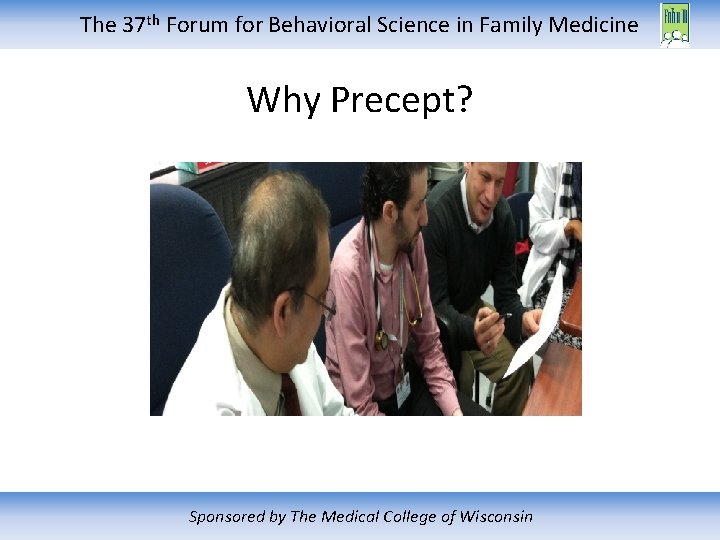
The 37 th Forum for Behavioral Science in Family Medicine Why Precept? Sponsored by The Medical College of Wisconsin
The 37 th Forum for Behavioral Science in Family Medicine Why Precept? • Importance – Teaching behavioral science in the clinic setting reinforces skills so that they are more likely to be implemented – Knowledge can be applied to real situations, skills learned and practiced – Didactic sessions are often not reinforced in clinic setting – The “hidden curriculum” and decrease in empathy and compassion throughout training – Prevalence of psychosocial concerns presenting in primary care – Addressing psychosocial concerns improves care: information-gathering, accurate diagnoses, adherence with treatment plan, patient and physician satisfaction. – Precepting poorly can increase stress, burnout for teachers and learners, increase wait times and decrease patient satisfaction – ACGME requirements • Effectiveness – No research on effectiveness of precepting behavioral science Sponsored by The Medical College of Wisconsin
The 37 th Forum for Behavioral Science in Family Medicine Bronx-Lebanon Hospital Center Department of Family Medicine • • • 2 clinics 38 residents 25 attending physicians (AP) – 1 full-time preceptor – All others rotate • 5 behavioral science instructors (BSI) Social Workers Rotate precepting: total of 3 days/week Month long behavioral science rotation with PGY-1 2 -3 didactic sessions plus 4 Grand Rounds per year with PGY-2, 3 – Assigned Behavioral Science Advisors – Monthly resident support group – – • No training on precepting Sponsored by The Medical College of Wisconsin
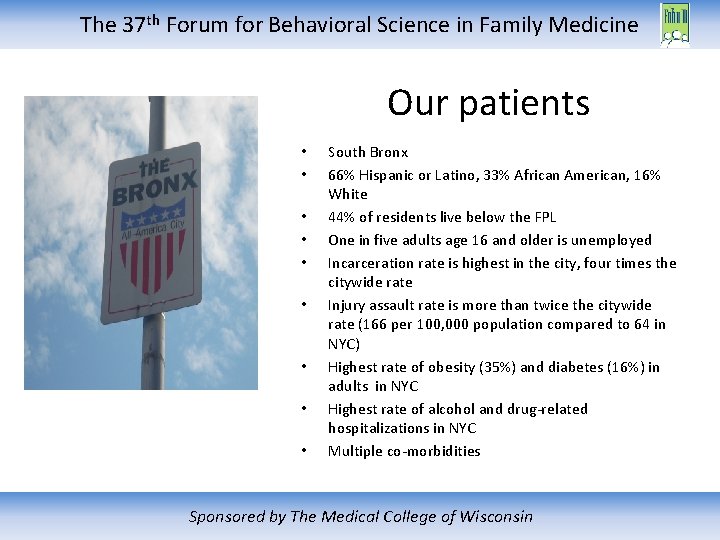
The 37 th Forum for Behavioral Science in Family Medicine Our patients • • • South Bronx 66% Hispanic or Latino, 33% African American, 16% White 44% of residents live below the FPL One in five adults age 16 and older is unemployed Incarceration rate is highest in the city, four times the citywide rate Injury assault rate is more than twice the citywide rate (166 per 100, 000 population compared to 64 in NYC) Highest rate of obesity (35%) and diabetes (16%) in adults in NYC Highest rate of alcohol and drug-related hospitalizations in NYC Multiple co-morbidities Sponsored by The Medical College of Wisconsin
The 37 th Forum for Behavioral Science in Family Medicine What is the BSI role in precepting? • Referrals/Warm hand-offs • Time saver • Wait, aren’t I an “instructor”? Sponsored by The Medical College of Wisconsin
The 37 th Forum for Behavioral Science in Family Medicine 2015 Survey of Attending and Resident Physician Attitudes Response Rate: Attendings 19/25: 76% Residents: 21/35: 60% “It is important or extremely important for patient care to teach residents behavioral science. ” 84. 2% of attendings 72% of residents Sponsored by The Medical College of Wisconsin
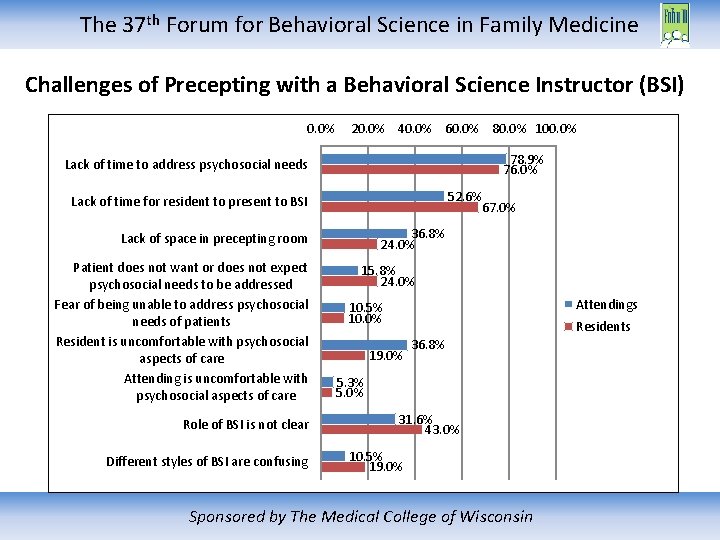
The 37 th Forum for Behavioral Science in Family Medicine Challenges of Precepting with a Behavioral Science Instructor (BSI) 0. 0% 20. 0% 40. 0% 60. 0% 80. 0% 100. 0% 78. 9% 76. 0% Lack of time to address psychosocial needs 52. 6% 67. 0% Lack of time for resident to present to BSI 36. 8% 24. 0% Lack of space in precepting room Patient does not want or does not expect psychosocial needs to be addressed Fear of being unable to address psychosocial needs of patients Resident is uncomfortable with psychosocial aspects of care Attending is uncomfortable with psychosocial aspects of care Role of BSI is not clear Different styles of BSI are confusing 15. 8% 24. 0% Attendings 10. 5% 10. 0% Residents 19. 0% 36. 8% 5. 3% 5. 0% 31. 6% 43. 0% 10. 5% 19. 0% Sponsored by The Medical College of Wisconsin
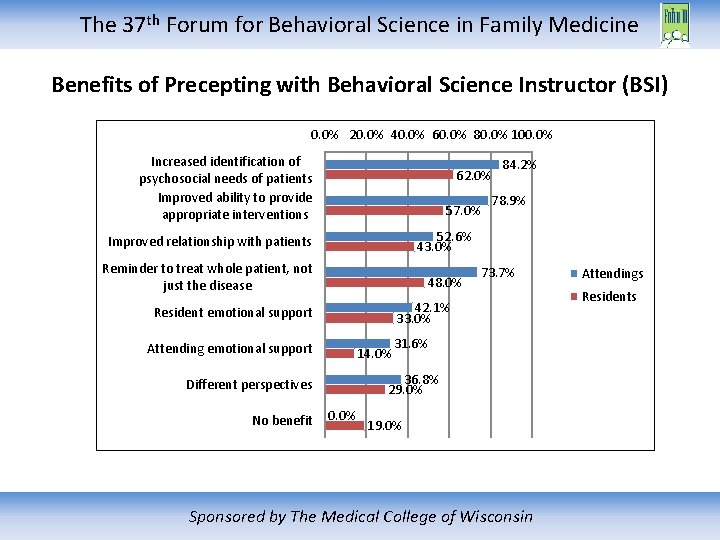
The 37 th Forum for Behavioral Science in Family Medicine Benefits of Precepting with Behavioral Science Instructor (BSI) 0. 0% 20. 0% 40. 0% 60. 0% 80. 0% 100. 0% Increased identification of psychosocial needs of patients Improved ability to provide appropriate interventions 62. 0% 57. 0% Improved relationship with patients 52. 6% 43. 0% Reminder to treat whole patient, not just the disease 48. 0% 78. 9% 73. 7% 42. 1% 33. 0% Resident emotional support Attending emotional support 14. 0% 31. 6% 36. 8% 29. 0% Different perspectives No benefit 84. 2% 0. 0% 19. 0% Sponsored by The Medical College of Wisconsin Attendings Residents
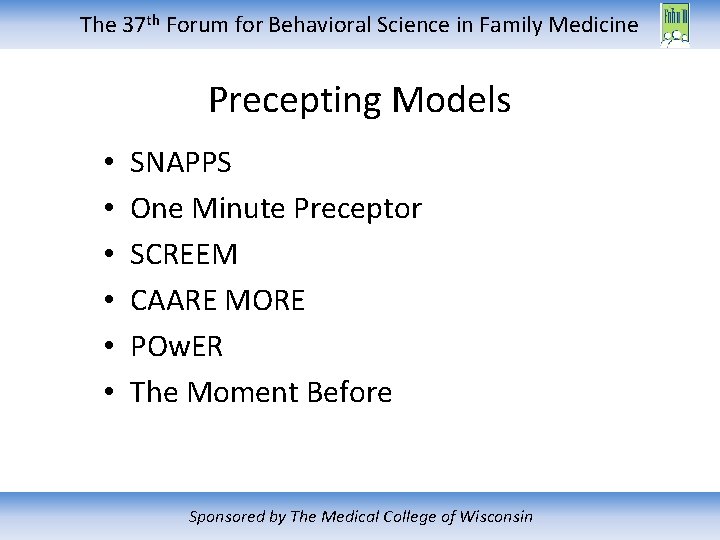
The 37 th Forum for Behavioral Science in Family Medicine Precepting Models • • • SNAPPS One Minute Preceptor SCREEM CAARE MORE POw. ER The Moment Before Sponsored by The Medical College of Wisconsin
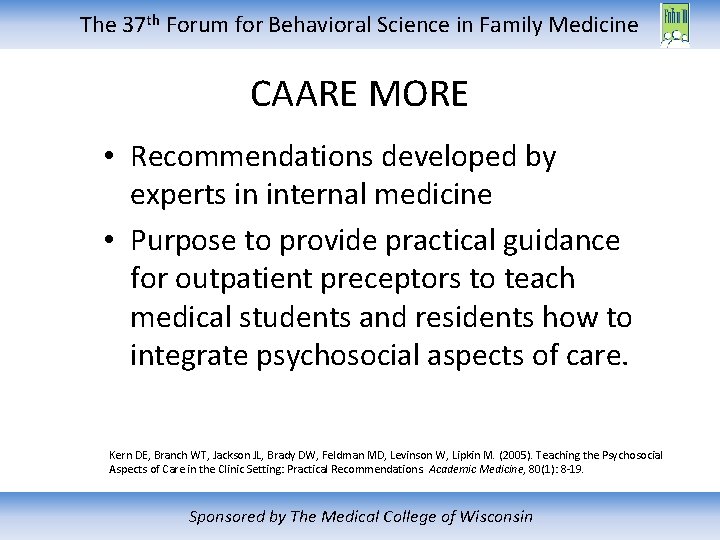
The 37 th Forum for Behavioral Science in Family Medicine CAARE MORE • Recommendations developed by experts in internal medicine • Purpose to provide practical guidance for outpatient preceptors to teach medical students and residents how to integrate psychosocial aspects of care. Kern DE, Branch WT, Jackson JL, Brady DW, Feldman MD, Levinson W, Lipkin M. (2005). Teaching the Psychosocial Aspects of Care in the Clinic Setting: Practical Recommendations. Academic Medicine, 80(1): 8 -19. Sponsored by The Medical College of Wisconsin
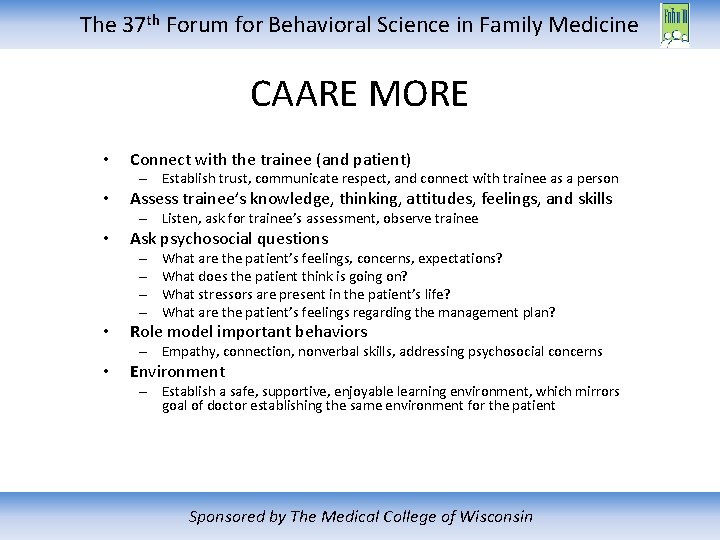
The 37 th Forum for Behavioral Science in Family Medicine CAARE MORE • Connect with the trainee (and patient) – Establish trust, communicate respect, and connect with trainee as a person • Assess trainee’s knowledge, thinking, attitudes, feelings, and skills – Listen, ask for trainee’s assessment, observe trainee • Ask psychosocial questions – – • What are the patient’s feelings, concerns, expectations? What does the patient think is going on? What stressors are present in the patient’s life? What are the patient’s feelings regarding the management plan? Role model important behaviors – Empathy, connection, nonverbal skills, addressing psychosocial concerns • Environment – Establish a safe, supportive, enjoyable learning environment, which mirrors goal of doctor establishing the same environment for the patient Sponsored by The Medical College of Wisconsin
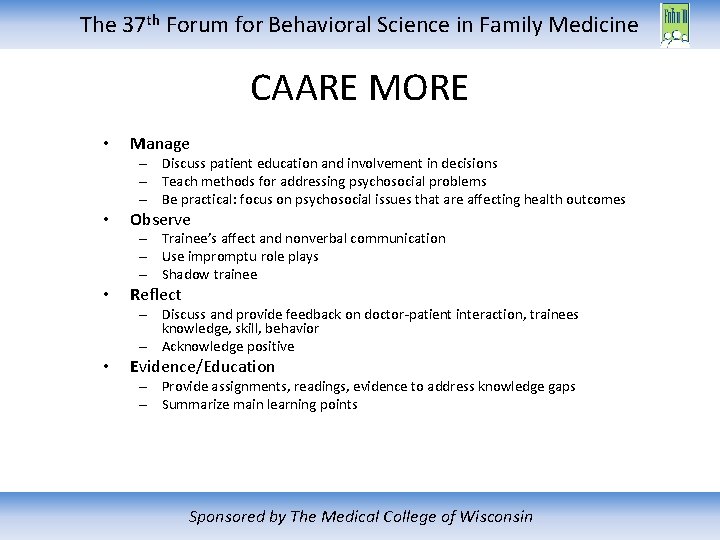
The 37 th Forum for Behavioral Science in Family Medicine CAARE MORE • Manage – Discuss patient education and involvement in decisions – Teach methods for addressing psychosocial problems – Be practical: focus on psychosocial issues that are affecting health outcomes • Observe – Trainee’s affect and nonverbal communication – Use impromptu role plays – Shadow trainee • Reflect – Discuss and provide feedback on doctor-patient interaction, trainees knowledge, skill, behavior – Acknowledge positive • Evidence/Education – Provide assignments, readings, evidence to address knowledge gaps – Summarize main learning points Sponsored by The Medical College of Wisconsin
The 37 th Forum for Behavioral Science in Family Medicine SNAPPS • Learner-centered precepting – Learner is active participant in teaching encounter – Encourages learning beyond summarization of facts, to engage in problem-solving and critical thinking – Perhaps mirrors goal of activation of patients and relationship with physician in patientcentered care Wolpaw TM, Wolpaw DR, Papp KK. SNAPPS: A learner-centered model for outpatient education. Academic Medicine. 2003; 78(9): 893 -898. Sponsored by The Medical College of Wisconsin
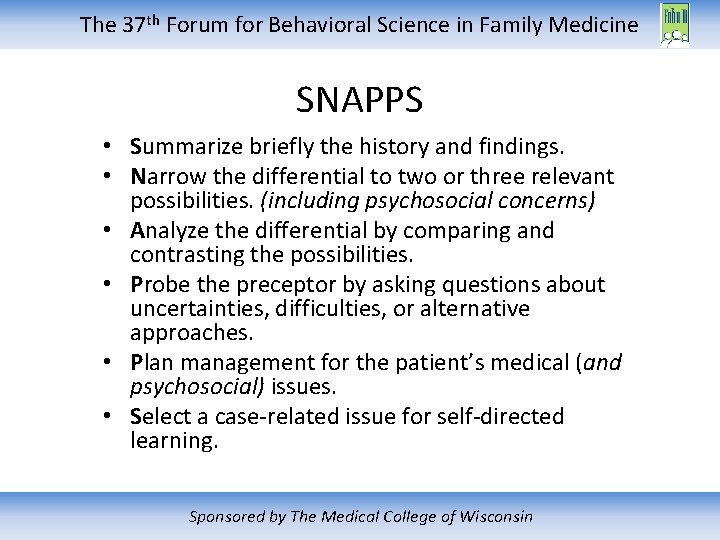
The 37 th Forum for Behavioral Science in Family Medicine SNAPPS • Summarize briefly the history and findings. • Narrow the differential to two or three relevant possibilities. (including psychosocial concerns) • Analyze the differential by comparing and contrasting the possibilities. • Probe the preceptor by asking questions about uncertainties, difficulties, or alternative approaches. • Plan management for the patient’s medical (and psychosocial) issues. • Select a case-related issue for self-directed learning. Sponsored by The Medical College of Wisconsin
The 37 th Forum for Behavioral Science in Family Medicine The Moment Before • What is learner’s clinical question? • Based on Adult Learning theory: – Knowledge must be conscious in order to acquire skills – Adult learners are self-motivated by personal interest Belinda Fu, MD, Swedish Family Medicine Residency/University of Washington FMR. Presentation at STFM Annual Conference 2015, Orlando FL. Sponsored by The Medical College of Wisconsin
The 37 th Forum for Behavioral Science in Family Medicine One Minute Preceptor/5 Microskills 1. Get a commitment: What do you think is going on? 2. Probe for supporting evidence: Why do you think it’s …. ? 3. Teach general principles (not just specific to this patient) 4. Reinforce what is correct. 5. Correct mistakes. Neher JO, Stevens NG. The one-minute preceptor: shaping the teaching conversation. Family Medicine. 2003; 35(6); 391 -3. Sponsored by The Medical College of Wisconsin
The 37 th Forum for Behavioral Science in Family Medicine POw. ER • Preceptor is often a passive consultant, which can waste preceptor’s skills and knowledge. • Preceptor as active coach is a better use of time and expertise Lillich DW, Mace K, Goodell M, Kinnee C. Active precepting in the residency clinic: a pilot study of a new model. Family Medicine. 2005; 37(3): 205 -210. Sponsored by The Medical College of Wisconsin
The 37 th Forum for Behavioral Science in Family Medicine POw. ER • • Prepare Orchestrate Educate Review Sponsored by The Medical College of Wisconsin
The 37 th Forum for Behavioral Science in Family Medicine Key Concepts Align with Social Work Principles • Learner-Centered – Start where the client (patient/resident/attending) is at • Relationship-Centered – Spend time building the relationship, establishing trust • Active Preceptor and Learner – Preceptor as guide, learner is empowered • Strengths-Based Sponsored by The Medical College of Wisconsin
The 37 th Forum for Behavioral Science in Family Medicine Collaborative Model Purpose: To offer a flexible and collaborative model of precepting in the outpatient clinic to improve resident learning, patient care, and time management. Sponsored by The Medical College of Wisconsin
The 37 th Forum for Behavioral Science in Family Medicine Collaborative Model Goals: Support and improve residents’ interpersonal and communication skills. (Interpersonal and Communication Skills, Professionalism*) Support and improve residents’ abilities to identify and intervene in patients’ psychosocial circumstances. (Patient Care and Procedural Skills, Medical Knowledge, System-Based Practice*) Support and improve residents’ self-awareness and practice of self-care. (Professionalism*) *ACGME Competencies Sponsored by The Medical College of Wisconsin
The 37 th Forum for Behavioral Science in Family Medicine Collaborative Model 1. Shared Agenda Setting/Preparation • • AP and BSI identify any residents they want to focus on and any particular concerns. AP and BSI discuss with residents if they have any patients they want support with and how. AP and BSI discuss the priorities of the day: Residents who are struggling, patients who are struggling, needs of clinic, etc. BSI reminds residents to present at least 2 psychosocial aspects of care for each patient. Sponsored by The Medical College of Wisconsin
The 37 th Forum for Behavioral Science in Family Medicine Collaborative Model 2. Presentation: – The Moment Before: Residentifies clinical question or need. “What do I want to learn? ” – During presentation, residentifies and presents at least 2 psychosocial factors that may impact (positively or negatively) patient’s health. – Resident, AP, and BSI discuss assessment and plan. Resident incorporates knowledge of DSM 5, behavioral screening tools, counseling techniques, and behavioral health, social services, and community referrals. Sponsored by The Medical College of Wisconsin
The 37 th Forum for Behavioral Science in Family Medicine Examples of Behavioral Clinical Questions: Interpersonal and Communication Skills How do I encourage patients to follow up with me? I really dislike this patient, or feel overwhelmed, what do I do? Patient Care and Procedural Skills What are some tools for me to counsel a patient to make lifestyle changes for diabetes? What can I do to help my patient get better housing? Medical Knowledge What is the best treatment for depression? Practice-Based Learning and Improvement Can you shadow me on this patient to help me with. . ? Professionalism I'm feeling really stressed and tired today, how can I still make sure I am giving my patients good care? Systems-Based Practice How should I talk to my patient about a referral to (social services, substance abuse treatment. . . ) so that he will more likely go? Sponsored by The Medical College of Wisconsin
The 37 th Forum for Behavioral Science in Family Medicine Psychosocial Factors: “SCREEM” • Social/Support – – – • Cultural – – • What level of education has the patient attained? Does the patient have any difficulty reading English? Economics – – • Does the patient adhere to any religious or spiritual beliefs? Would the patient name a representative from his/her faith community to be contacted? Education – – • What are the cultural influences on the patient’s health and family? What is the patient’s native language? Religious/Spiritual – – • With whom does the patient live? Who does the patient rely on for emotional support? Does the patient feel safe at home? Is the patient able to pay for currently prescribed medications? Would the patient benefit from a social work consult to discuss financial assistance? Medical Care – – Does the patient have any difficulty attending appointments with medical providers? Does the patient have advanced directives written? Kertesz JW, Delbridge EJ, Felix DS. Models for integrating behavioral medicine on a family medicine in-patient teaching service. International Journal of Psychiatry in Medicine. 2014; 47(4): 357 -367. Sponsored by The Medical College of Wisconsin
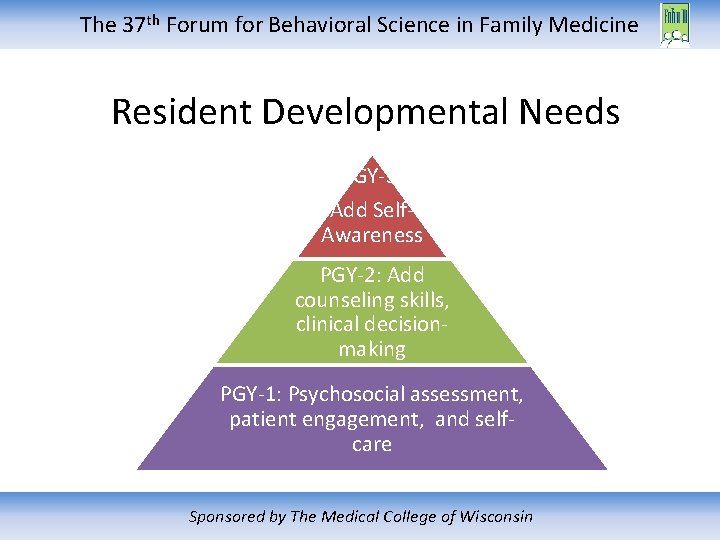
The 37 th Forum for Behavioral Science in Family Medicine Resident Developmental Needs PGY-3: Add Self. Awareness PGY-2: Add counseling skills, clinical decisionmaking PGY-1: Psychosocial assessment, patient engagement, and selfcare Sponsored by The Medical College of Wisconsin
The 37 th Forum for Behavioral Science in Family Medicine Preceptor skills/activities: – Ask open-ended questions to promote problem-solving and critical thinking. – Provide instruction, modeling, and guidance – Provide feedback that is specific, constructive, and not emotional. – Offer role modeling or shadowing with resident and patient. – Reinforce behavioral tools and themes learned during concepts. – Discuss themes from behavioral topics of the month. – Consider follow-up assignments (article on assessment tool or treatment, find local resource for victims of domestic violence) Sponsored by The Medical College of Wisconsin
The 37 th Forum for Behavioral Science in Family Medicine Barriers to Collaboration • Time – Wait time for patients – Patient satisfaction • • • Relationship (with resident, with attending) Different goals than attending physician Poor communication with resident and attending Lack of continuity Others? Sponsored by The Medical College of Wisconsin
The 37 th Forum for Behavioral Science in Family Medicine Role Plays Preparation Shared Agenda Setting The Moment Before Presentation: SNAPPS 5 Microskills SCREEM Preceptor Activities CAARE MORE Sponsored by The Medical College of Wisconsin
The 37 th Forum for Behavioral Science in Family Medicine Group discussion • What was your clinical question? • What behavioral science concepts did you want the resident to learn? • How did you collaborate with the resident and attending physician? • How would your focus have been different if the resident was a PGY 1, 2, or 3? • Did you have time for feedback? Sponsored by The Medical College of Wisconsin
The 37 th Forum for Behavioral Science in Family Medicine Thank you! “Better than a thousand days of diligent study is one day with a great teacher. ” --Japanese Proverb Sponsored by The Medical College of Wisconsin
- Slides: 37