
The 3 D Reflectivity Structure of Intense Atlantic
- Slides: 12
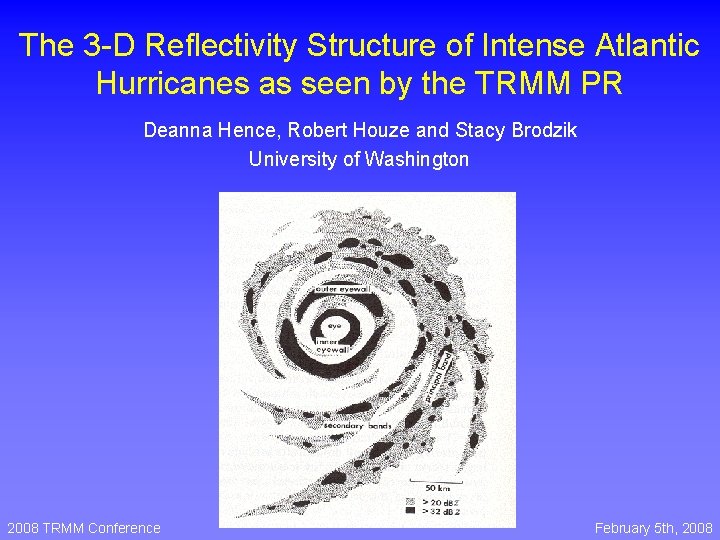
The 3 -D Reflectivity Structure of Intense Atlantic Hurricanes as seen by the TRMM PR Deanna Hence, Robert Houze and Stacy Brodzik University of Washington 2008 TRMM Conference February 5 th, 2008
Objectives of the Study • To develop a three-dimensional climatology of precipitation structures within tropical cyclones • To characterize the dynamics of the rainbands —are they more like ordinary convection or eyewall convection? 2008 TRMM Conference February 5 th, 2008
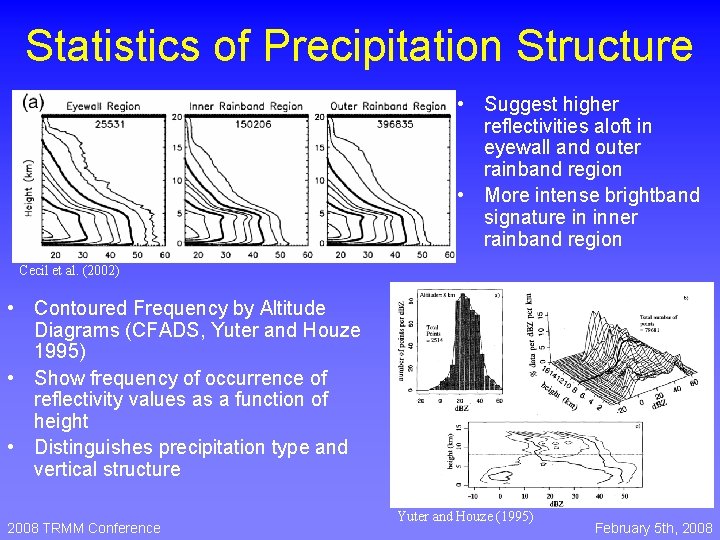
Statistics of Precipitation Structure • Suggest higher reflectivities aloft in eyewall and outer rainband region • More intense brightband signature in inner rainband region Cecil et al. (2002) • Contoured Frequency by Altitude Diagrams (CFADS, Yuter and Houze 1995) • Show frequency of occurrence of reflectivity values as a function of height • Distinguishes precipitation type and vertical structure 2008 TRMM Conference Yuter and Houze (1995) February 5 th, 2008
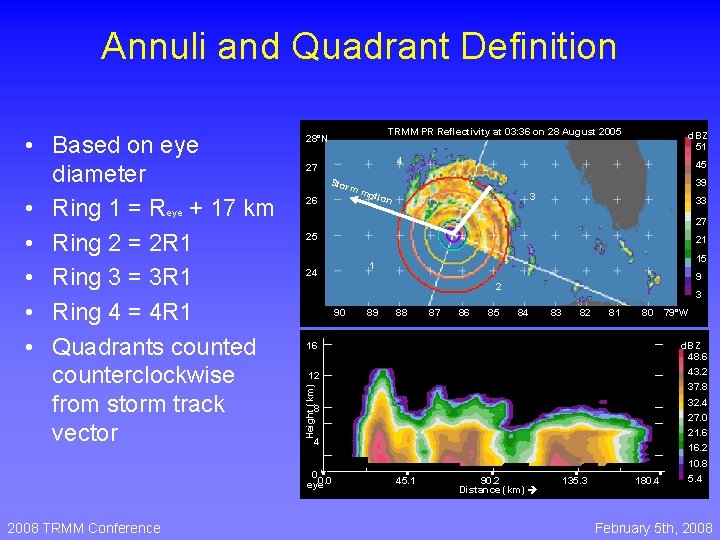
Annuli and Quadrant Definition d. BZ 51 4 27 Stor 39 mm 26 45 otio 3 n 33 27 25 21 15 1 24 9 2 90 89 88 16 87 86 85 3 84 83 82 81 80 79°W d. BZ 48. 6 43. 2 TRMM PR Vertical Slice 12 37. 8 Height (km) • Based on eye diameter • Ring 1 = Reye + 17 km • Ring 2 = 2 R 1 • Ring 3 = 3 R 1 • Ring 4 = 4 R 1 • Quadrants counted counterclockwise from storm track vector TRMM PR Reflectivity at 03: 36 on 28 August 2005 28°N 32. 4 8 27. 0 21. 6 16. 2 4 10. 8 0 0. 0 eye 2008 TRMM Conference 45. 1 90. 2 Distance (km) 135. 3 180. 4 5. 4 February 5 th, 2008
TCSP and RAINEX • Initial study includes Hurricanes Dennis, Emily, Katrina, and Rita of 2005 • Analysis of overpasses when storms are hurricane strength • Quadrant analysis revealed lack of consistent asymmetry 2008 TRMM Conference February 5 th, 2008
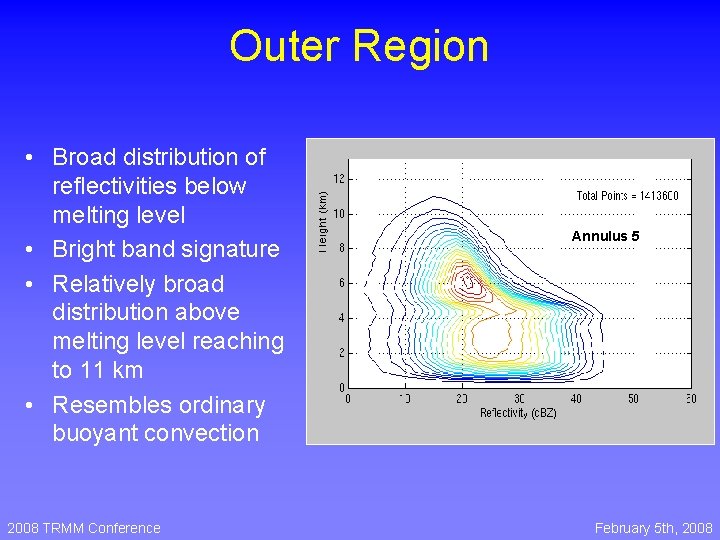
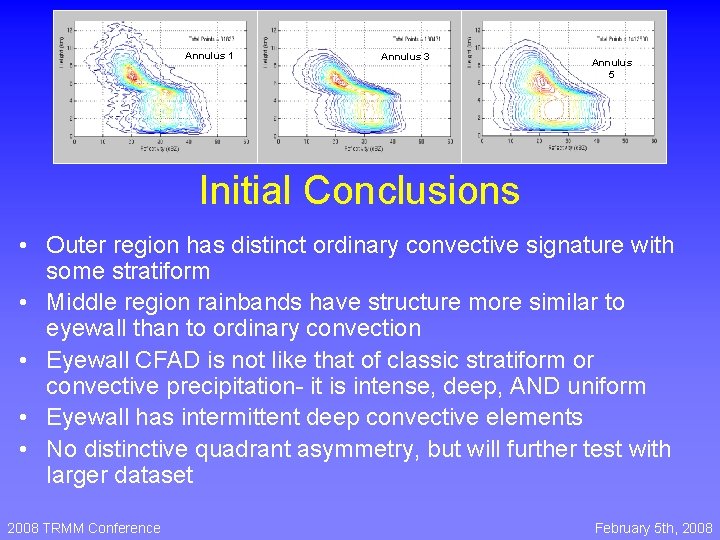
Outer Region • Broad distribution of reflectivities below melting level • Bright band signature • Relatively broad distribution above melting level reaching to 11 km • Resembles ordinary buoyant convection 2008 TRMM Conference Annulus 5 February 5 th, 2008
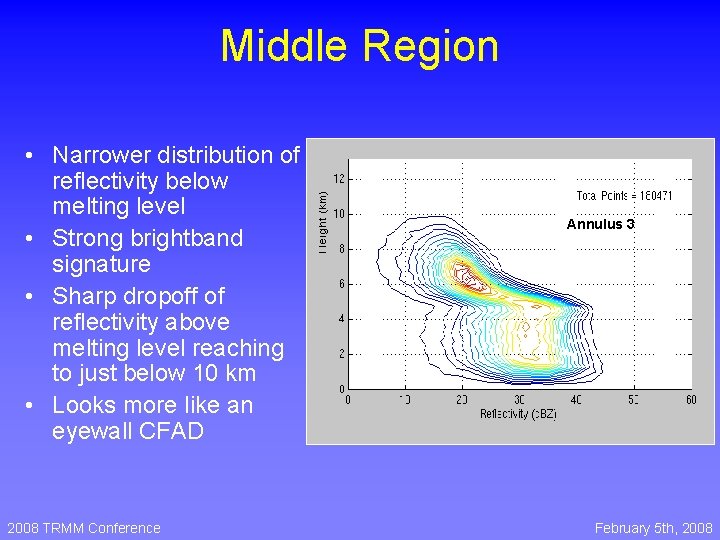
Middle Region • Narrower distribution of reflectivity below melting level • Strong brightband signature • Sharp dropoff of reflectivity above melting level reaching to just below 10 km • Looks more like an eyewall CFAD 2008 TRMM Conference Annulus 3 February 5 th, 2008
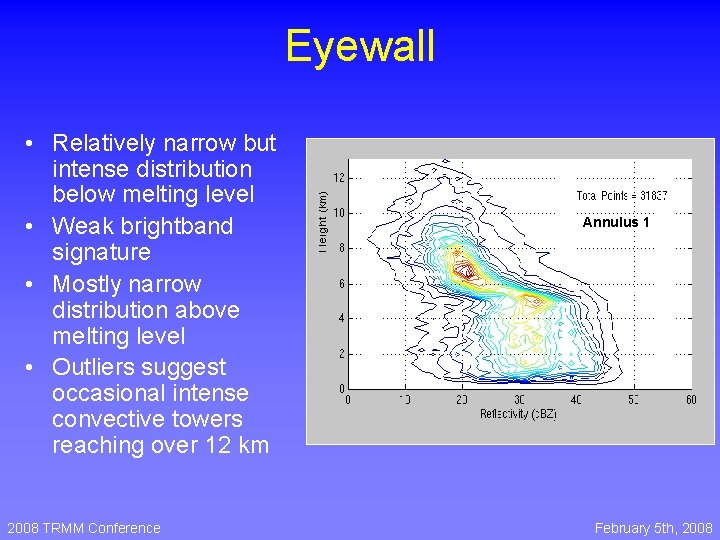
Eyewall • Relatively narrow but intense distribution below melting level • Weak brightband signature • Mostly narrow distribution above melting level • Outliers suggest occasional intense convective towers reaching over 12 km 2008 TRMM Conference Annulus 1 February 5 th, 2008
Annulus 1 Annulus 3 Annulus 5 Initial Conclusions • Outer region has distinct ordinary convective signature with some stratiform • Middle region rainbands have structure more similar to eyewall than to ordinary convection • Eyewall CFAD is not like that of classic stratiform or convective precipitation- it is intense, deep, AND uniform • Eyewall has intermittent deep convective elements • No distinctive quadrant asymmetry, but will further test with larger dataset 2008 TRMM Conference February 5 th, 2008
Further Data • First expansion is into the overpasses of all hurricanes between 1997 -2007 that reach Category 4 and 5 intensity • Overpasses are stratified into when the storm is Cat 1 or 2 and when Cat 3, 4, and 5 • Category 5 overpasses are also looked at separately 2008 TRMM Conference February 5 th, 2008
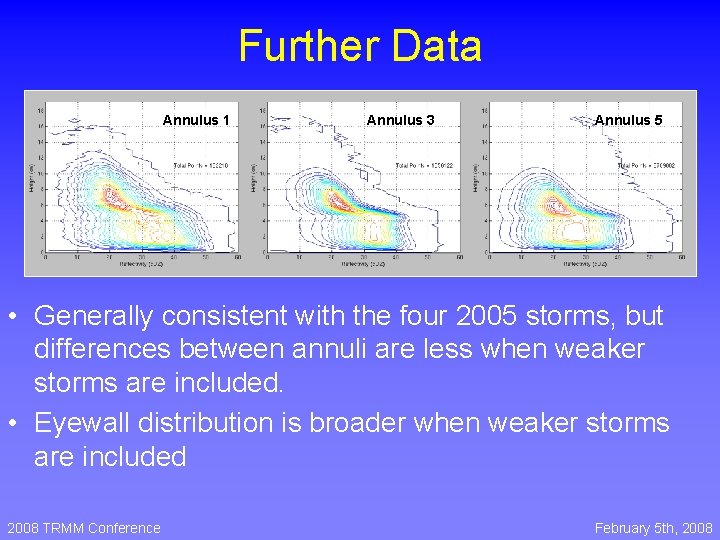
Further Data Annulus 1 Annulus 3 Annulus 5 • Generally consistent with the four 2005 storms, but differences between annuli are less when weaker storms are included. • Eyewall distribution is broader when weaker storms are included 2008 TRMM Conference February 5 th, 2008
Future work • Continue expansion of database to all Atlantic Basin hurricanes, and eventually to all basins • Stratify overpasses based on track speed, wind shear, and other factors known to influence storm structure and intensity • Develop method of quantitatively sorting CFADs 2008 TRMM Conference February 5 th, 2008