
The 28 th International Conference on Distributed Computing

The 28 th International Conference on Distributed Computing Systems Connectivity-Guaranteed and Obstacle-Adaptive Deployment Schemes for MSN Writer : Guang Tan et al. Speaker : Heon-Jong Lee Laboratory of Intelligent Networks
Outline Introduction Preliminaries CPVF(connectivity-preserved virtual force) scheme Floor-based scheme Performance evaluation 2/28 Mobile Sensor Robot
Introduction Self-deployment problem n Given a target sensing field with an arbitrary initial sensor distribution, how to guide sensors to selforganize into a connected network that has the maximum coverage at the cost of the minimum moving distance? Previously proposed methods n n n 3/28 potential field[5], virtual forces[13] Voronoi Diagram(VD)[2, 4] combination[9] Mobile Sensor Robot
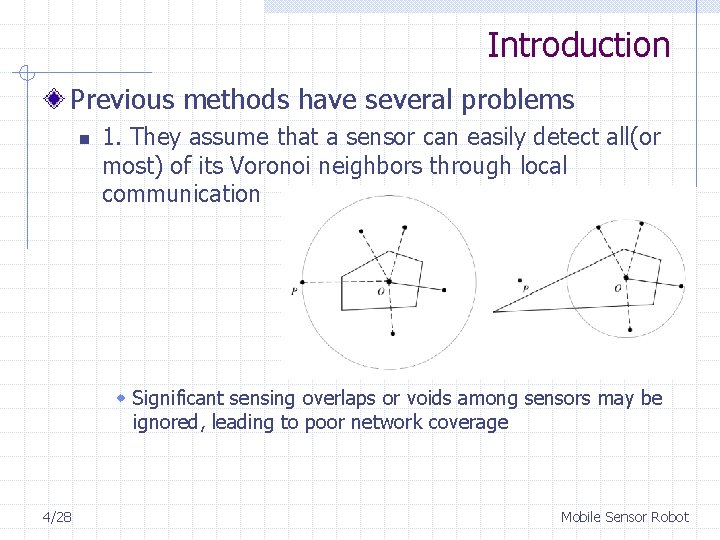
Introduction Previous methods have several problems n 1. They assume that a sensor can easily detect all(or most) of its Voronoi neighbors through local communication w Significant sensing overlaps or voids among sensors may be ignored, leading to poor network coverage 4/28 Mobile Sensor Robot
Introduction n 2. While concentrating on the motion planning of sensors, tend to assume that the network remains connected throughout the process of sensor relocation w It can be guaranteed by a high node density, or a large R c n 3. Sensing field is obstacle-free[8, 12] w However, many real-world environments have buildings, plants, water etc. 5/28 Mobile Sensor Robot
Introduction In this paper aim to achieve three goals: n n n 1. To achieve connectivity for a network with arbitrary initial distribution, communication/sensing range, or node densities 2. To minimize moving distance, which dominates energy consumption in the deployment process 3. To be able to work without any knowledge of the field layout The CPVF scheme and the Floor scheme 6/28 Mobile Sensor Robot
Preliminaries System Assumptions n n n n 7/28 r s, r c sensor’s neighbors : sensors within rc a sensor knows its own position and can determine neighbor’s location by communication a sensor can recognize the boundary of the obstacles within its rs step : a sensor moves in a straight line at a uniform speed for a fixed amount of time(period, T) maximum moving speed is V the filed is on 2 -D coordinate plane a reference point O(base station) is at (0, 0) Mobile Sensor Robot
![Preliminaries Obstacle avoidance algorithm n n 8/28 Using BUG 2[7] Help a sensor move](http://slidetodoc.com/presentation_image_h2/3c10739f08628113cdd6aabfe4587dd7/image-8.jpg "Preliminaries Obstacle avoidance algorithm n n 8/28 Using BUG 2[7] Help a sensor move")
Preliminaries Obstacle avoidance algorithm n n 8/28 Using BUG 2[7] Help a sensor move from a starting point Start to a destination point Target Moves along the straight line (Start, Target)(reference line), until it encounters an obstacle at some hitting point H The sensor follows the boundary using the right-hand rule until it gets back to the reference line Mobile Sensor Robot
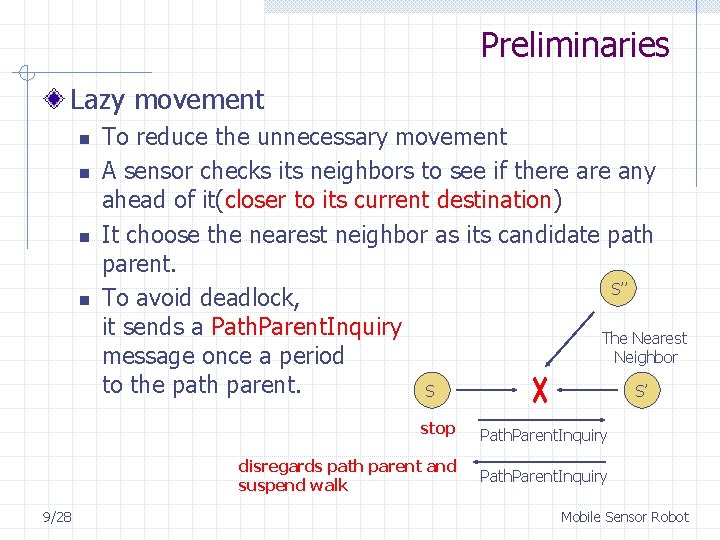
Preliminaries Lazy movement n n 9/28 To reduce the unnecessary movement A sensor checks its neighbors to see if there any ahead of it(closer to its current destination) It choose the nearest neighbor as its candidate path parent. S’’ To avoid deadlock, it sends a Path. Parent. Inquiry The Nearest Neighbor message once a period to the path parent. S S’ stop Path. Parent. Inquiry disregards path parent and suspend walk Path. Parent. Inquiry Mobile Sensor Robot
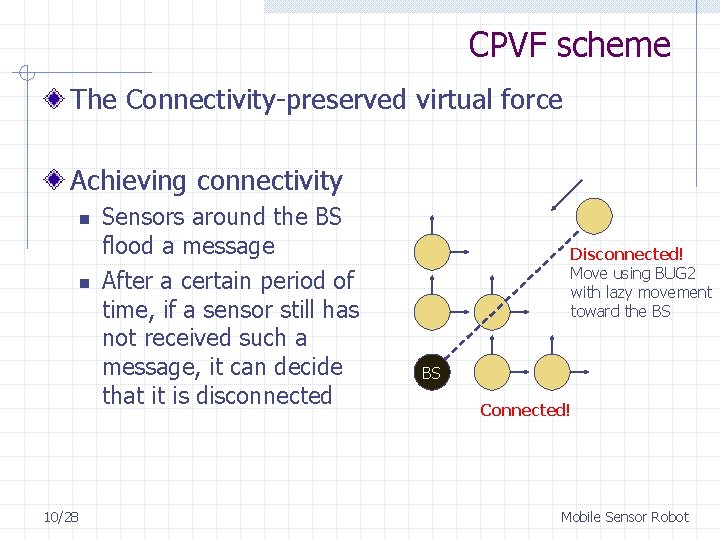
CPVF scheme The Connectivity-preserved virtual force Achieving connectivity n n 10/28 Sensors around the BS flood a message After a certain period of time, if a sensor still has not received such a message, it can decide that it is disconnected Disconnected! Move using BUG 2 with lazy movement toward the BS BS Connected! Mobile Sensor Robot
![CPVF scheme Maximizing sensing coverage using VF n n VF method(like [13]) is used](http://slidetodoc.com/presentation_image_h2/3c10739f08628113cdd6aabfe4587dd7/image-11.jpg "CPVF scheme Maximizing sensing coverage using VF n n VF method(like [13]) is used")
CPVF scheme Maximizing sensing coverage using VF n n VF method(like [13]) is used in our scheme only for determining moving directions Step size needs special care w too long : cause network partition w too short : network have poor coverage 11/28 Mobile Sensor Robot
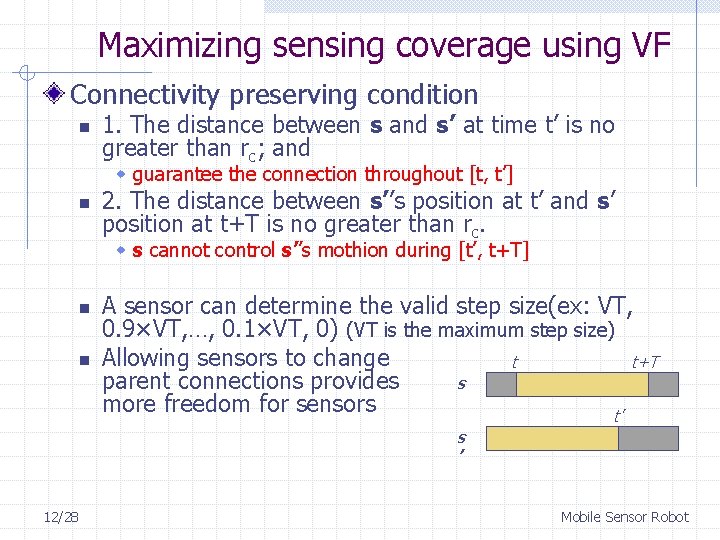
Maximizing sensing coverage using VF Connectivity preserving condition n 1. The distance between s and s’ at time t’ is no greater than rc; and w guarantee the connection throughout [t, t’] n 2. The distance between s’’s position at t’ and s’ position at t+T is no greater than rc. w s cannot control s’’s mothion during [t’, t+T] n n A sensor can determine the valid step size(ex: VT, 0. 9×VT, …, 0. 1×VT, 0) (VT is the maximum step size) Allowing sensors to change t t+T parent connections provides s more freedom for sensors t’ s ’ 12/28 Mobile Sensor Robot
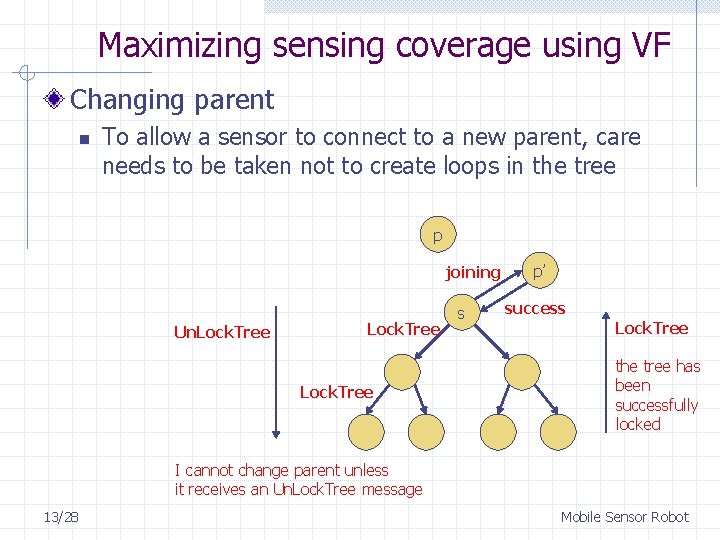
Maximizing sensing coverage using VF Changing parent n To allow a sensor to connect to a new parent, care needs to be taken not to create loops in the tree p joining Un. Lock. Tree s p’ success Lock. Tree the tree has been successfully locked I cannot change parent unless it receives an Un. Lock. Tree message 13/28 Mobile Sensor Robot
Coverage performance of CPVF Simulation n n n 14/28 using C++ 240 sensors are initially randomly distributed in a sub -area {(x, y) : 0 ≤ x ≤ 500 m, 0 ≤ y ≤ 500 m} of a target field {(x, y) : 0 ≤ x ≤ 1000 m, 0 ≤ y ≤ 1000 m} Base station location : (0, 0) rs : 40 m, rc : 40 m, 60 m Maximum moving speed : 2 m/s Period length : 1 sec. Simulation running time : 750 sec. Mobile Sensor Robot
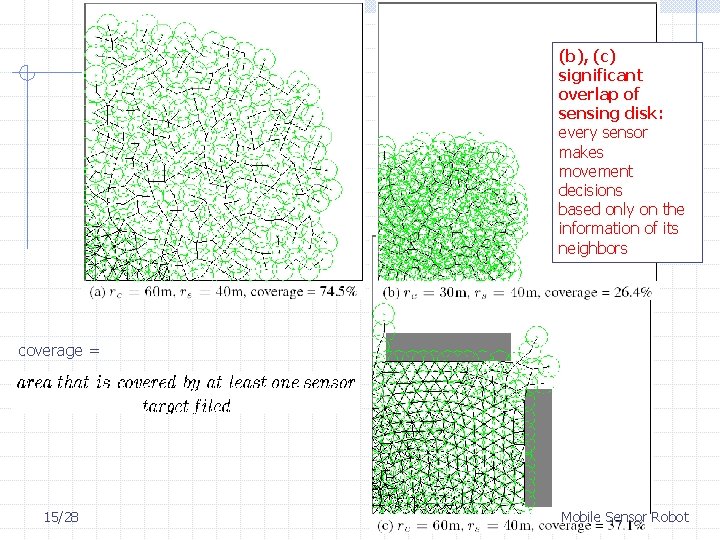
(b), (c) significant overlap of sensing disk: every sensor makes movement decisions based only on the information of its neighbors coverage = 15/28 Mobile Sensor Robot
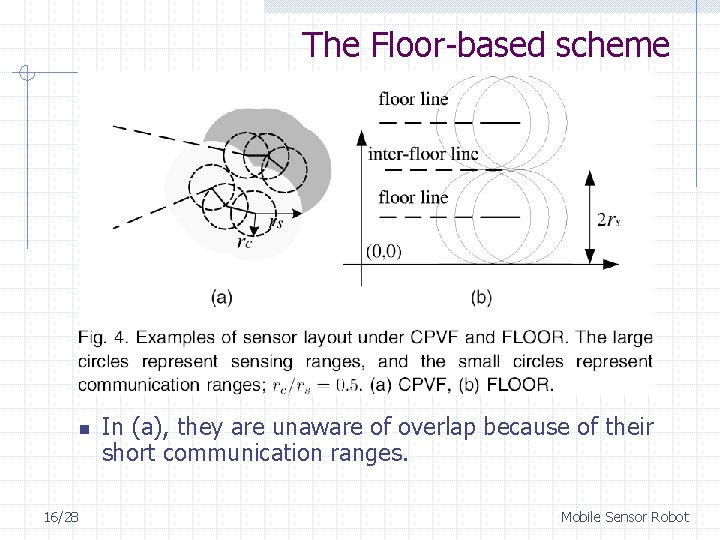
The Floor-based scheme n 16/28 In (a), they are unaware of overlap because of their short communication ranges. Mobile Sensor Robot
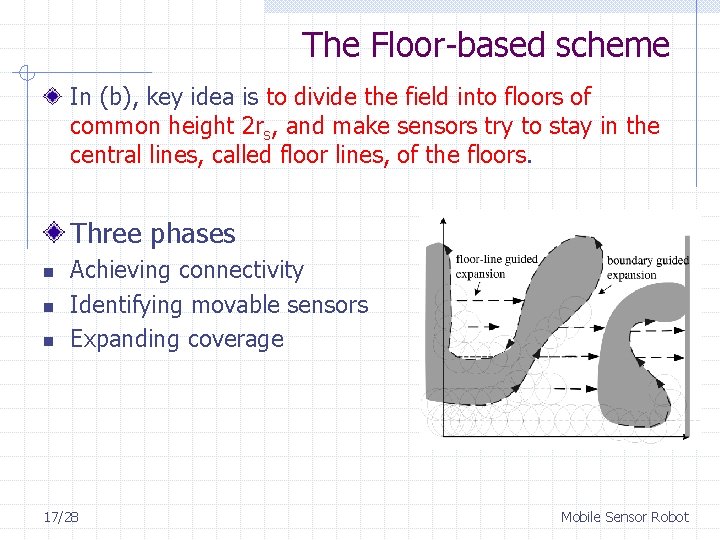
The Floor-based scheme In (b), key idea is to divide the field into floors of common height 2 rs, and make sensors try to stay in the central lines, called floor lines, of the floors. Three phases n n n Achieving connectivity Identifying movable sensors Expanding coverage 17/28 Mobile Sensor Robot
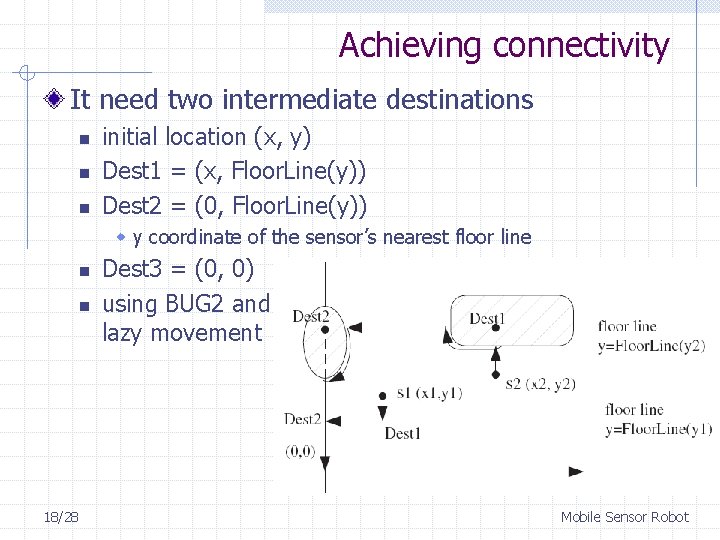
Achieving connectivity It need two intermediate destinations n n n initial location (x, y) Dest 1 = (x, Floor. Line(y)) Dest 2 = (0, Floor. Line(y)) w y coordinate of the sensor’s nearest floor line n n 18/28 Dest 3 = (0, 0) using BUG 2 and lazy movement Mobile Sensor Robot
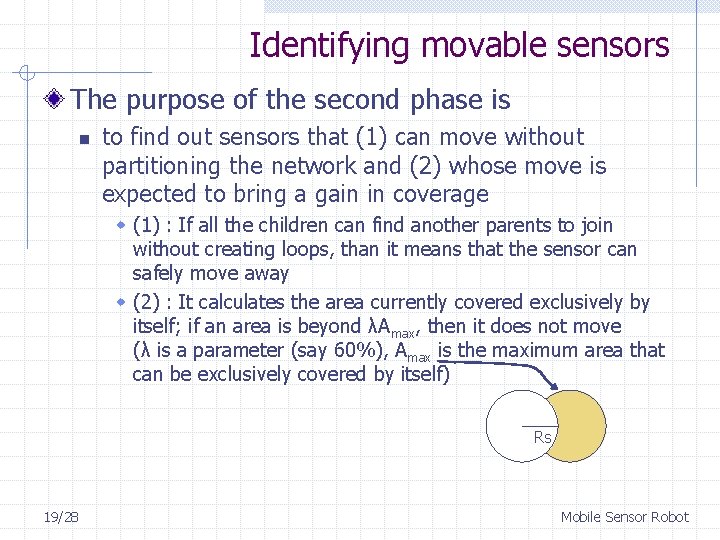
Identifying movable sensors The purpose of the second phase is n to find out sensors that (1) can move without partitioning the network and (2) whose move is expected to bring a gain in coverage w (1) : If all the children can find another parents to join without creating loops, than it means that the sensor can safely move away w (2) : It calculates the area currently covered exclusively by itself; if an area is beyond λAmax, then it does not move (λ is a parameter (say 60%), Amax is the maximum area that can be exclusively covered by itself) Rs 19/28 Mobile Sensor Robot
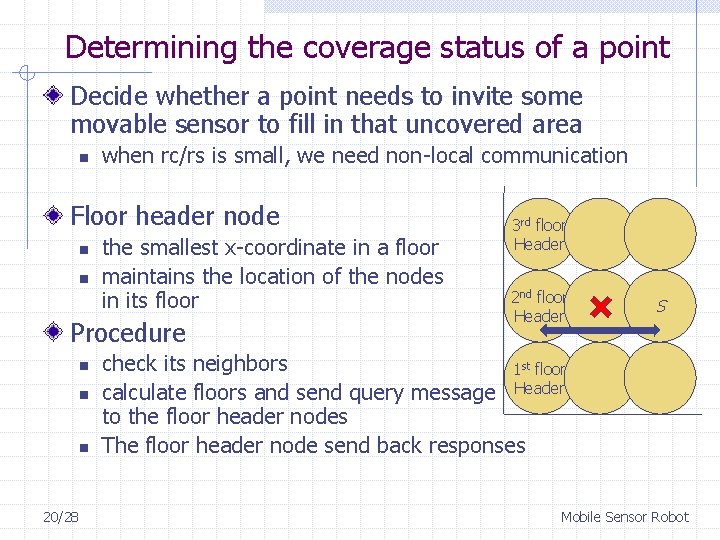
Determining the coverage status of a point Decide whether a point needs to invite some movable sensor to fill in that uncovered area n when rc/rs is small, we need non-local communication Floor header node n n the smallest x-coordinate in a floor maintains the location of the nodes in its floor Procedure n n n 20/28 3 rd floor Header 2 nd floor Header S check its neighbors 1 st floor calculate floors and send query message Header to the floor header nodes The floor header node send back responses Mobile Sensor Robot
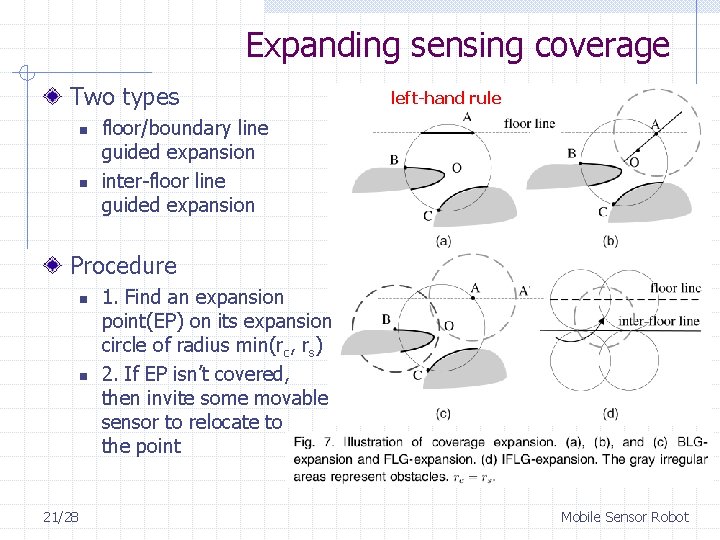
Expanding sensing coverage Two types n n left-hand rule floor/boundary line guided expansion inter-floor line guided expansion Procedure n n 21/28 1. Find an expansion point(EP) on its expansion circle of radius min(rc, rs) 2. If EP isn’t covered, then invite some movable sensor to relocate to the point Mobile Sensor Robot
Inviting movable sensors Procedure n n The sensor which has EP periodically(once a period) sends an Invitation message to the network A movable sensor picks the message according to the priority order: w Floor-line > Boundary-line > Inter-floor-line w Nearest source(with Euclidean distance) n n 22/28 The movable sensor sends an Accept. Invitation message to that inviter and move The inviting sensor send the location information to the root on behalf of the invited sensor Mobile Sensor Robot
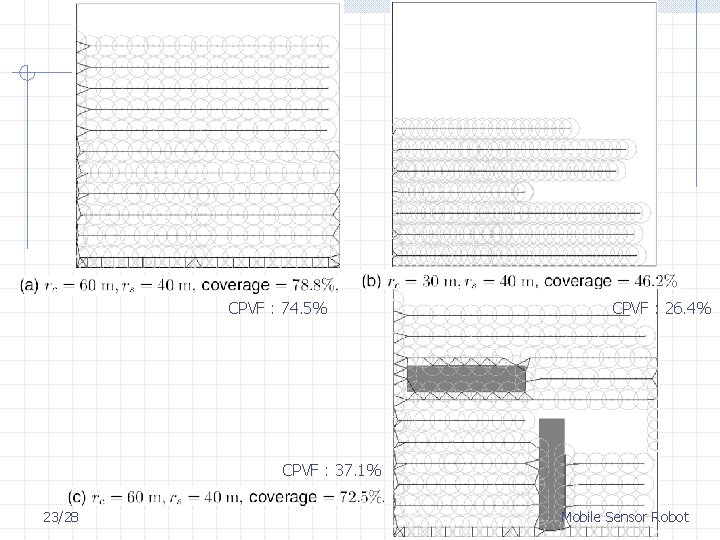
CPVF : 74. 5% CPVF : 26. 4% CPVF : 37. 1% 23/28 Mobile Sensor Robot
![Performance Evaluation Coverage(Obstacle-free) Optimal is a centralized scheme [1] (only suitable for a non-obstacle](http://slidetodoc.com/presentation_image_h2/3c10739f08628113cdd6aabfe4587dd7/image-24.jpg "Performance Evaluation Coverage(Obstacle-free) Optimal is a centralized scheme [1] (only suitable for a non-obstacle")
Performance Evaluation Coverage(Obstacle-free) Optimal is a centralized scheme [1] (only suitable for a non-obstacle environment) 110% higher 24/28 Mobile Sensor Robot
![Performance Evaluation Moving distance(Obstacle-free) Oscillation happens very often Optimal is a centralized scheme [1]](http://slidetodoc.com/presentation_image_h2/3c10739f08628113cdd6aabfe4587dd7/image-25.jpg "Performance Evaluation Moving distance(Obstacle-free) Oscillation happens very often Optimal is a centralized scheme [1]")
Performance Evaluation Moving distance(Obstacle-free) Oscillation happens very often Optimal is a centralized scheme [1] they know the destination already 25/28 Mobile Sensor Robot
Performance Evaluation Oscillation avoidance techniques in CPVF n 1. one-step oscillation avoidance w If the next step size is smaller then VT/δ, than a sensor cancels its movement for the next step (VT is the maximum step size) w A similar strategy has been used [5] n 2. two-step oscillation avoidance w Calculate its future location at the end of next step with its past location at the end of last step w If the distance between them is smaller than VT/δ, than a sensor cancels its movement for the next step w A similar strategy has been used [9] 26/28 Mobile Sensor Robot
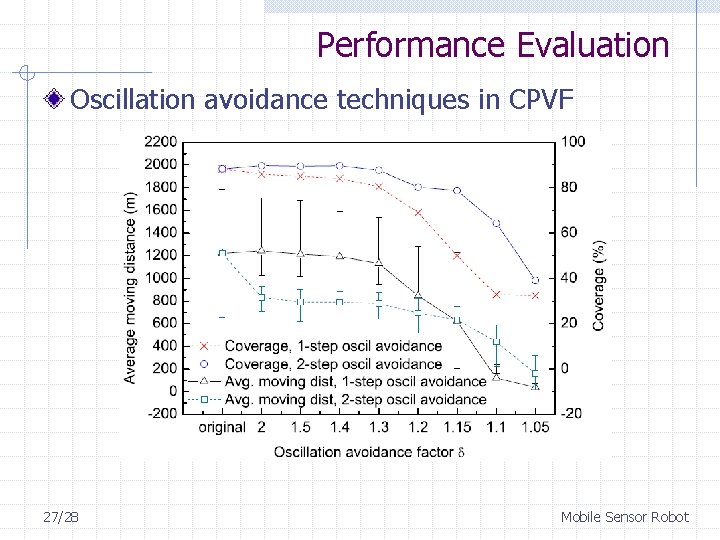
Performance Evaluation Oscillation avoidance techniques in CPVF 27/28 Mobile Sensor Robot
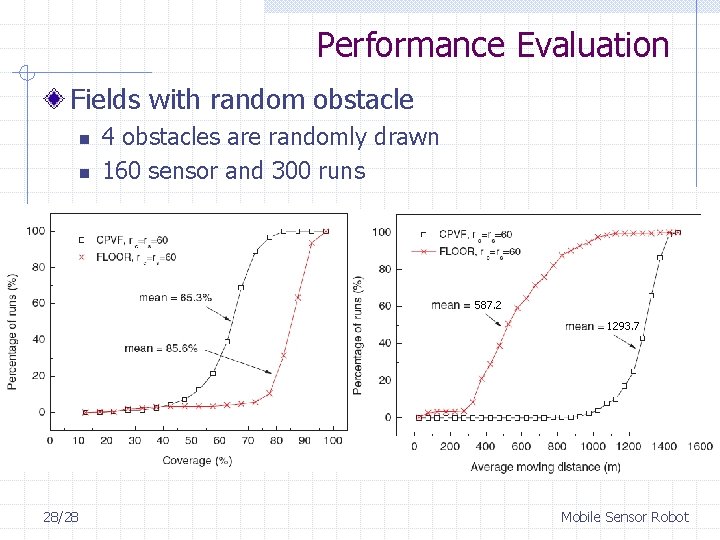
Performance Evaluation Fields with random obstacle n n 4 obstacles are randomly drawn 160 sensor and 300 runs 587. 2 1293. 7 28/28 Mobile Sensor Robot
- Slides: 28