
The 2019 Current Population Survey New Questions Improved
- Slides: 3
The 2019 Current Population Survey: New Questions, Improved Results? This report is copyrighted by the Employee Benefit Research Institute (EBRI). You may copy or print this report solely for personal and noncommercial use, provided that all hard copies retain any and all copyright and other applicable notices contained therein, and you may cite or quote small portions of the report provided that you do so verbatim and with proper citation. Any use beyond the scope of the foregoing requires EBRI’s prior express permission. For permissions, please contact EBRI at permissions@ebri. org. © Employee Benefit Research Institute 2020
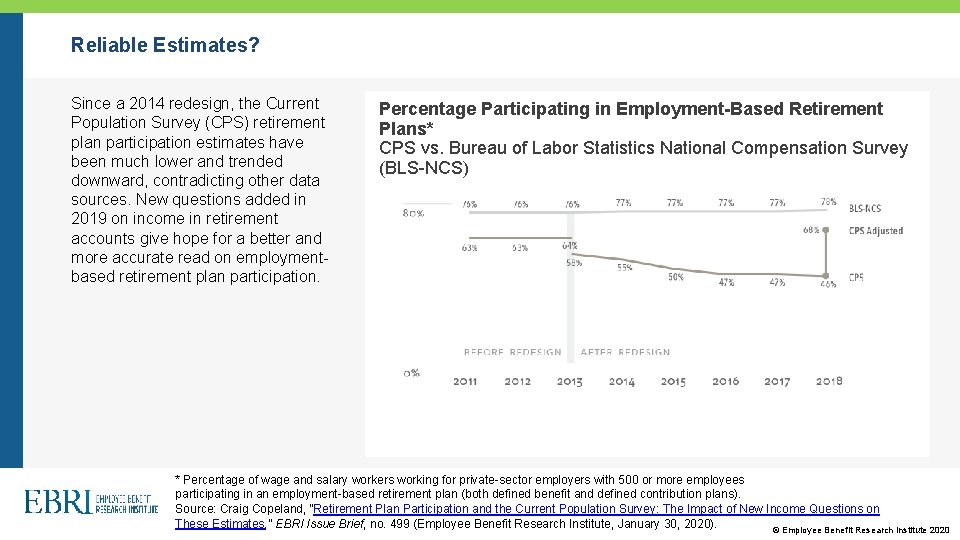
Reliable Estimates? Since a 2014 redesign, the Current Population Survey (CPS) retirement plan participation estimates have been much lower and trended downward, contradicting other data sources. New questions added in 2019 on income in retirement accounts give hope for a better and more accurate read on employmentbased retirement plan participation. Percentage Participating in Employment-Based Retirement Plans* CPS vs. Bureau of Labor Statistics National Compensation Survey (BLS-NCS) * Percentage of wage and salary workers working for private-sector employers with 500 or more employees participating in an employment-based retirement plan (both defined benefit and defined contribution plans). Source: Craig Copeland, “Retirement Plan Participation and the Current Population Survey: The Impact of New Income Questions on These Estimates, ” EBRI Issue Brief, no. 499 (Employee Benefit Research Institute, January 30, 2020). © Employee Benefit Research Institute 2020
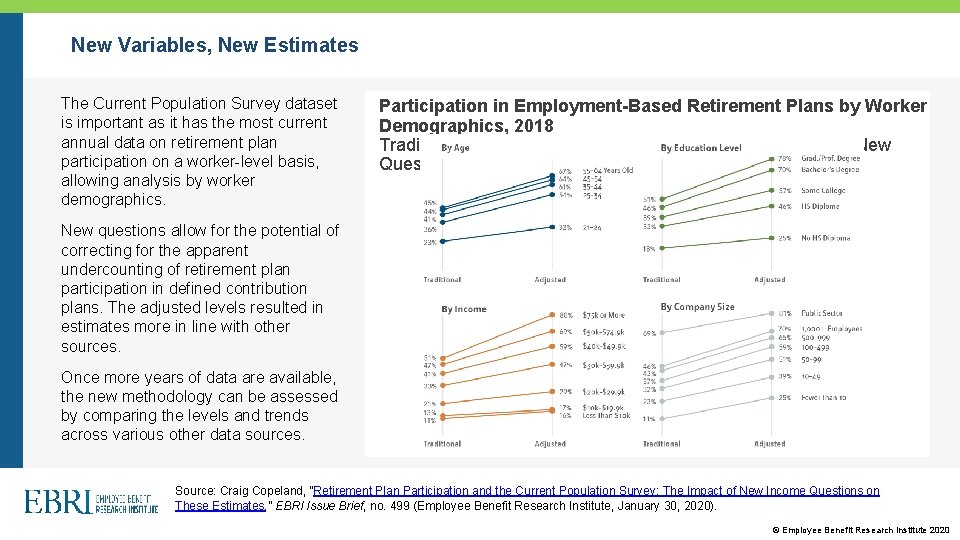
New Variables, New Estimates The Current Population Survey dataset is important as it has the most current annual data on retirement plan participation on a worker-level basis, allowing analysis by worker demographics. Participation in Employment-Based Retirement Plans by Worker Demographics, 2018 Traditional Estimates vs. Adjusted Estimates (Incorporating New Questions) New questions allow for the potential of correcting for the apparent undercounting of retirement plan participation in defined contribution plans. The adjusted levels resulted in estimates more in line with other sources. Once more years of data are available, the new methodology can be assessed by comparing the levels and trends across various other data sources. Source: Craig Copeland, “Retirement Plan Participation and the Current Population Survey: The Impact of New Income Questions on These Estimates, ” EBRI Issue Brief, no. 499 (Employee Benefit Research Institute, January 30, 2020). © Employee Benefit Research Institute 2020