
THE 2016 POBAL HP DEPRIVATION INDEX FOR SMALL
THE 2016 POBAL HP DEPRIVATION INDEX FOR SMALL AREAS (SA) INTRODUCTION AND KEY FINDINGS Trutz Haase & Jonathan Pratschke Dublin, 9 th November, 2017
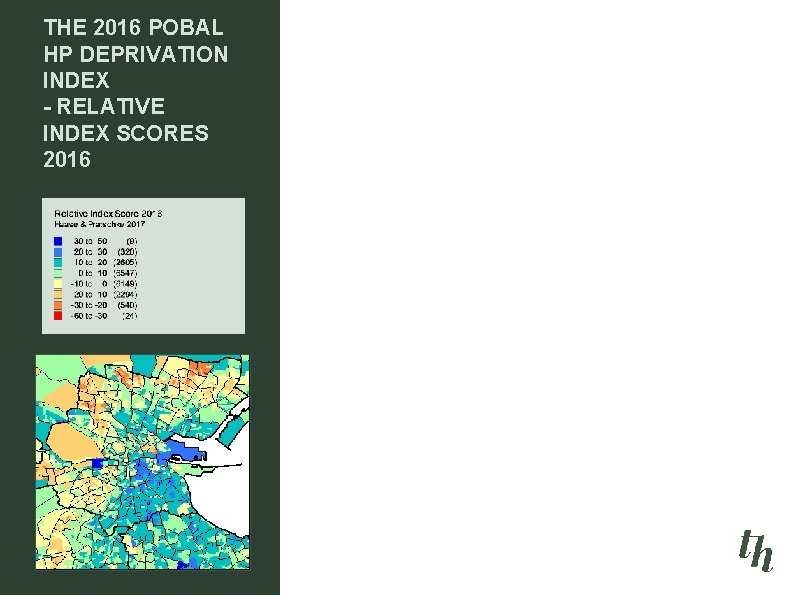
THE 2016 POBAL HP DEPRIVATION INDEX - RELATIVE INDEX SCORES 2016
MAJOR APPLICATIONS OF THE RELATIVE POBAL HP DEPRIVATION INDEX q q Local Development: § Used by Pobal in the Resource Allocation Model for Local Development Companies under successive Local Development Programmes. § Used by Pobal in the roll-out of early-years education initiatives as part of the free Pre-school year. § Used by DECLG in the Resource Allocation Model for Local Development Companies funded under LEADER. § Used by BIM in the Resource Allocation Model for Fisheries Local Action Groups supported through the European Fisheries Support Fund. Education: § Used by the DES for the designation and funding of schools under the disadvantaged schools scheme (DEIS). § Will be used by the HEA to monitor the affect of social class on access to and progression in third-level education.
MAJOR APPLICATIONS OF THE POBAL HP DEPRIVATION INDEX q Health: § Used to support research into the predictors of population health (Irish Health Survey, Healthy Ireland, GUI, TILDA, National Drug Treatment Reporting System (NDTRS), National Cancer Registry Ireland, etc. ). § Central to the Resource Profiler currently being developed by the HSE Health Intelligence Unit and Health Atlas. § The Resource Profiler is currently being used to analyse existing resource distributions across the HSE and will increasingly be used in the future to facilitate evidence-based resource allocations across the entire health system. § Will be used in the Resource Allocation Model and Performance Measurement Framework for Local and Regional Drug Task Forces (DATF). § Used to support strategic management and resource allocations within TUSLA.
MAJOR APPLICATIONS OF THE POBAL HP DEPRIVATION INDEX q Other important uses: § Used by An Garda Síochána in the profiling of local areas to support community -based policing. § Used by the National Transport Authority to optimise the social benefits of alternative route and services design. § Used by the Central Statistics Office in the survey design of all of its household surveys (QNHS EU-SILC, etc. ). § Used by the Central Statistics Office as a predictor for the Residential Property Price Index (RPPI). § Used by the Revenue Commissioners to independently assess Local Property Tax. § Used by a myriad of research applications in the universities and research centres, as well as private-sector spatial data applications (e. g. used by several health and other insurance companies for their risk asessment models.
STARTING POINT FOR THE POBAL HP DEPRIVATION INDEX: A COMPREHENSIVE DEFINITION OF POVERTY “The fundamental implication of the term deprivation is of an absence – of essential or desirable attributes, possessions and opportunities which are considered no more than the minimum by that society. ” (Coombes et al. , Do. E – UK, 1995)
THE UNDERLYING DIMENSIONS OF THE POBAL HP DEPRIVATION INDEX q Demographic Decline (predominantly rural) § population loss and the social and demographic effects of emigration (age dependency, low education of adult population) q Social Class Deprivation (equally applying in rural and urban and rural areas) § social class composition, education, housing quality q Labour Market Deprivation (predominantly urban) § unemployment, lone parents, low skills base
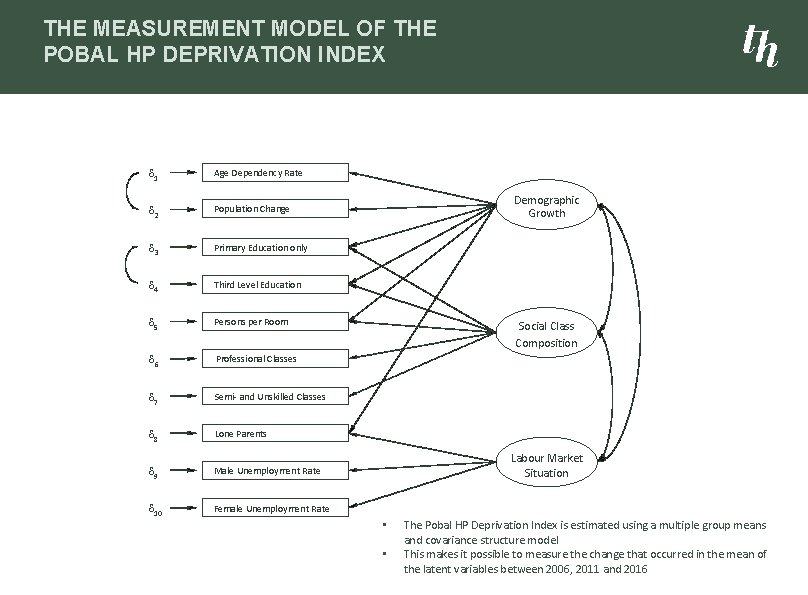
THE MEASUREMENT MODEL OF THE POBAL HP DEPRIVATION INDEX d 1 Age Dependency Rate d 2 Population Change d 3 Primary Education only d 4 Third Level Education d 5 Persons per Room d 6 Professional Classes d 7 Semi- and Unskilled Classes d 8 Lone Parents d 9 Male Unemployment Rate d 10 Female Unemployment Rate Demographic Growth Social Class Composition Labour Market Situation • • The Pobal HP Deprivation Index is estimated using a multiple group means and covariance structure model This makes it possible to measure the change that occurred in the mean of the latent variables between 2006, 2011 and 2016
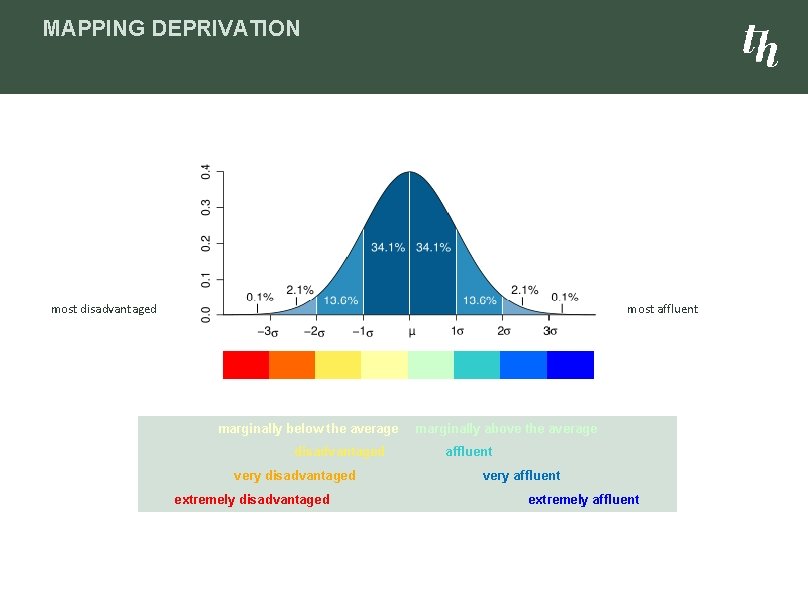
MAPPING DEPRIVATION most disadvantaged most affluent marginally below the average disadvantaged very disadvantaged extremely disadvantaged marginally above the average affluent very affluent extremely affluent
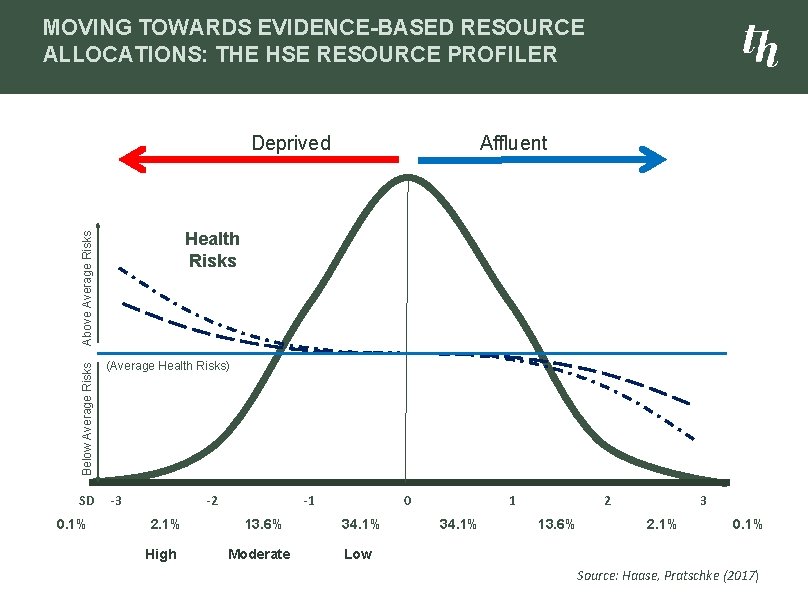
MOVING TOWARDS EVIDENCE-BASED RESOURCE ALLOCATIONS: THE HSE RESOURCE PROFILER Deprived Health Risks Above Average Risks Below Average Risks SD 0. 1% Affluent (Average Health Risks) -3 -2 2. 1% High -1 13. 6% Moderate 0 34. 1% 1 34. 1% 2 13. 6% 3 2. 1% 0. 1% Low Source: Haase, Pratschke (2017)
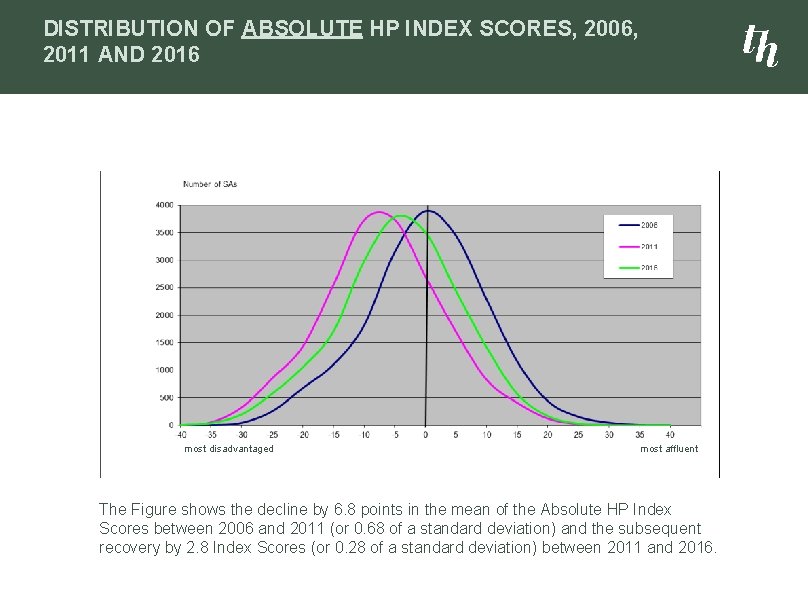
DISTRIBUTION OF ABSOLUTE HP INDEX SCORES, 2006, 2011 AND 2016 most disadvantaged most affluent The Figure shows the decline by 6. 8 points in the mean of the Absolute HP Index Scores between 2006 and 2011 (or 0. 68 of a standard deviation) and the subsequent recovery by 2. 8 Index Scores (or 0. 28 of a standard deviation) between 2011 and 2016.
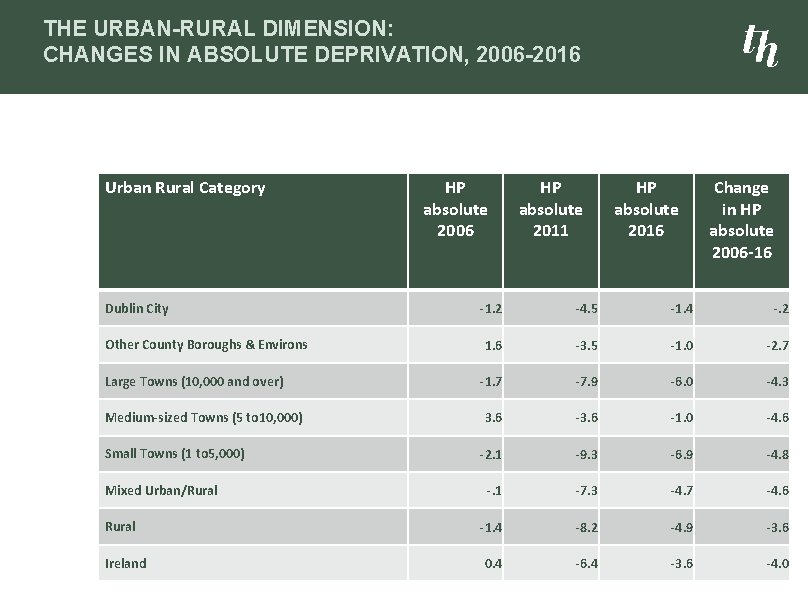
THE URBAN-RURAL DIMENSION: CHANGES IN ABSOLUTE DEPRIVATION, 2006 -2016 Urban Rural Category Dublin City Other County Boroughs & Environs Large Towns (10, 000 and over) Medium-sized Towns (5 to 10, 000) Small Towns (1 to 5, 000) Mixed Urban/Rural Ireland HP absolute 2006 HP absolute 2011 HP absolute 2016 Change in HP absolute 2006 -16 -1. 2 -4. 5 -1. 4 -. 2 1. 6 -3. 5 -1. 0 -2. 7 -1. 7 -7. 9 -6. 0 -4. 3 3. 6 -1. 0 -4. 6 -2. 1 -9. 3 -6. 9 -4. 8 -. 1 -7. 3 -4. 7 -4. 6 -1. 4 -8. 2 -4. 9 -3. 6 0. 4 -6. 4 -3. 6 -4. 0
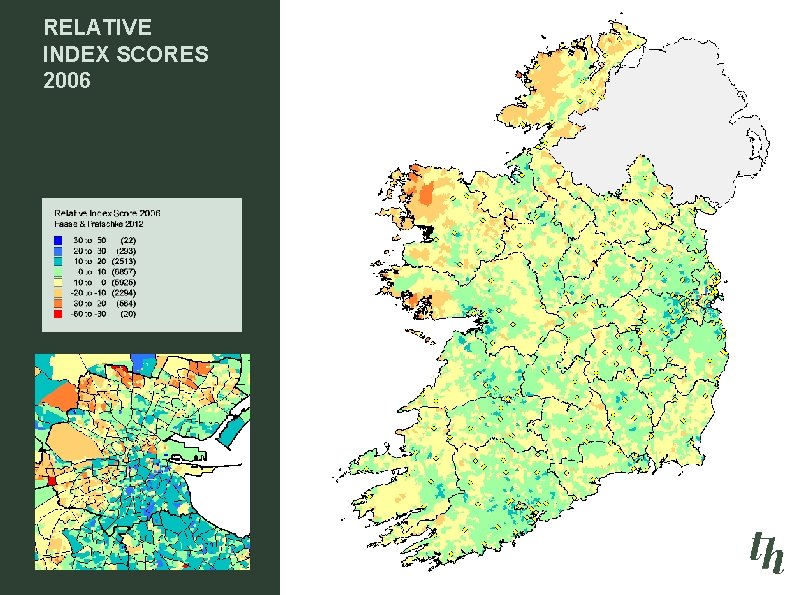
RELATIVE INDEX SCORES 2006
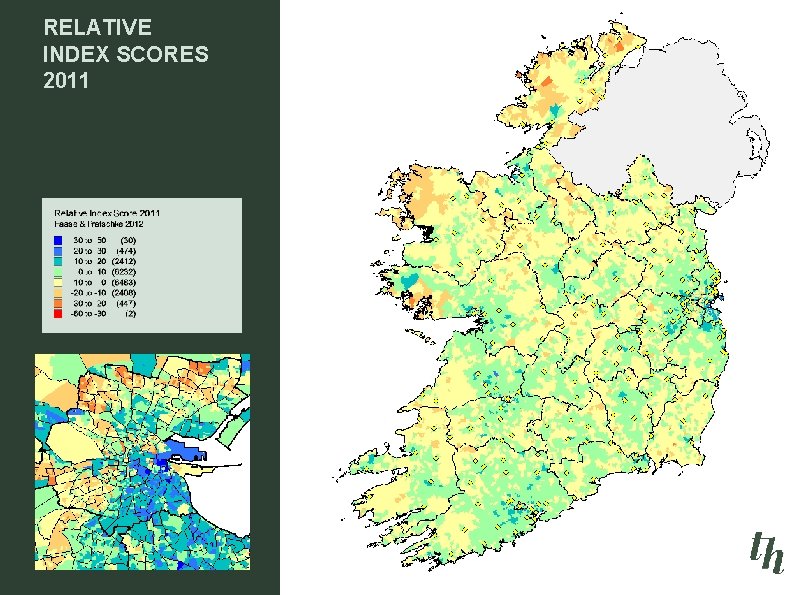
RELATIVE INDEX SCORES 2011
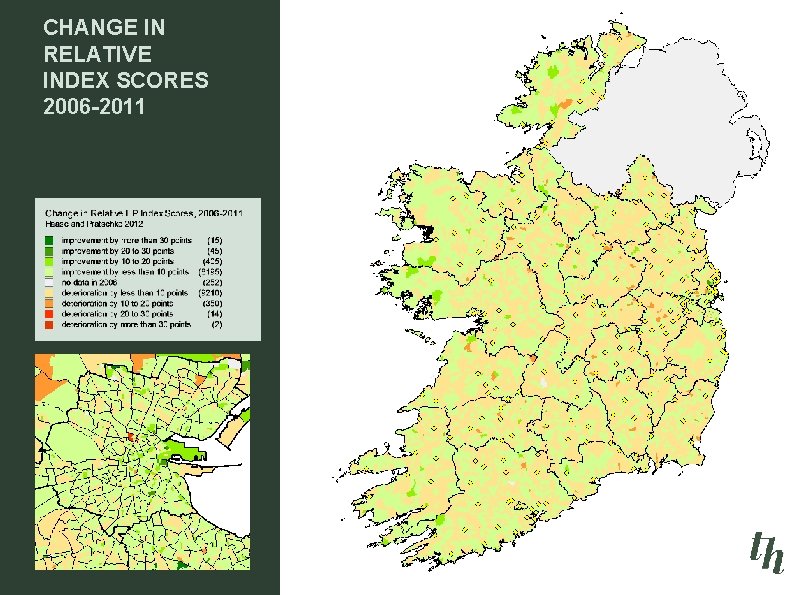
CHANGE IN RELATIVE INDEX SCORES 2006 -2011
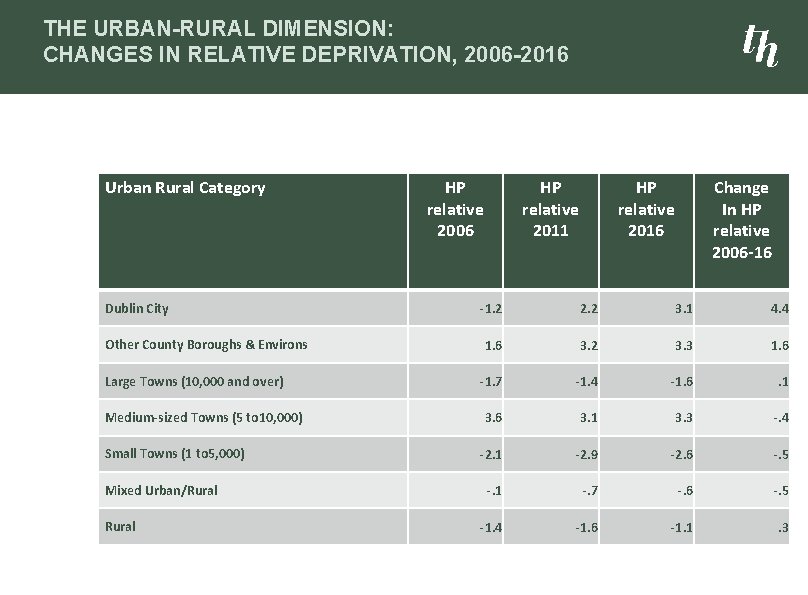
THE URBAN-RURAL DIMENSION: CHANGES IN RELATIVE DEPRIVATION, 2006 -2016 Urban Rural Category Dublin City Other County Boroughs & Environs Large Towns (10, 000 and over) Medium-sized Towns (5 to 10, 000) Small Towns (1 to 5, 000) Mixed Urban/Rural HP relative 2006 HP relative 2011 HP relative 2016 Change In HP relative 2006 -16 -1. 2 2. 2 3. 1 4. 4 1. 6 3. 2 3. 3 1. 6 -1. 7 -1. 4 -1. 6 . 1 3. 6 3. 1 3. 3 -. 4 -2. 1 -2. 9 -2. 6 -. 5 -. 1 -. 7 -. 6 -. 5 -1. 4 -1. 6 -1. 1 . 3
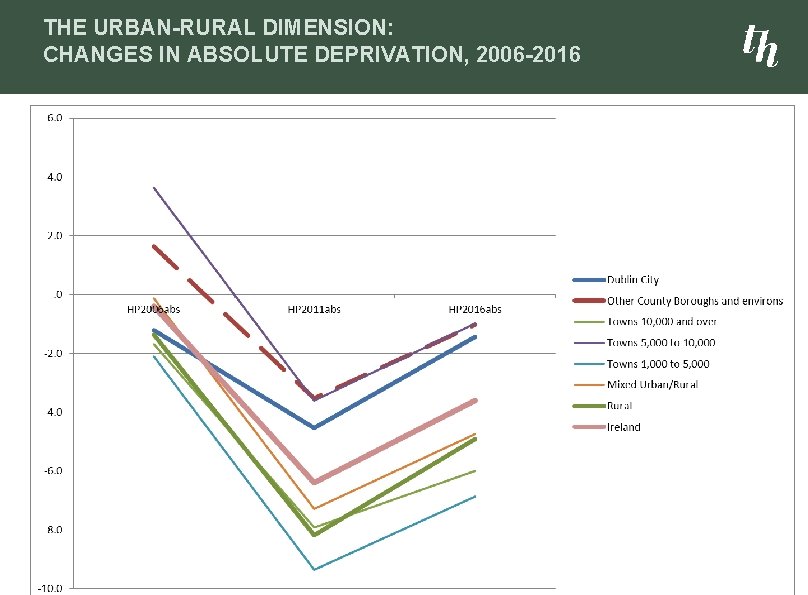
THE URBAN-RURAL DIMENSION: CHANGES IN ABSOLUTE DEPRIVATION, 2006 -2016
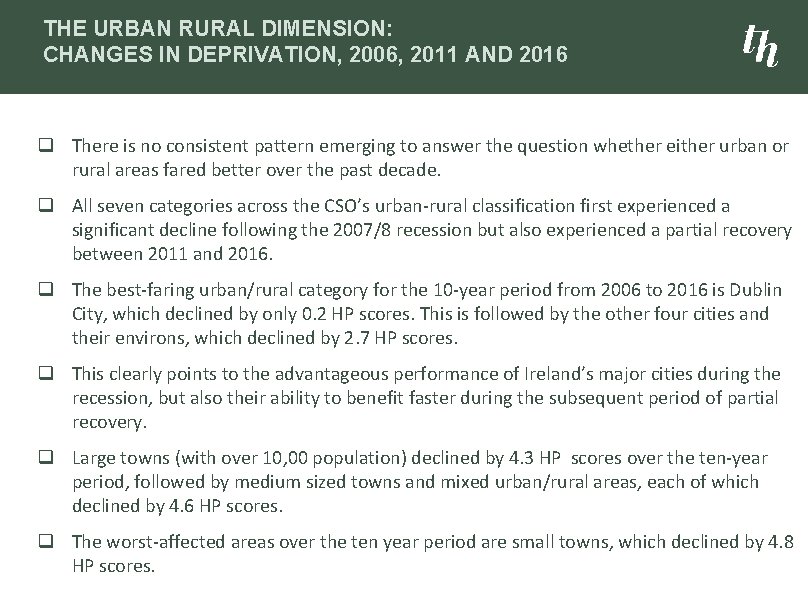
THE URBAN RURAL DIMENSION: CHANGES IN DEPRIVATION, 2006, 2011 AND 2016 q There is no consistent pattern emerging to answer the question whether either urban or rural areas fared better over the past decade. q All seven categories across the CSO’s urban-rural classification first experienced a significant decline following the 2007/8 recession but also experienced a partial recovery between 2011 and 2016. q The best-faring urban/rural category for the 10 -year period from 2006 to 2016 is Dublin City, which declined by only 0. 2 HP scores. This is followed by the other four cities and their environs, which declined by 2. 7 HP scores. q This clearly points to the advantageous performance of Ireland’s major cities during the recession, but also their ability to benefit faster during the subsequent period of partial recovery. q Large towns (with over 10, 00 population) declined by 4. 3 HP scores over the ten-year period, followed by medium sized towns and mixed urban/rural areas, each of which declined by 4. 6 HP scores. q The worst-affected areas over the ten year period are small towns, which declined by 4. 8 HP scores.
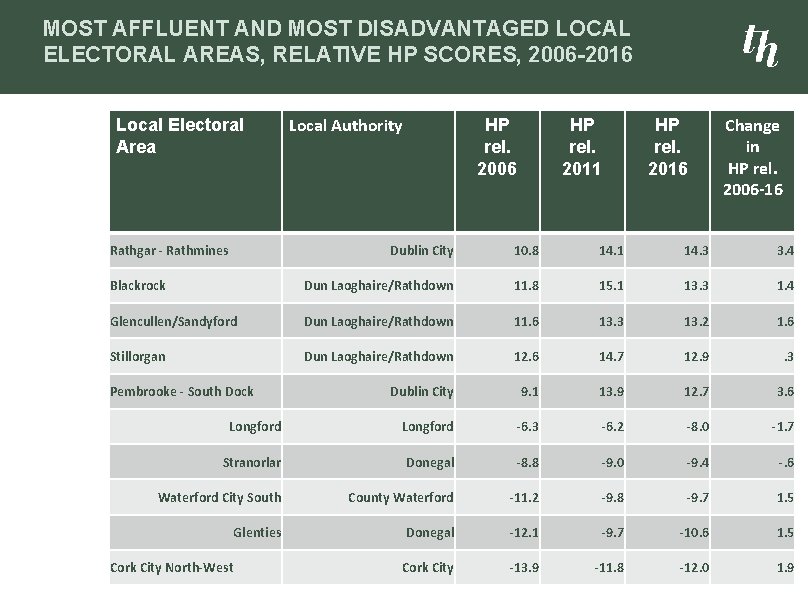
MOST AFFLUENT AND MOST DISADVANTAGED LOCAL ELECTORAL AREAS, RELATIVE HP SCORES, 2006 -2016 Local Electoral Area Local Authority HP rel. 2006 HP rel. 2011 HP rel. 2016 Change in HP rel. 2006 -16 Dublin City 10. 8 14. 1 14. 3 3. 4 Blackrock Dun Laoghaire/Rathdown 11. 8 15. 1 13. 3 1. 4 Glencullen/Sandyford Dun Laoghaire/Rathdown 11. 6 13. 3 13. 2 1. 6 Stillorgan Dun Laoghaire/Rathdown 12. 6 14. 7 12. 9 . 3 Dublin City 9. 1 13. 9 12. 7 3. 6 Longford -6. 3 -6. 2 -8. 0 -1. 7 Stranorlar Donegal -8. 8 -9. 0 -9. 4 -. 6 Waterford City South County Waterford -11. 2 -9. 8 -9. 7 1. 5 Glenties Donegal -12. 1 -9. 7 -10. 6 1. 5 Cork City -13. 9 -11. 8 -12. 0 1. 9 Rathgar - Rathmines Pembrooke - South Dock Cork City North-West
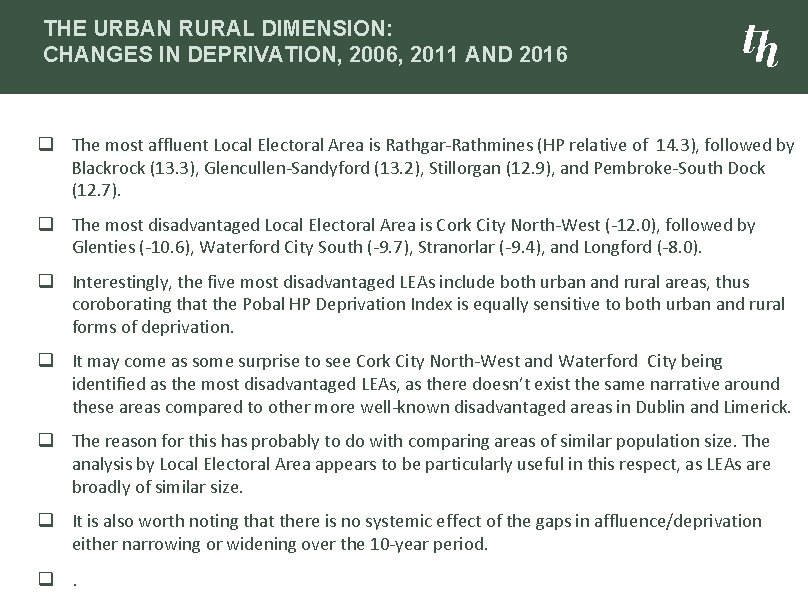
THE URBAN RURAL DIMENSION: CHANGES IN DEPRIVATION, 2006, 2011 AND 2016 q The most affluent Local Electoral Area is Rathgar-Rathmines (HP relative of 14. 3), followed by Blackrock (13. 3), Glencullen-Sandyford (13. 2), Stillorgan (12. 9), and Pembroke-South Dock (12. 7). q The most disadvantaged Local Electoral Area is Cork City North-West (-12. 0), followed by Glenties (-10. 6), Waterford City South (-9. 7), Stranorlar (-9. 4), and Longford (-8. 0). q Interestingly, the five most disadvantaged LEAs include both urban and rural areas, thus coroborating that the Pobal HP Deprivation Index is equally sensitive to both urban and rural forms of deprivation. q It may come as some surprise to see Cork City North-West and Waterford City being identified as the most disadvantaged LEAs, as there doesn’t exist the same narrative around these areas compared to other more well-known disadvantaged areas in Dublin and Limerick. q The reason for this has probably to do with comparing areas of similar population size. The analysis by Local Electoral Area appears to be particularly useful in this respect, as LEAs are broadly of similar size. q It is also worth noting that there is no systemic effect of the gaps in affluence/deprivation either narrowing or widening over the 10 -year period. q.
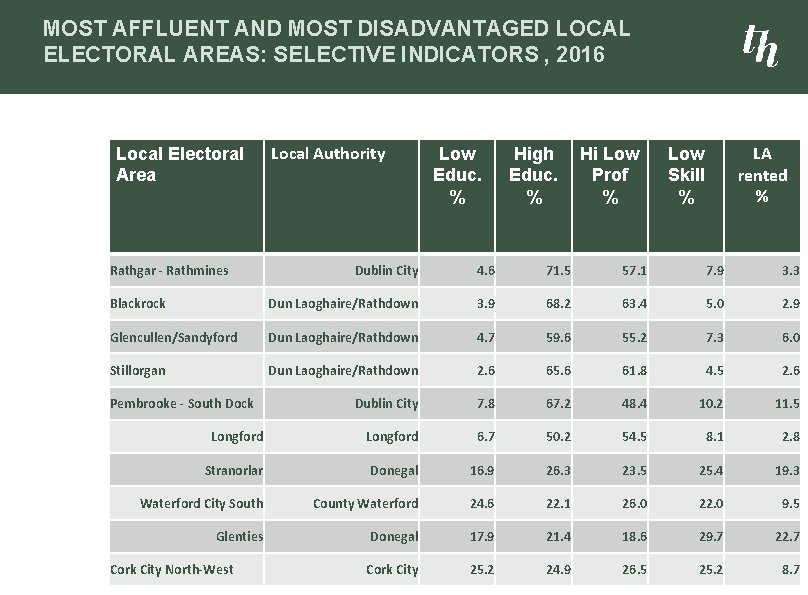
MOST AFFLUENT AND MOST DISADVANTAGED LOCAL ELECTORAL AREAS: SELECTIVE INDICATORS , 2016 Local Electoral Area Local Authority Low Educ. % High Educ. % Hi Low Prof % LA rented % Low Skill % Dublin City 4. 6 71. 5 57. 1 7. 9 3. 3 Blackrock Dun Laoghaire/Rathdown 3. 9 68. 2 63. 4 5. 0 2. 9 Glencullen/Sandyford Dun Laoghaire/Rathdown 4. 7 59. 6 55. 2 7. 3 6. 0 Stillorgan Dun Laoghaire/Rathdown 2. 6 65. 6 61. 8 4. 5 2. 6 Dublin City 7. 8 67. 2 48. 4 10. 2 11. 5 Longford 6. 7 50. 2 54. 5 8. 1 2. 8 Stranorlar Donegal 16. 9 26. 3 23. 5 25. 4 19. 3 Waterford City South County Waterford 24. 6 22. 1 26. 0 22. 0 9. 5 Glenties Donegal 17. 9 21. 4 18. 6 29. 7 22. 7 Cork City 25. 2 24. 9 26. 5 25. 2 8. 7 Rathgar - Rathmines Pembrooke - South Dock Cork City North-West
- Slides: 22