
The 2016 Annual Business Survey A Sample Optimisation
The 2016 Annual Business Survey: A Sample Optimisation Megan Pope and Jonathan Digby-North Survey Methodology, Office for National Statistics
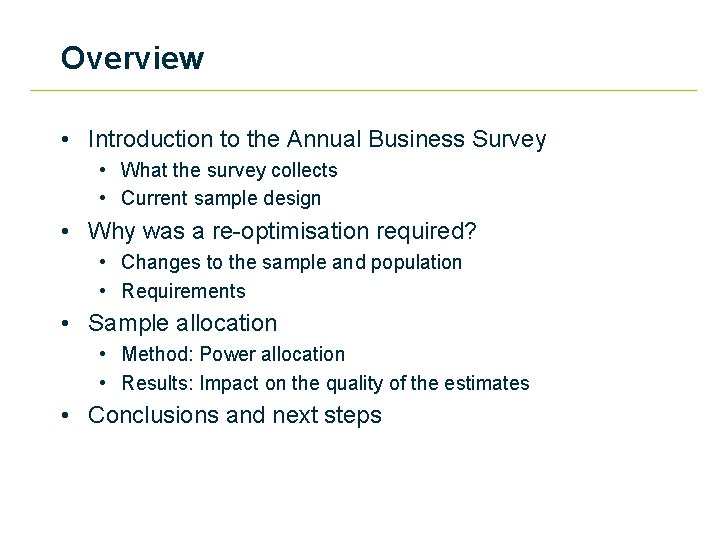
Overview • Introduction to the Annual Business Survey • What the survey collects • Current sample design • Why was a re-optimisation required? • Changes to the sample and population • Requirements • Sample allocation • Method: Power allocation • Results: Impact on the quality of the estimates • Conclusions and next steps
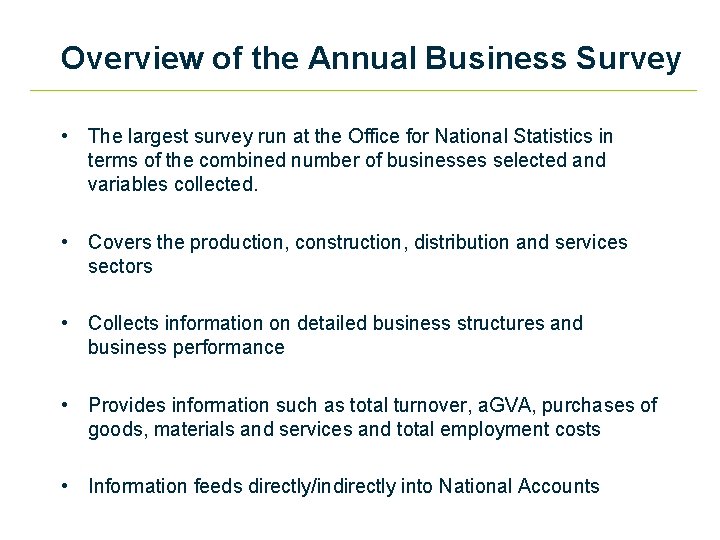
Overview of the Annual Business Survey • The largest survey run at the Office for National Statistics in terms of the combined number of businesses selected and variables collected. • Covers the production, construction, distribution and services sectors • Collects information on detailed business structures and business performance • Provides information such as total turnover, a. GVA, purchases of goods, materials and services and total employment costs • Information feeds directly/indirectly into National Accounts
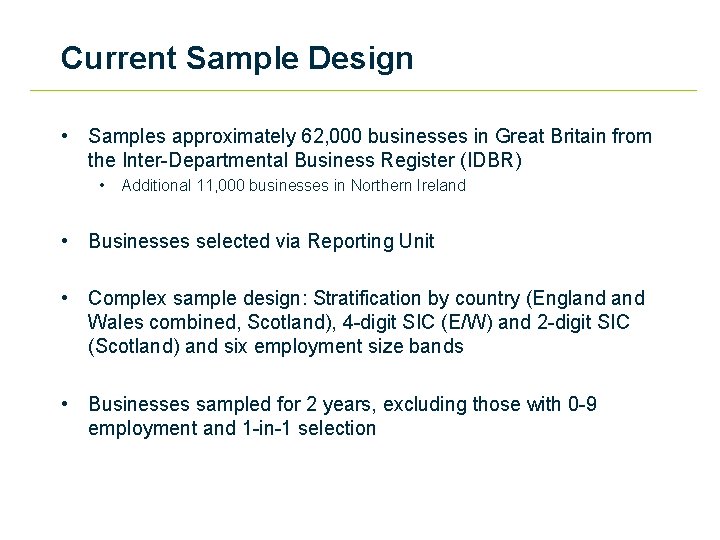
Current Sample Design • Samples approximately 62, 000 businesses in Great Britain from the Inter-Departmental Business Register (IDBR) • Additional 11, 000 businesses in Northern Ireland • Businesses selected via Reporting Unit • Complex sample design: Stratification by country (England Wales combined, Scotland), 4 -digit SIC (E/W) and 2 -digit SIC (Scotland) and six employment size bands • Businesses sampled for 2 years, excluding those with 0 -9 employment and 1 -in-1 selection
Why was a new sample allocation required? • The sample was last optimised in 2010 • Changes to both the sample and population over the past six years: • • • Manual reduction in 0 -9 sample due to resource requirements Inclusion of certain former inquiry stop 6 (PAYE only) businesses in the ABS universe for the first time in 2016 Breach of target dispatch counts • Previous sample allocation out-of-date • Number of requirements for the sample: Old and new!
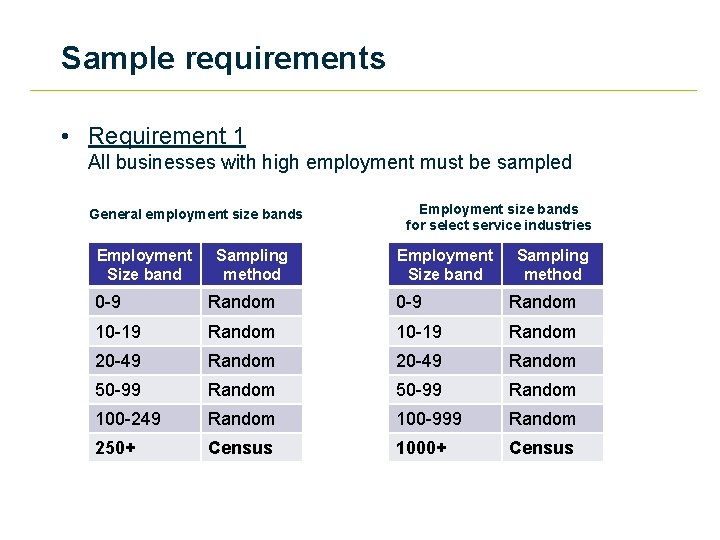
Sample requirements • Requirement 1 All businesses with high employment must be sampled General employment size bands Employment Size band Sampling method Employment size bands for select service industries Employment Size band Sampling method 0 -9 Random 10 -19 Random 20 -49 Random 50 -99 Random 100 -249 Random 100 -999 Random 250+ Census 1000+ Census
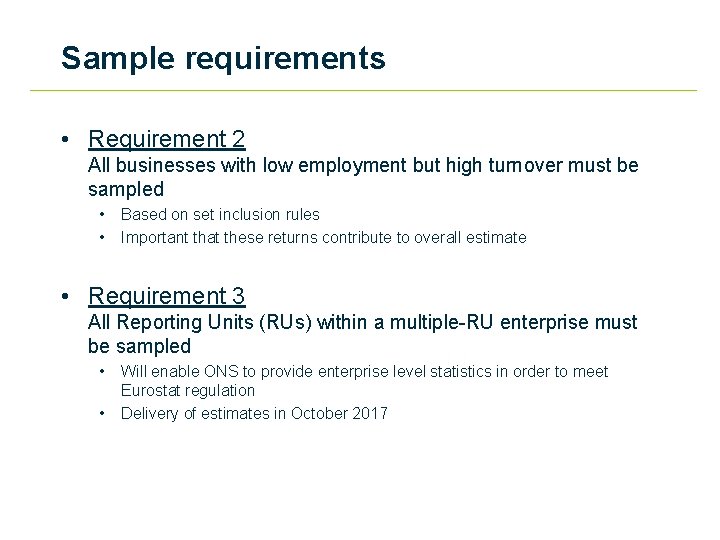
Sample requirements • Requirement 2 All businesses with low employment but high turnover must be sampled • • Based on set inclusion rules Important that these returns contribute to overall estimate • Requirement 3 All Reporting Units (RUs) within a multiple-RU enterprise must be sampled • • Will enable ONS to provide enterprise level statistics in order to meet Eurostat regulation Delivery of estimates in October 2017
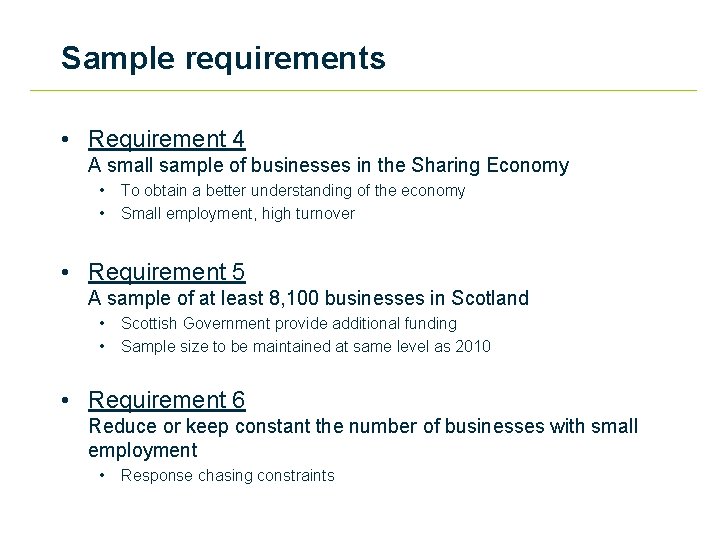
Sample requirements • Requirement 4 A small sample of businesses in the Sharing Economy • • To obtain a better understanding of the economy Small employment, high turnover • Requirement 5 A sample of at least 8, 100 businesses in Scotland • • Scottish Government provide additional funding Sample size to be maintained at same level as 2010 • Requirement 6 Reduce or keep constant the number of businesses with small employment • Response chasing constraints
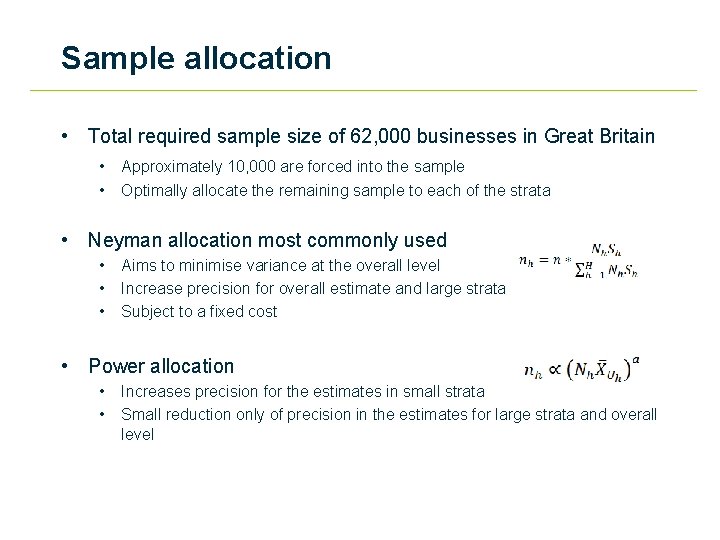
Sample allocation • Total required sample size of 62, 000 businesses in Great Britain • • Approximately 10, 000 are forced into the sample Optimally allocate the remaining sample to each of the strata • Neyman allocation most commonly used • • • Aims to minimise variance at the overall level Increase precision for overall estimate and large strata Subject to a fixed cost • Power allocation • • Increases precision for the estimates in small strata Small reduction only of precision in the estimates for large strata and overall level
Sample allocation • A Power Allocation was used to optimise the sample • • • Allocates proportional to population size and average importance measure in the population raised to some index a Middle ground between Neyman and precision for strata level estimates Reduces the impact large population sizes can have • Turnover used as importance measure • Number of constraints imposed on the allocations • • 1 -in-1 selection in order to meet requirements Full enumeration of small populations Minimum sample sizes Iterative process to avoid oversampling
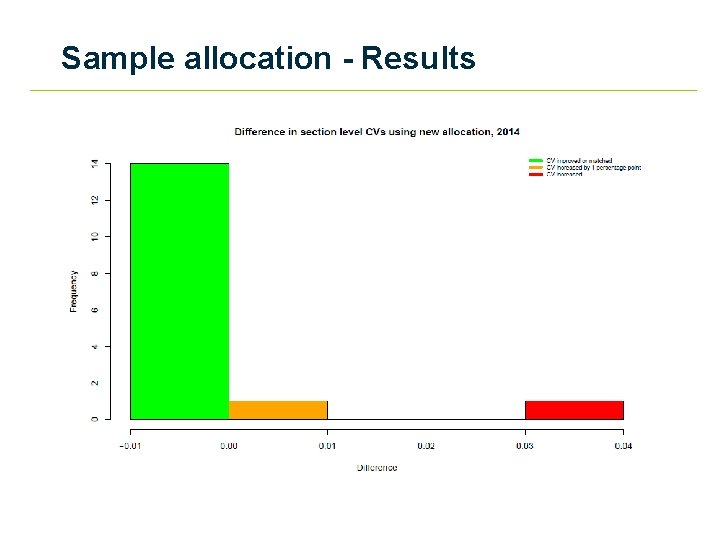
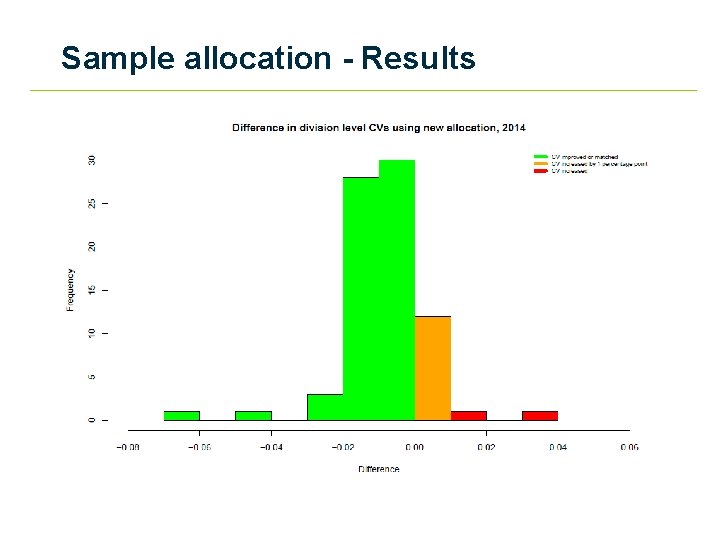
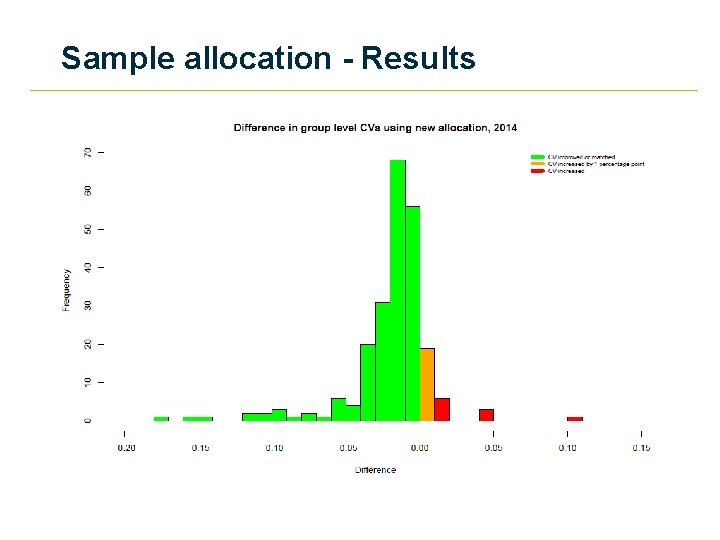
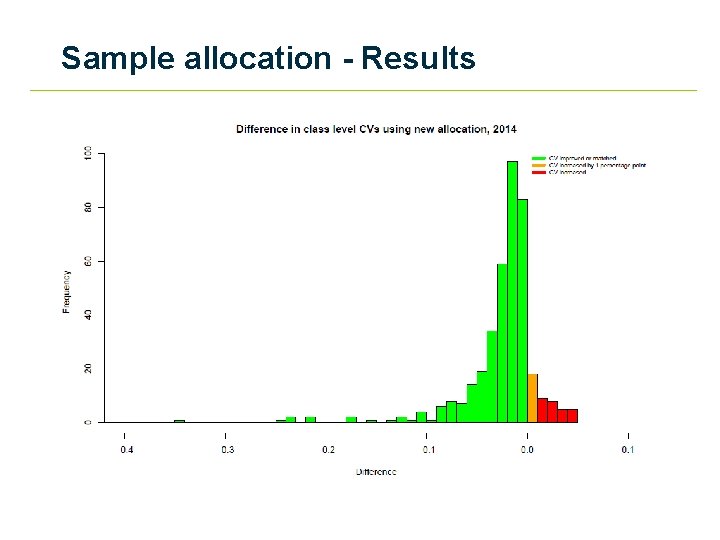
Sample allocation - Results • ~54, 000 businesses sampled in England & Wales, and ~8, 100 in Scotland • Assessing the impact of the new allocation • • Allocation was applied to three years of past data Comparisons made between current CVs for turnover at a section, division, group and class level • 80 -90% of CVs across all domains were replicated or improved upon

Sample allocation - Results
Sample allocation - Results
Sample allocation - Results
Sample allocation - Results
Sample allocation - Results
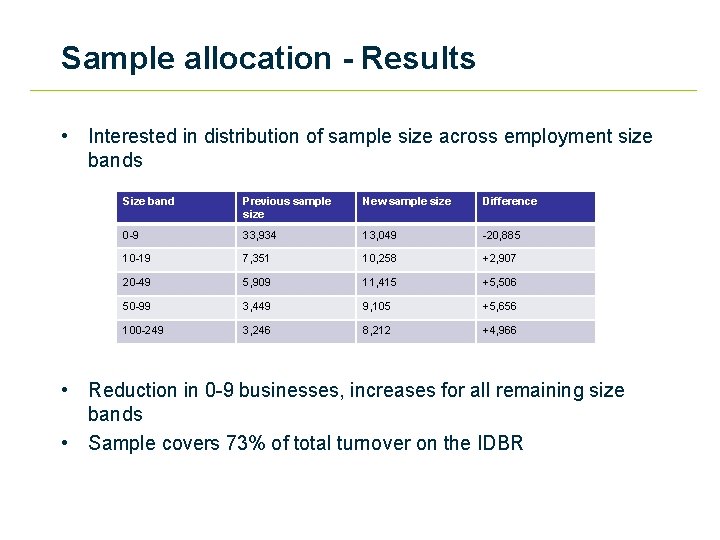
Sample allocation - Results • Interested in distribution of sample size across employment size bands Size band Previous sample size New sample size Difference 0 -9 33, 934 13, 049 -20, 885 10 -19 7, 351 10, 258 +2, 907 20 -49 5, 909 11, 415 +5, 506 50 -99 3, 449 9, 105 +5, 656 100 -249 3, 246 8, 212 +4, 966 • Reduction in 0 -9 businesses, increases for all remaining size bands • Sample covers 73% of total turnover on the IDBR
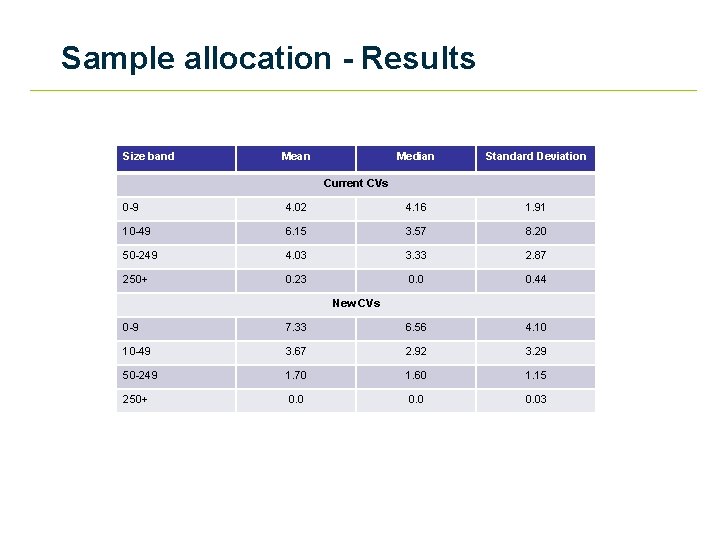
Sample allocation - Results Size band Mean Median Standard Deviation Current CVs 0 -9 4. 02 4. 16 1. 91 10 -49 6. 15 3. 57 8. 20 50 -249 4. 03 3. 33 2. 87 250+ 0. 23 0. 0 0. 44 New CVs 0 -9 7. 33 6. 56 4. 10 10 -49 3. 67 2. 92 3. 29 50 -249 1. 70 1. 60 1. 15 250+ 0. 03
Conclusions and next steps • The ABS sample was selected at the end of December • • Results currently being processed Provisional results released in November 2017 • Preparations on-going for the Eurostat delivery on enterprise level statistics • • • Building new IT system Implementing methods to construct data at the enterprise level Delivery 31 st October
Any questions? Megan Pope megan. pope@ons. gsi. gov. uk Survey Methodology Office for National Statistics
- Slides: 20