
The 2010 Florida Building Code Guide Disclaimer This
The 2010 Florida Building Code Guide
Disclaimer • This material is intended to give the reader only general factual information/training current at the time of publication. The subject areas of this presentation are not a substitute for the Florida Building Code and should not be used for guidance or decisions related to a specific design or construction project. The content of the materials is not intended to reflect the opinion of any of the entities, agencies or organizations identified in the materials and any opinions expressed are those of the individual author and should not be relied upon in any event applicable to the 2010 Florida Building Code.
Contents • Part 1 - History • Part 2 - The Code Change Process and Options • Part 3 – Code Printing • Part 4 – Significant Changes (by volume) 11/21/2020 3
• This presentation is interactive • Throughout the presentation you will see icons that look like this: • Move your mouse cursor over the icon to show additional pop-up information • Pop up text not available in hardcopy handouts : /

PART 1 : HISTORY
Why change the Code? : • The Florida Building Commission “the Commission” is required by Florida law to update the Florida Building Code “FBC” every three years. Adopting the 2010 update to the FBC will enable the Commission to carryout its responsibilities in a timely manner.
Why change the Code? (cont. ): • The FBC establishes minimum life safety construction requirements to protect buildings and their occupants from fire, wind, flood and storm surge using latest technical research and engineering standards for buildings and material products.
Why change the Code? (cont. ): • In order to keep the FBC current and offer the citizens of the State with the optimal standards for protection, it is important that the Commission adopt the latest edition of the model building codes and standards to better keep pace with changes in building technology and advances in the science of building performance and construction.
Why change the Code? (cont. ): • It is the desire of all impacted parties including the construction industry that the Commission updates the FBC using latest edition of the model codes as soon as possible narrowing the technical gap and the time lag between the current edition of the FBC and that of the latest edition of the national model code.

Why change the Code? (cont. ): • An up-to-date FBC will offer engineers, architects, contractors, product manufacturers and builders with more efficient and cost‐effective design solutions, options, standards and technologies.
Why change the Code? (cont. ): • The FBC is a complex interrelated documents consisting of thousands of pages containing myriad related standards and provisions that must be evaluated and updated on an ongoing basis.
Why change the Code? (cont. ): • The Commission and the State Fire Marshall have worked closely making sure that the 2010 update to both codes are correlated and consistent. Therefore, adopting the 2010 update is essential to continue the harmonization between these two main codes.
Why change the Code? (cont. ): • Product manufacturers are required to test and evaluate their products using the latest industry testing standards and construction design. The 2010 update to the FBC will provide for the latest industry standards and design. Ratification of the proposed rule will permit manufacturers to use their latesting and evaluation without the need to justify their product to an outdated standards thus incurring additional cost. •
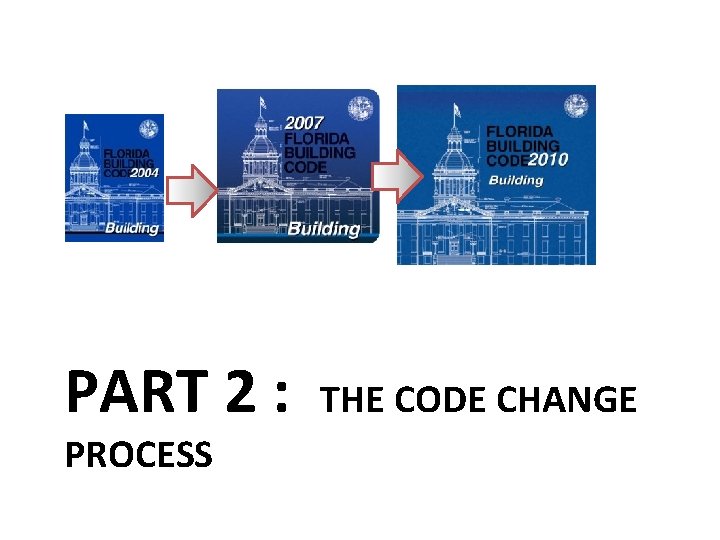
PART 2 : THE CODE CHANGE PROCESS
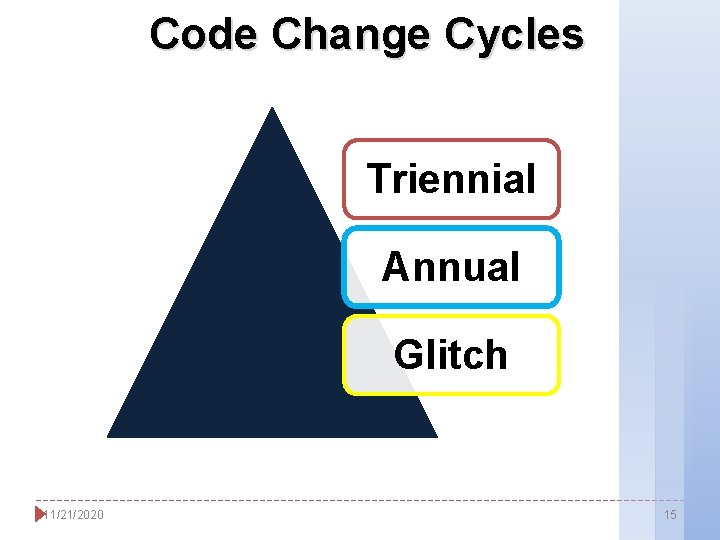
Code Change Cycles Triennial Annual Glitch 11/21/2020 15
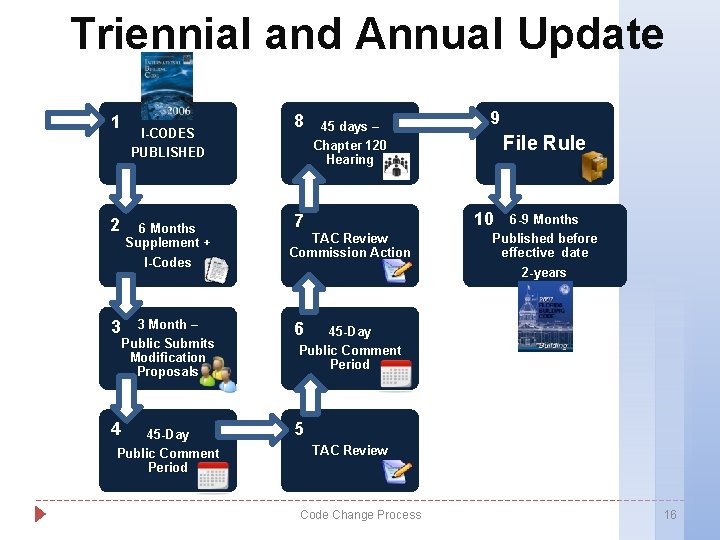
Triennial and Annual Update 1 2 I-CODES PUBLISHED 6 Months Supplement + I-Codes 8 TAC Review Commission Action 6 4 5 45 -Day Public Comment Period 9 File Rule 10 7 3 3 Month – Public Submits Modification Proposals 45 days – Chapter 120 Hearing 6 -9 Months Published before effective date 2 -years 45 -Day Public Comment Period TAC Review Code Change Process 16
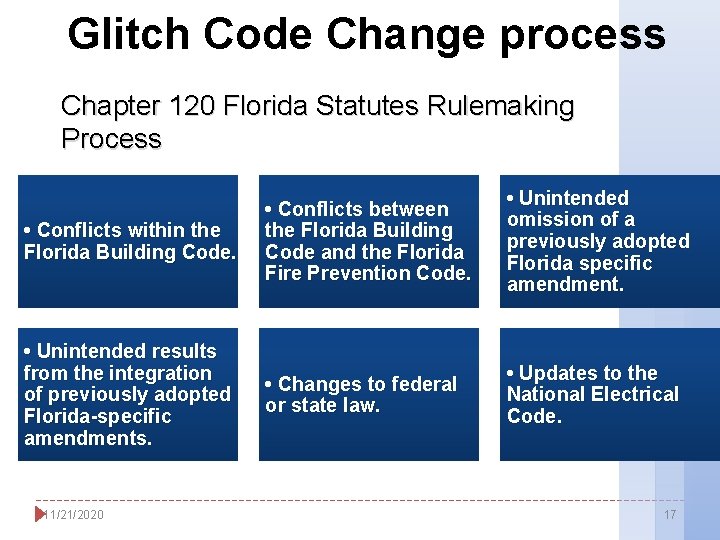
Glitch Code Change process Chapter 120 Florida Statutes Rulemaking Process • Conflicts within the Florida Building Code. • Conflicts between the Florida Building Code and the Florida Fire Prevention Code. • Unintended omission of a previously adopted Florida specific amendment. • Unintended results from the integration of previously adopted Florida-specific amendments. • Changes to federal or state law. • Updates to the National Electrical Code. 11/21/2020 17

PART 3 : CODE PRINTING
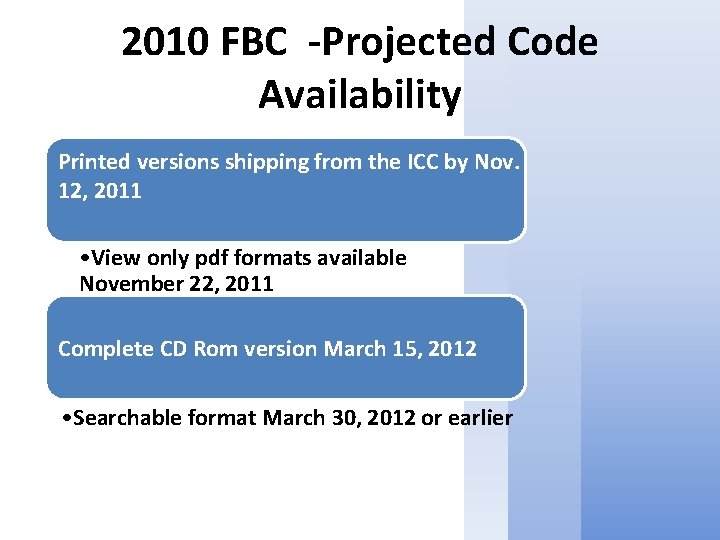
2010 FBC ‐Projected Code Availability Printed versions shipping from the ICC by Nov. 12, 2011 • View only pdf formats available November 22, 2011 Complete CD Rom version March 15, 2012 • Searchable format March 30, 2012 or earlier
PART 4 : SIGNIFICANT CHANGES
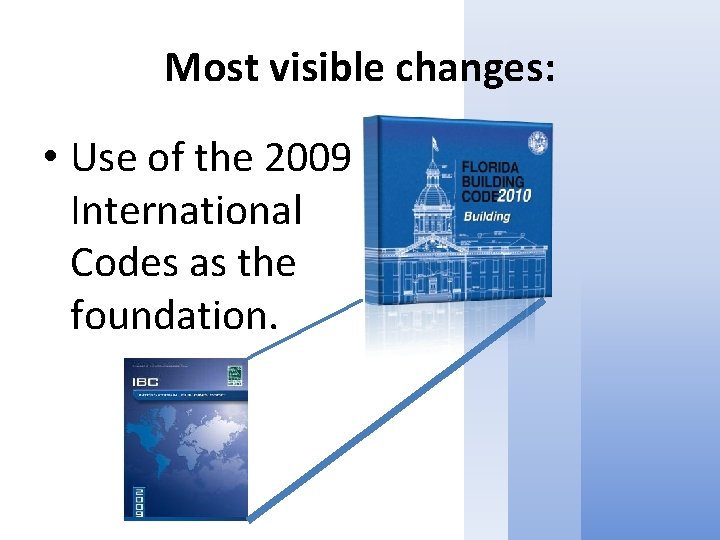
Most visible changes: • Use of the 2009 International Codes as the foundation.
Most visible changes: • Integration of the 2010 ADA requirements within the 2010 Florida Accessibility Code. • Moving the energy provisions that where in Chapter 13 of the Building Code and Chapter 11 of the Residential Code to the 2010 Florida Energy Conservation Code, centralizing all energy provisions in one location for ease of use and application.
Most visible changes continued… • Substantial revisions to wind-and flood-design provisions found in Chapter 16 of the Building Code. • Creates a new wind map for the state In accordance with the new American Society of Civil Engineers (ASCE 7 – 2010).
a. Building Volume
Chapter 1: Administration 102. 2 – Add new exceptions for family mausoleums not exceeding 250 square feet and temporary housing provided by Department of Correction. 102. 8 – Clarify when existing mechanical equipment on the surface of the roof must be installed as per the FBC.
Chapter 3: Use and Occupancy Classification 310. 1 – Classification of several residential uses through the inclusion of specific allowances for small transient uses, live/work units, and small residential care facilities. R-1 Added: Congregate living facilities (transient) with 10 or fewer occupants are permitted to comply with the construction requirements for Group R-3. R-2 Added: Live/work units
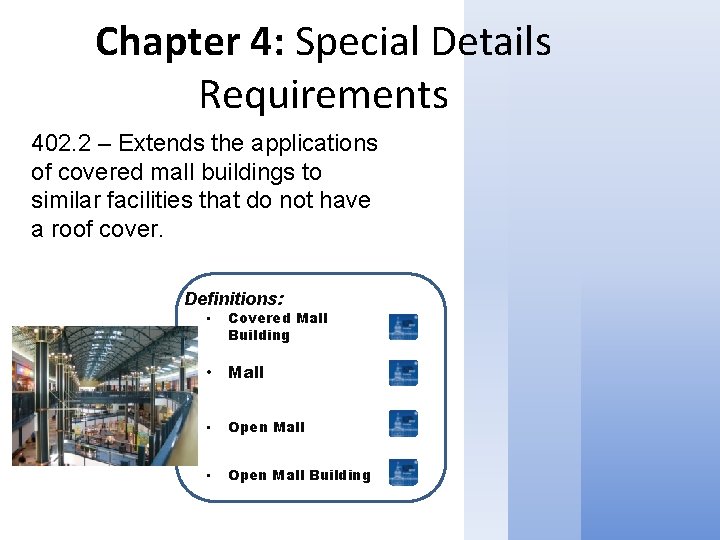
Chapter 4: Special Details Requirements 402. 2 – Extends the applications of covered mall buildings to similar facilities that do not have a roof cover. Definitions: • Covered Mall Building • Mall • Open Mall Building
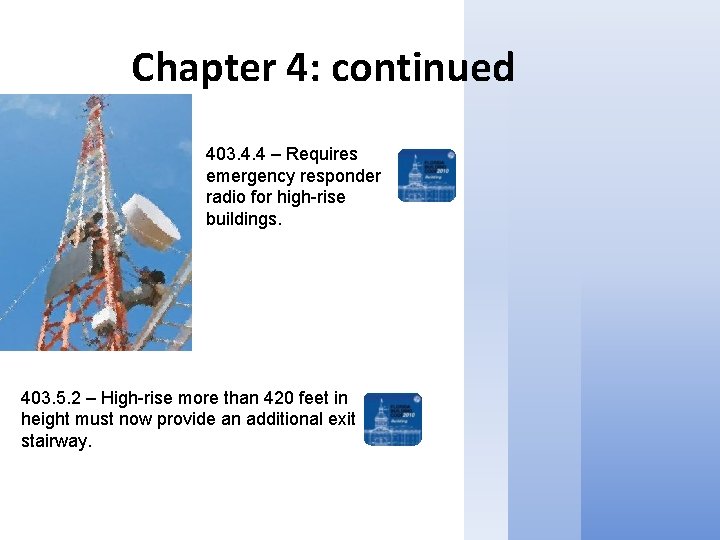
Chapter 4: continued 403. 4. 4 – Requires emergency responder radio for high-rise buildings. 403. 5. 2 – High-rise more than 420 feet in height must now provide an additional exit stairway.
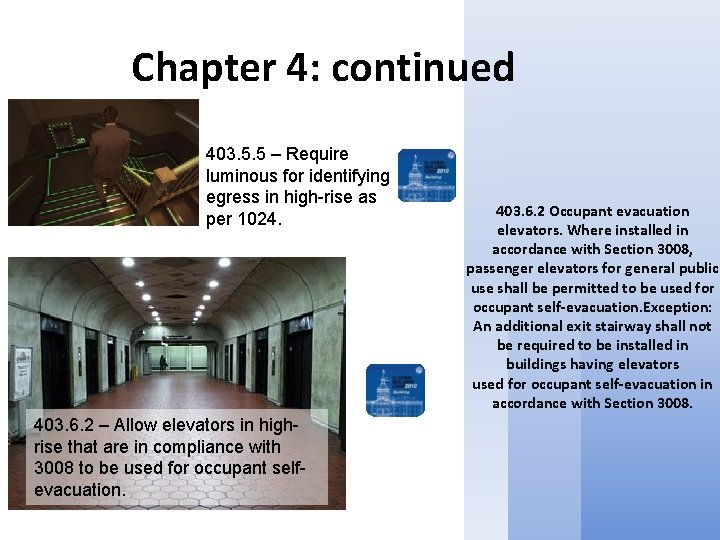
Chapter 4: continued 403. 5. 5 – Require luminous for identifying egress in high-rise as per 1024. 403. 6. 2 – Allow elevators in highrise that are in compliance with 3008 to be used for occupant selfevacuation. 403. 6. 2 Occupant evacuation elevators. Where installed in accordance with Section 3008, passenger elevators for general public use shall be permitted to be used for occupant self‐evacuation. Exception: An additional exit stairway shall not be required to be installed in buildings having elevators used for occupant self‐evacuation in accordance with Section 3008.
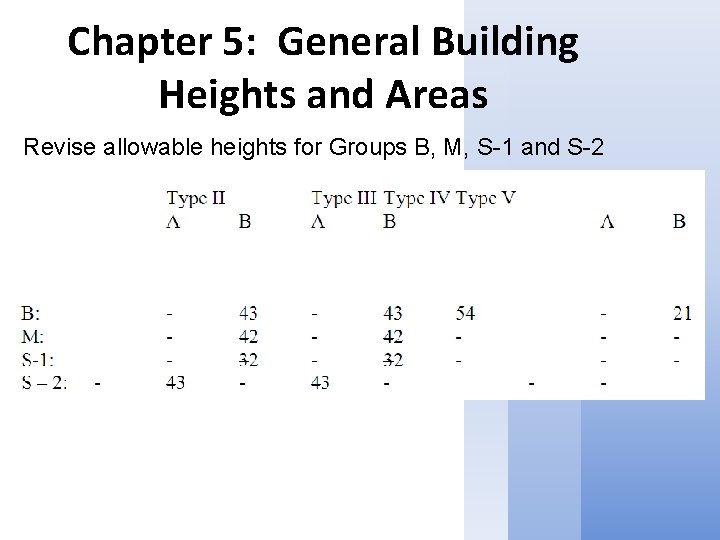
Chapter 5: General Building Heights and Areas Revise allowable heights for Groups B, M, S-1 and S-2
Chapter 5 continued 506. 5 – Revise the method for calculating allowable area for mixed-occupancy multi-story. 506. 5. 1 No more than one story above grade plane. 506. 5. 2 More than one story above grade plane.
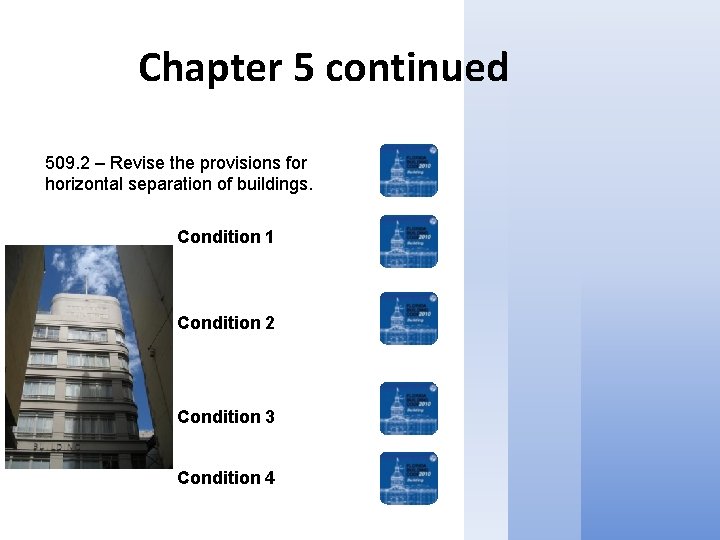
Chapter 5 continued 509. 2 – Revise the provisions for horizontal separation of buildings. Condition 1 Condition 2 Condition 3 Condition 4
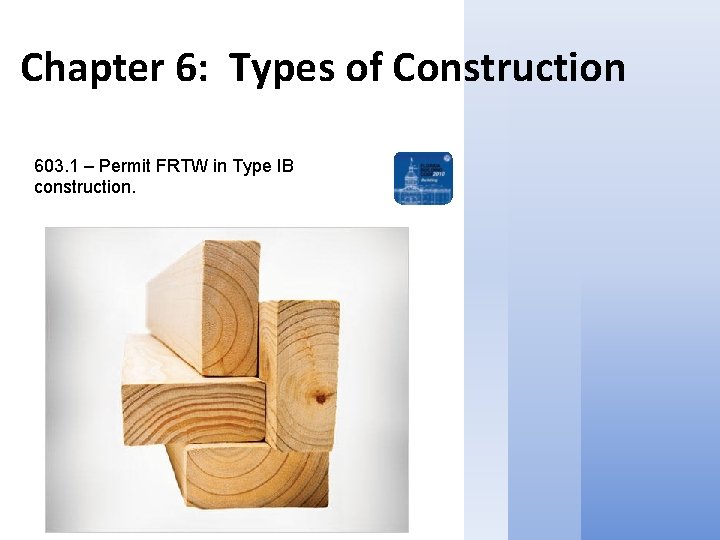
Chapter 6: Types of Construction 603. 1 – Permit FRTW in Type IB construction.
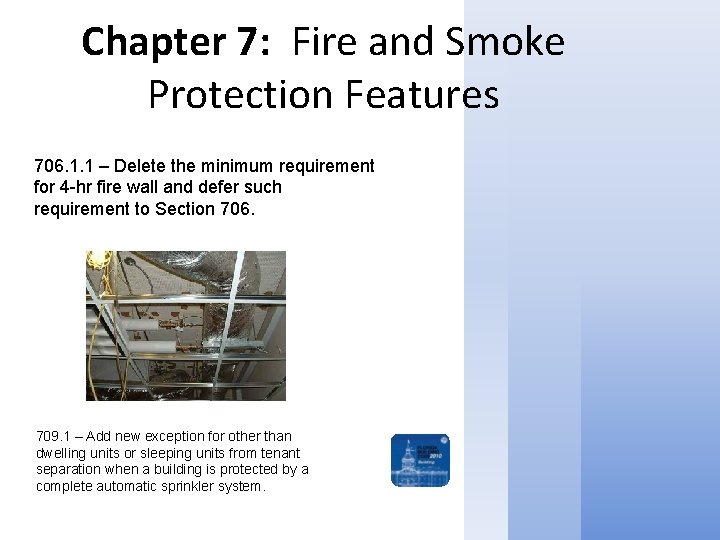
Chapter 7: Fire and Smoke Protection Features 706. 1. 1 – Delete the minimum requirement for 4 -hr fire wall and defer such requirement to Section 706. 709. 1 – Add new exception for other than dwelling units or sleeping units from tenant separation when a building is protected by a complete automatic sprinkler system.
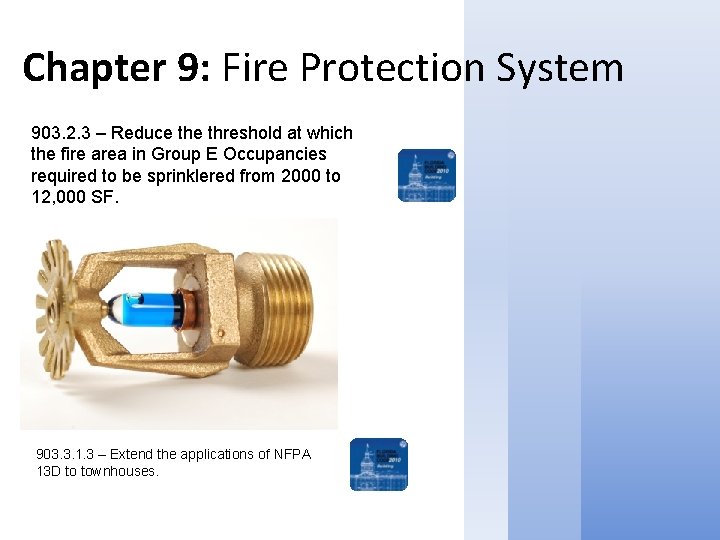
Chapter 9: Fire Protection System 903. 2. 3 – Reduce threshold at which the fire area in Group E Occupancies required to be sprinklered from 2000 to 12, 000 SF. 903. 3. 1. 3 – Extend the applications of NFPA 13 D to townhouses.
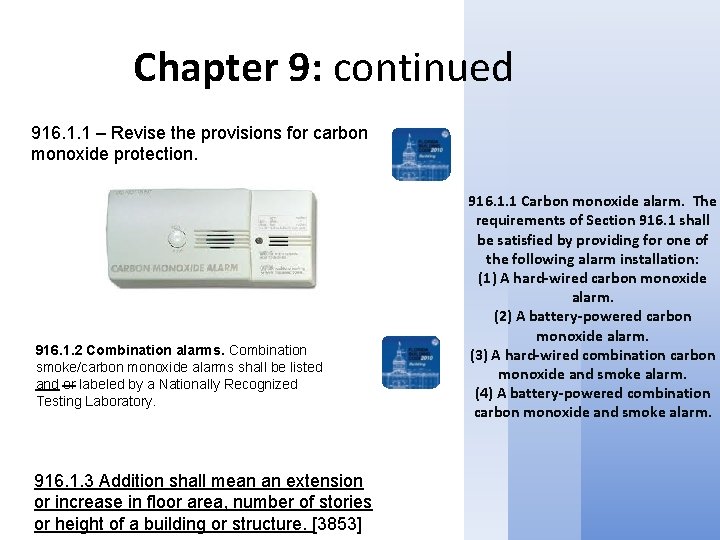
Chapter 9: continued 916. 1. 1 – Revise the provisions for carbon monoxide protection. 916. 1. 2 Combination alarms. Combination smoke/carbon monoxide alarms shall be listed and or labeled by a Nationally Recognized Testing Laboratory. 916. 1. 3 Addition shall mean an extension or increase in floor area, number of stories or height of a building or structure. [3853] 916. 1. 1 Carbon monoxide alarm. The requirements of Section 916. 1 shall be satisfied by providing for one of the following alarm installation: (1) A hard‐wired carbon monoxide alarm. (2) A battery‐powered carbon monoxide alarm. (3) A hard‐wired combination carbon monoxide and smoke alarm. (4) A battery‐powered combination carbon monoxide and smoke alarm.
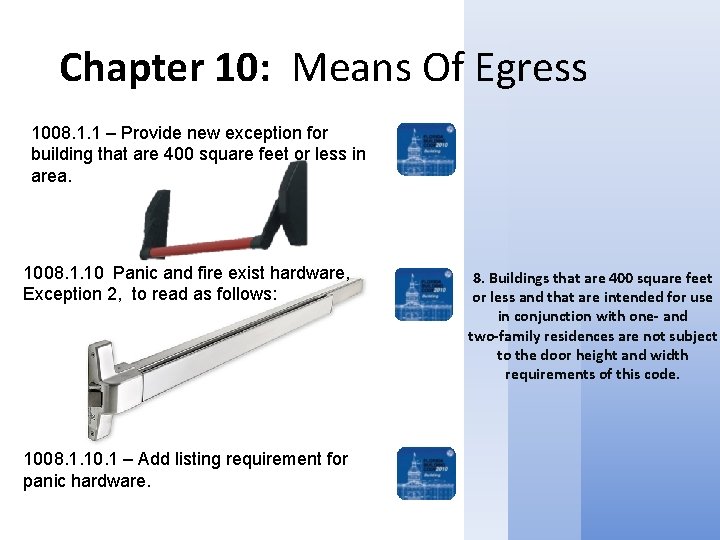
Chapter 10: Means Of Egress 1008. 1. 1 – Provide new exception for building that are 400 square feet or less in area. 1008. 1. 10 Panic and fire exist hardware, Exception 2, to read as follows: 1008. 1. 10. 1 – Add listing requirement for panic hardware. 8. Buildings that are 400 square feet or less and that are intended for use in conjunction with one‐ and two‐family residences are not subject to the door height and width requirements of this code.
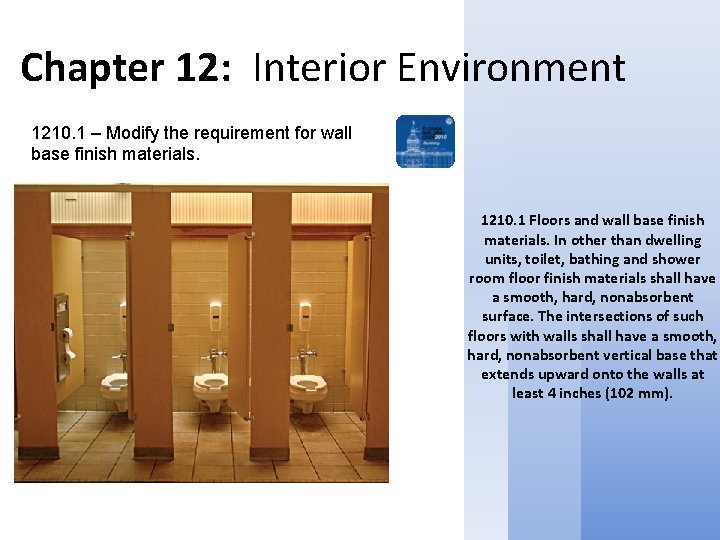
Chapter 12: Interior Environment 1210. 1 – Modify the requirement for wall base finish materials. 1210. 1 Floors and wall base finish materials. In other than dwelling units, toilet, bathing and shower room floor finish materials shall have a smooth, hard, nonabsorbent surface. The intersections of such floors with walls shall have a smooth, hard, nonabsorbent vertical base that extends upward onto the walls at least 4 inches (102 mm).
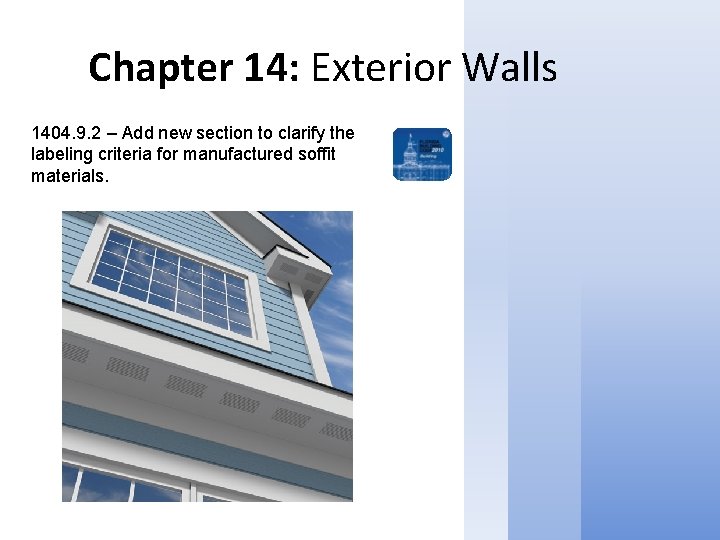
Chapter 14: Exterior Walls 1404. 9. 2 – Add new section to clarify the labeling criteria for manufactured soffit materials.
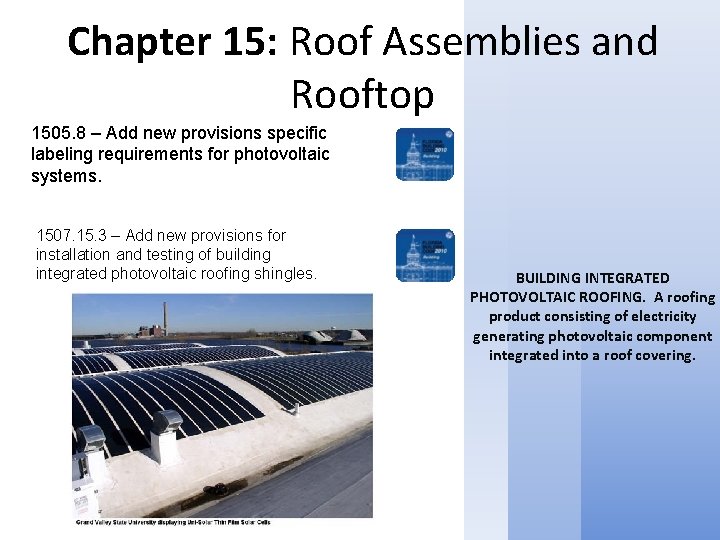
Chapter 15: Roof Assemblies and Rooftop 1505. 8 – Add new provisions specific labeling requirements for photovoltaic systems. 1507. 15. 3 – Add new provisions for installation and testing of building integrated photovoltaic roofing shingles. BUILDING INTEGRATED PHOTOVOLTAIC ROOFING. A roofing product consisting of electricity generating photovoltaic component integrated into a roof covering.
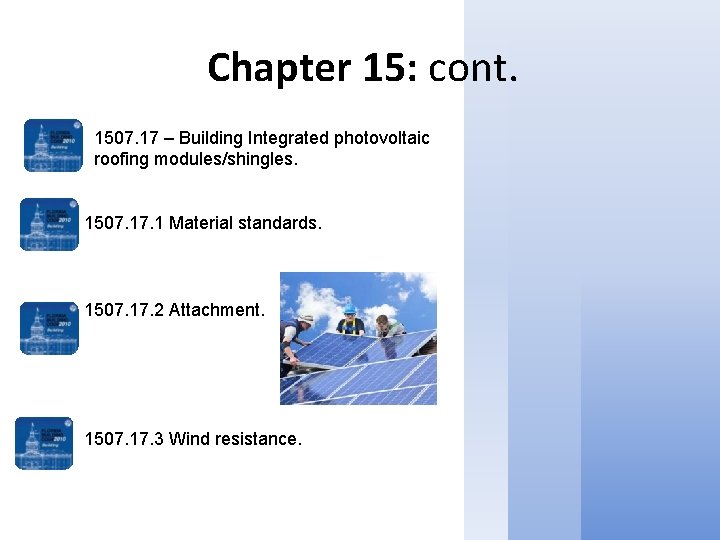
Chapter 15: cont. 1507. 17 – Building Integrated photovoltaic roofing modules/shingles. 1507. 1 Material standards. 1507. 17. 2 Attachment. 1507. 17. 3 Wind resistance.
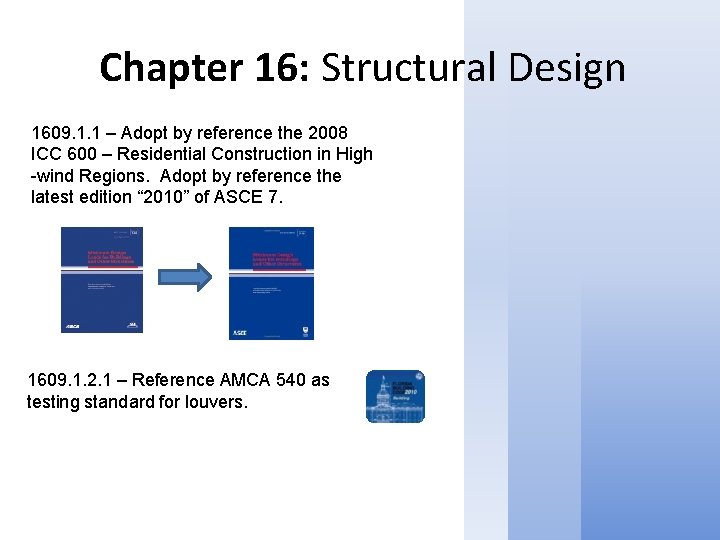
Chapter 16: Structural Design 1609. 1. 1 – Adopt by reference the 2008 ICC 600 – Residential Construction in High -wind Regions. Adopt by reference the latest edition “ 2010” of ASCE 7. 1609. 1. 2. 1 – Reference AMCA 540 as testing standard for louvers.
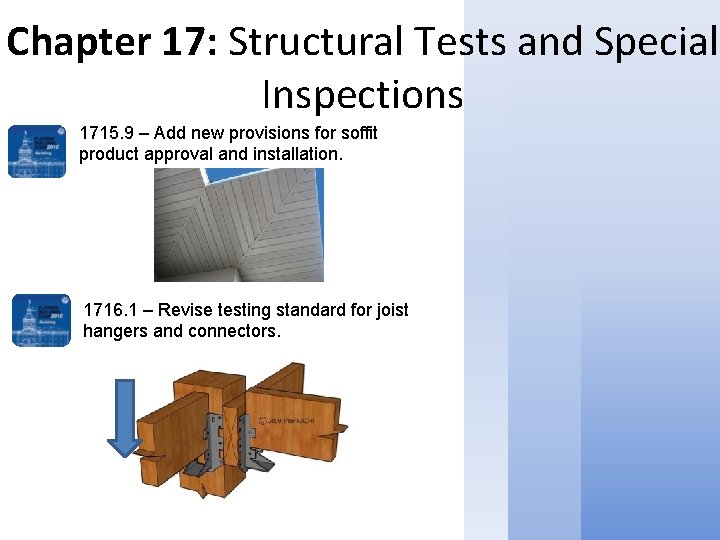
Chapter 17: Structural Tests and Special Inspections 1715. 9 – Add new provisions for soffit product approval and installation. 1716. 1 – Revise testing standard for joist hangers and connectors.
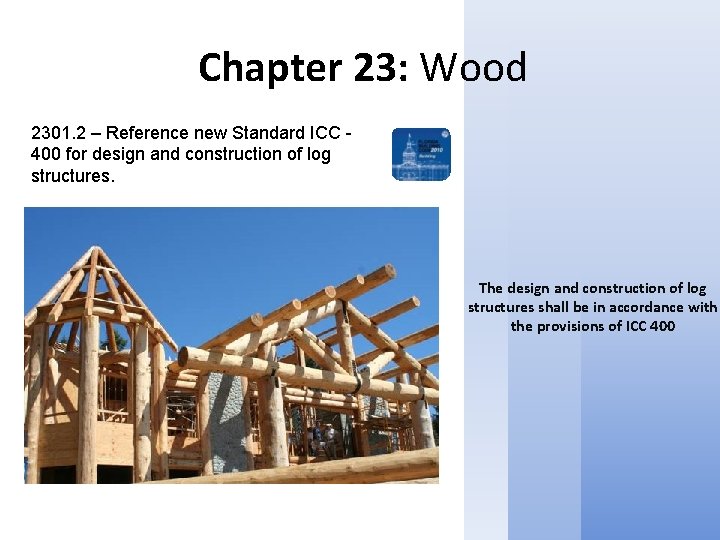
Chapter 23: Wood 2301. 2 – Reference new Standard ICC 400 for design and construction of log structures. The design and construction of log structures shall be in accordance with the provisions of ICC 400
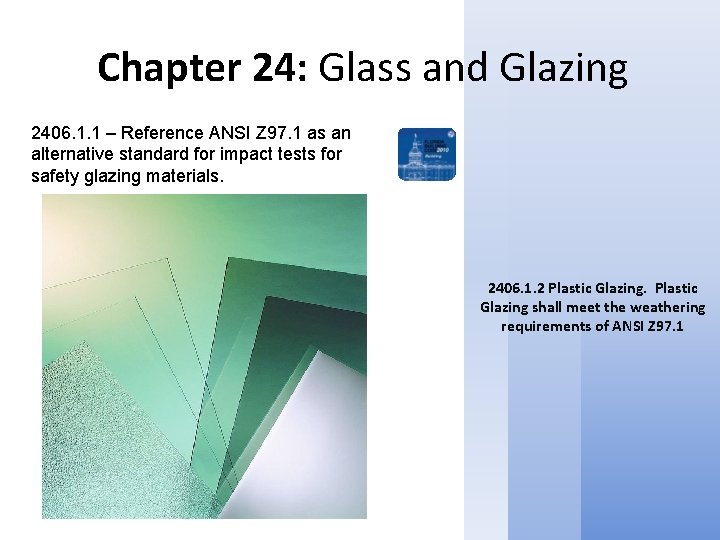
Chapter 24: Glass and Glazing 2406. 1. 1 – Reference ANSI Z 97. 1 as an alternative standard for impact tests for safety glazing materials. 2406. 1. 2 Plastic Glazing shall meet the weathering requirements of ANSI Z 97. 1
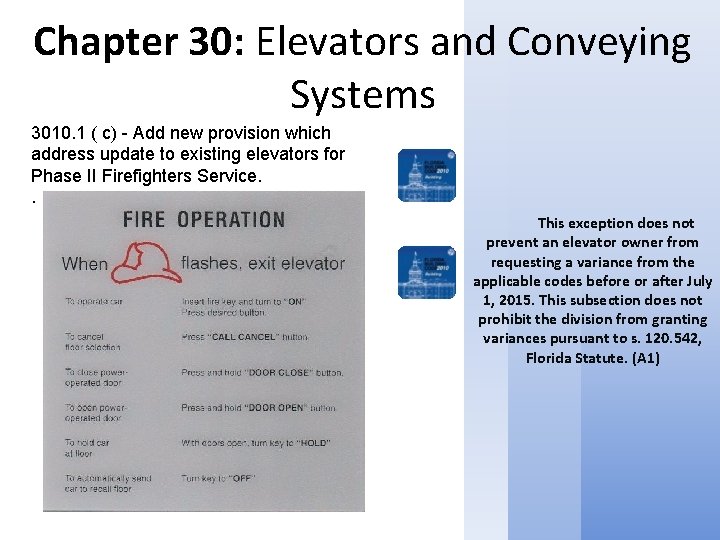
Chapter 30: Elevators and Conveying Systems 3010. 1 ( c) - Add new provision which address update to existing elevators for Phase II Firefighters Service. . This exception does not prevent an elevator owner from requesting a variance from the applicable codes before or after July 1, 2015. This subsection does not prohibit the division from granting variances pursuant to s. 120. 542, Florida Statute. (A 1)
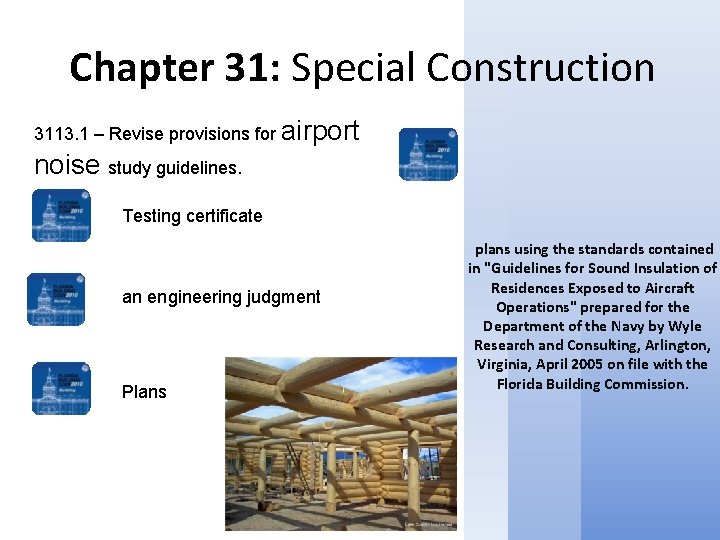
Chapter 31: Special Construction 3113. 1 – Revise provisions for airport noise study guidelines. Testing certificate an engineering judgment Plans plans using the standards contained in "Guidelines for Sound Insulation of Residences Exposed to Aircraft Operations" prepared for the Department of the Navy by Wyle Research and Consulting, Arlington, Virginia, April 2005 on file with the Florida Building Commission.
b. Residential Volume
Chapter 3: Building Planning R 301. 1. 1 – Add ICC – 400 as an (3) Ventilation openings in an exterior wall into an attic space in buildings located in windborne debris regions shall have opening protection from windborne debris. Such opening protection into an attic space shall meet the requirements AMCA 540 or or shall be protected by an impact resistant cover complying with an approved impact‐resistance standard or the large missile test of ASTM E 1996. alternative standard and update standard for cold-framing steel framing to AISI S 230. R 301. 2. 1. 1 – Update design criteria to include provisions for SIP, reference ICC 600. Correlate section with ASCE 7 – 2010. Update MAF Guide to concrete and the WFCM Guide to Wood Construction in High Wind Areas. R 301. 2 – Add new provision to address protection of ventilation openings in exterior wall of buildings located in WBDR.
Chapter 3: continued R 302. 1/Table R 302. 1 – Reformat and regroup provisions related to fire separation, penetrations and other fireresistance requirements under one section. Require testing for rating of fire separation. Provide exception for fire separation specific to buildings on the same lot. Add a new exception screen enclosure walls of insect screening. R 302. 6/Table R 302. 6 – add table for “Dwelling/Garage Separation”. 7. Screen enclosure walls of insect screening with a maximum of 25 percent solid flexible finishes.
Chapter 3: continued R 311. 2 – Add exception for building that are 400 square feet or less from the door height and width requirements. R 313 – Delete provisions for automatic fire sprinklers. R 315 – Revise the requirements for carbon monoxide alarms. R 315. 1 Carbon monoxide protection. R 315. 1. 1 Carbon monoxide alarm. R 315. 1. 2 Combination alarms. R 315. 1. 3 Addition shall mean: An extension or increase in floor area, number of stories or height of a building or structure.
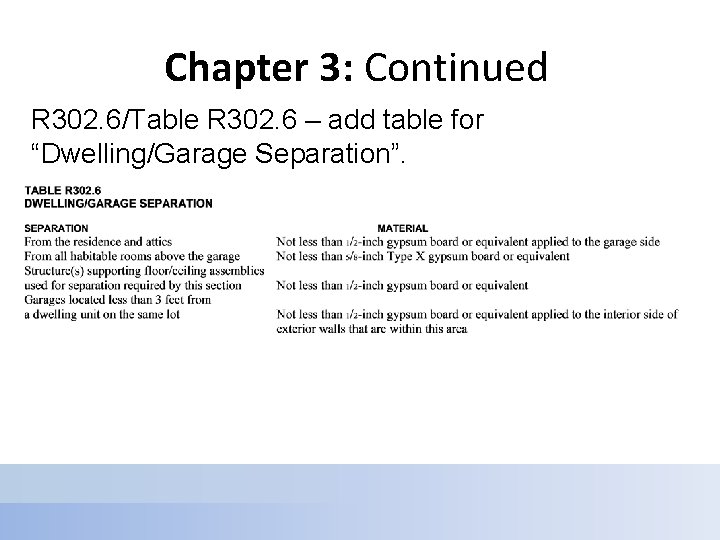
Chapter 3: Continued R 302. 6/Table R 302. 6 – add table for “Dwelling/Garage Separation”.
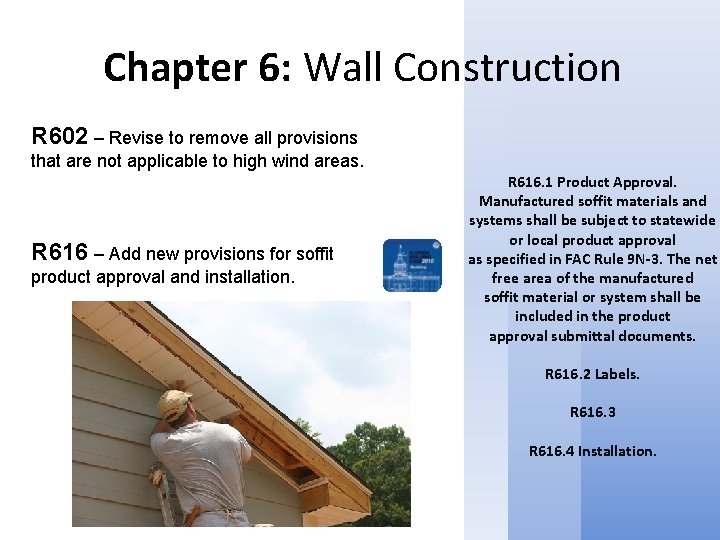
Chapter 6: Wall Construction R 602 – Revise to remove all provisions that are not applicable to high wind areas. R 616 – Add new provisions for soffit product approval and installation. R 616. 1 Product Approval. Manufactured soffit materials and systems shall be subject to statewide or local product approval as specified in FAC Rule 9 N‐ 3. The net free area of the manufactured soffit material or system shall be included in the product approval submittal documents. R 616. 2 Labels. R 616. 3 R 616. 4 Installation.
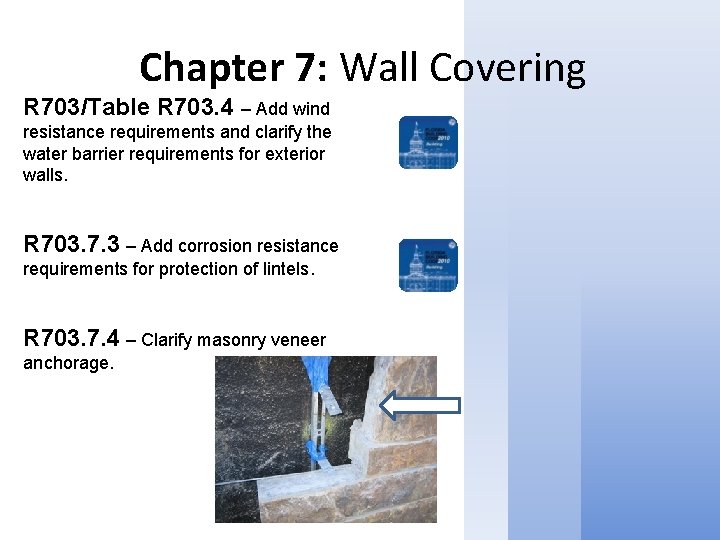
Chapter 7: Wall Covering R 703/Table R 703. 4 – Add wind resistance requirements and clarify the water barrier requirements for exterior walls. v R 703. 7. 3 – Add corrosion resistance requirements for protection of lintels. R 703. 7. 4 – Clarify masonry veneer anchorage.
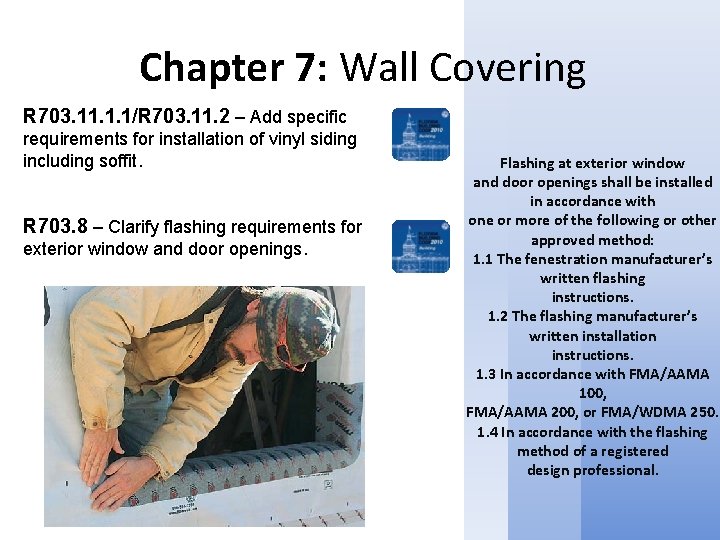
Chapter 7: Wall Covering R 703. 11. 1. 1/R 703. 11. 2 – Add specific requirements for installation of vinyl siding including soffit. R 703. 8 – Clarify flashing requirements for exterior window and door openings. Flashing at exterior window and door openings shall be installed in accordance with one or more of the following or other approved method: 1. 1 The fenestration manufacturer’s written flashing instructions. 1. 2 The flashing manufacturer’s written installation instructions. 1. 3 In accordance with FMA/AAMA 100, FMA/AAMA 200, or FMA/WDMA 250. 1. 4 In accordance with the flashing method of a registered design professional.
Chapter 7: Wall Covering R 703. 10 – Revise requirements for panel siding and lap siding for consistency with IRC. R 703. 10. 1 Panel siding. R 703. 10. 2 Lap siding. R 703. 11 – Clarify installation standard for vinyl siding. R 703. 11 Vinyl siding shall comply with and be labeled as conforming to ASTM D 3679 and is permitted to be used on exterior walls in accordance with the manufacturer’s approved installation instructions and Section R 703. 11. 1 and R 703. 11. 2.
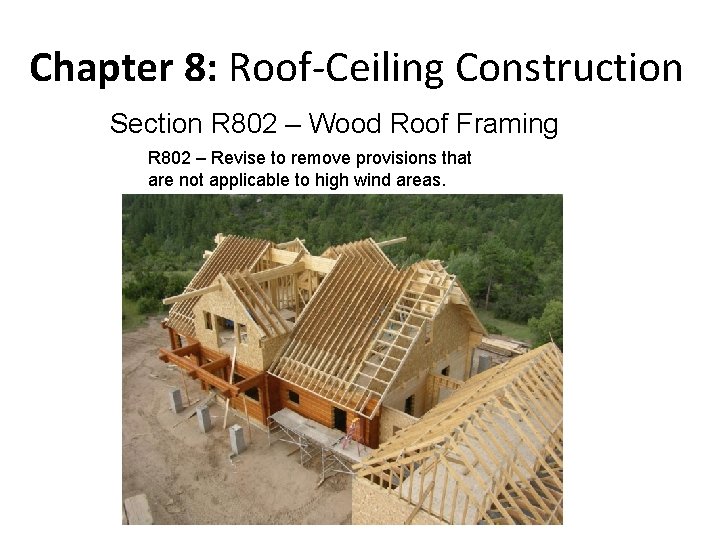
Chapter 8: Roof-Ceiling Construction Section R 802 – Wood Roof Framing R 802 – Revise to remove provisions that are not applicable to high wind areas.
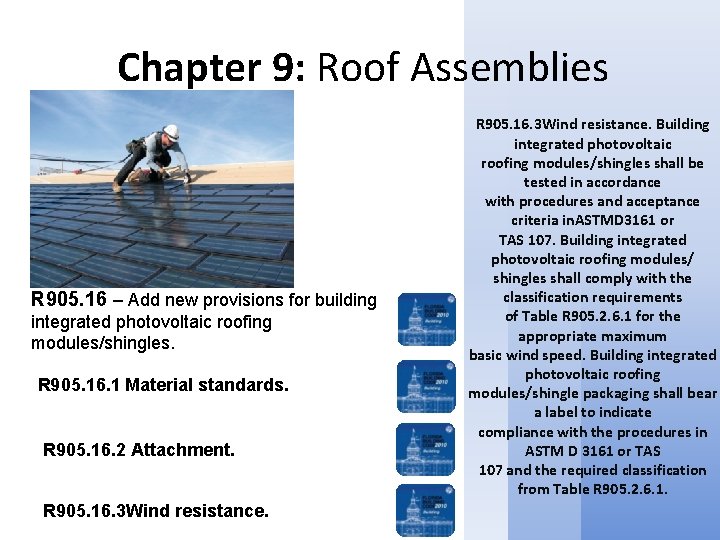
Chapter 9: Roof Assemblies R 905. 16 – Add new provisions for building integrated photovoltaic roofing modules/shingles. R 905. 16. 1 Material standards. R 905. 16. 2 Attachment. R 905. 16. 3 Wind resistance. Building integrated photovoltaic roofing modules/shingles shall be tested in accordance with procedures and acceptance criteria in. ASTMD 3161 or TAS 107. Building integrated photovoltaic roofing modules/ shingles shall comply with the classification requirements of Table R 905. 2. 6. 1 for the appropriate maximum basic wind speed. Building integrated photovoltaic roofing modules/shingle packaging shall bear a label to indicate compliance with the procedures in ASTM D 3161 or TAS 107 and the required classification from Table R 905. 2. 6. 1.
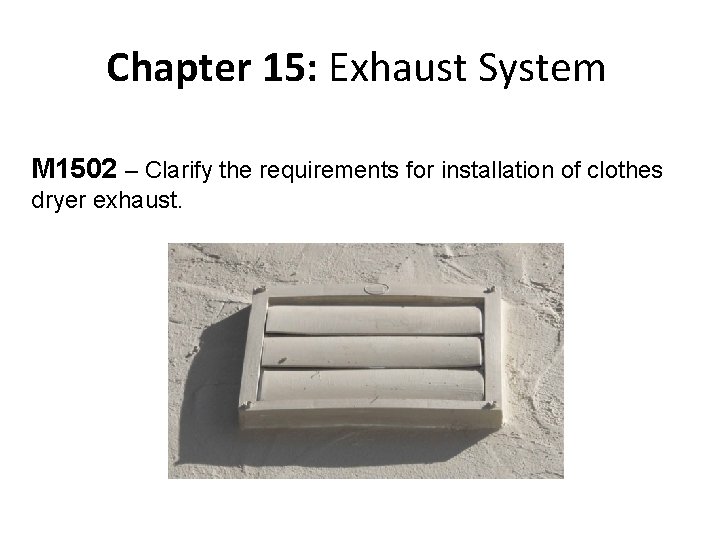
Chapter 15: Exhaust System M 1502 – Clarify the requirements for installation of clothes dryer exhaust.
Chapter 16: Duct Systems R 1601 – This section was revised extensively for consistency with the FBC, Energy Conservation. M 1601. 6 – Provide requirements for independent garage HVAC systems. M 1602. 2 – Add provisions to prohibit unconditioned attics and crawl spaces as source for outdoor and return air for HVAC systems. 403. 6. 2 Occupant evacuation elevators. Where installed in accordance with Section 3008, passenger elevators for general public use shall be permitted to be used for occupant self‐evacuation. Exception: An additional exit stairway shall not be required to be installed in buildings having elevators used for occupant self‐evacuation in accordance with Section 3008.
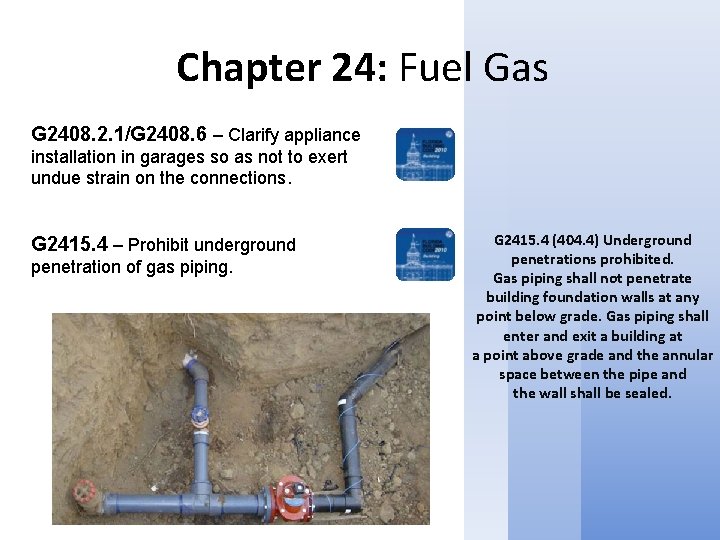
Chapter 24: Fuel Gas G 2408. 2. 1/G 2408. 6 – Clarify appliance installation in garages so as not to exert undue strain on the connections. G 2415. 4 – Prohibit underground penetration of gas piping. G 2415. 4 (404. 4) Underground penetrations prohibited. Gas piping shall not penetrate building foundation walls at any point below grade. Gas piping shall enter and exit a building at a point above grade and the annular space between the pipe and the wall shall be sealed.
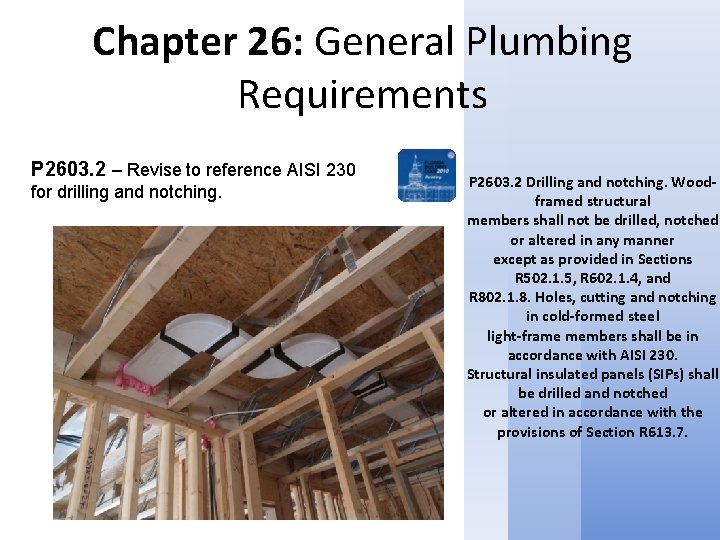
Chapter 26: General Plumbing Requirements P 2603. 2 – Revise to reference AISI 230 for drilling and notching. P 2603. 2 Drilling and notching. Wood‐ framed structural members shall not be drilled, notched or altered in any manner except as provided in Sections R 502. 1. 5, R 602. 1. 4, and R 802. 1. 8. Holes, cutting and notching in cold‐formed steel light‐frame members shall be in accordance with AISI 230. Structural insulated panels (SIPs) shall be drilled and notched or altered in accordance with the provisions of Section R 613. 7.
c. Mechanical Volume
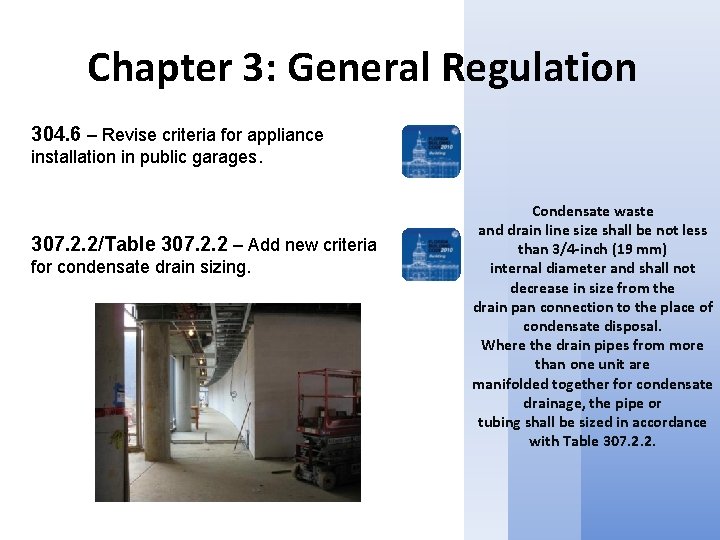
Chapter 3: General Regulation 304. 6 – Revise criteria for appliance installation in public garages. 307. 2. 2/Table 307. 2. 2 – Add new criteria for condensate drain sizing. Condensate waste and drain line size shall be not less than 3/4‐inch (19 mm) internal diameter and shall not decrease in size from the drain pan connection to the place of condensate disposal. Where the drain pipes from more than one unit are manifolded together for condensate drainage, the pipe or tubing shall be sized in accordance with Table 307. 2. 2.
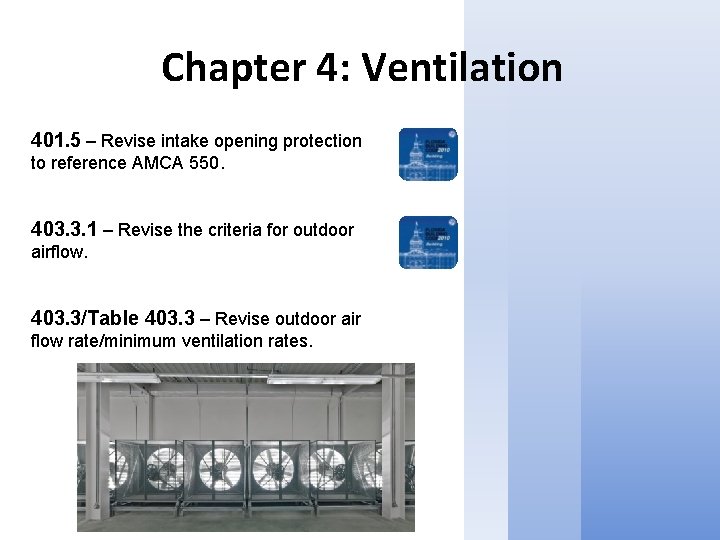
Chapter 4: Ventilation 401. 5 – Revise intake opening protection to reference AMCA 550. 403. 3. 1 – Revise the criteria for outdoor airflow. 403. 3/Table 403. 3 – Revise outdoor air flow rate/minimum ventilation rates.
Chapter 5: Exhaust Systems 501. 3 – Revise the criteria for pressure equalization to include R-2 occupancies. 504. 8 – Add new criteria for common exhaust systems for clothes dryers located in multi-story structures. 506. 4. 2 – Add new criteria for type II termination specific to Type II commercial kitchen hood exhaust.
d. Plumbing Volume
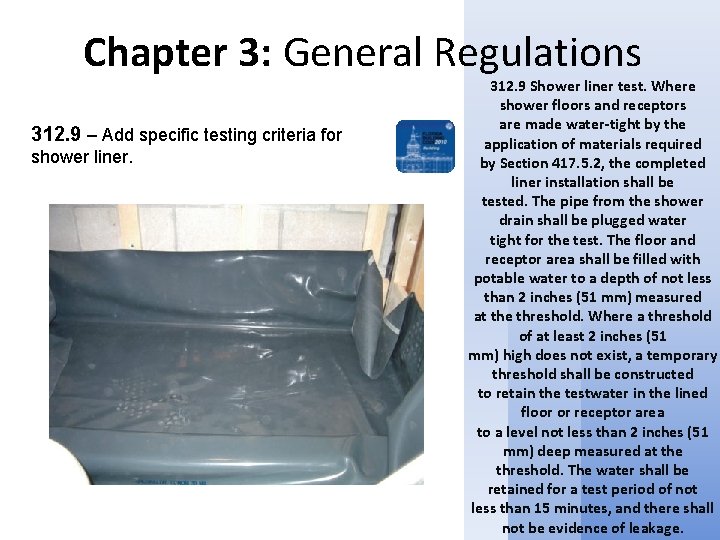
Chapter 3: General Regulations 312. 9 – Add specific testing criteria for shower liner. 312. 9 Shower liner test. Where shower floors and receptors are made water‐tight by the application of materials required by Section 417. 5. 2, the completed liner installation shall be tested. The pipe from the shower drain shall be plugged water tight for the test. The floor and receptor area shall be filled with potable water to a depth of not less than 2 inches (51 mm) measured at the threshold. Where a threshold of at least 2 inches (51 mm) high does not exist, a temporary threshold shall be constructed to retain the testwater in the lined floor or receptor area to a level not less than 2 inches (51 mm) deep measured at the threshold. The water shall be retained for a test period of not less than 15 minutes, and there shall not be evidence of leakage.
Chapter 4: Fixtures, Faucets and Fixtures Fittings Table 403. 1 – Revise the minimum number of required plumbing fixtures for Group I-4; modify minimum number of required plumbing fixtures for Assembly A 4 and A-5; and revise the minimum number of required plumbing fixtures for structures with an occupant load of 15 or fewer. 403. 3 – Clarify the method for calculating fixture count for each sex. 403. 3. 1 Access (public toilet facilities)
Chapter 4: Fixtures, Faucets and Fixtures Fittings 410. 2 – Revise to provide clear prohibited locations for drinking fountains. 416. 5/424. 3. 1 – Provide for CSA B 125. 3 as performance criteria for tempered water for public hand-washing facilities, whirlpool bathtub valves, and fill valves. 417. 5. 2/417. 5. 2. 5 – Add criteria for shower lining and sheet-applied, load bearing, bonded, waterproof membranes. 416. 5 Tempered water for public hand‐washing facilities. Tempered water shall be delivered from public hand‐washing facilities. Tempered water shall be delivered through an approved water‐temperature limiting device that conforms to ASSE 1070 or CSA B 125. 3.
Chapter 5: Water Heaters 502. 5 – Add criteria for clearances for maintenance and replacement. 504. 6 – Clarify requirements for discharge piping. 504. 7 - Revise provisions for protection against physical and provide specific thickness for required pan.
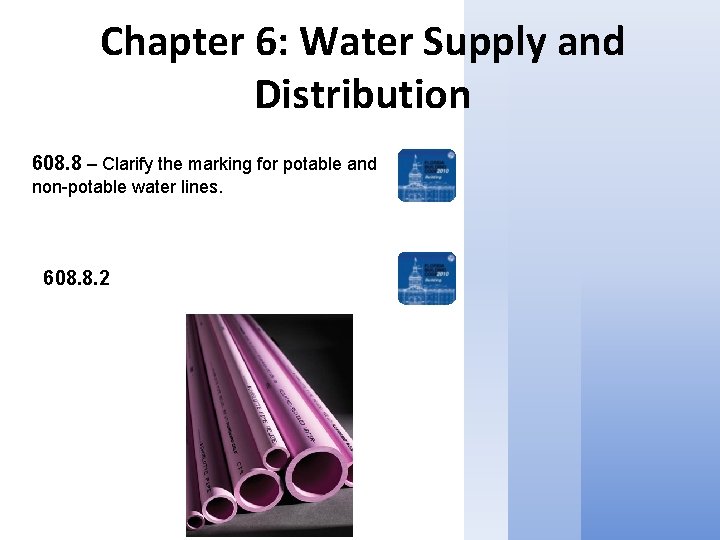
Chapter 6: Water Supply and Distribution 608. 8 – Clarify the marking for potable and non-potable water lines. 608. 8. 2
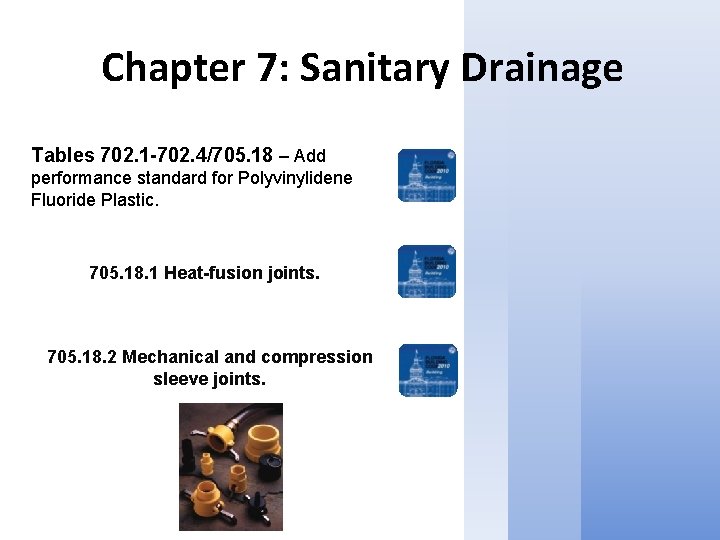
Chapter 7: Sanitary Drainage Tables 702. 1 -702. 4/705. 18 – Add performance standard for Polyvinylidene Fluoride Plastic. 705. 18. 1 Heat-fusion joints. 705. 18. 2 Mechanical and compression sleeve joints.
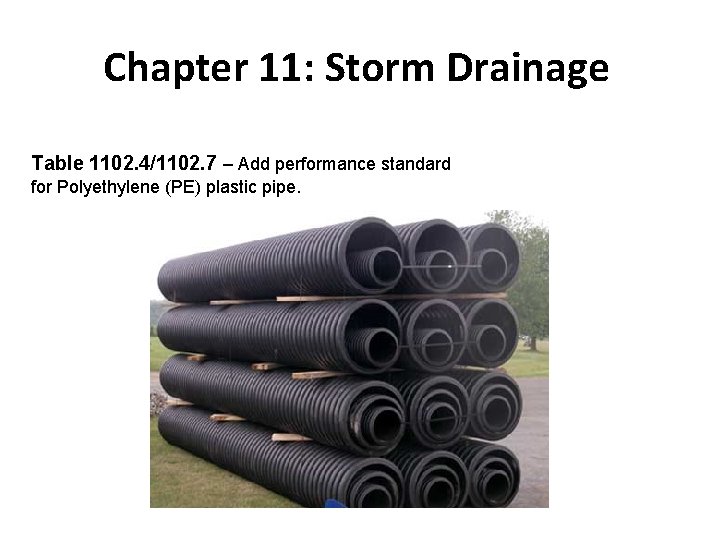
Chapter 11: Storm Drainage Table 1102. 4/1102. 7 – Add performance standard for Polyethylene (PE) plastic pipe.
e. Fuel/Gas Volume
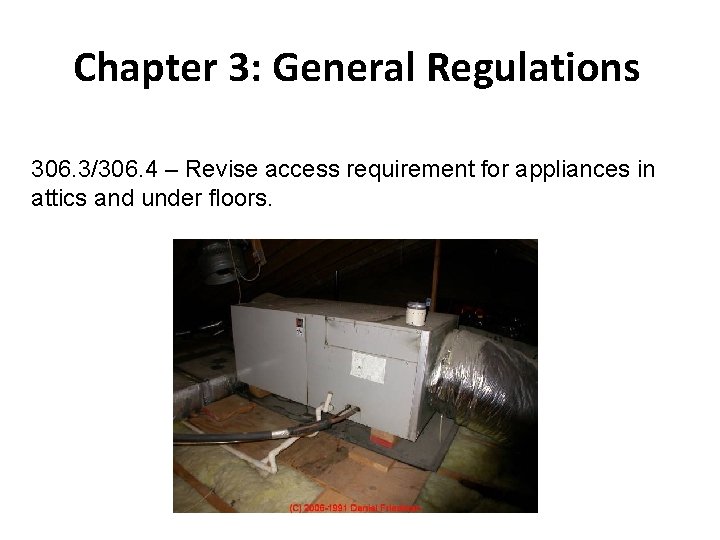
Chapter 3: General Regulations 306. 3/306. 4 – Revise access requirement for appliances in attics and under floors.
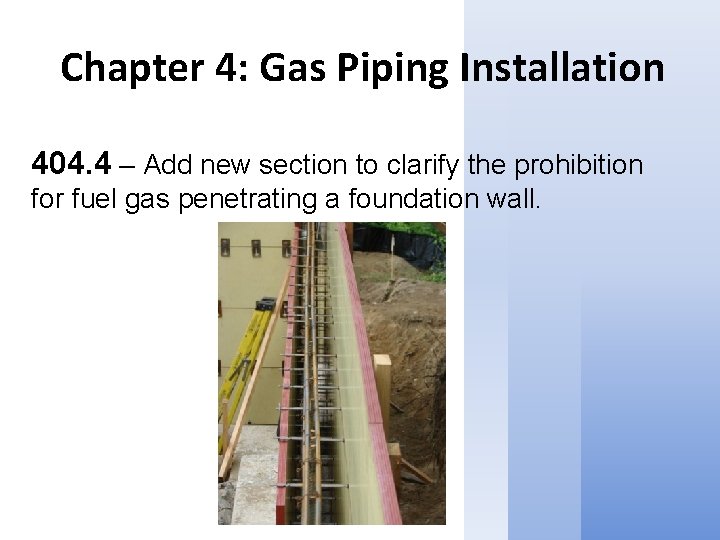
Chapter 4: Gas Piping Installation 404. 4 – Add new section to clarify the prohibition for fuel gas penetrating a foundation wall.
• Questions? • Please call Codes and Standards 850 -487 -1824
- Slides: 78