
The 20 th ENERGY EFFICIENCY IN CHURCH BUILDING
The 20 th ENERGY EFFICIENCY IN CHURCH BUILDING BASED ON SEFAIRA ENERGY USE INTENSITY STANDARD Aisyah Nabilah 1, Hanna Putri Devita 1, Yohannes Van Halen 1, Aldissain Jurizat, S. Pd, M. T. 1 1 Universitas Pendidikan Indonesia nabilaha 37@upi. edu International Conference on Sustainable Environment & Architecture Urban Retrofitting: Building, Cities and Communities in The Disruptive Era Presenter Affiliation: Organized By: Supported By:
INTRODUCTION Buildings for religious purposes such as churches have infrequent periods of near full occupancy to minimal or no occupancy. This results in lower overall energy intensity than other commercial buildings [1]. However, churches have many paintings, frescoes, and other religious objects that needed maintenance. Providing suitable indoor climate conditions for churches by its architecture design could not only preserve the objects from deformation or deposition, but also could reduce the energy it needed by reducing the use of electricity. To achieve the best building performance result, the design could be simulated in Performance-Based Design software. Sefaira is a Performance-Based Design software that functions to analyse energy efficiency in a building [9]. Organized By: Supported By: 2
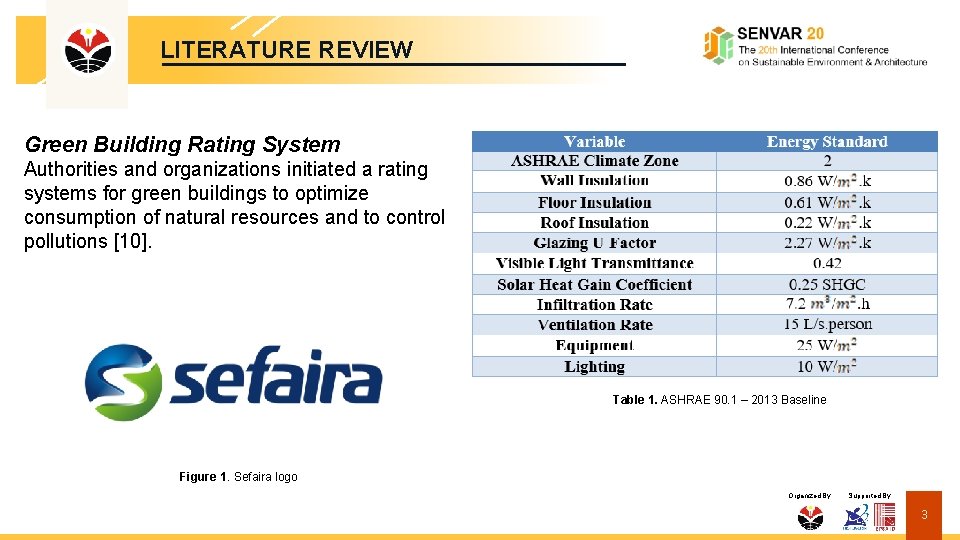
LITERATURE REVIEW Green Building Rating System Authorities and organizations initiated a rating systems for green buildings to optimize consumption of natural resources and to control pollutions [10]. Table 1. ASHRAE 90. 1 – 2013 Baseline Figure 1. Sefaira logo Organized By: Supported By: 3
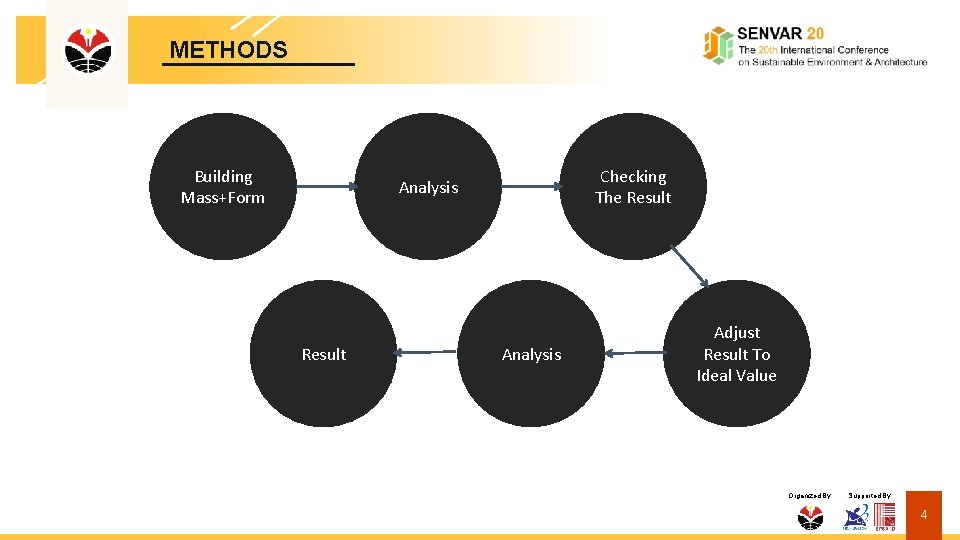
METHODS Building Mass+Form Checking The Result Analysis Adjust Result To Ideal Value Organized By: Supported By: 4
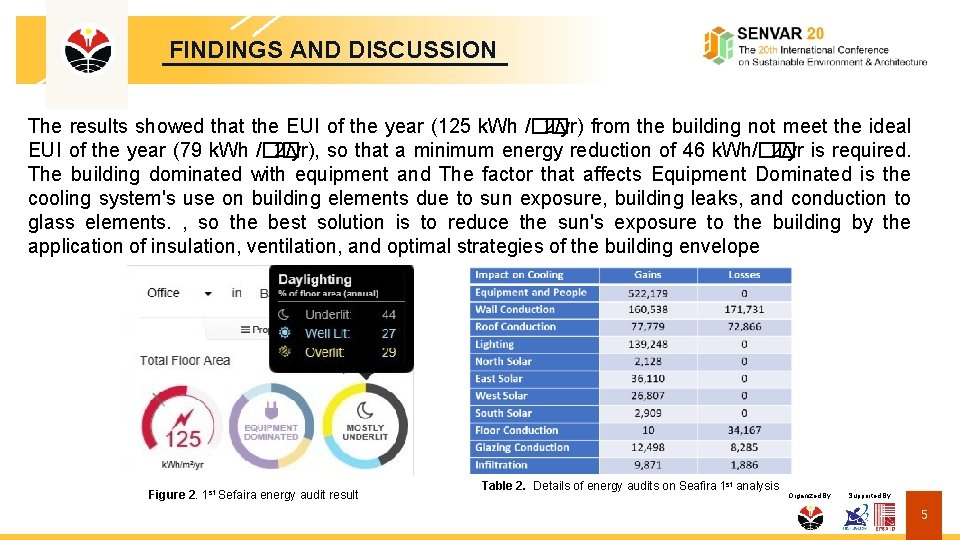
FINDINGS AND DISCUSSION The results showed that the EUI of the year (125 k. Wh /�� 2/yr) from the building not meet the ideal EUI of the year (79 k. Wh /�� 2/yr), so that a minimum energy reduction of 46 k. Wh/�� 2/yr is required. The building dominated with equipment and The factor that affects Equipment Dominated is the cooling system's use on building elements due to sun exposure, building leaks, and conduction to glass elements. , so the best solution is to reduce the sun's exposure to the building by the application of insulation, ventilation, and optimal strategies of the building envelope Figure 2. 1 st Sefaira energy audit result Table 2. Details of energy audits on Seafira 1 st analysis Organized By: Supported By: 5
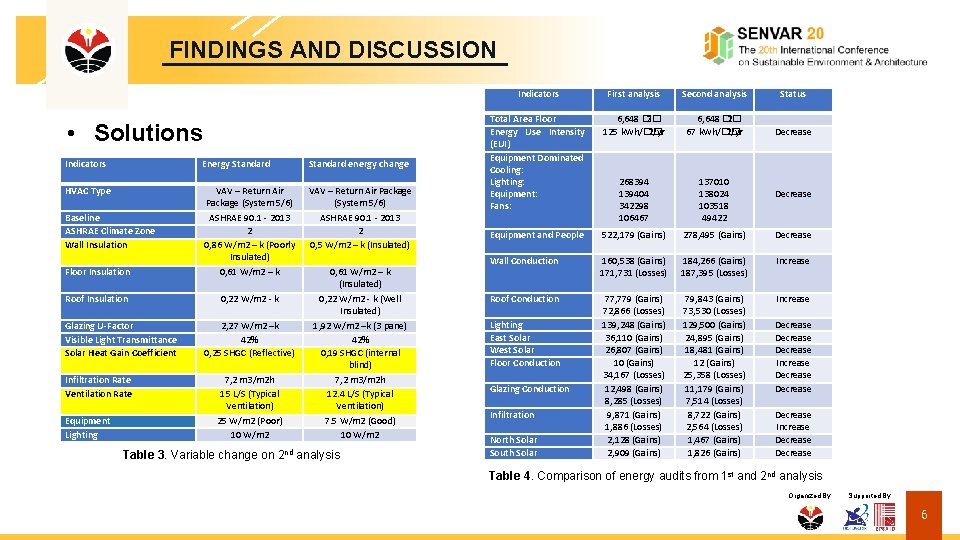
FINDINGS AND DISCUSSION • Solutions Indicators Energy Standard energy change Indicators First analysis Second analysis Status Total Area Floor Energy Use Intensity (EUI) Equipment Dominated Cooling: Lighting: Equipment: Fans: 6, 648 �� 2 125 k. Wh/�� 2/yr 6, 648 �� 2 67 k. Wh/�� 2/yr Decrease 268394 139404 342298 106467 137010 138024 103518 49422 Equipment and People 522, 179 (Gains) 278, 495 (Gains) Decrease Wall Conduction 160, 538 (Gains) 171, 731 (Losses) 184, 266 (Gains) 187, 395 (Losses) Increase 77, 779 (Gains) 72, 866 (Losses) 139, 248 (Gains) 36, 110 (Gains) 26, 807 (Gains) 10 (Gains) 34, 167 (Losses) 12, 498 (Gains) 8, 285 (Losses) 9, 871 (Gains) 1, 886 (Losses) 2, 128 (Gains) 2, 909 (Gains) 79, 843 (Gains) 73, 530 (Losses) 129, 500 (Gains) 24, 895 (Gains) 18, 481 (Gains) 12 (Gains) 25, 358 (Losses) 11, 179 (Gains) 7, 514 (Losses) 8, 722 (Gains) 2, 564 (Losses) 1, 467 (Gains) 1, 826 (Gains) Increase HVAC Type VAV – Return Air Package (System 5/6) Baseline ASHRAE Climate Zone Wall Insulation ASHRAE 90. 1 - 2013 2 0, 86 W/m 2 – k (Poorly Insulated) ASHRAE 90. 1 - 2013 2 0, 5 W/m 2 – k (Insulated) Floor Insulation 0, 61 W/m 2 – k (Insulated) Roof Insulation 0, 22 W/m 2 - k (Well Insulated) Roof Conduction 2, 27 W/m 2 –k 42% 0, 25 SHGC (Reflective) 1, 92 W/m 2 –k (3 pane) 42% 0, 19 SHGC (internal blind) Lighting East Solar West Solar Floor Conduction 7, 2 m 3/m 2 h 15 L/S (Typical Ventilation) 7, 2 m 3/m 2 h 12. 4 L/S (Typical Ventilation) 25 W/m 2 (Poor) 10 W/m 2 7. 5 W/m 2 (Good) 10 W/m 2 Glazing U-Factor Visible Light Transmittance Solar Heat Gain Coefficient Infiltration Rate Ventilation Rate Equipment Lighting Table 3. Variable change on 2 nd analysis Glazing Conduction Infiltration North Solar South Solar Decrease Decrease Increase Decrease Table 4. Comparison of energy audits from 1 st and 2 nd analysis Organized By: Supported By: 6
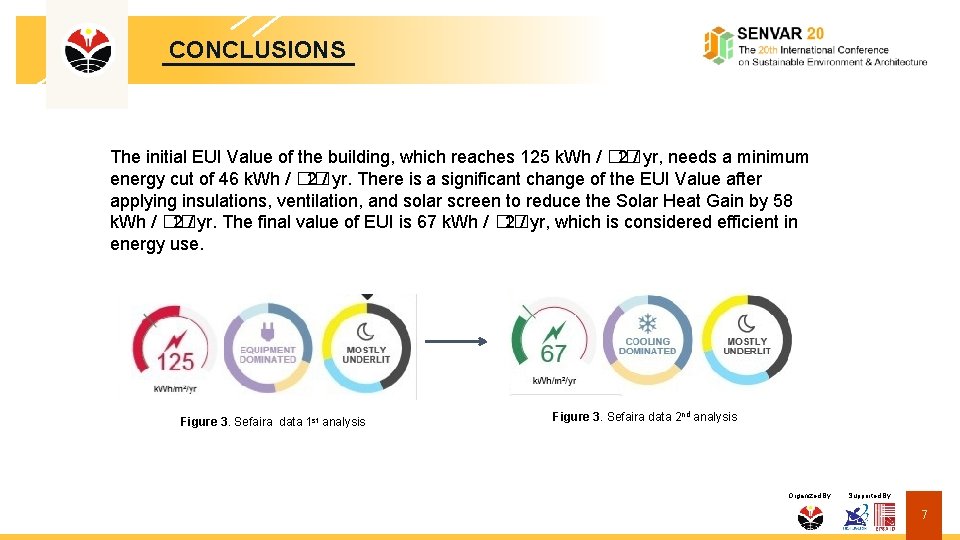
CONCLUSIONS The initial EUI Value of the building, which reaches 125 k. Wh / �� 2 / yr, needs a minimum energy cut of 46 k. Wh / �� 2 / yr. There is a significant change of the EUI Value after applying insulations, ventilation, and solar screen to reduce the Solar Heat Gain by 58 k. Wh / �� 2 / yr. The final value of EUI is 67 k. Wh / �� 2 / yr, which is considered efficient in energy use. Figure 3. Sefaira data 1 st analysis Figure 3. Sefaira data 2 nd analysis Organized By: Supported By: 7
![REFERENCES [1] T. J. Terrill and B. P. Rasmussen, “An evaluation of HVAC energy](http://slidetodoc.com/presentation_image_h2/788dcff2e4412536bdd56f10bd927df8/image-8.jpg "REFERENCES [1] T. J. Terrill and B. P. Rasmussen, “An evaluation of HVAC energy")
REFERENCES [1] T. J. Terrill and B. P. Rasmussen, “An evaluation of HVAC energy usage and occupant comfort in religious facilities, ” Energy Build. , vol. 128, pp. 224– 235, 2016, doi: 10. 1016/j. enbuild. 2016. 078. [2] F. E. Turcanu, M. Verdes, and I. Serbanoiu, “Churches Heating: The Optimum Balance Between Cost Management and Thermal Comfort, ” Procedia Technol. , vol. 22, pp. 821– 828, 2016, doi: 10. 1016/j. protcy. 2016. 01. 055. [3] D. Camuffo and A. della Valle, “Church Heating A Balance between Conservation and Thermal Comfort Problems with Central Heating, ” Contrib. to Expert. Roundtable Sustain. Clim. Manag. Strateg. , no. April, pp. 1– 23, 2007, [Online]. Available: http: //www. getty. edu/conservation/our_projects/science/climate/paper_camuffo. pdf. [4] M. Napp and T. Kalamees, “Energy use and indoor climate of conservation heating, dehumidification and adaptive ventilation for the climate control of a mediaeval church in a cold climate, ” Energy Build. , vol. 108, pp. 61– 71, 2015, doi: 10. 1016/j. enbuild. 2015. 08. 013. [5] T. Harso, “Arsitektur Tropis dan Bangunan Hemat Energi, ” Kalang, vol. 1, no. 1, pp. 1– 9, 2016. [6] A. Sekatia, E. Setyowati, and G. Hardiman, “Thermal condition of passive cooling system in Bogor Cathedral Church, ” IOP Conf. Ser. Earth Environ. Sci. , vol. 213, no. 1, 2018, doi: 10. 1088/1755 -1315/213/1/012044. [7] F. S. Pradifta and I. U. Afiya, “Promoting tropical architecture by implementing design control in zoning regulation, ” IOP Conf. Ser. Mater. Sci. Eng. , vol. 830, no. 2, 2020, doi: 10. 1088/1757 -899 X/830/2/022058. [8] M. Amalia, B. Paramita, R. Minggra, and M. D. Koerniawan, “Efficiency Energy on Office Building in South Jakarta, ” IOP Conf. Ser. Earth Environ. Sci. , vol. 520, no. 1, 2020, doi: 10. 1088/1755 -1315/520/1/012022. [9] B. Paramita, B. A. Rabbani, and D. C. P. Sari, “Energy optimization on preliminary design of the botani museum using sefaira®, ” Int. J. Eng. Adv. Technol. , vol. 8, no. 5, pp. 2614– 2618, 2019. [10] D. T. Doan, A. Ghaffarianhoseini, N. Naismith, T. Zhang, A. Ghaffarianhoseini, and J. Tookey, “A critical comparison of green building rating systems, ” Build. Environ. , vol. 123, pp. 243– 260, 2017, doi: 10. 1016/j. buildenv. 2017. 007. [11] I. M. C. S. Illankoon, V. W. Y. Tam, K. N. Le, and L. Shen, “Key credit criteria among international green building rating tools, ” J. Clean. Prod. , vol. 164, pp. 209– 220, 2017, doi: 10. 1016/j. jclepro. 2017. 06. 206. [12] B. Mattoni, C. Guattari, L. Evangelisti, F. Bisegna, P. Gori, and F. Asdrubali, “Critical review and methodological approach to evaluate the differences among international green building rating tools, ” Renew. Sustain. Energy Rev. , vol. 82, no. September 2017, pp. 950– 960, 2018, doi: 10. 1016/j. rser. 2017. 09. 105. [13] G. B. C. Indonesia, “Rating Tools, ” 2020. http: //www. gbcindonesia. org/greenship. [14] D. R. dan T. GBCI, “GREENSHIP RATING TOOLS GREENSHIP untuk BANGUNAN BARU Versi 1. 2, ” 2014. [15] J. H. Choi, “Investigation of the correlation of building energy use intensity estimated by six building performance simulation tools, ” Energy Build. , vol. 147, pp. 14– 26, 2017, doi: 10. 1016/j. enbuild. 2017. 04. 078. [16] M. R. Nurlette and B. Paramita, "Optimization of Energy Usage of the Building Envelope Material at the Rental Office Buildings, " IOP Conf. Series: Earth and Environmental Science, 2018. [17] Hertwich, E. G. et al. (2015) "Integrated life-cycle assessment of electricity-suppy scenarios confirms global environmental benefit of low-carbon technologies", Proceedings of the National Academy of Sciences. [18] Etheridge D, Sandberg M. Building ventilation — theory and measurement. Chichester, UK: John Wiley & Sons; 1996. Organized By: Supported By: 8
The 20 th International Conference on Sustainable Environment & Architecture Thank You Presenter Affiliation: Organized By: Supported By:
- Slides: 9