
The 20 th DEVELOPMENT OF THE MOVABLE SHADING
The 20 th DEVELOPMENT OF THE MOVABLE SHADING DEVICE: ITS EFFECTS ON THE INDOOR THERMAL ENVIRONMENTS Muhammad Nur Fajri Alfata 1, Amalia Nurjannah 2, 1 Division of Building Sciences, Directorate of Engineering Affairs for Human Settlements and Housing 2 YKK AP R&D Center Indonesia Corresponding Author: ariel. alfata@puskim. pu. go. id International Conference on Sustainable Environment & Architecture Urban Retrofitting: Building, Cities and Communities in The Disruptive Era Presenter Affiliation: Place Your Affiliation Logo Here Organized By: Supported By:
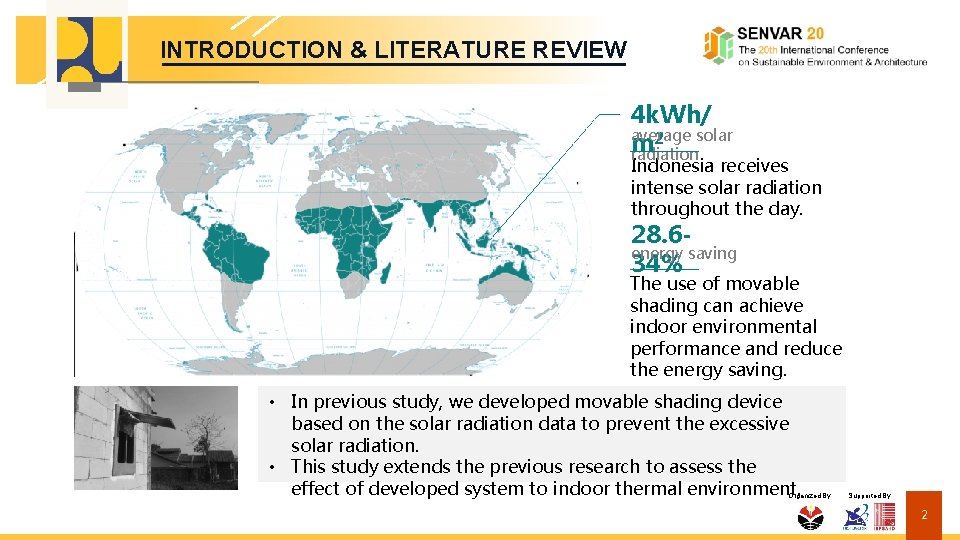
Place Your Affiliation Logo Here INTRODUCTION & LITERATURE REVIEW 4 k. Wh/ average solar 2 m radiation Indonesia receives intense solar radiation throughout the day. 28. 6 energy saving 34% The use of movable shading can achieve indoor environmental performance and reduce the energy saving. • In previous study, we developed movable shading device based on the solar radiation data to prevent the excessive solar radiation. • This study extends the previous research to assess the effect of developed system to indoor thermal environment. Organized By: Supported By: 2

Place Your Affiliation Logo Here METHODS Prototype of automated shading device Physical system • Window frame: Manglid Wood (900 mm x 700 mm) • Window pane: corrugated plastic (560 mm x 500 mm) Mechanical system • Motor DC Stepper (torque value of 3. 6 Nm) for loading up to 1. 2 kg Sensor and acquisition data system • TSL 2561 (lux meter) with accuracy R 2 of 0. 86 *Solar radiation can be represented by illuminance (1 W/m 2 = 100 lux) • Arduino Mega 2560 (microcontroller) Control system The motor stepper enabled moving the Control algorithm implemented using Arduino window pane without any significant IDE interferences and obstructions Organized By: Supported By: 3
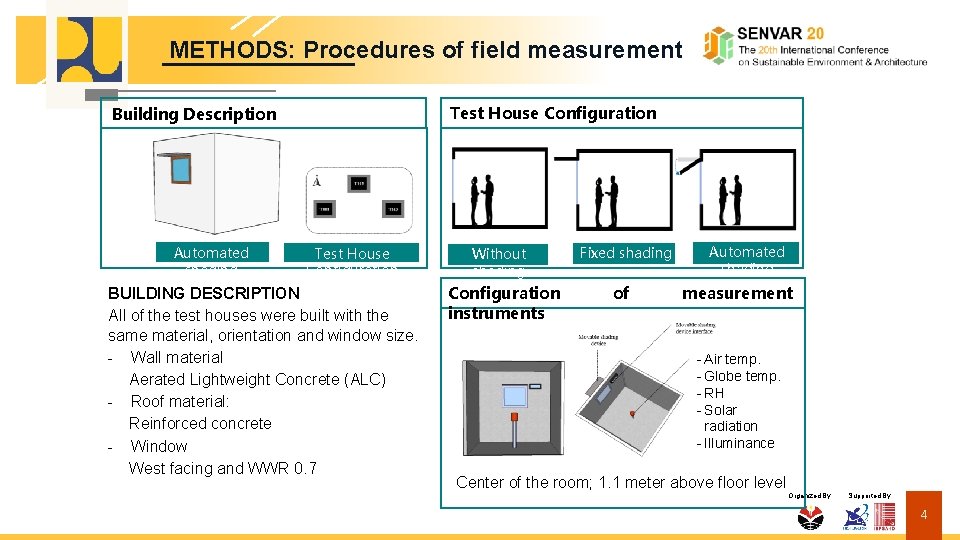
Place Your Affiliation Logo Here METHODS: Procedures of field measurement Test House Configuration Building Description Automated shading Test House Configuration BUILDING DESCRIPTION All of the test houses were built with the same material, orientation and window size. - Wall material Aerated Lightweight Concrete (ALC) - Roof material: Reinforced concrete - Window West facing and WWR 0. 7 Without shading Configuration instruments Fixed shading of Automated shading measurement - Air temp. - Globe temp. - RH - Solar radiation - Illuminance Center of the room; 1. 1 meter above floor level Organized By: Supported By: 4
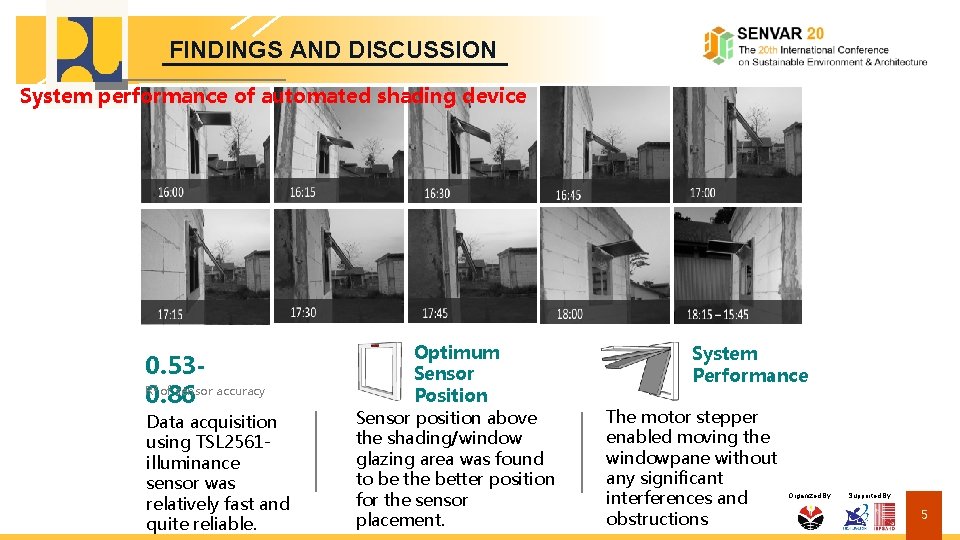
Place Your Affiliation Logo Here FINDINGS AND DISCUSSION System performance of automated shading device 0. 53 R of sensor accuracy 0. 86 2 Data acquisition using TSL 2561 illuminance sensor was relatively fast and quite reliable. Optimum Sensor Position Sensor position above the shading/window glazing area was found to be the better position for the sensor placement. System Performance The motor stepper enabled moving the windowpane without any significant interferences and obstructions Organized By: Supported By: 5
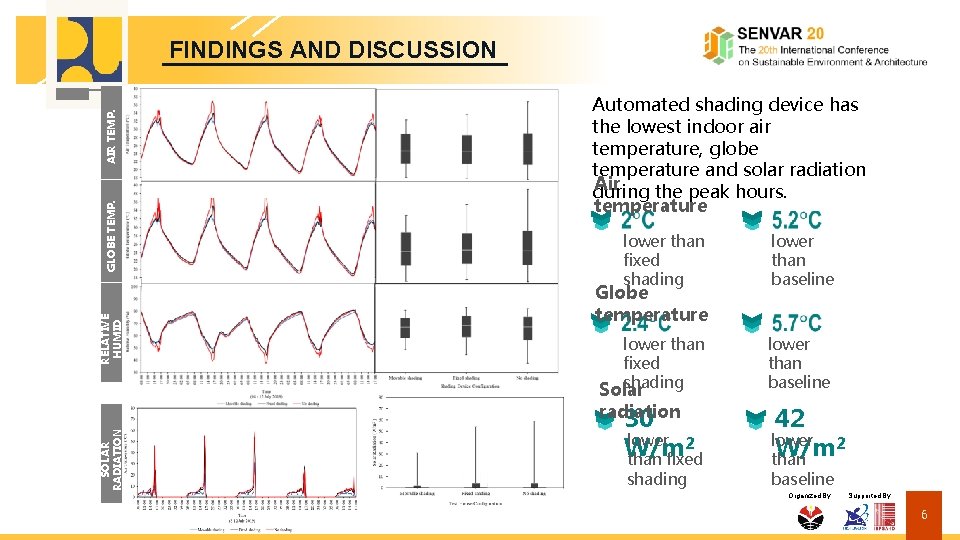
RELATIVE HUMID GLOBE TEMP. AIR TEMP. Place Your Affiliation Logo Here FINDINGS AND DISCUSSION Automated shading device has the lowest indoor air temperature, globe temperature and solar radiation Air during the peak hours. temperature lower than fixed shading Globe temperature lower than fixed shading lower than baseline 30 lower 2 W/m than fixed 42 lower 2 W/m than Solar radiation SOLAR RADIATION lower than baseline shading baseline Organized By: Supported By: 6
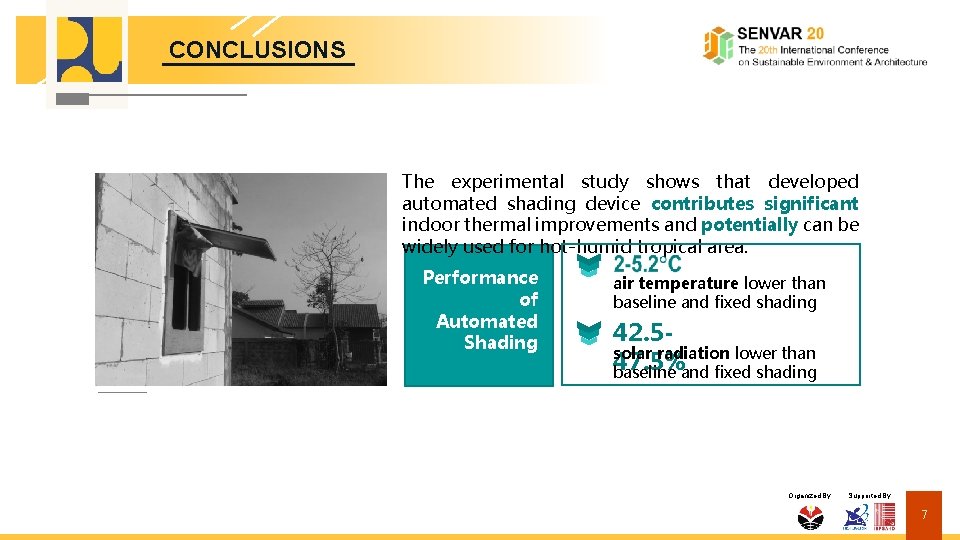
Place Your Affiliation Logo Here CONCLUSIONS The experimental study shows that developed automated shading device contributes significant indoor thermal improvements and potentially can be widely used for hot-humid tropical area. Performance air temperature lower than of baseline and fixed shading Automated 42. 5 Shading solar radiation lower than 47. 5% baseline and fixed shading Organized By: Supported By: 7
Place Your Affiliation Logo Here REFERENCES 1. Grynning, S. , Gustavsen, A. , Time, B. , Jelle, B. : Windows in the buildings of tomorrow: energy losers or energy gainers? Energy and Buildings; 2013; 61; 185 – 192. 2. Energy Information Administration: Residential Energy Consumption Survey 1993, Housing Characteristic; 1995; 93. 3. Freewan, A. : Impact of eksternal shading devices on thermal and daylighting performance of offices in hot humid climate regions, Solar Energy; 2014; 102; 14 -30. 4. Yu J. , Yang C. , Tian L. : Low-energy envelope design of residential building in hot summer and cold winter zone in China, Energy and Buildings; 2008; 40; 1536 -1546. 5. Yao, J. : An investigation into the impact of movable solar shades on energy, indoor thermal and visual comfort improvements. Building and Environment; 2014; 71; 24 -32. 6. Paramita, B. , Fukuda, H. , Khidmat, RP. , Matzarakis, A. : Building configuration of low-cost apartments in Bandung- Its contribution to the microclimate and outdoor thermal comfort, Buildings; 2018; 8(9). 7. Choi, S. J. , Lee, D. S. , Hun, J. J. : Lighting and cooling energy assesment of multi-purpose control strategies for external movable shading devices by using shaded fraction, Energy and Building; 2017; 150; 328 – 338. 8. Manzan, M. : Genetic optimization of external fixed shading devices, Energy and Building; 2014; 72; 431 – 440. 9. Hashemi, A. : Daylighting and solar shading performances of an innovative automated reflective louvre system, Energy and Buildings; 2014; 82; 607 – 620. 10. Hammad, F. , Abu-Hijleh, B. : The energy savings potential of using dynamic external louvers in an office building, Energy and Buildings; 2010; 42; 1888 -1895 11. Nurjannah, A. , Alfata, M. N. F. : Prototype of automated shading device: preliminary development, Engineering Journal; 2020; 24(4); 229 -238. 12. Szokolay, S. Introduction to Architectural Science: The Basis of Sustainable Design, Architectural Press; 2004; Oxford. Organized By: Supported By: 8
The 20 th International Conference on Sustainable Environment & Architecture Thank You Presenter Affiliation: Organized By: Supported By:
- Slides: 9