
The 18 th Century Enlightenment THE AGE OF



- Slides: 17
The 18 th Century Enlightenment THE AGE OF REASON
Defining the Enlightenment The Enlightenment is known as the “age of reason” Individuals began applying a “common sense” approach to everyday life instead of simply believing everything was controlled by God and religion. A more complex definition is: The age of reason, when people moved away from religious fundamentalism and toward secular reasoning. (Secular means “not religious”)
What is reason? justification: an explanation or justification for something motive: a motive or cause for acting or thinking in a particular way cause that explains something: a cause that explains a particular phenomenon Ready for a quiz on reason? Here we go!
Question 1 If you fall off your bike and get a bad scrape, what do you do to prevent infection? A. Wash it with soap and warm water, apply a medicated cream then bandage it. B. Take no action, but pray to God (or whatever deity in which you believe) and trust in him/her/it. C. Do nothing because you’re wicked tough. D. Rub dirt on it.
Answer to Question 1 The answer is “A” A reasonable human being knows that to prevent infection, one must clean a bad scrape and use an antibiotic cream to fight bacteria and infection. If you pray to a ‘higher being’ you may escape infection, but odds are, you won’t because you didn’t physically clean it and bandage it. As tough as you think you are, when you wake up the next morning with a blood and puss filled wound, you’ll be crying for your mother. Rubbing dirt on it is the opposite of what you should do to avoid infection. Prepare to have that thing amputated within two weeks.
Causes of the Enlightenment Once upon a time, people believed everything and everyone was created and controlled by God or Gods. In the Christian faith, the bible was absolute. Kings and Queens were thought to be “divine, ” or chosen by God to rule. If a King or Queen were chosen and empowered by God, could they ever be wrong? But, some people began to believe that maybe there was more to the physical world than simply believing everything as controlled by God. People began to apply reason to science, politics, society and religion.
Causes of the Enlightenment 1. The Scientific Revolution In the 15, 16, and 17 hundreds, thinkers, astronomers, scientists and biologists and others began experimenting with the physical world to truly figure out the “laws of nature”, or the rules that govern human existence. Here are some of the most famous people of the Scientific Revolution…
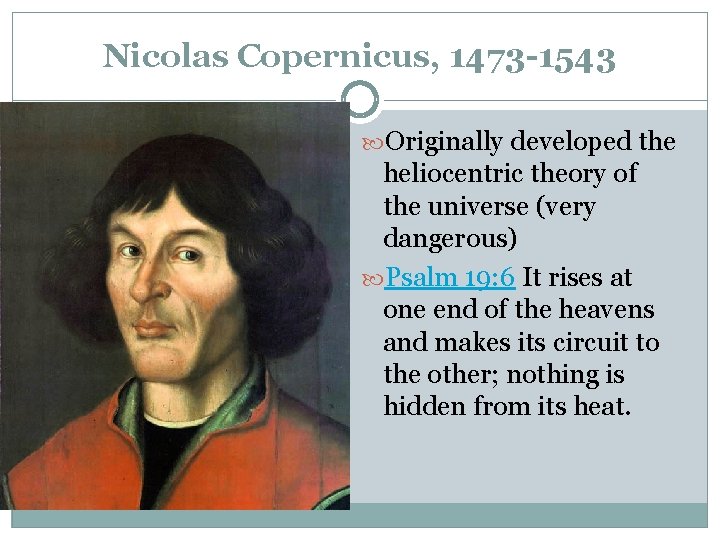
Nicolas Copernicus, 1473 -1543 Originally developed the heliocentric theory of the universe (very dangerous) Psalm 19: 6 It rises at one end of the heavens and makes its circuit to the other; nothing is hidden from its heat.
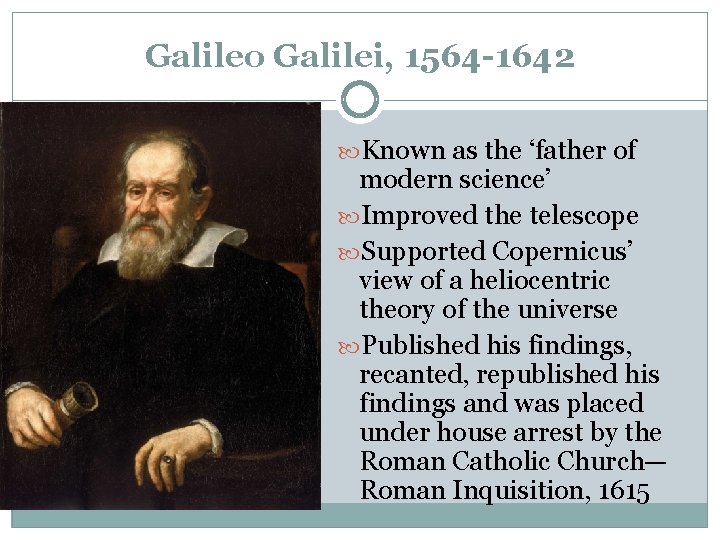
Galileo Galilei, 1564 -1642 Known as the ‘father of modern science’ Improved the telescope Supported Copernicus’ view of a heliocentric theory of the universe Published his findings, recanted, republished his findings and was placed under house arrest by the Roman Catholic Church— Roman Inquisition, 1615
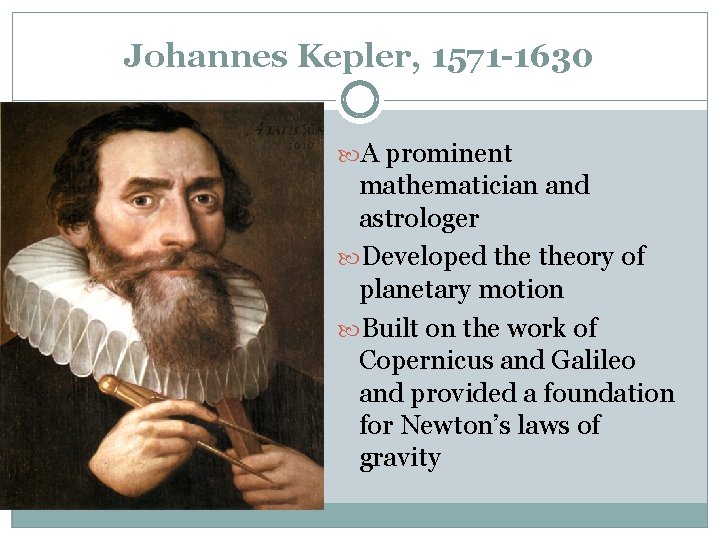
Johannes Kepler, 1571 -1630 A prominent mathematician and astrologer Developed theory of planetary motion Built on the work of Copernicus and Galileo and provided a foundation for Newton’s laws of gravity
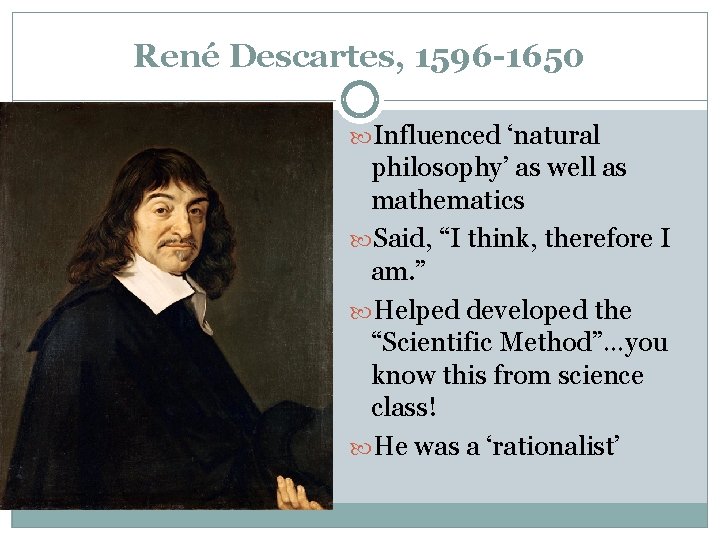
René Descartes, 1596 -1650 Influenced ‘natural philosophy’ as well as mathematics Said, “I think, therefore I am. ” Helped developed the “Scientific Method”…you know this from science class! He was a ‘rationalist’
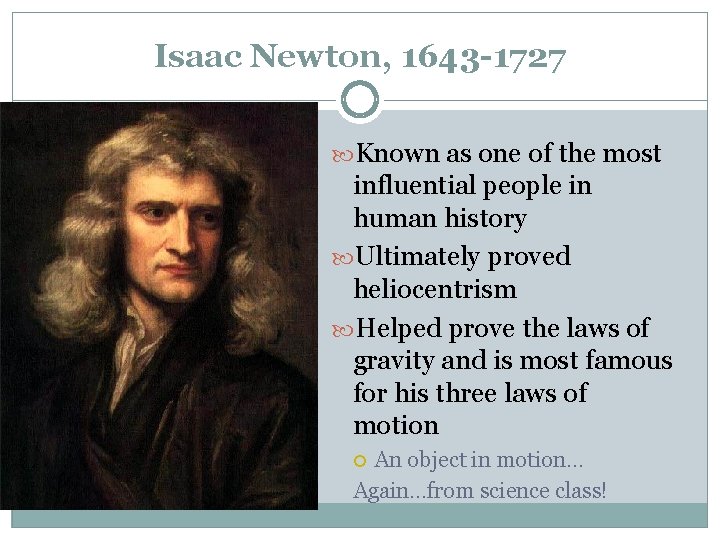
Isaac Newton, 1643 -1727 Known as one of the most influential people in human history Ultimately proved heliocentrism Helped prove the laws of gravity and is most famous for his three laws of motion An object in motion… Again…from science class!
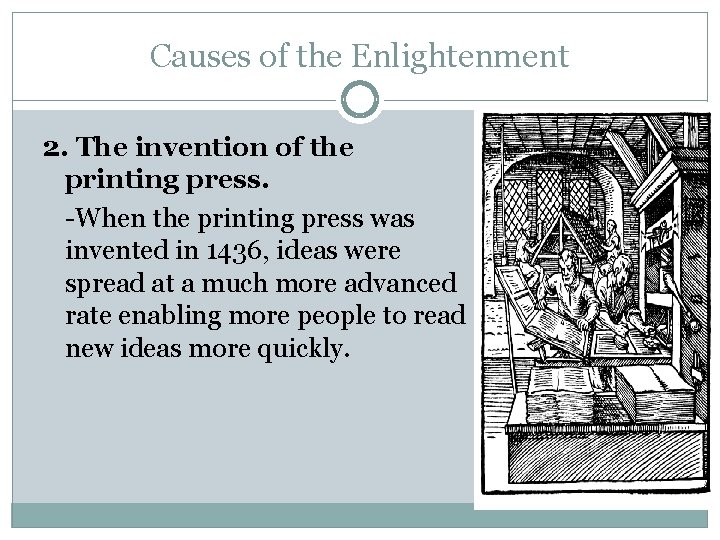
Causes of the Enlightenment 2. The invention of the printing press. -When the printing press was invented in 1436, ideas were spread at a much more advanced rate enabling more people to read new ideas more quickly.
Causes of the Enlightenment 3. Abuse of Leadership -Kings and Queens would act more like tyrants. They would use and abuse their subjects. -If Kings and Queens were divine (chosen by God) why were they bad? Why did they treat their subjects poorly? Did God want these people to suffer? -Caste system—People were not allowed to rise up in society. If they were born into money and title, they had money and title; if they were born into poverty, they were peasants forever. Is this fundamentally just? (right/acceptable/OK)
Causes of the Enlightenment 4. Abuses of the church -As stated before, the church had a tremendous amount of power. -They almost always worked with the King/Queen to rule the kingdom or at least influence them greatly -Indulgences and Simony -Pay for Pray ($$$$) -Wanna buy a crucifix?
Power. Point Summary �The Enlightenment is the Age of Reason when people started thinking more secularly (non-religiously). �The Scientific Revolution was the main cause of the Enlightenment �Scientists started experimenting with the physical world and didn’t just credit God and religion as the reason for everything �The invention of the printing press helped spread the ideas of the Scientific Revolution and the Enlightenment �Abuses of Kings/Queens and the Church turned people away from the “old regime” and drove them toward wanting change!
Video