
The 13 Colonies Exploring the who when where


- Slides: 40
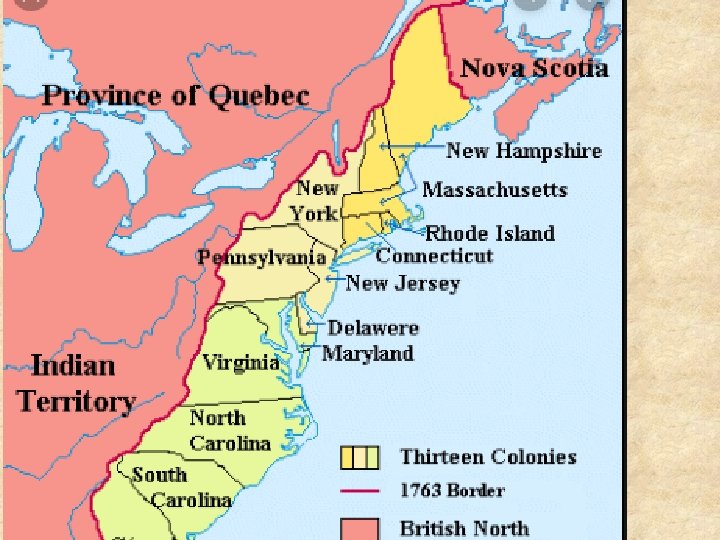
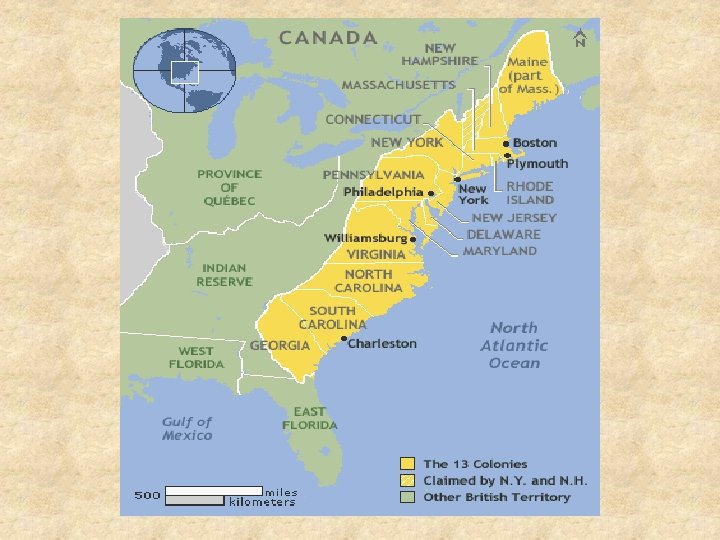
The 13 Colonies Exploring the who, when, where, and why behind the 13 original colonies of early America.
Instructional Objectives • Why were there British colonies in North America? • How long were they there before the Revolution? • Why did the colonists want change by the 1750 s? • Do not copy the following notes word for word. Write your own notes in a way that makes sense for you!
What’s going on in England? • In the years leading up to 1600 s, wealthy land owners could make more money from selling wool than from selling food. They converted farmers’ fields into pastures for sheep. This led to a food shortage; at the same time, many agricultural workers lost their jobs. People were displaced from the land, unemployed, and hungry… • The official Church of England didn’t tolerate other religions, and even within the official church there were groups who wanted the church to be more strict… • The King (and his church) were taxing people more and more…Land Tax, Excise Tax, Luxury Tax…everything had a tax that went to the King and his government.
What’s it to you? • What would it be like to start a new town? • What kind of obstacles would you face? • Would you have enough support to do it? • Who would pay for everything? What do you think?
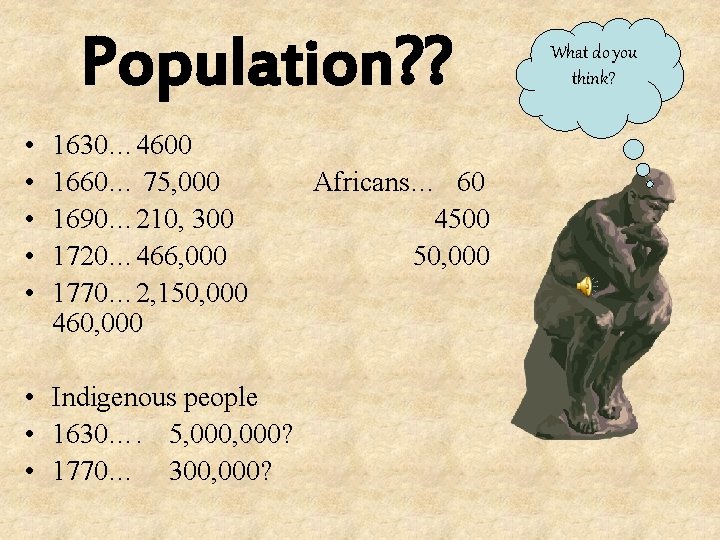
Population? ? • • • 1630… 4600 1660… 75, 000 1690… 210, 300 1720… 466, 000 1770… 2, 150, 000 460, 000 • Indigenous people • 1630…. 5, 000? • 1770… 300, 000? Africans… 60 4500 50, 000 What do you think?
Population? ? • • • 1630… 4600 1660… 75, 000 1690… 210, 300 1720… 466, 000 1770… 2, 150, 000 460, 000 • Indigenous people • 1630…. 5, 000? • 1770… 300, 000? Africans… 60 4500 50, 000
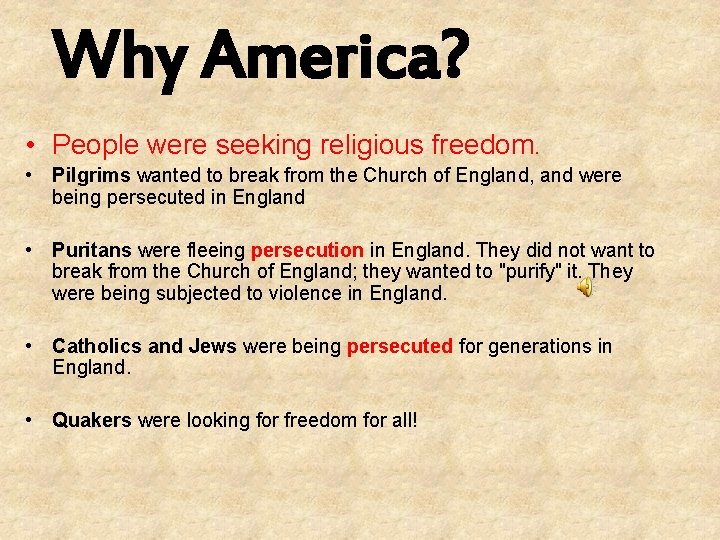
Why America? • People were seeking religious freedom. • Pilgrims wanted to break from the Church of England, and were being persecuted in England • Puritans were fleeing persecution in England. They did not want to break from the Church of England; they wanted to "purify" it. They were being subjected to violence in England. • Catholics and Jews were being persecuted for generations in England. • Quakers were looking for freedom for all!
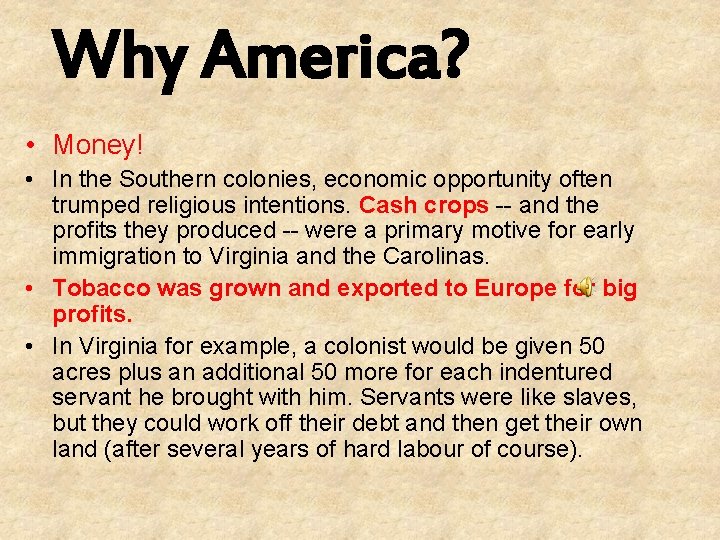
Why America? • Money! • In the Southern colonies, economic opportunity often trumped religious intentions. Cash crops -- and the profits they produced -- were a primary motive for early immigration to Virginia and the Carolinas. • Tobacco was grown and exported to Europe for big profits. • In Virginia for example, a colonist would be given 50 acres plus an additional 50 more for each indentured servant he brought with him. Servants were like slaves, but they could work off their debt and then get their own land (after several years of hard labour of course).
Why America? • Land Opportunity England was still like a feudal society. Poor people worked for rich people. The King was in charge and favored rich people. America was a place where poor people could go and escape the control of the king (or so they believed). The reality was that rich people often came to America to get richer and brought poor people to work for them. To make even more profit they began importing African slaves to do the work. Estimates suggest that as many as 6 to 7 million Africans were brought to America in the 18 th century alone. In the South, slaves often represented a significant proportion of the local population.
Let’s get Started!!!!!!!
Did you know? ? ? Children in early settlements did not go to school. The settlements could not afford to have someone teach and not work on providing food for the colonists. Instead, children helped to grow food and did chores around the house such as fetching water and mending clothes. Some children learned to read and basic math skills in the evening after the days’ work was done.
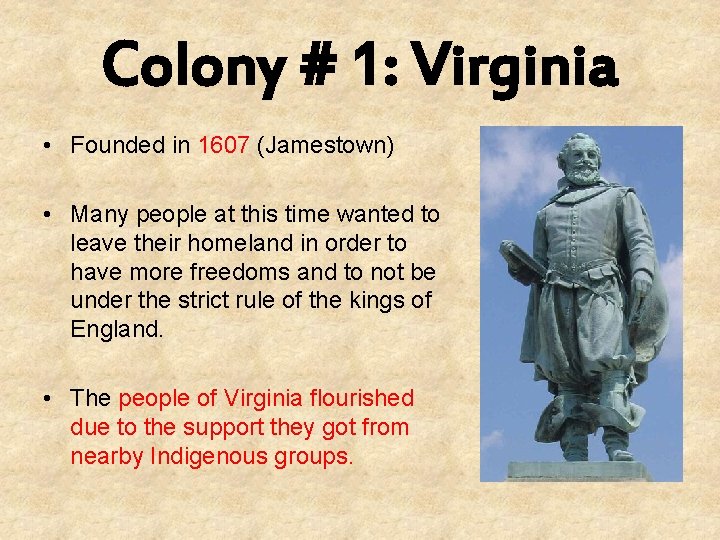
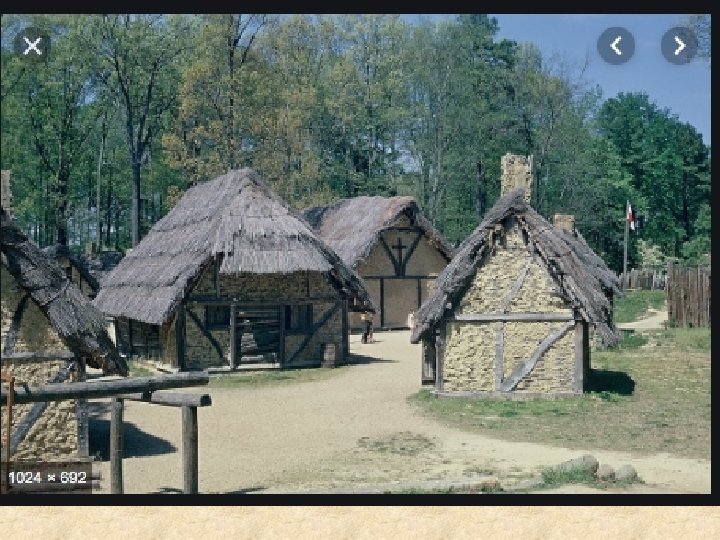
Colony # 1: Virginia • Founded in 1607 (Jamestown) • Many people at this time wanted to leave their homeland in order to have more freedoms and to not be under the strict rule of the kings of England. • The people of Virginia flourished due to the support they got from nearby Indigenous groups.
Colony # 1: Virginia • Founded in 1607 (Jamestown) • Many people at this time wanted to leave their homeland in order to have more freedoms and to not be under the strict rule of the kings of England. • The people of Virginia flourished due to the support they got from nearby Indigenous groups.
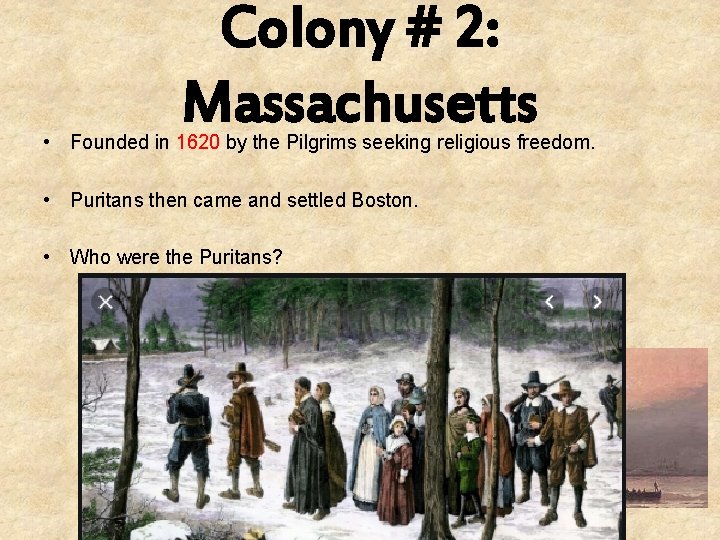
Colony # 2: Massachusetts • Founded in 1620 by the Pilgrims seeking religious freedom. • Puritans then came and settled Boston. • Who were the Puritans?
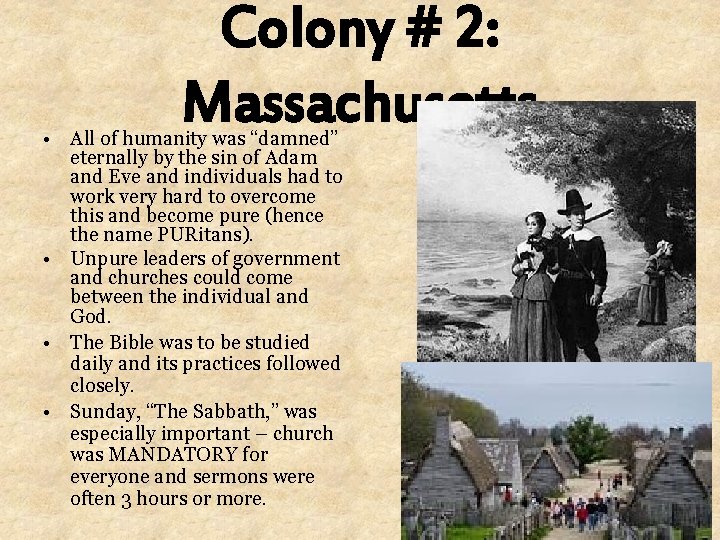
Colony # 2: Massachusetts • All of humanity was “damned” eternally by the sin of Adam and Eve and individuals had to work very hard to overcome this and become pure (hence the name PURitans). • Unpure leaders of government and churches could come between the individual and God. • The Bible was to be studied daily and its practices followed closely. • Sunday, “The Sabbath, ” was especially important – church was MANDATORY for everyone and sermons were often 3 hours or more. Plymouth Plantation, with Cape Cod Bay visible in the distance
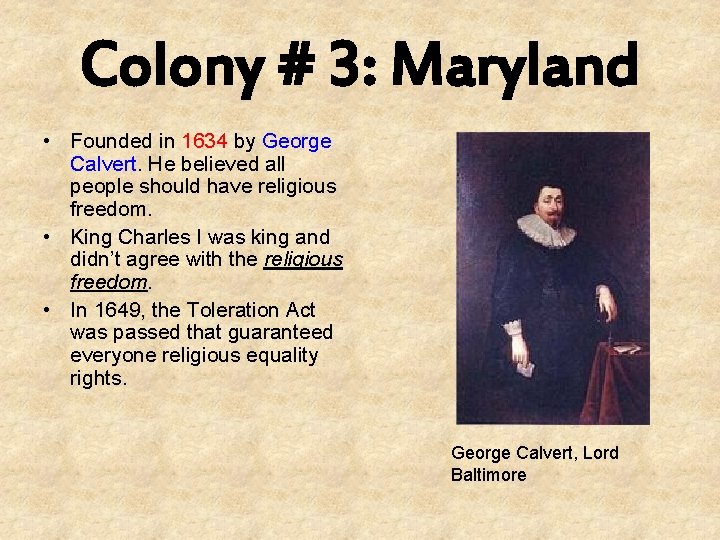
Colony # 3: Maryland • Founded in 1634 by George Calvert. He believed all people should have religious freedom. • King Charles I was king and didn’t agree with the religious freedom. • In 1649, the Toleration Act was passed that guaranteed everyone religious equality rights. George Calvert, Lord Baltimore
Colony # 3: Maryland • Founded in 1634 by George Calvert. He believed all people should have religious freedom. • King Charles I was king and didn’t agree with the religious freedom. • In 1649, the Toleration Act was passed that guaranteed everyone religious equality rights. George Calvert, Lord Baltimore
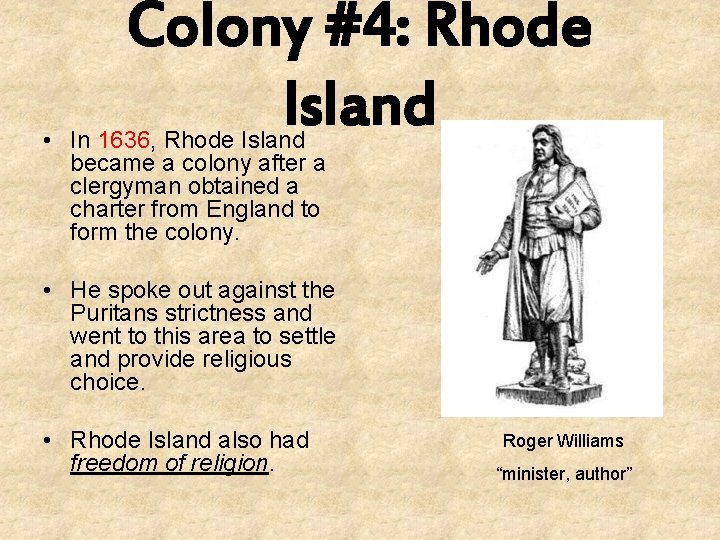
Colony #4: Rhode Island • In 1636, Rhode Island became a colony after a clergyman obtained a charter from England to form the colony. • He spoke out against the Puritans strictness and went to this area to settle and provide religious choice. • Rhode Island also had freedom of religion. Roger Williams “minister, author”
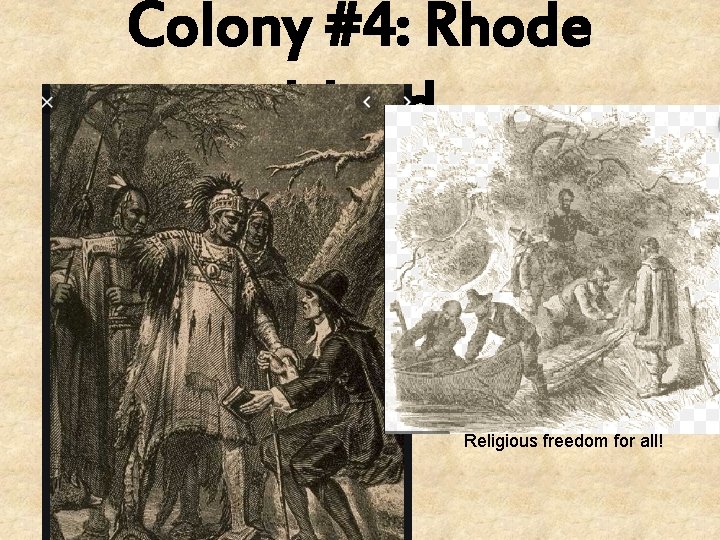
Colony #4: Rhode Island • In 1636, Rhode Island became a colony after a clergyman obtained a charter from England to form the colony. • He spoke out against the Puritans strictness and went to this area to settle and provide religious choice. • Rhode Island also had freedom of religion. Religious freedom for all!
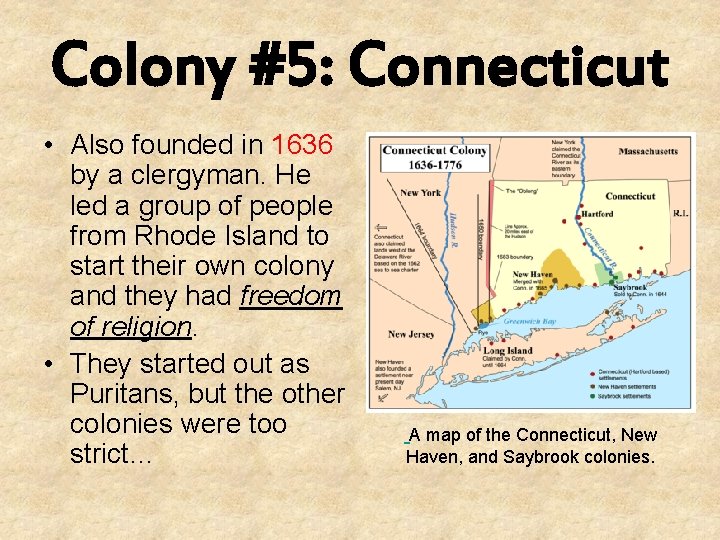
Colony #5: Connecticut • Also founded in 1636 by a clergyman. He led a group of people from Rhode Island to start their own colony and they had freedom of religion. • They started out as Puritans, but the other colonies were too strict… A map of the Connecticut, New Haven, and Saybrook colonies.
Colony #5: Connecticut • Also founded in 1636 by a clergyman. He led a group of people from Rhode Island to start their own colony and they had freedom of religion. • They started out as Puritans, but the other colonies were to strict. A map of the Connecticut, New Haven, and Saybrook colonies.
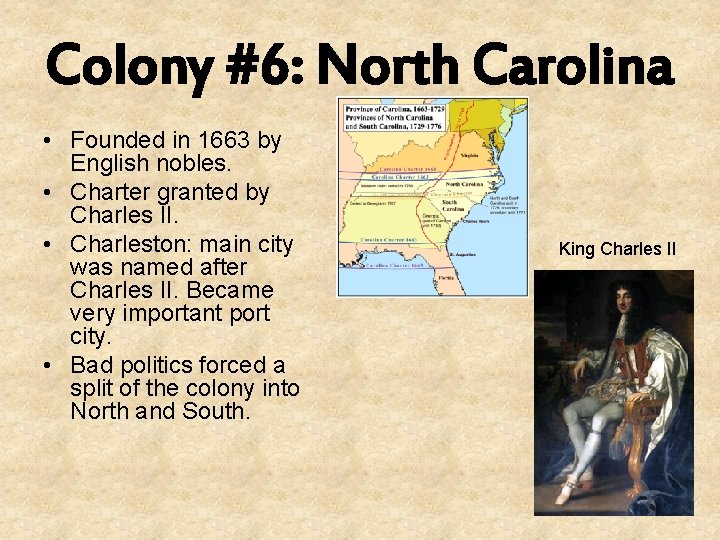
Colony #6: North Carolina • Founded in 1663 by English nobles. • Charter granted by Charles II. • Charleston: main city was named after Charles II. Became very important port city. • Bad politics forced a split of the colony into North and South. King Charles II
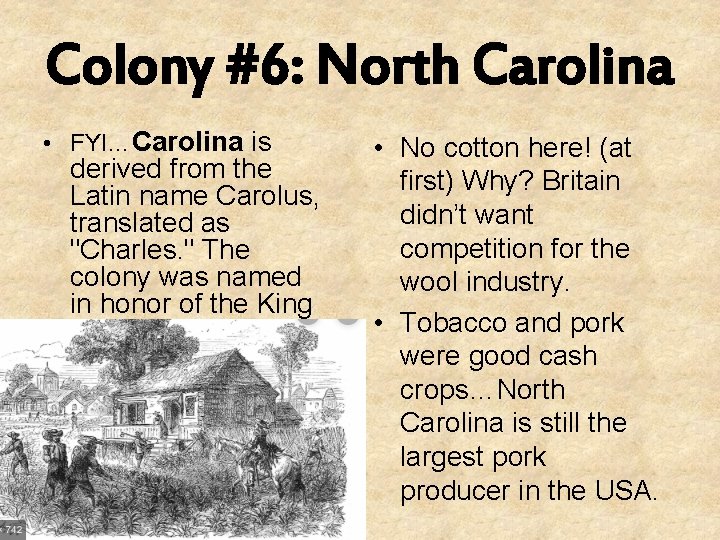
Colony #6: North Carolina • FYI…Carolina is derived from the Latin name Carolus, translated as "Charles. " The colony was named in honor of the King • No cotton here! (at first) Why? Britain didn’t want competition for the wool industry. • Tobacco and pork were good cash crops…North Carolina is still the largest pork producer in the USA.
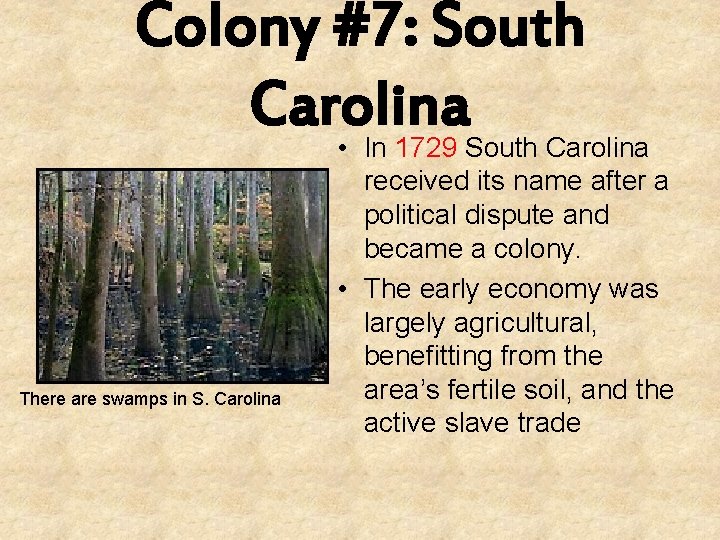
Colony #7: South Carolina There are swamps in S. Carolina • In 1729 South Carolina received its name after a political dispute and became a colony. • The early economy was largely agricultural, benefitting from the area’s fertile soil, and the active slave trade
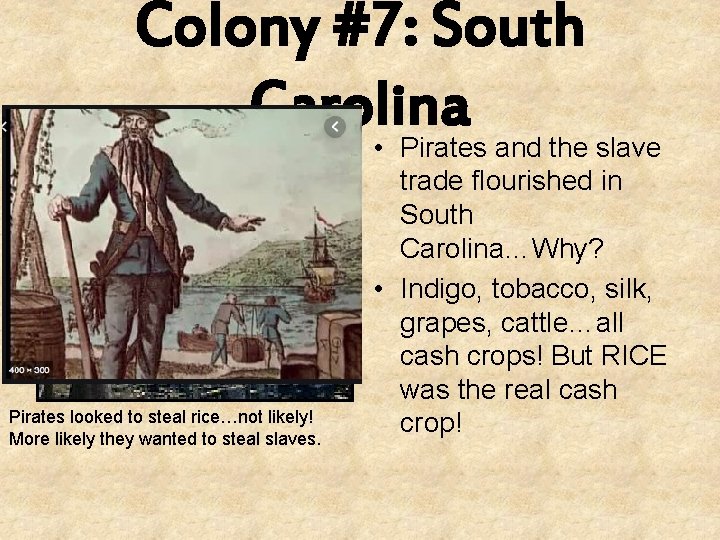
Colony #7: South Carolina Pirates looked to steal rice…not likely! More likely they wanted to steal slaves. • Pirates and the slave trade flourished in South Carolina…Why? • Indigo, tobacco, silk, grapes, cattle…all cash crops! But RICE was the real cash crop!
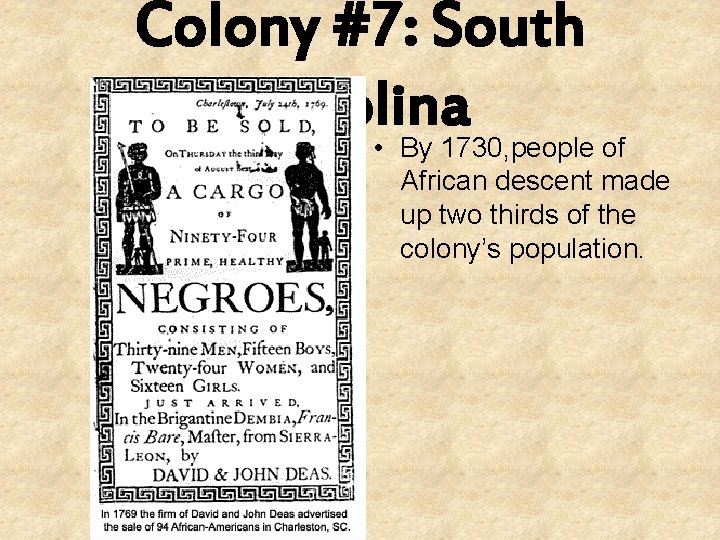
Colony #7: South Carolina • By 1730, people of African descent made up two thirds of the colony’s population.
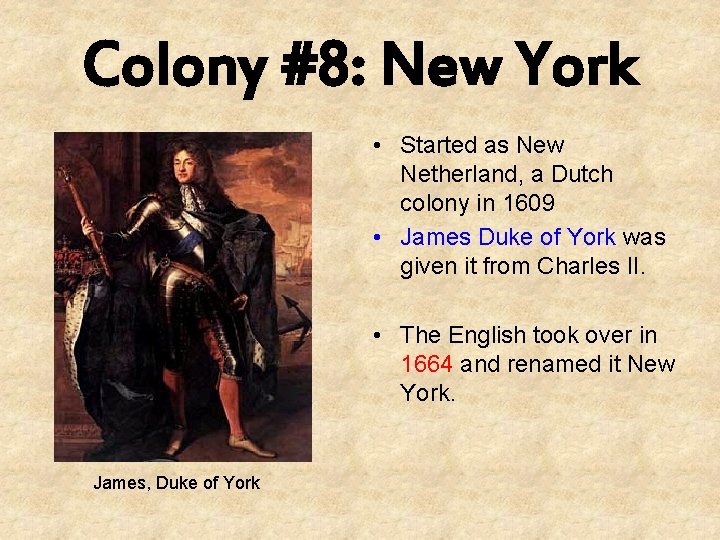
Colony #8: New York • Started as New Netherland, a Dutch colony in 1609 • James Duke of York was given it from Charles II. • The English took over in 1664 and renamed it New York. James, Duke of York
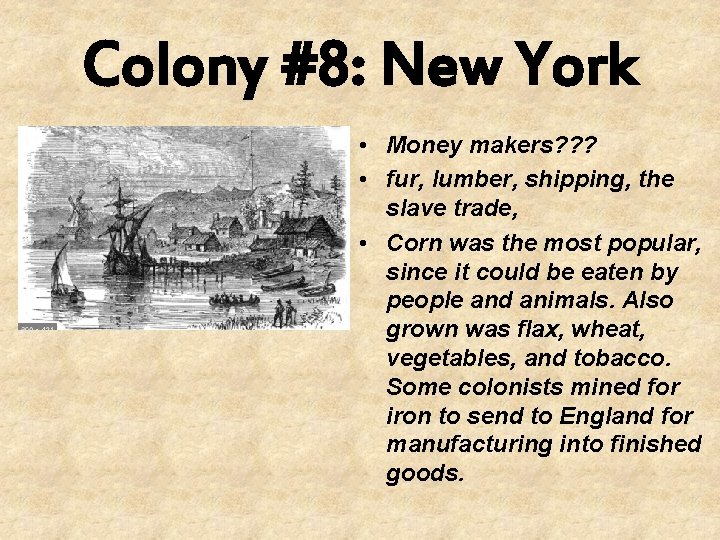
Colony #8: New York • Money makers? ? ? • fur, lumber, shipping, the slave trade, • Corn was the most popular, since it could be eaten by people and animals. Also grown was flax, wheat, vegetables, and tobacco. Some colonists mined for iron to send to England for manufacturing into finished goods.
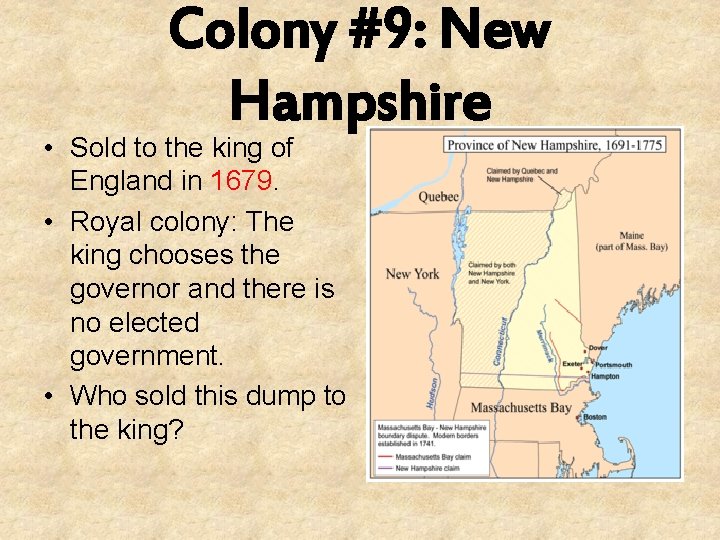
Colony #9: New Hampshire • Sold to the king of England in 1679. • Royal colony: The king chooses the governor and there is no elected government. • Who sold this dump to the king?
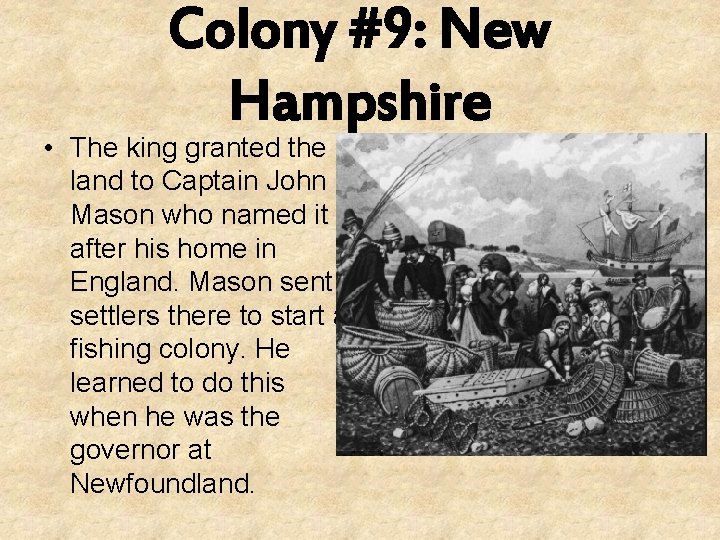
Colony #9: New Hampshire • The king granted the land to Captain John Mason who named it after his home in England. Mason sent settlers there to start a fishing colony. He learned to do this when he was the governor at Newfoundland.
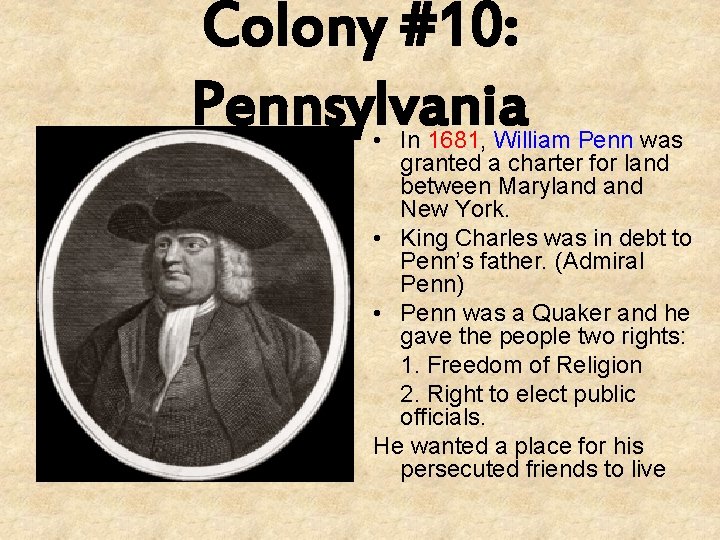
Colony #10: Pennsylvania • In 1681, William Penn was granted a charter for land between Maryland New York. • King Charles was in debt to Penn’s father. (Admiral Penn) • Penn was a Quaker and he gave the people two rights: 1. Freedom of Religion 2. Right to elect public officials. He wanted a place for his persecuted friends to live
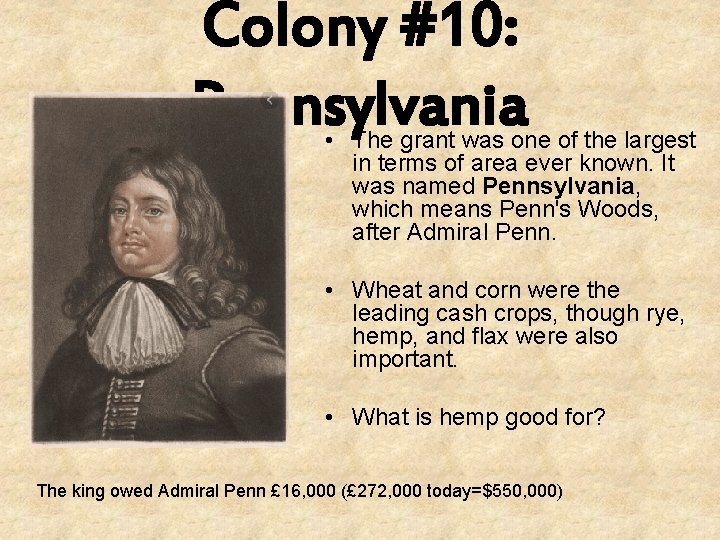
Colony #10: Pennsylvania • The grant was one of the largest in terms of area ever known. It was named Pennsylvania, which means Penn's Woods, after Admiral Penn. • Wheat and corn were the leading cash crops, though rye, hemp, and flax were also important. • What is hemp good for? The king owed Admiral Penn £ 16, 000 (£ 272, 000 today=$550, 000)
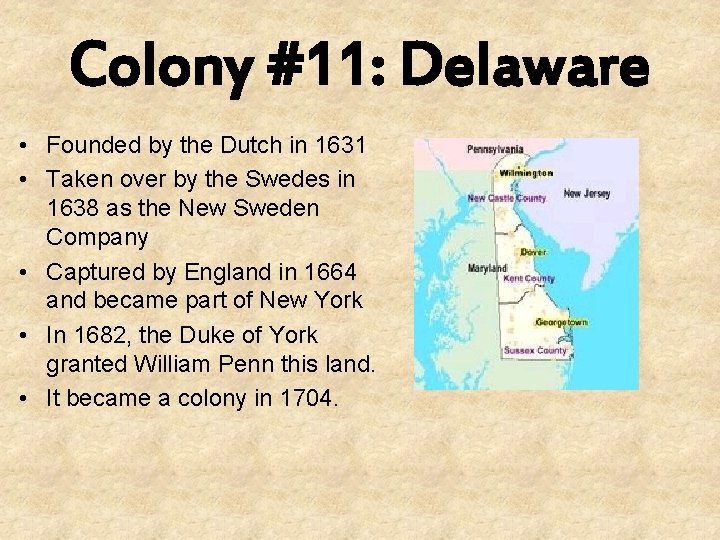
Colony #11: Delaware • Founded by the Dutch in 1631 • Taken over by the Swedes in 1638 as the New Sweden Company • Captured by England in 1664 and became part of New York • In 1682, the Duke of York granted William Penn this land. • It became a colony in 1704.
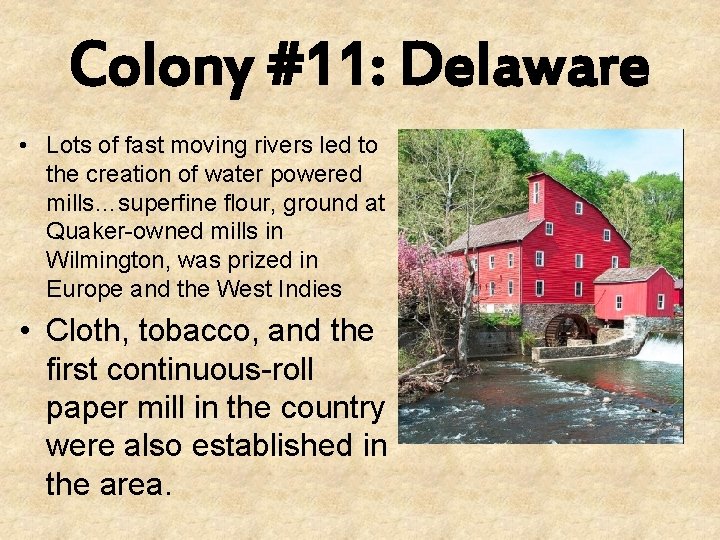
Colony #11: Delaware • Lots of fast moving rivers led to the creation of water powered mills…superfine flour, ground at Quaker-owned mills in Wilmington, was prized in Europe and the West Indies • Cloth, tobacco, and the first continuous-roll paper mill in the country were also established in the area.
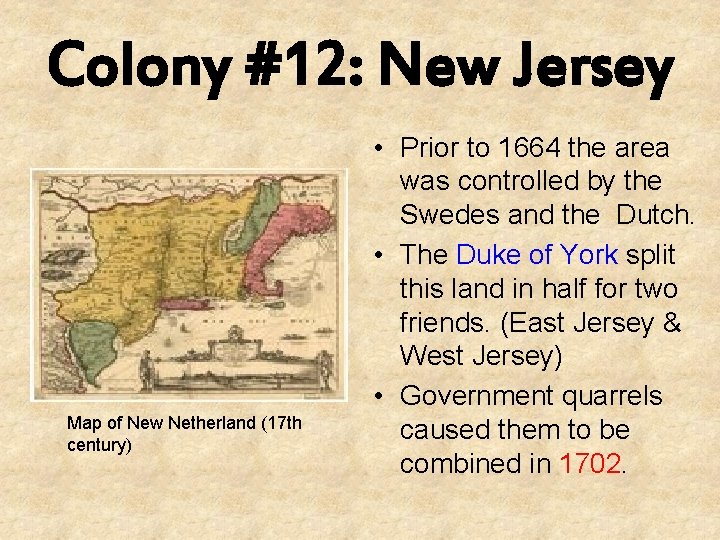
Colony #12: New Jersey Map of New Netherland (17 th century) • Prior to 1664 the area was controlled by the Swedes and the Dutch. • The Duke of York split this land in half for two friends. (East Jersey & West Jersey) • Government quarrels caused them to be combined in 1702.
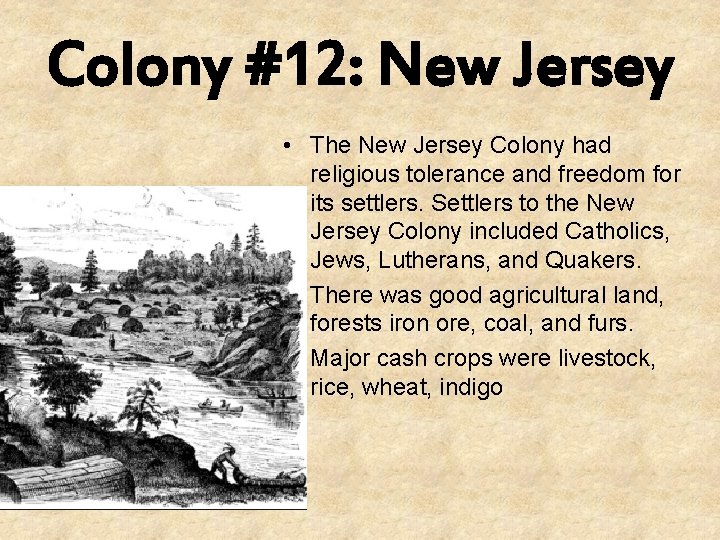
Colony #12: New Jersey • The New Jersey Colony had religious tolerance and freedom for its settlers. Settlers to the New Jersey Colony included Catholics, Jews, Lutherans, and Quakers. • There was good agricultural land, forests iron ore, coal, and furs. • Major cash crops were livestock, rice, wheat, indigo
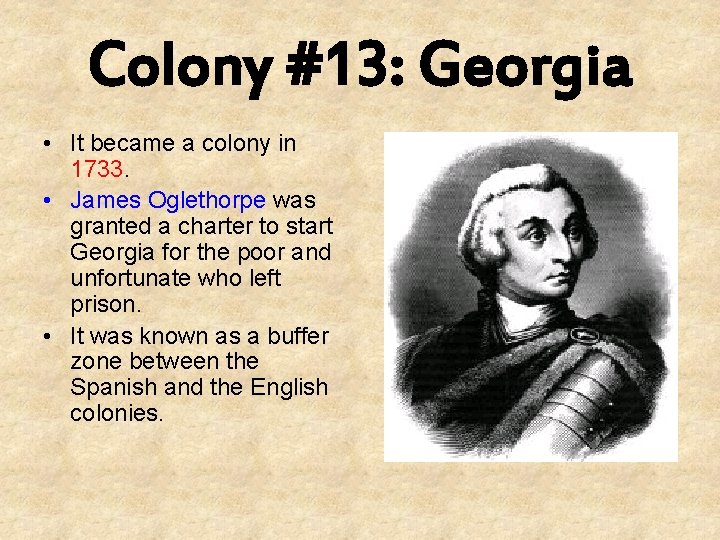
Colony #13: Georgia • It became a colony in 1733. • James Oglethorpe was granted a charter to start Georgia for the poor and unfortunate who left prison. • It was known as a buffer zone between the Spanish and the English colonies.
The 13 Originals (Conclusion) • What was the big thing most people wanted when these new colonies were started?
Great Job!!!