
The 12 th lecture in molecular biology RNA
The 12 th lecture in molecular biology RNA transcription & Post transcription events
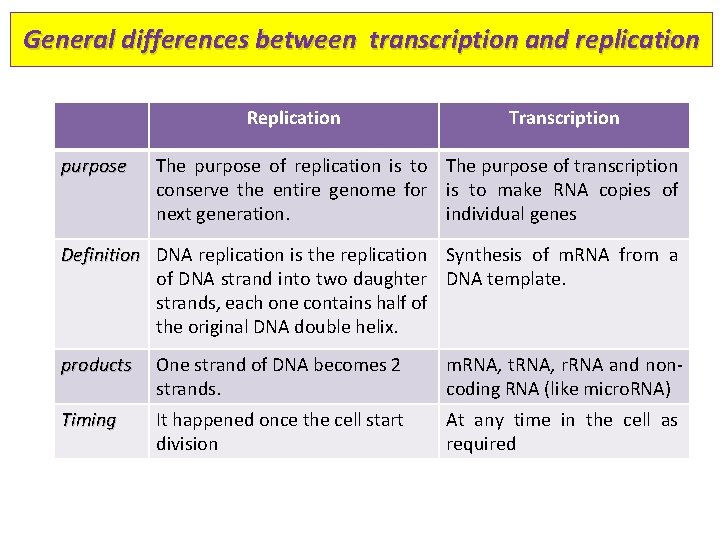
General differences between transcription and replication Replication purpose Transcription The purpose of replication is to The purpose of transcription conserve the entire genome for is to make RNA copies of next generation. individual genes Definition DNA replication is the replication Synthesis of m. RNA from a of DNA strand into two daughter DNA template. strands, each one contains half of the original DNA double helix. products One strand of DNA becomes 2 strands. m. RNA, t. RNA, r. RNA and noncoding RNA (like micro. RNA) Timing It happened once the cell start division At any time in the cell as required
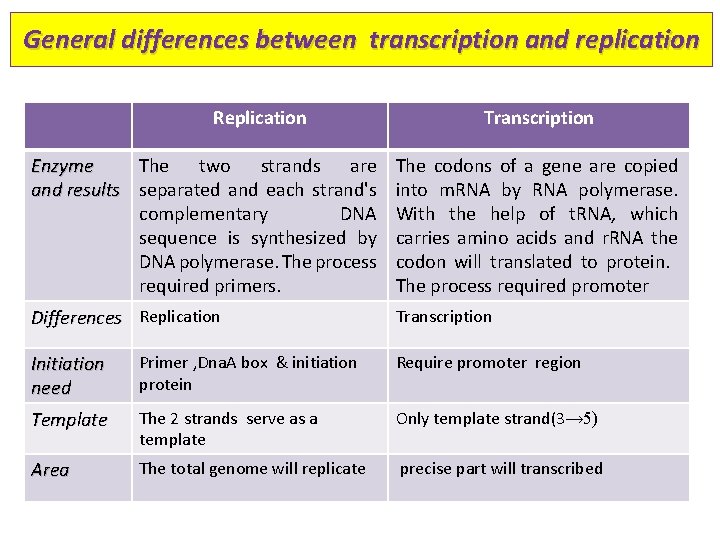
General differences between transcription and replication Replication Transcription Enzyme The two strands are and results separated and each strand's complementary DNA sequence is synthesized by DNA polymerase. The process required primers. The codons of a gene are copied into m. RNA by RNA polymerase. With the help of t. RNA, which carries amino acids and r. RNA the codon will translated to protein. The process required promoter Differences Replication Transcription Initiation need Primer , Dna. A box & initiation protein Require promoter region Template The 2 strands serve as a template Only template strand(3→ 5) Area The total genome will replicate precise part will transcribed
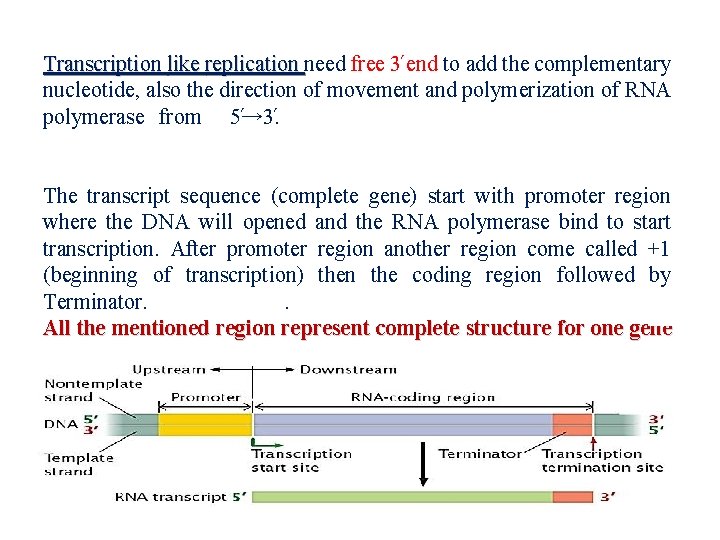
Transcription like replication need free 3 end to add the complementary nucleotide, also the direction of movement and polymerization of RNA polymerase from 5 → 3. . The transcript sequence (complete gene) start with promoter region where the DNA will opened and the RNA polymerase bind to start transcription. After promoter region another region come called +1 (beginning of transcription) then the coding region followed by Terminator. . All the mentioned region represent complete structure for one gene
Identifications… promoter: a regulatory nucleotide sequences of DNA (40 -60 nts) at the beginning of every gene located upstream (towards the 5' region) of a gene (in prokaryote more than one gene shard the same promoter unlike Eukaryotic cell ), in this site the two DNA strand will opened but it is un translated area by providing a control point for regulated gene transcription. In prokaryotes, the promoter is recognized by RNA polymerase (δ sigma sub unite), this sub unit has a great affinity to bind to this region. There are great differences between promoter area of prokaryotic and Eukaryotic cell as it is divided to many sub regions.
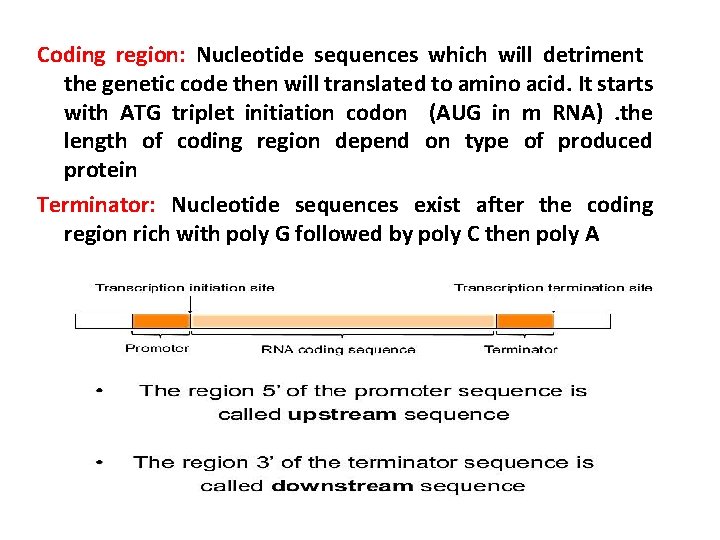
Coding region: Nucleotide sequences which will detriment the genetic code then will translated to amino acid. It starts with ATG triplet initiation codon (AUG in m RNA). the length of coding region depend on type of produced protein Terminator: Nucleotide sequences exist after the coding region rich with poly G followed by poly C then poly A
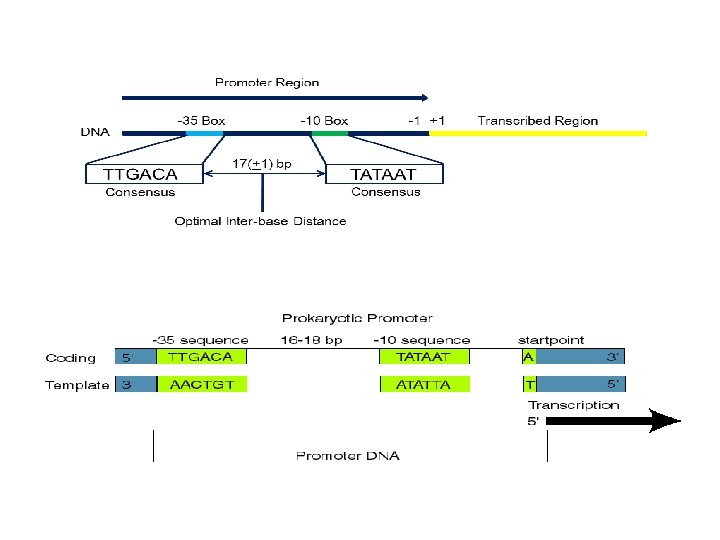
Difference between Eukaryotic and Prokaryotic Promoters Prokaryotic promoters… The promoter consists of two short sequences know as -10 box and -35 box positions upstream from the transcription start site. • The sequence at -10 box is also known as -10 elements or the Pribnow box (according to David Pribnow how discover this elements), and usually consists of the six nucleotides TATAAT. The Pribnow box is absolutely essential to start transcription in prokaryotes since it rich with T & A nitrogen bases. • The other sequence is -35 box ( -35 element) usually consists of the six nucleotides TTGACA. RNA polymerase attached here via its sigma unit. The two boxes separated by 17 ± 1 base pairs. The promoter region will not translate to protein
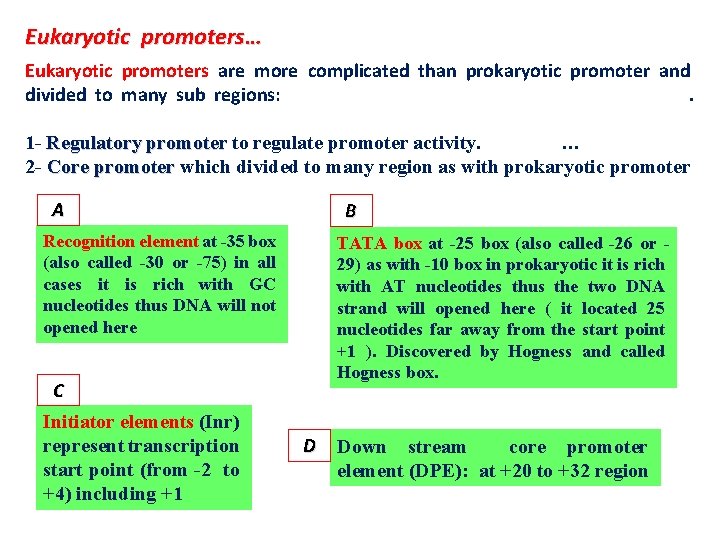
Eukaryotic promoters… Eukaryotic promoters are more complicated than prokaryotic promoter and divided to many sub regions: . 1 - Regulatory promoter to regulate promoter activity. … 2 - Core promoter which divided to many region as with prokaryotic promoter A B Recognition element at -35 box (also called -30 or -75) in all cases it is rich with GC nucleotides thus DNA will not opened here TATA box at -25 box (also called -26 or 29) as with -10 box in prokaryotic it is rich with AT nucleotides thus the two DNA strand will opened here ( it located 25 nucleotides far away from the start point +1 ). Discovered by Hogness and called Hogness box. C Initiator elements (Inr) represent transcription start point (from -2 to +4) including +1 D Down stream core promoter element (DPE): at +20 to +32 region
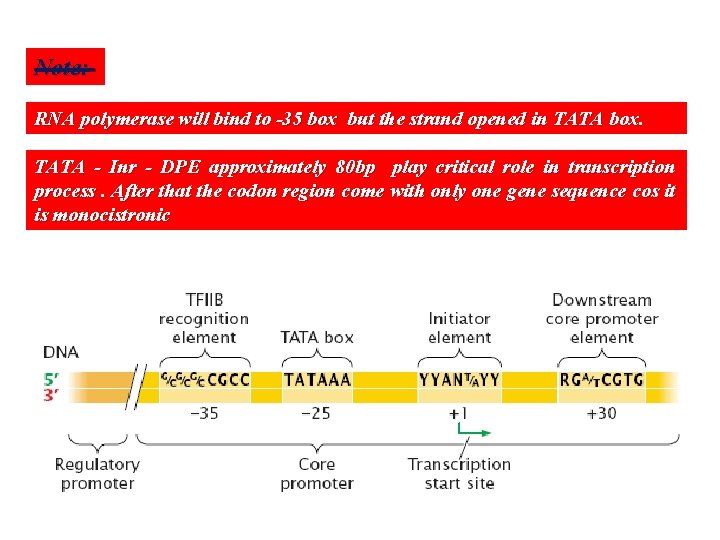
Note: RNA polymerase will bind to -35 box but the strand opened in TATA box. TATA - Inr - DPE approximately 80 bp play critical role in transcription process. After that the codon region come with only one gene sequence cos it is monocistronic
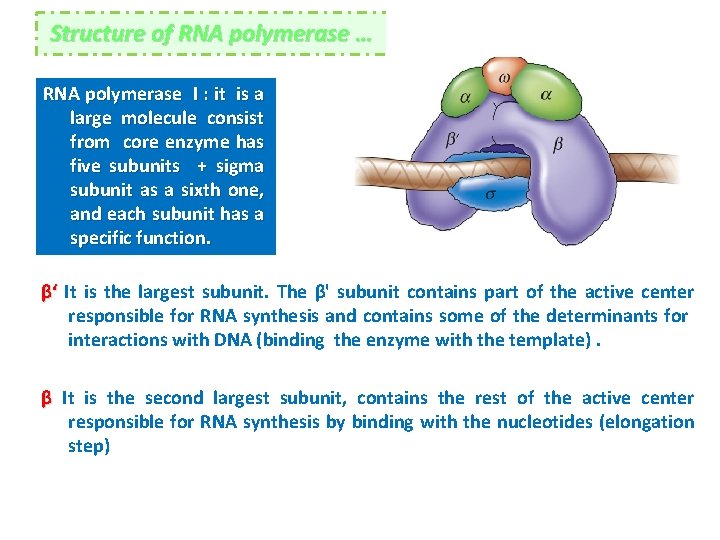
Structure of RNA polymerase … RNA polymerase I : it is a large molecule consist from core enzyme has five subunits + sigma subunit as a sixth one, and each subunit has a specific function. β‘ It is the largest subunit. The β' subunit contains part of the active center responsible for RNA synthesis and contains some of the determinants for interactions with DNA (binding the enzyme with the template). β It is the second largest subunit, contains the rest of the active center responsible for RNA synthesis by binding with the nucleotides (elongation step)
αI and αII The α subunit is the third-largest subunit and is present in two copies per molecule of RNA polymers (RNAP), αI and αII. Each α subunit contains two domains for assembly of RNA Polymerase and for interaction with promoter DNA. ω The ω subunit is the smallest subunit. The ω subunit facilitates assembly of the enzyme and stabilizes assembled RNA Polymerase. σ In order to bind promoters, RNA polymers core associates with the transcription initiation factor sigma (σ) to form RNA polymerase holoenzyme. Sigma increasing affinity specificity for promoters, allowing transcription to initiate at correct sites. The complete holoenzyme therefore has 6 subunits: β‘ β αI αII ω and σ (total molecular weight for the enzyme ~450 k. Da).
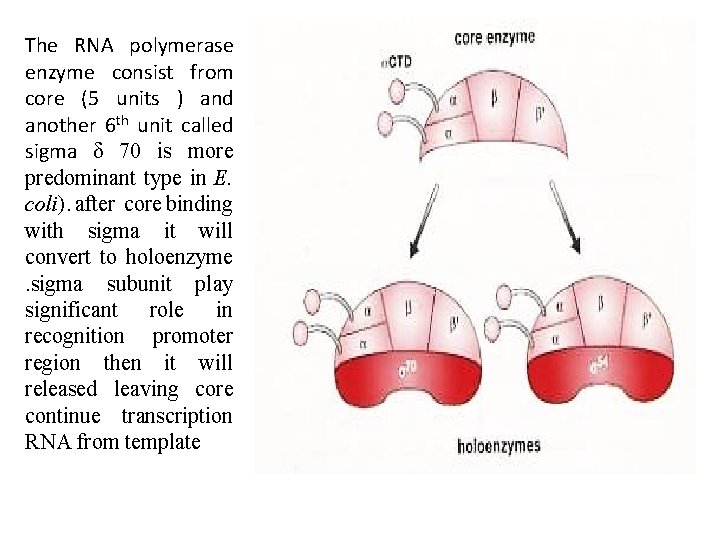
The RNA polymerase enzyme consist from core (5 units ) and another 6 th unit called sigma δ 70 is more predominant type in E. coli). after core binding with sigma it will convert to holoenzyme. sigma subunit play significant role in recognition promoter region then it will released leaving core continue transcription RNA from template
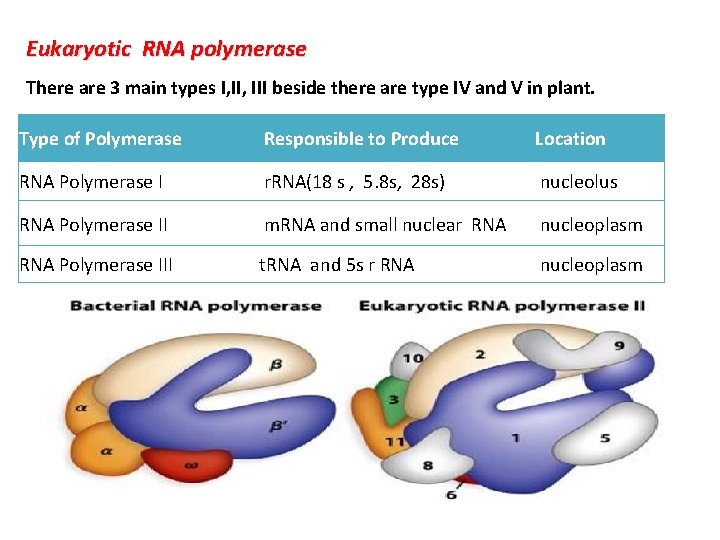
Eukaryotic RNA polymerase There are 3 main types I, III beside there are type IV and V in plant. Type of Polymerase Responsible to Produce Location RNA Polymerase I r. RNA(18 s , 5. 8 s, 28 s) nucleolus RNA Polymerase II m. RNA and small nuclear RNA nucleoplasm RNA Polymerase III t. RNA and 5 s r RNA nucleoplasm
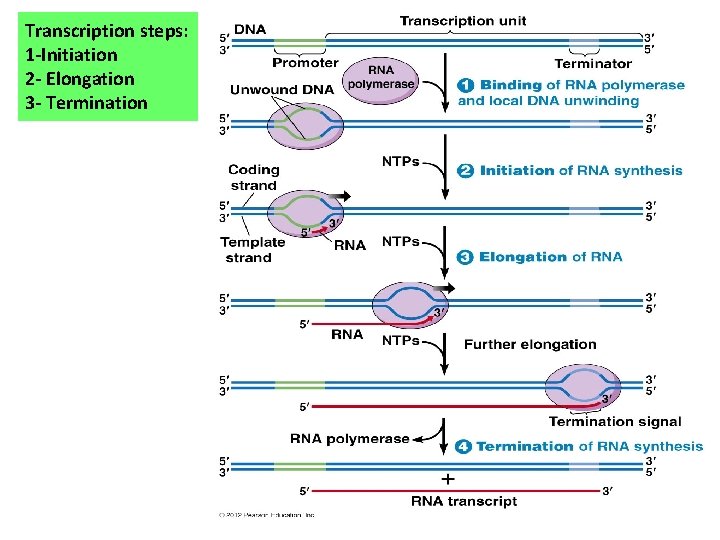
Transcription steps: 1 -Initiation 2 - Elongation 3 - Termination
1 - Initiation stage… • RNA polymerase binding in bacteria: involves recognizing core promoter region by sigma factor then binding to -35 box forming closed complex also the α subunit C-terminal domain help in recognizing promoter upstream elements. Usually in E. coli, σ70 is expressed under normal conditions and recognizes promoters for genes required under normal conditions (house-keeping genes), while σ32 recognizes promoters for genes required at high temperatures (heat-shock genes). • After binding to the DNA, the RNA polymerase switches from a closed complex to an open complex at -10 box. This change involves the separation of the DNA strands to form an unwound DNA strand of approximately 13 bp, referred to as the transcription bubble. Ribonucleotides are base-paired to the template DNA strand, according to Watson-Crick base-pairing interactions. Super coiling plays an important part in polymerase activity because of the unwinding and rewinding of DNA. Usually regions of DNA in front of RNA Polymerase are unwound while regions behind RNAP are rewound and negative super coiled are present.
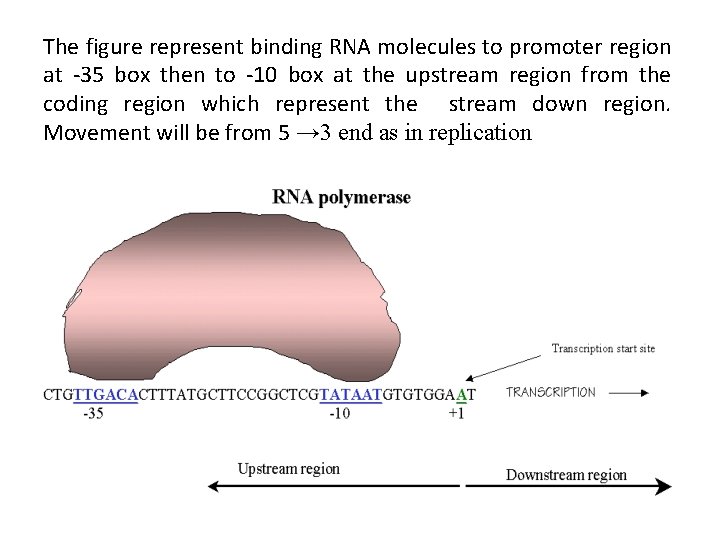
The figure represent binding RNA molecules to promoter region at -35 box then to -10 box at the upstream region from the coding region which represent the stream down region. Movement will be from 5 → 3 end as in replication
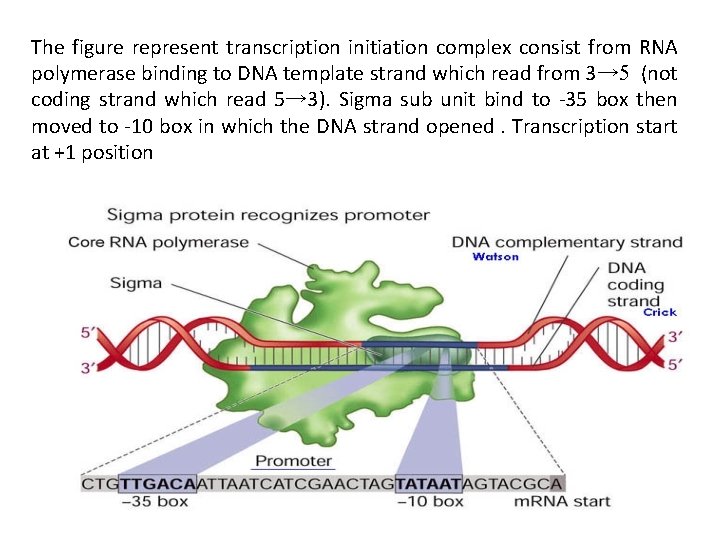
The figure represent transcription initiation complex consist from RNA polymerase binding to DNA template strand which read from 3→ 5 (not coding strand which read 5→ 3). Sigma sub unit bind to -35 box then moved to -10 box in which the DNA strand opened. Transcription start at +1 position
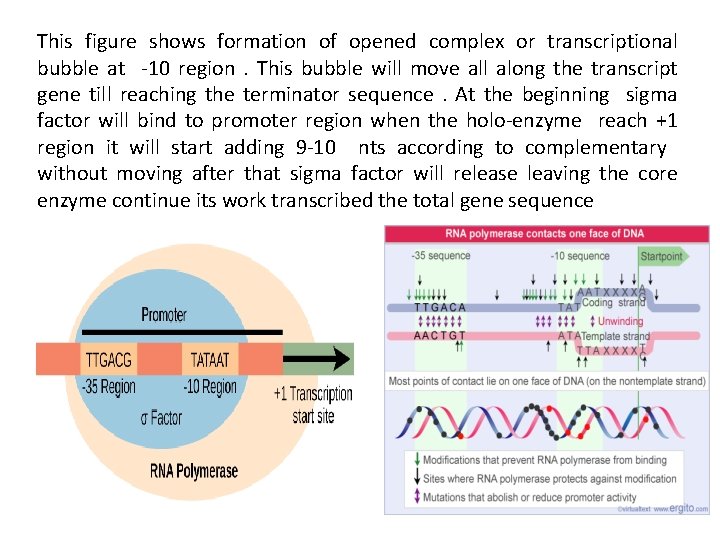
This figure shows formation of opened complex or transcriptional bubble at -10 region. This bubble will move all along the transcript gene till reaching the terminator sequence. At the beginning sigma factor will bind to promoter region when the holo-enzyme reach +1 region it will start adding 9 -10 nts according to complementary without moving after that sigma factor will release leaving the core enzyme continue its work transcribed the total gene sequence
2. Elongation stage… • Transcription elongation involves the further addition of ribonucleotides and the change of the open complex(at -10 box) to the transcriptional complex. RNA P cannot start forming full length transcripts because of its strong binding to the promoter so it must leave promoter region and further progress. Transcription at this stage primarily results in short RNA fragments of around 10 - 9 bp. Once the RNAP starts forming longer transcripts after leaving the promoter ( σ factor falls off RNAP). This allows the rest of the RNAP complex (core RNA polymerase )to move forward. • As transcription progresses, ribonucleotides are added to the 3' end of the RNA transcript and the RNAP complex moves along the DNA. The enzyme is highly possessive , it can add 30 nts sec. • Although RNAP does not seem to have the 3'exonuclease activity that characterizes the proofreading activity found in DNA polymerase, there is evidence of that RNAP will stop at mismatched base-pairs and correct it.
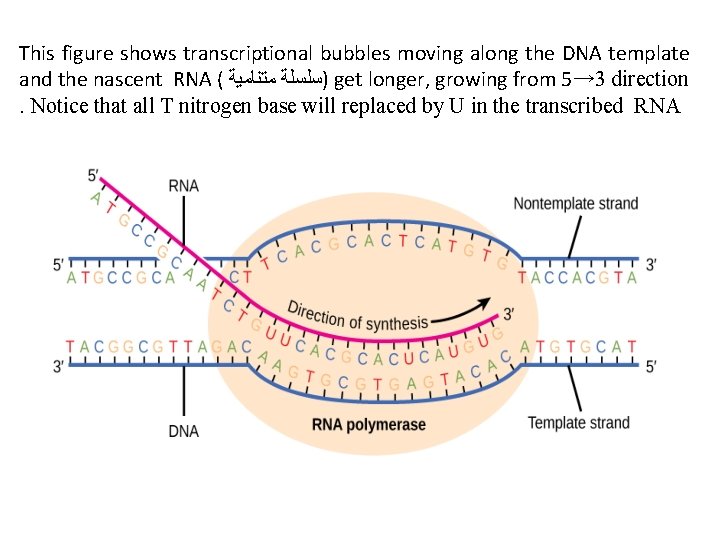
This figure shows transcriptional bubbles moving along the DNA template and the nascent RNA ( )ﺳﻠﺴﻠﺔ ﻣﺘﻨﺎﻣﻴﺔ get longer, growing from 5→ 3 direction. Notice that all T nitrogen base will replaced by U in the transcribed RNA
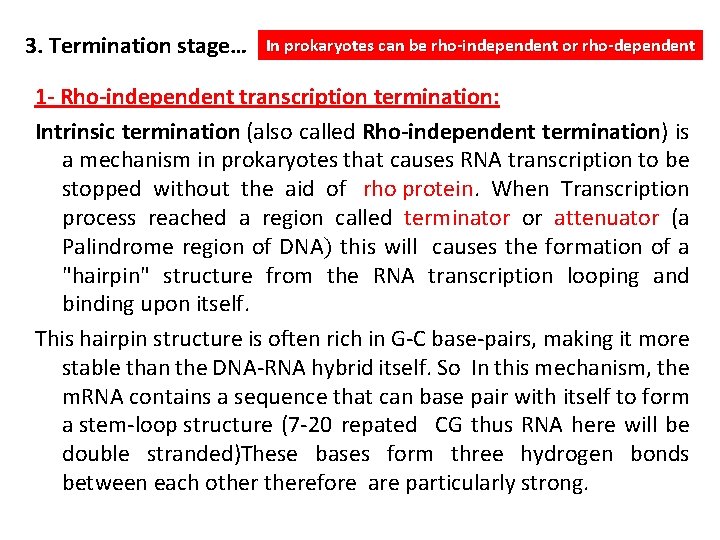
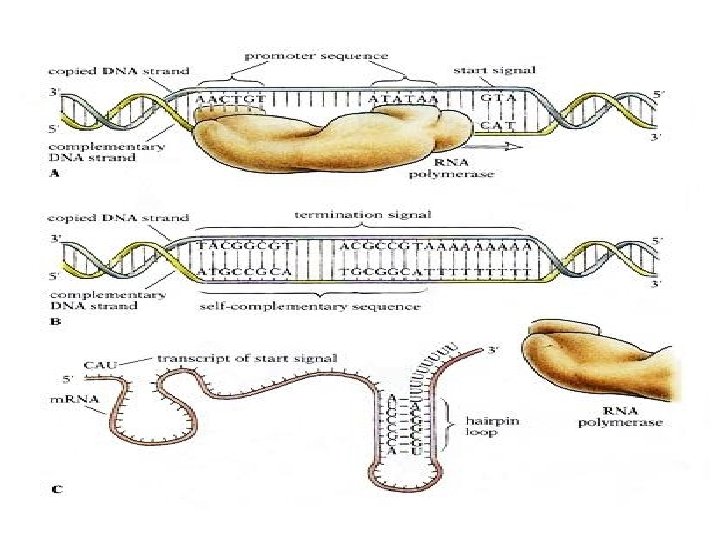
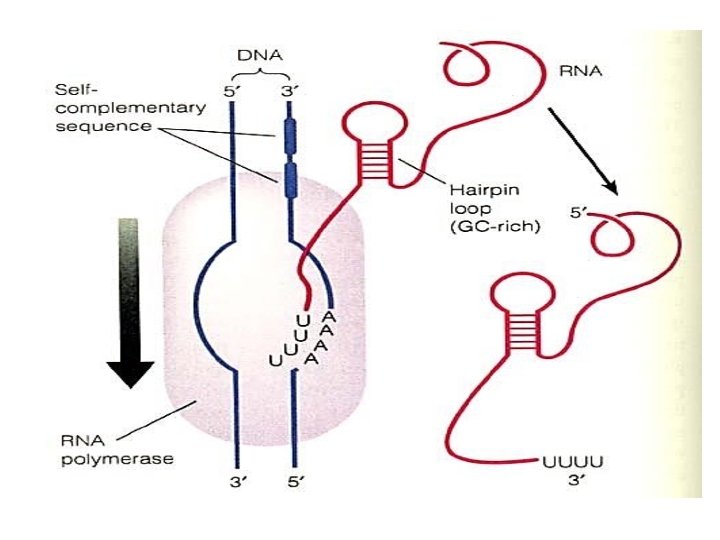
3. Termination stage… In prokaryotes can be rho-independent or rho-dependent 1 - Rho-independent transcription termination: Intrinsic termination (also called Rho-independent termination) is a mechanism in prokaryotes that causes RNA transcription to be stopped without the aid of rho protein. When Transcription process reached a region called terminator or attenuator (a Palindrome region of DNA) this will causes the formation of a "hairpin" structure from the RNA transcription looping and binding upon itself. This hairpin structure is often rich in G-C base-pairs, making it more stable than the DNA-RNA hybrid itself. So In this mechanism, the m. RNA contains a sequence that can base pair with itself to form a stem-loop structure (7 -20 repated CG thus RNA here will be double stranded)These bases form three hydrogen bonds between each otherefore are particularly strong.
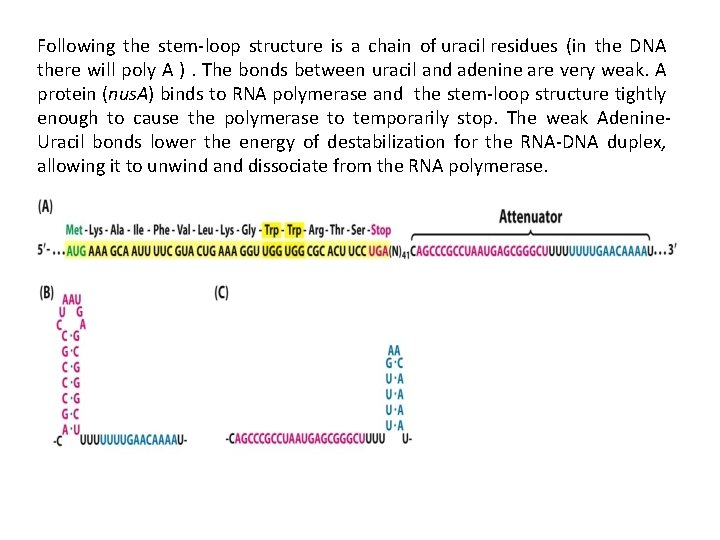
Following the stem-loop structure is a chain of uracil residues (in the DNA there will poly A ). The bonds between uracil and adenine are very weak. A protein (nus. A) binds to RNA polymerase and the stem-loop structure tightly enough to cause the polymerase to temporarily stop. The weak Adenine. Uracil bonds lower the energy of destabilization for the RNA-DNA duplex, allowing it to unwind and dissociate from the RNA polymerase.
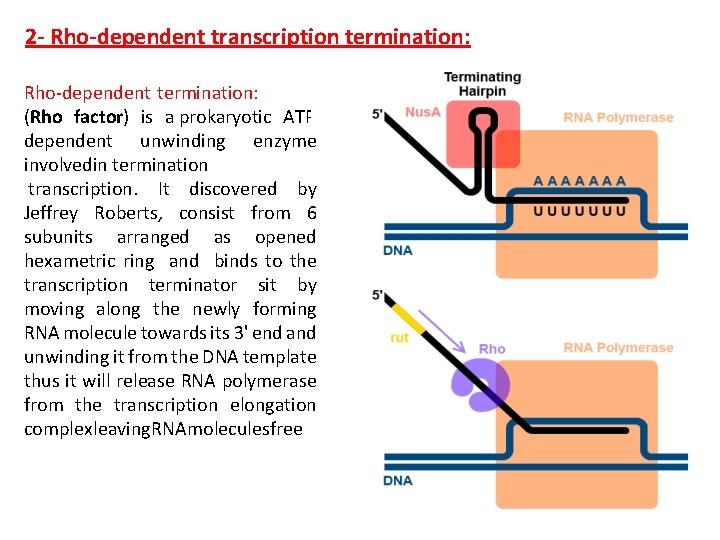
2 - Rho-dependent transcription termination: Rho-dependent termination: , (Rho factor) is a prokaryotic ATPdependent unwinding enzyme involvedin termination transcription. It discovered by Jeffrey Roberts, consist from 6 subunits arranged as opened hexametric ring and binds to the transcription terminator sit by moving along the newly forming RNA molecule towards its 3' end and unwinding it from the DNA template thus it will release RNA polymerase from the transcription elongation complexleaving. RNAmolecules free.
l a n o i t p i r c s n a r t t s Po s t n e v e
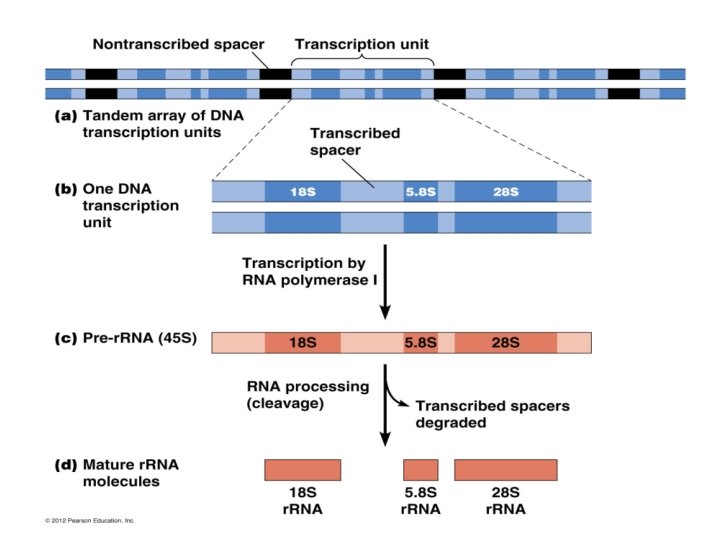
Post transcriptional events ` Each of transcript RNA type will subjected to modification events after ending transcription as follow : for r. RNA, at the beginning it produced as one precursor unit , in Eukaryotic cell known as 45 s pre-RNA it will methylated & cleaved by endonuclease enzyme beside removing all the spaces(spacers) between r. RNA types to convert to mature 18 s, 5. 8 s and 28 s The same events will happened with prokaryotic r. RNA. it produced as one segment known as 30 s pre-r. RNA then it will cleaved by endonuclease followed by Trimming by exonuclease enzyme to convert it to mature 16 s, 23 s and 5 s beside the transcript t. RNA
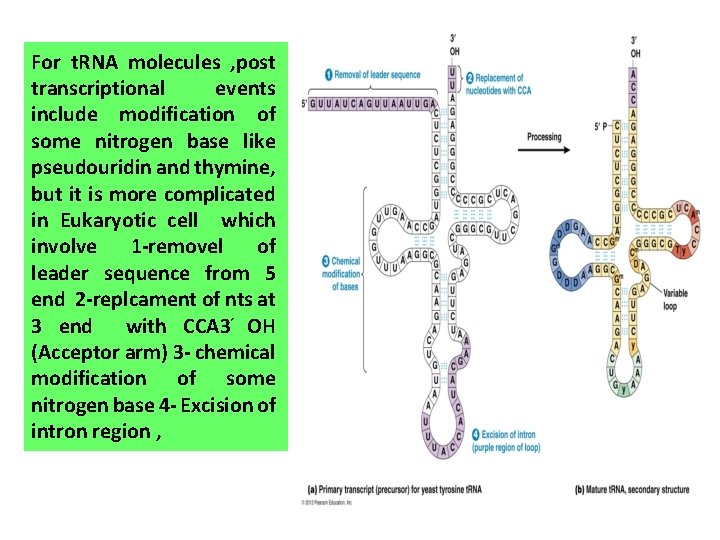
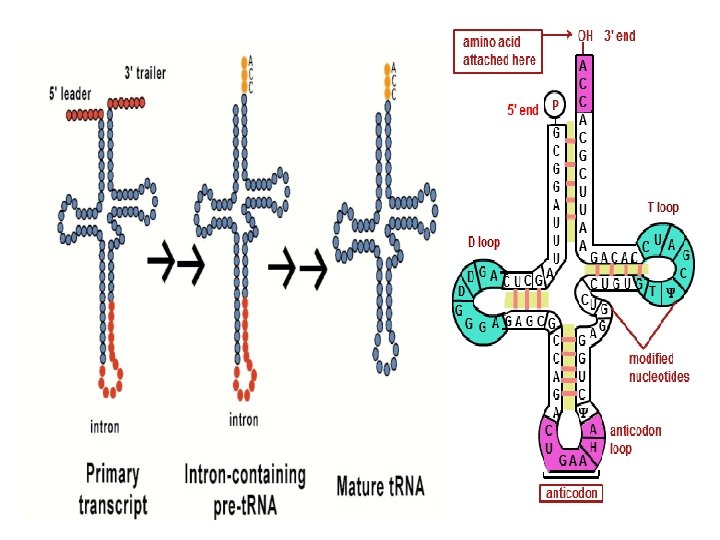
For t. RNA molecules , post transcriptional events include modification of some nitrogen base like pseudouridin and thymine, but it is more complicated in Eukaryotic cell which involve 1 -removel of leader sequence from 5 end 2 -replcament of nts at 3 end with CCA 3 OH (Acceptor arm) 3 - chemical modification of some nitrogen base 4 - Excision of intron region ,
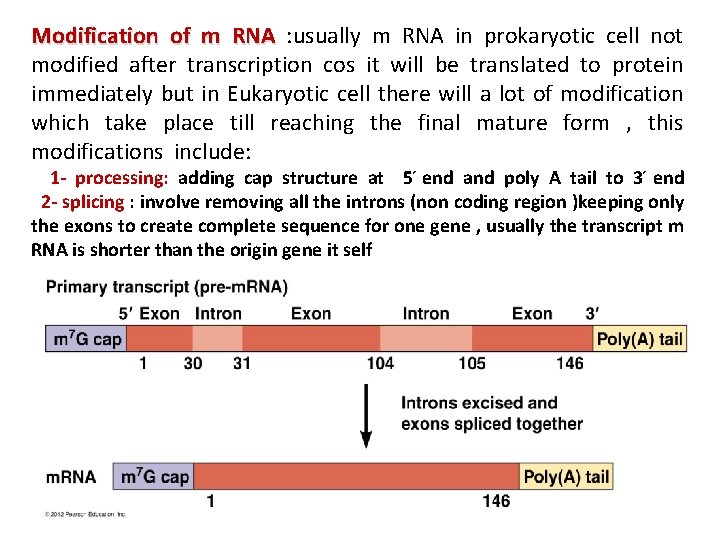
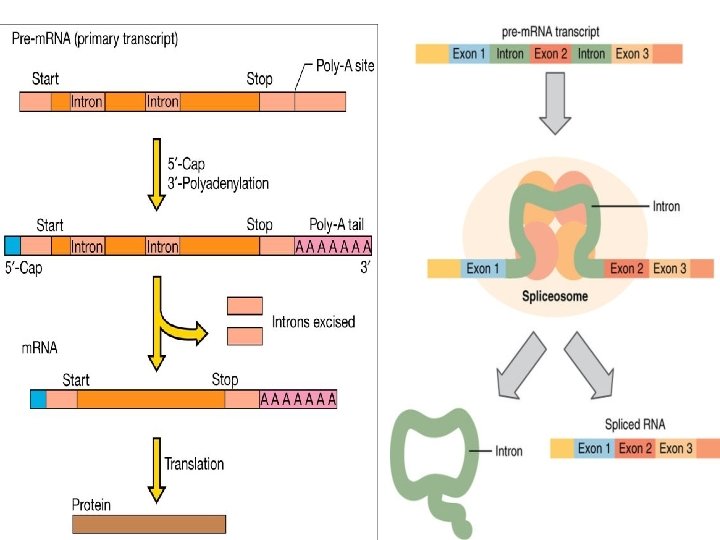
Modification of m RNA : usually m RNA in prokaryotic cell not modified after transcription cos it will be translated to protein immediately but in Eukaryotic cell there will a lot of modification which take place till reaching the final mature form , this modifications include: m 1 - processing: adding cap structure at 5 end and poly A tail to 3 end 2 - splicing : involve removing all the introns (non coding region )keeping only the exons to create complete sequence for one gene , usually the transcript m RNA is shorter than the origin gene it self
m. RNA Processing: Eukaryotic pre-m. RNA receives a 5' cap and a 3' poly -A tail before introns are removed and the m. RNA is considered ready for translation. j For the processing it include 1 - Adding cap structure at 5 end to protect m. RNA from degradation by endonuclease enzyme thus it may remain for days. Cap structure formed by adding 3 phosphate group for 5 end followed by adding Guanosine residue to form guanosine tri phosphate then guanosine will methylated at 7 carbon atom to become 7 methyl guanosine (m 7 G cap). 2 - Polyadenylation (poly Adenine residue ) is the addition of poly(A) tail to a primary transcript m. RNA. The poly(A) tail consists of multiple adenosine monophosphates; in other words, it is a stretch of RNA that has only adenine bases. In eukaryotes, polyadenylation is part of the process that produces mature messenger RNA (m. RNA) for translation. It, therefore, forms part of the larger process of gene expression. the poly(A) tail will protects the m. RNA molecule from enzymatic degradation in the cytoplasm and aids in transcription termination. All Eukaryotic m. RNA are methylated. The enzyme responsible for adding a string of approximately 200 poly A residues, is called polyadenylate polymerase.
3 - Pre-m. RNA Splicing (Introns are removed from the pre-m. RNA before protein synthesis): Eukaryotic genes are composed of exons, which correspond to protein-coding sequences (ex-on signifies that they are expressed), and intervening sequences called introns (non expressed sequence) which may be involved in gene regulation, but are removed from the pre-m. RNA during processing. Intron sequences in m. RNA do not encode functional proteins All introns in a pre-m. RNA must be completely and precisely removed before protein synthesis: . 1 -The first cleavage occur by Splicesome machine at 5 end of the intron region rich with GU residue. f 2 -Then the intron bend back to form lariat structure via 5 3 phosphodiester bond 3 - cleavage at 3 end of the intron to completely released 4 - joining the exons by ligase enzyme to give arise to mature m. RNA
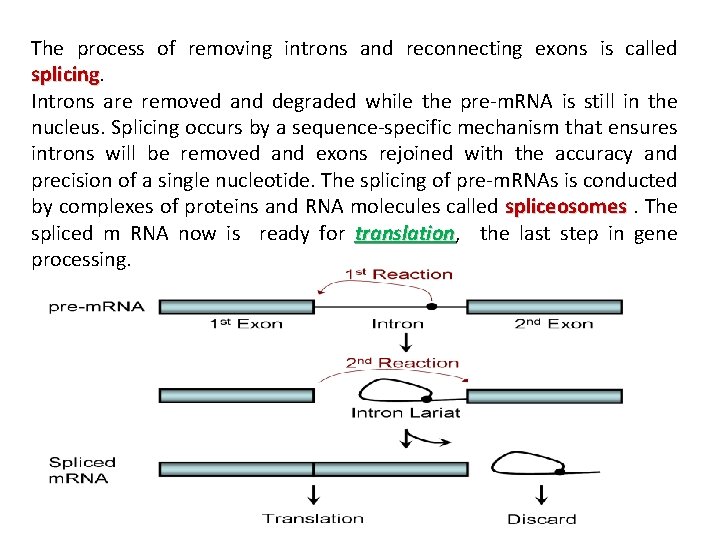
The process of removing introns and reconnecting exons is called splicing. jk splicing Introns are removed and degraded while the pre-m. RNA is still in the nucleus. Splicing occurs by a sequence-specific mechanism that ensures introns will be removed and exons rejoined with the accuracy and precision of a single nucleotide. The splicing of pre-m. RNAs is conducted by complexes of proteins and RNA molecules called spliceosomes. The spliced m RNA now is ready for translation, translation the last step in gene processing.
- Slides: 36