
The 12 Principles of Animation Digital Media 1
- Slides: 14
The 12 Principles of Animation Digital Media 1 Mr. Nicholas Goble
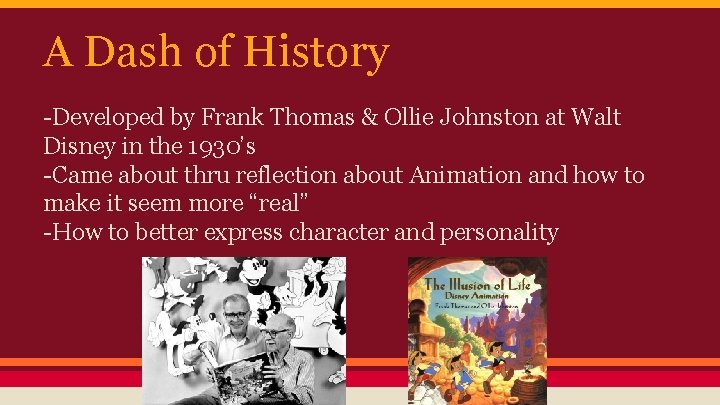
A Dash of History -Developed by Frank Thomas & Ollie Johnston at Walt Disney in the 1930’s -Came about thru reflection about Animation and how to make it seem more “real” -How to better express character and personality
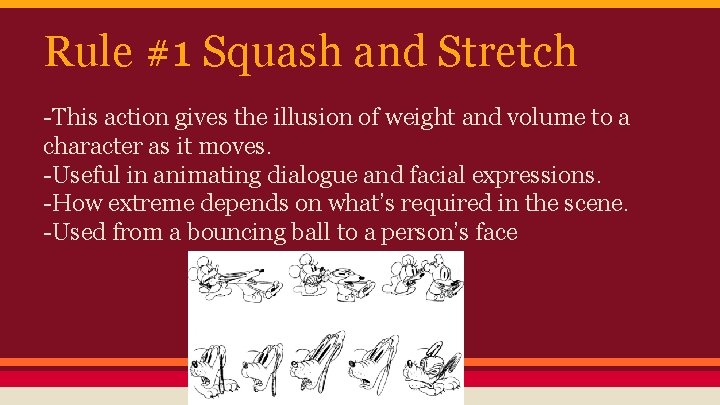
Rule #1 Squash and Stretch -This action gives the illusion of weight and volume to a character as it moves. -Useful in animating dialogue and facial expressions. -How extreme depends on what’s required in the scene. -Used from a bouncing ball to a person’s face
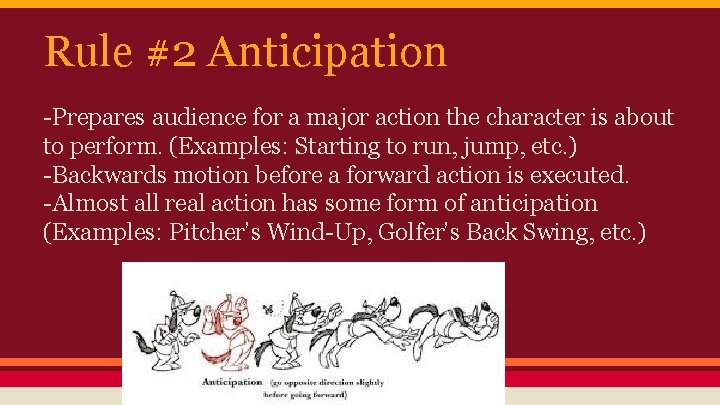
Rule #2 Anticipation -Prepares audience for a major action the character is about to perform. (Examples: Starting to run, jump, etc. ) -Backwards motion before a forward action is executed. -Almost all real action has some form of anticipation (Examples: Pitcher’s Wind-Up, Golfer’s Back Swing, etc. )
Rule #3 Staging -Directs audience’s attention to the story being told. -Make sure the Background works with the Animation -Pose or action should communicate to the audience the attitude, mood, or reaction of character in relation to story. -Effective use of Long, Medium, or Close Up Shots and different camera angles. -Don’t confuse the audience, use one action clearly to get the idea across. (Unless you’re trying to depict clutter/confusion. )
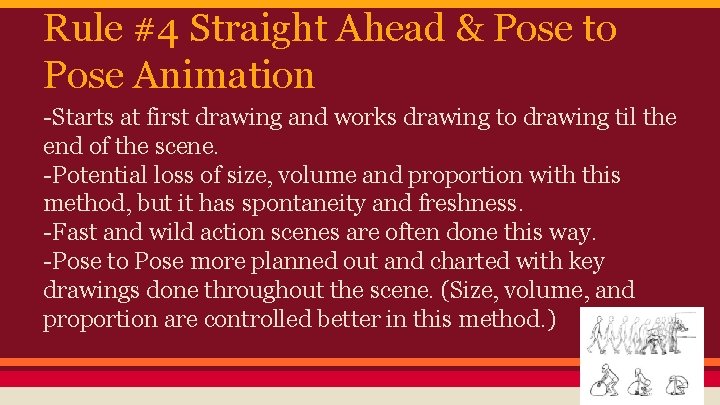
Rule #4 Straight Ahead & Pose to Pose Animation -Starts at first drawing and works drawing to drawing til the end of the scene. -Potential loss of size, volume and proportion with this method, but it has spontaneity and freshness. -Fast and wild action scenes are often done this way. -Pose to Pose more planned out and charted with key drawings done throughout the scene. (Size, volume, and proportion are controlled better in this method. )
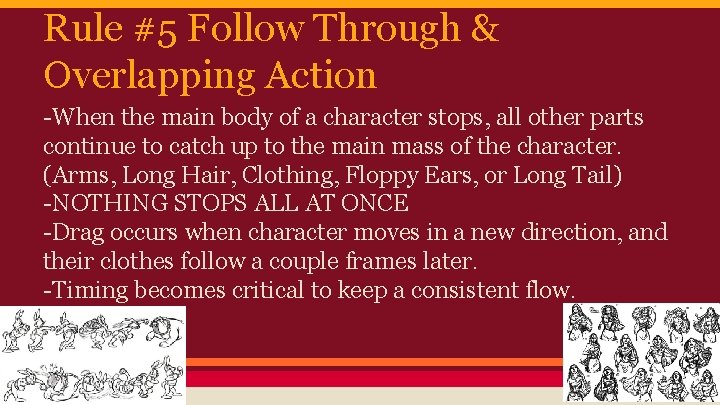
Rule #5 Follow Through & Overlapping Action -When the main body of a character stops, all other parts continue to catch up to the main mass of the character. (Arms, Long Hair, Clothing, Floppy Ears, or Long Tail) -NOTHING STOPS ALL AT ONCE -Drag occurs when character moves in a new direction, and their clothes follow a couple frames later. -Timing becomes critical to keep a consistent flow.
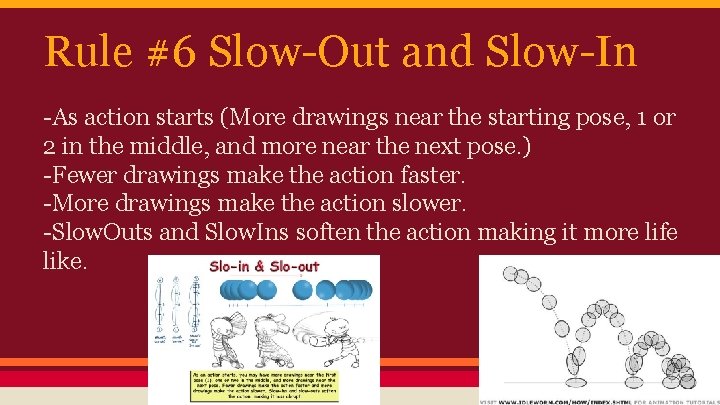
Rule #6 Slow-Out and Slow-In -As action starts (More drawings near the starting pose, 1 or 2 in the middle, and more near the next pose. ) -Fewer drawings make the action faster. -More drawings make the action slower. -Slow. Outs and Slow. Ins soften the action making it more life like.
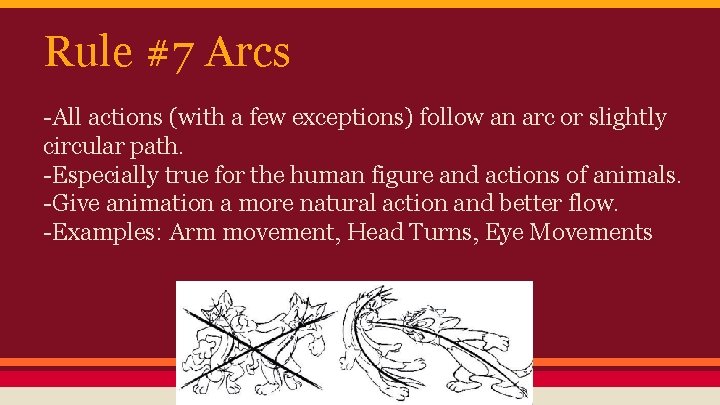
Rule #7 Arcs -All actions (with a few exceptions) follow an arc or slightly circular path. -Especially true for the human figure and actions of animals. -Give animation a more natural action and better flow. -Examples: Arm movement, Head Turns, Eye Movements
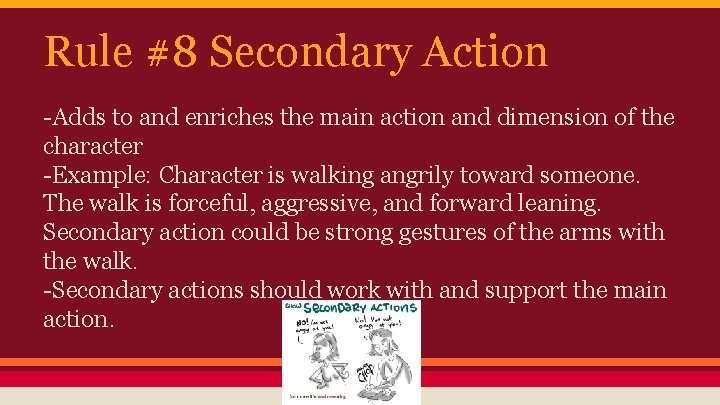
Rule #8 Secondary Action -Adds to and enriches the main action and dimension of the character -Example: Character is walking angrily toward someone. The walk is forceful, aggressive, and forward leaning. Secondary action could be strong gestures of the arms with the walk. -Secondary actions should work with and support the main action.
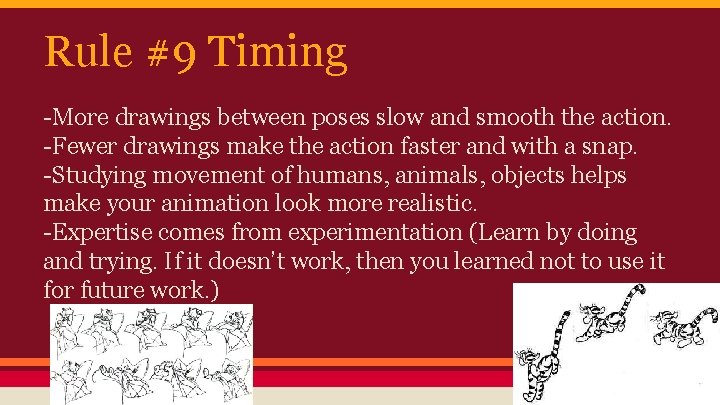
Rule #9 Timing -More drawings between poses slow and smooth the action. -Fewer drawings make the action faster and with a snap. -Studying movement of humans, animals, objects helps make your animation look more realistic. -Expertise comes from experimentation (Learn by doing and trying. If it doesn’t work, then you learned not to use it for future work. )
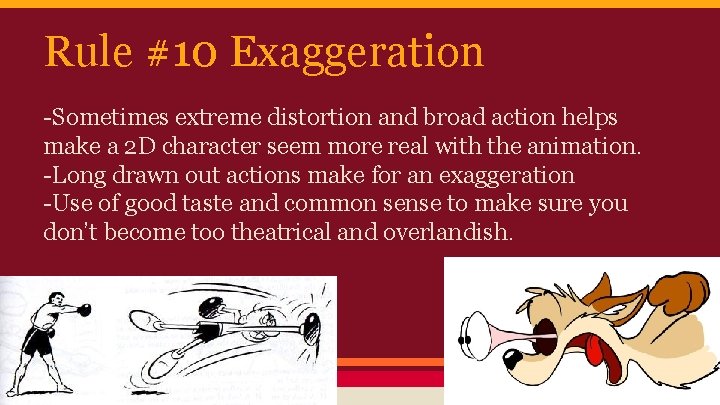
Rule #10 Exaggeration -Sometimes extreme distortion and broad action helps make a 2 D character seem more real with the animation. -Long drawn out actions make for an exaggeration -Use of good taste and common sense to make sure you don’t become too theatrical and overlandish.
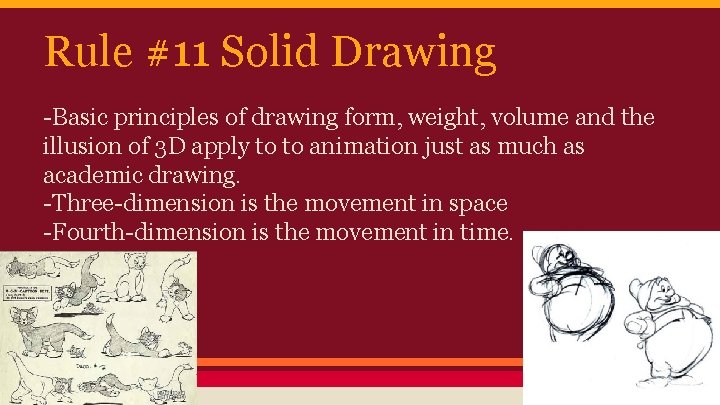
Rule #11 Solid Drawing -Basic principles of drawing form, weight, volume and the illusion of 3 D apply to to animation just as much as academic drawing. -Three-dimension is the movement in space -Fourth-dimension is the movement in time.
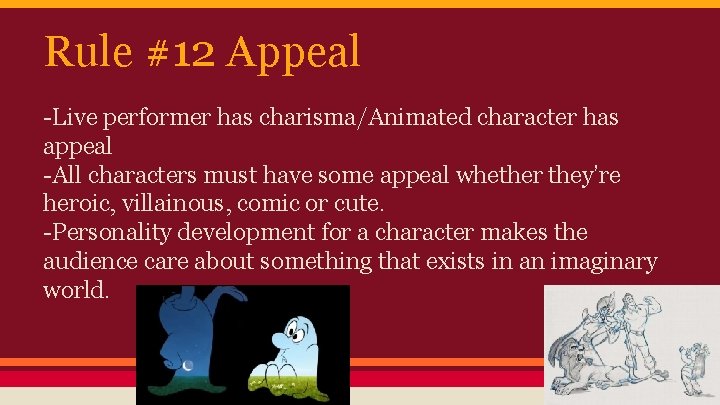
Rule #12 Appeal -Live performer has charisma/Animated character has appeal -All characters must have some appeal whether they’re heroic, villainous, comic or cute. -Personality development for a character makes the audience care about something that exists in an imaginary world.