
The 12 Months of the Year The 12

- Slides: 21
The 12 Months of the Year
The 12 Months of the Year • A year has 365 days divided into 12 months in the modern day Gregorian calendar(公历). • Each month has either 28, 30, or 31 days during the common year.
Common Year – Standard Year – Normal Year • A common year is a standard calendar year with 365 days, 12 months and no extra, or intercalary day(插在中间的, 闰节) in February. • A calendar Year • In our modern day Gregorian Calendar(公历), a common year has 365 days, as opposed to a leap year which has 366 days. • Leap : vi. 跳; vt. 跳过; n. 跳跃; 闰年 • Intercalary : 插在中间的, 闰节 • Feb. 29 is an intercalary day. 2月29日是个闰日
Leap Year • Nearly every four years is a leap year which has 366 days, as opposed to a common year, which has 365 in the Gregorian Calendar. • Next leap day is February 29, 2020. • Last leap day was February 29, 2016.
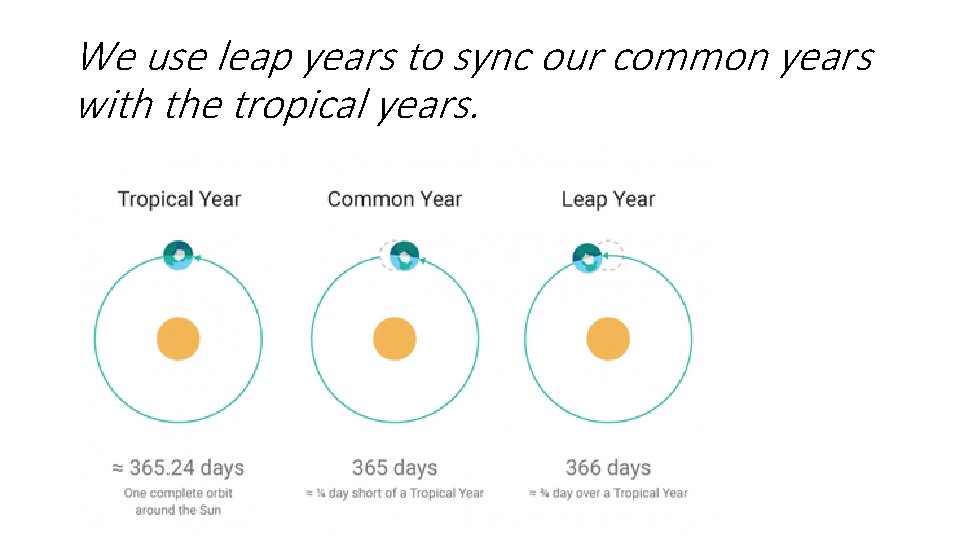
Why Add Leap Years? • Leap years are needed to keep our modern day Gregorian calendar in alignment(n. 结盟; 队列; 一致性) with the Earth’s revolutions(n. 革命; 旋转; 彻底改变; 运行, 公 转; ) around the sun. • It takes the Earth approximately 365. 242189 days——or 365 days, 5 hours, 48 minutes, and 45 seconds – to circle once around the sun. • This is called a tropical year(n. 回归年, 太阳年; Tropical : adj. 热带的; 炎热的; 热情的), and is measured from the March equinox(春分点, 三月春分). • However, the Gregorian calendar has only 365 days in a year, so if we didn’t add a leap day on February 29 nearly every four years, we would lose almost six hours off our calendar every year. After only 100 years, our calendar would be off by around 24 days!
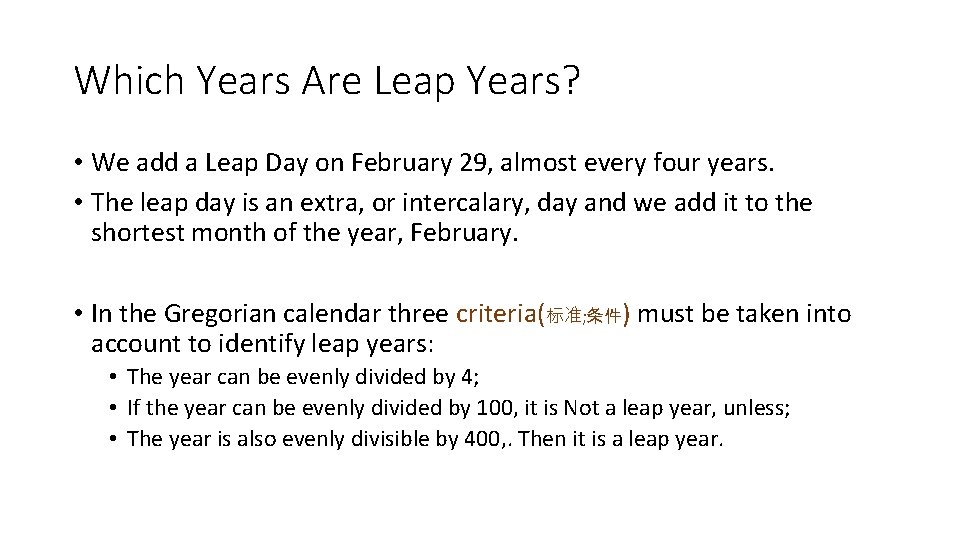
Which Years Are Leap Years? • We add a Leap Day on February 29, almost every four years. • The leap day is an extra, or intercalary, day and we add it to the shortest month of the year, February. • In the Gregorian calendar three criteria(标准; 条件) must be taken into account to identify leap years: • The year can be evenly divided by 4; • If the year can be evenly divided by 100, it is Not a leap year, unless; • The year is also evenly divisible by 400, . Then it is a leap year.
We use leap years to sync our common years with the tropical years.
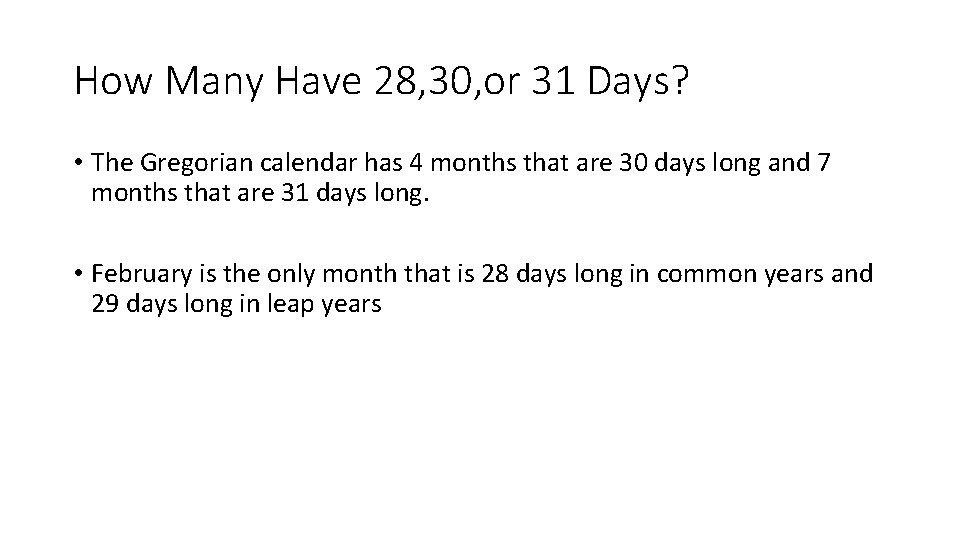
How Many Have 28, 30, or 31 Days? • The Gregorian calendar has 4 months that are 30 days long and 7 months that are 31 days long. • February is the only month that is 28 days long in common years and 29 days long in leap years
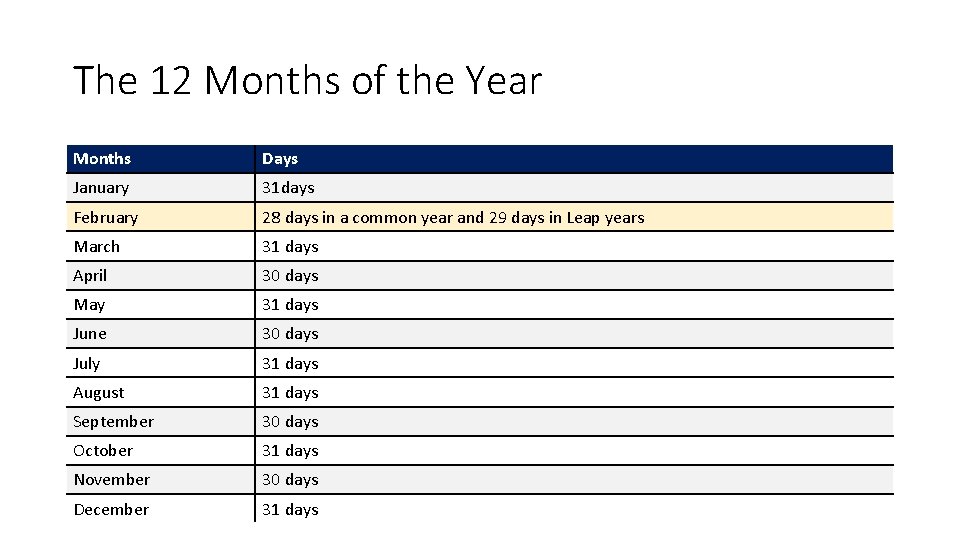
The 12 Months of the Year Months Days January 31 days February 28 days in a common year and 29 days in Leap years March 31 days April 30 days May 31 days June 30 days July 31 days August 31 days September 30 days October 31 days November 30 days December 31 days
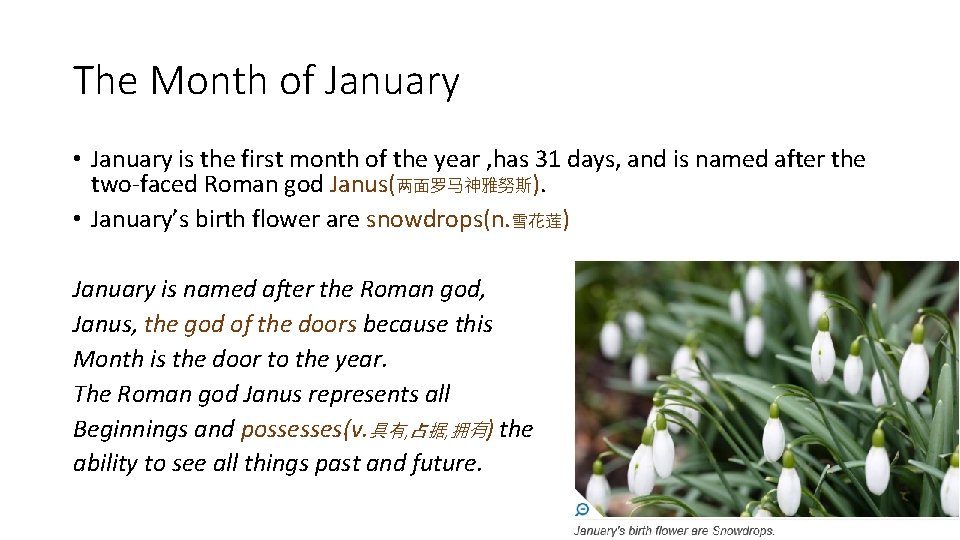
The Month of January • January is the first month of the year , has 31 days, and is named after the two-faced Roman god Janus(两面罗马神雅努斯). • January’s birth flower are snowdrops(n. 雪花莲) January is named after the Roman god, Janus, the god of the doors because this Month is the door to the year. The Roman god Janus represents all Beginnings and possesses(v. 具有, 占据, 拥有) the ability to see all things past and future.
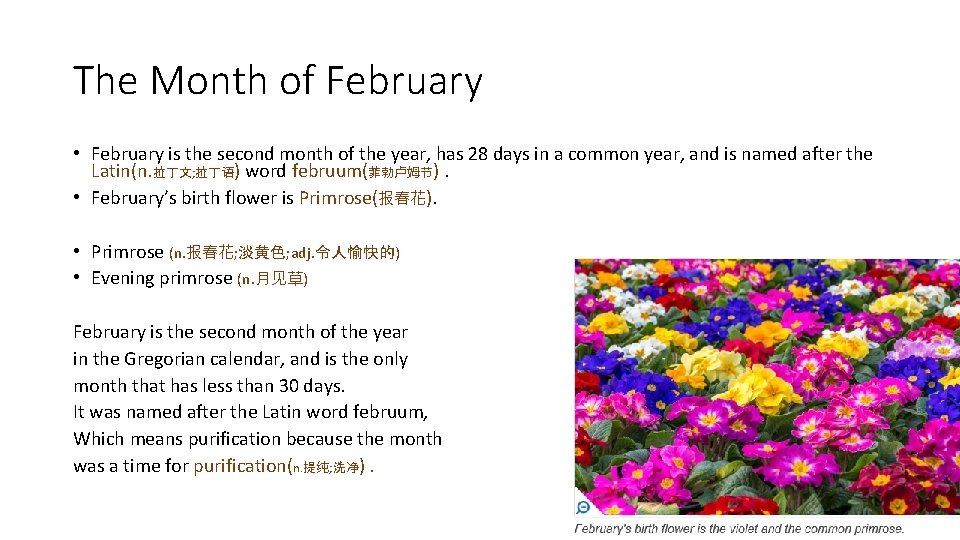
The Month of February • February is the second month of the year, has 28 days in a common year, and is named after the Latin(n. 拉丁文; 拉丁语) word februum(菲勃卢姆节). • February’s birth flower is Primrose(报春花). • Primrose (n. 报春花; 淡黄色; adj. 令人愉快的) • Evening primrose (n. 月见草) February is the second month of the year in the Gregorian calendar, and is the only month that has less than 30 days. It was named after the Latin word februum, Which means purification because the month was a time for purification(n. 提纯; 洗净).
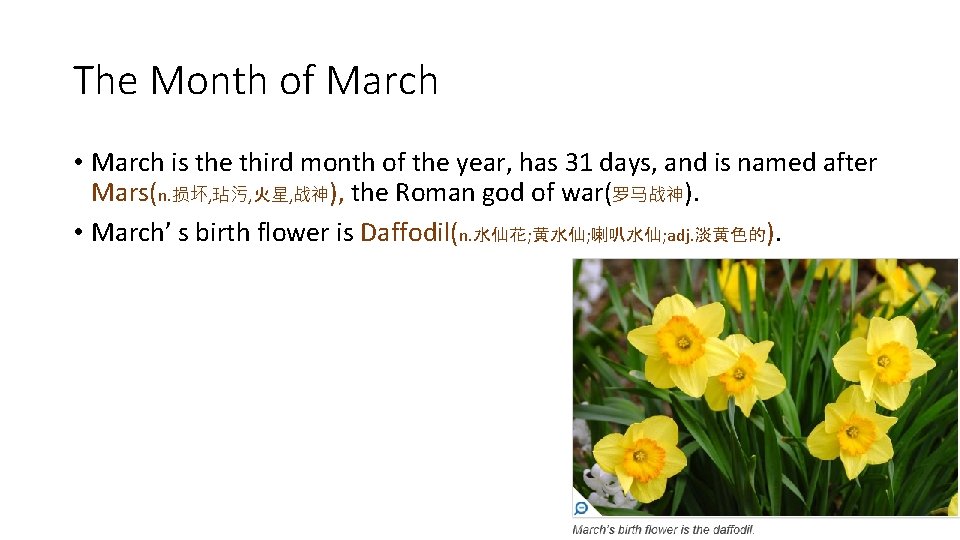
The Month of March • March is the third month of the year, has 31 days, and is named after Mars(n. 损坏, 玷污, 火星, 战神), the Roman god of war(罗马战神). • March’ s birth flower is Daffodil(n. 水仙花; 黄水仙; 喇叭水仙; adj. 淡黄色的).
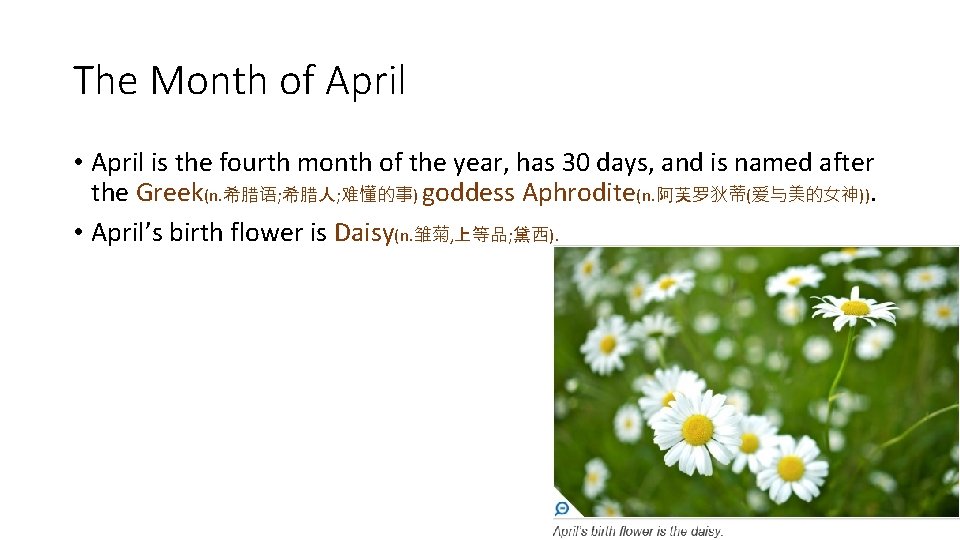
The Month of April • April is the fourth month of the year, has 30 days, and is named after the Greek(n. 希腊语; 希腊人; 难懂的事) goddess Aphrodite(n. 阿芙罗狄蒂(爱与美的女神)). • April’s birth flower is Daisy(n. 雏菊, 上等品; 黛西).
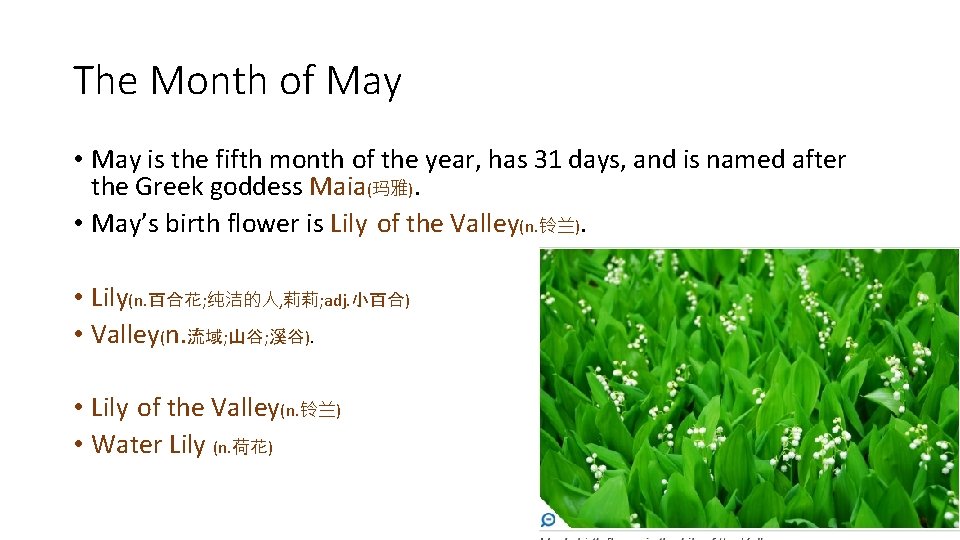
The Month of May • May is the fifth month of the year, has 31 days, and is named after the Greek goddess Maia(玛雅). • May’s birth flower is Lily of the Valley(n. 铃兰). • Lily(n. 百合花; 纯洁的人, 莉莉; adj. 小百合) • Valley(n. 流域; 山谷; 溪谷). • Lily of the Valley(n. 铃兰) • Water Lily (n. 荷花)
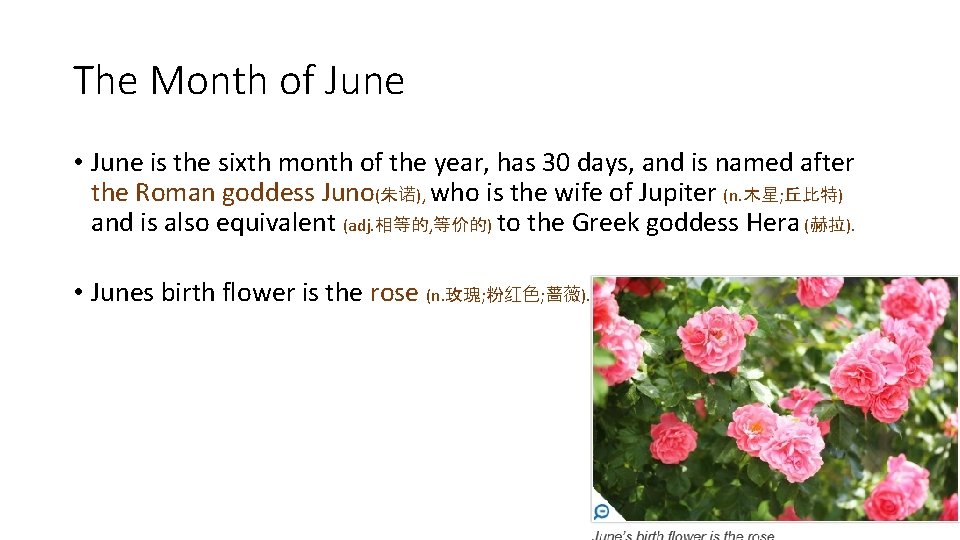
The Month of June • June is the sixth month of the year, has 30 days, and is named after the Roman goddess Juno(朱诺), who is the wife of Jupiter (n. 木星; 丘比特) and is also equivalent (adj. 相等的, 等价的) to the Greek goddess Hera (赫拉). • Junes birth flower is the rose (n. 玫瑰; 粉红色; 蔷薇).
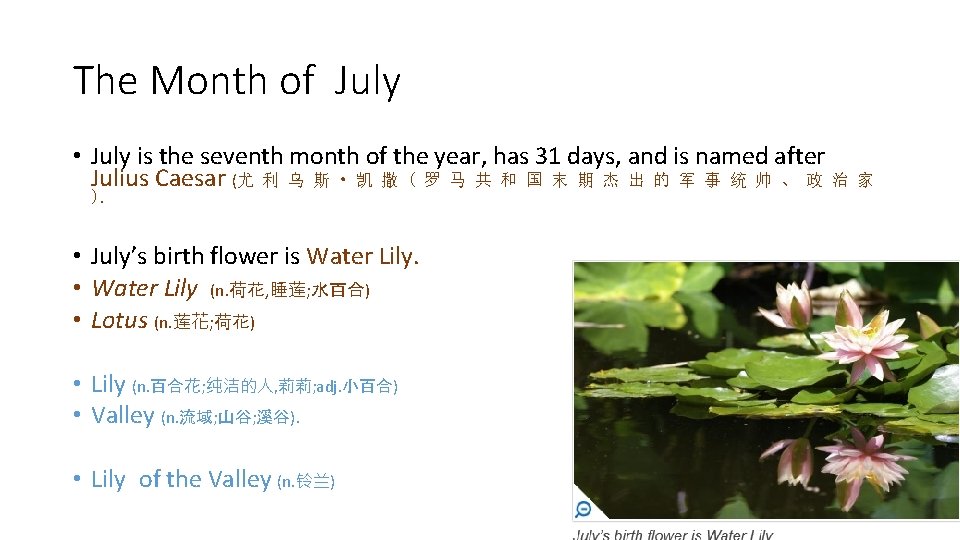
The Month of July • July is the seventh month of the year, has 31 days, and is named after Julius Caesar (尤 利 乌 斯 • 凯 撒 ( 罗 马 共 和 国 末 期 杰 出 的 军 事 统 帅 、 政 治 ). • July’s birth flower is Water Lily. • Water Lily (n. 荷花, 睡莲; 水百合) • Lotus (n. 莲花; 荷花) • Lily (n. 百合花; 纯洁的人, 莉莉; adj. 小百合) • Valley (n. 流域; 山谷; 溪谷). • Lily of the Valley (n. 铃兰) 家
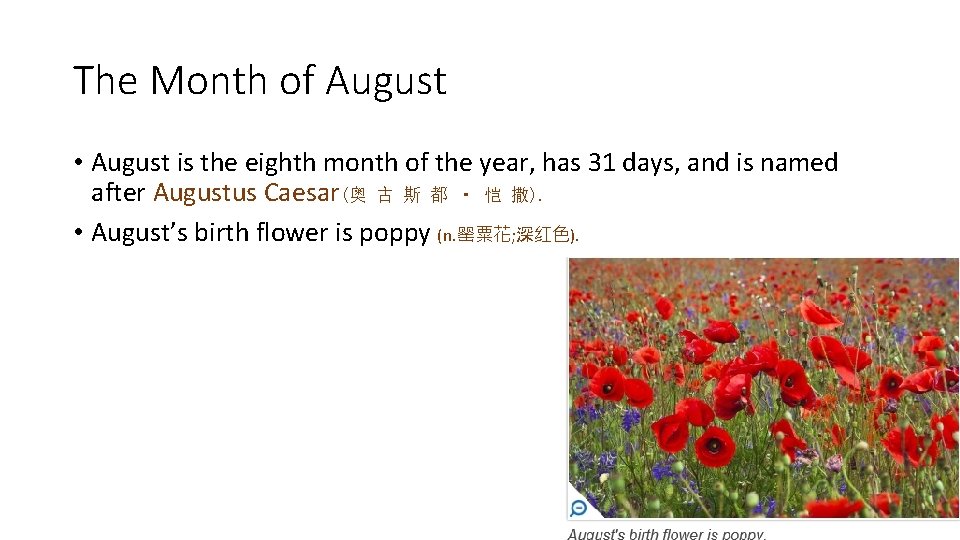
The Month of August • August is the eighth month of the year, has 31 days, and is named after Augustus Caesar(奥 古 斯 都 · 恺 撒). • August’s birth flower is poppy (n. 罂粟花; 深红色).
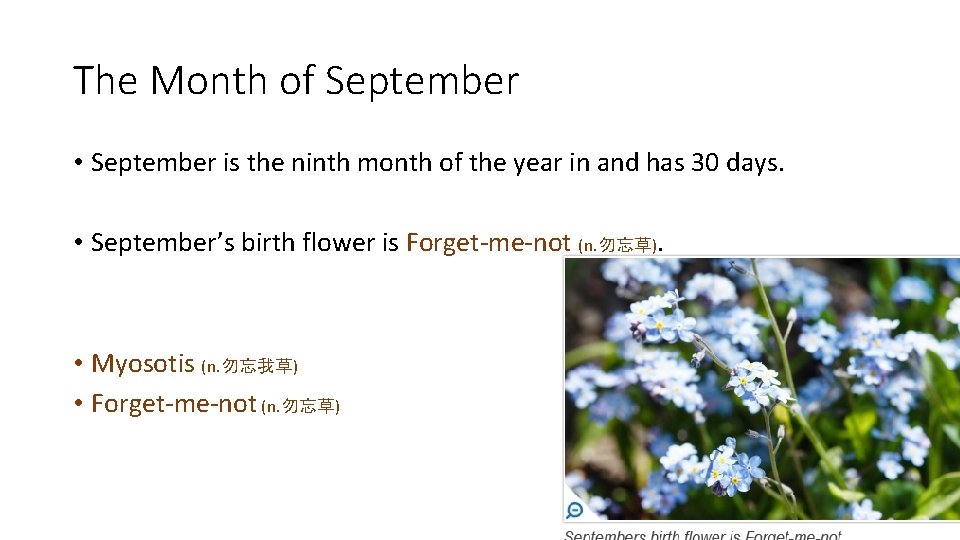
The Month of September • September is the ninth month of the year in and has 30 days. • September’s birth flower is Forget-me-not (n. 勿忘草). • Myosotis (n. 勿忘我草) • Forget-me-not (n. 勿忘草)
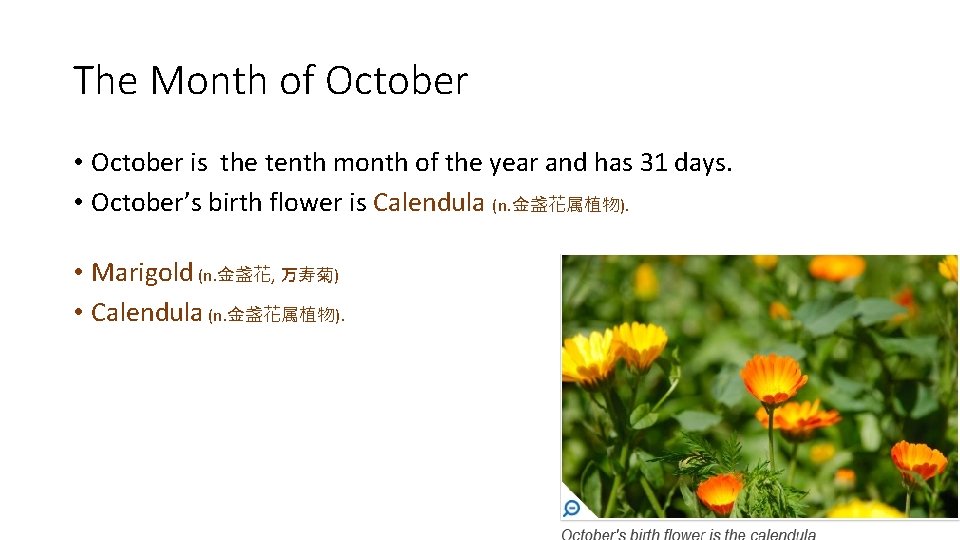
The Month of October • October is the tenth month of the year and has 31 days. • October’s birth flower is Calendula (n. 金盏花属植物). • Marigold (n. 金盏花, 万寿菊) • Calendula (n. 金盏花属植物).
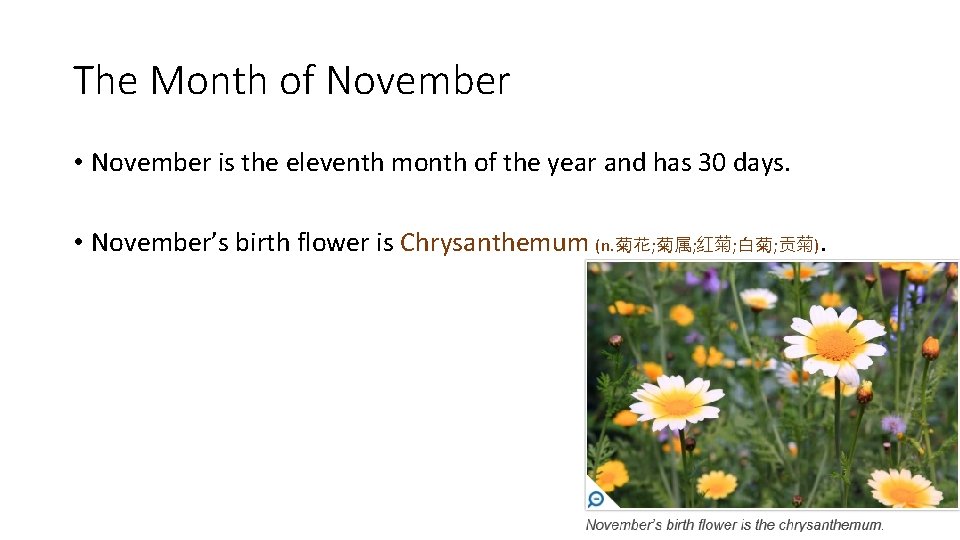
The Month of November • November is the eleventh month of the year and has 30 days. • November’s birth flower is Chrysanthemum (n. 菊花; 菊属; 红菊; 白菊; 贡菊).
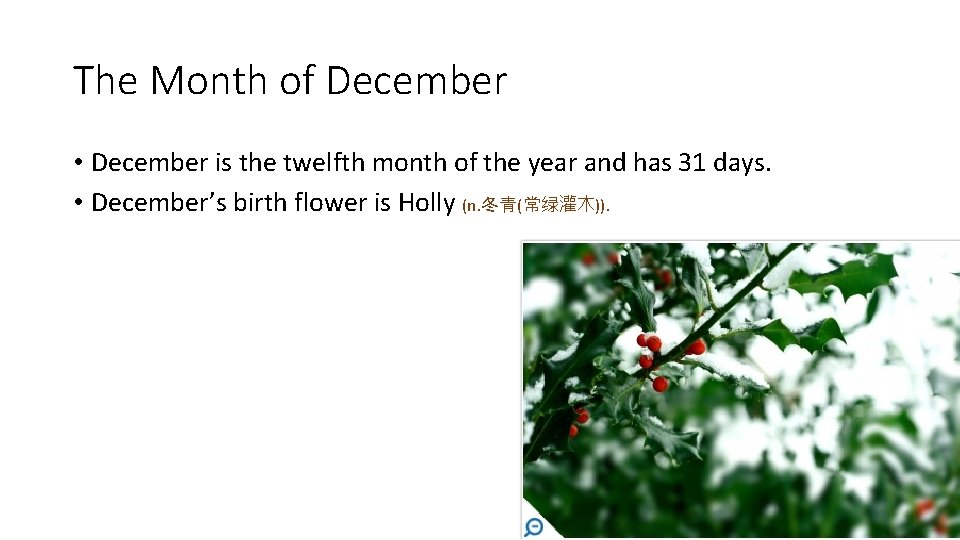
The Month of December • December is the twelfth month of the year and has 31 days. • December’s birth flower is Holly (n. 冬青(常绿灌木)).